
Preventing Ad Spend Waste on Fake Traffic: The Executive Guide to Human-Verified Growth
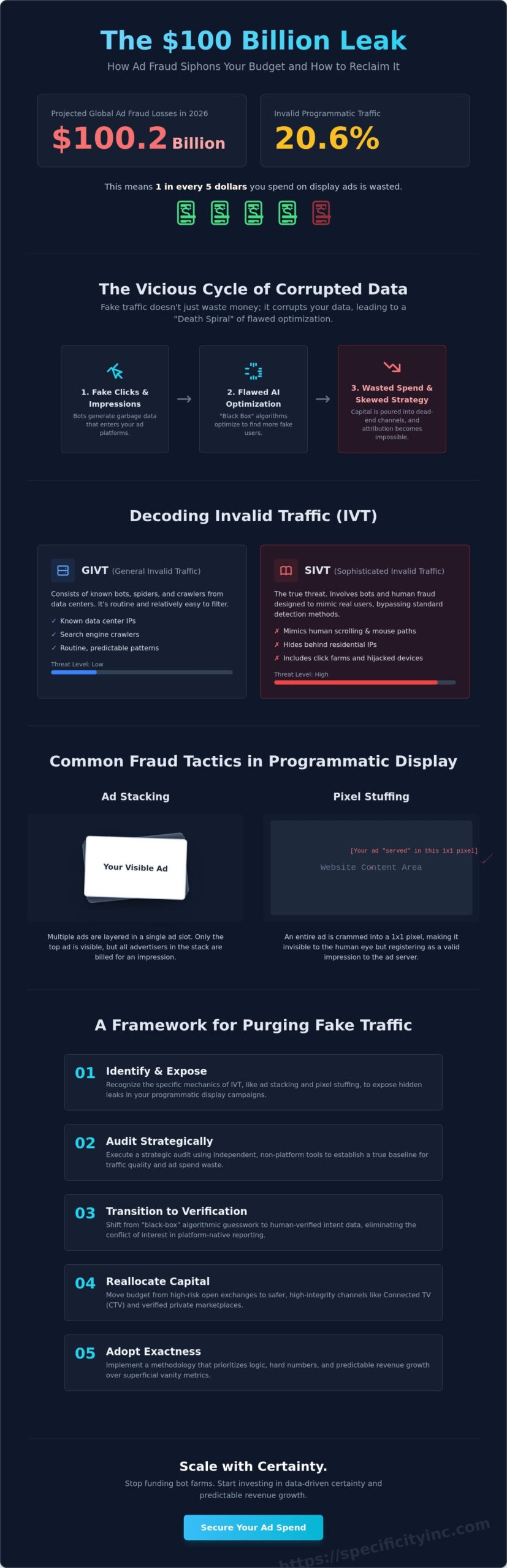
Global ad fraud losses are projected to reach $100.2 billion in 2026, a staggering figure that represents a direct hit to your bottom line. Approximately 20.6% of all programmatic traffic is now classified as invalid; this means one out of every five dollars you spend on display ads is likely funding an autonomous bot farm or a human click farm. You’re likely already aware that your reported metrics do not align with your actual revenue growth. This discrepancy is the primary challenge in preventing ad spend waste on fake traffic. Traditional platforms offer zero transparency while their “black box” algorithms optimize for garbage data, forcing you to pay for engagement that never had a chance of converting.
You need a methodology that prioritizes quantitative outcomes over platform-reported vanity metrics. This guide provides the strategic framework to reclaim your budget by shifting from algorithmic guesswork to human-verified intent data. We’ll demonstrate how to bypass the current Performance Max crisis and implement behavioral intelligence that secures your SEM and programmatic display campaigns. It’s time to eliminate the noise and focus on the data-driven certainty required for predictable revenue growth.
Key Takeaways
- Identify the specific mechanics of Invalid Traffic, including ad stacking and pixel stuffing, to expose hidden budget leaks in programmatic display environments.
- Execute a strategic audit using independent, non-platform tools to establish a baseline for preventing ad spend waste on fake traffic.
- Transition from black-box algorithmic guesswork to human-verified intent data to eliminate the conflict of interest inherent in platform-native reporting.
- Reallocate capital from high-risk open exchanges to connected TV advertising and verified display to ensure maximum impression integrity.
- Adopt a methodology of exactness that prioritizes logic and hard numbers over the superficial metrics of traditional digital marketing.
The $100 Billion Leak: Defining Fake Traffic in 2026
The $100 billion drain on marketing budgets isn’t a future warning; it’s a current operational reality. Juniper Research confirms that global ad fraud losses will reach $100.2 billion in 2026. This loss represents a massive, systematic siphoning of capital from legitimate growth initiatives into the hands of fraudulent operators. When we discuss Defining Fake Traffic, we are identifying a spectrum of Invalid Traffic (IVT) that ranges from simple data center pings to sophisticated AI entities. Relying on platform-native filters to protect your budget is a strategic error. These internal tools are frequently obsolete against modern threats, failing to catch Agentic AI that mimics human scrolling, hesitation, and click patterns with surgical precision. Successfully preventing ad spend waste on fake traffic requires a pivot from trusting platform transparency to demanding human-verified intent data.
The scale of the problem is quantified by hard data. Fraudlogix reports that 20.6% of all programmatic traffic in 2026 is invalid. This means one out of every five dollars you allocate to display ads is likely funding a bot farm. These bots don’t just steal your money; they steal your time by forcing your team to analyze ghost metrics that never result in revenue. You aren’t just losing cash. You’re losing the ability to make data-driven decisions based on reality.
SIVT vs. GIVT: The Technical Distinction
Understanding the technical nuances of IVT is essential for executive leadership. General Invalid Traffic (GIVT) consists of routine crawlers and known data center IPs that are relatively easy to block. Sophisticated Invalid Traffic (SIVT) is the true threat to your bottom line. SIVT involves bots that simulate human behavior to bypass standard detection. These entities execute complex movements, such as specific mouse paths and varied dwell times, to appear as high-value prospects. SIVT is the primary driver of ad spend waste in high-intent campaigns because it targets the very signals your team uses to measure success. If you can’t distinguish between a bot and a buyer, your scaling efforts will fail.
The Hidden Cost: Data Corruption and Strategy Drift
The most dangerous aspect of ad fraud isn’t the immediate financial loss. It’s the “Death Spiral” of corrupted data. When fake clicks trigger your platform’s tracking pixels, you’re feeding garbage data into AI-powered bidding algorithms. These algorithms then optimize your spend to find more of what they think are “converting” users, which are actually just more sophisticated bots. This ruins b2b marketing strategies by skewing your understanding of the customer journey. You end up investing more capital into channels that appear high-performing on a dashboard but are functionally dead. Accurate attribution is impossible without human-verified traffic. You must purge these fake signals to restore the integrity of your marketing funnel.
Beyond the Bot: Identifying the Mechanics of Invalid Traffic (IVT)
Ad fraud has evolved. It’s migrated from simple search engine clicks to the complex, high-stakes world of programmatic display and Connected TV (CTV). Effectively preventing ad spend waste on fake traffic now requires a deep understanding of sophisticated impression theft. It’s not just about simple bots anymore; it’s about an entire infrastructure designed to simulate human engagement where none exists. These sophisticated operations target the highest CPM environments to maximize their illicit returns at your expense.
Two primary methods dominate display advertising: Ad Stacking and Pixel Stuffing. Ad Stacking layers multiple ads on top of each other in a single placement. Only the top ad is visible, but every advertiser in the stack is billed for the impression. Pixel Stuffing serves an entire ad within a single 1×1 pixel. It’s invisible to the human eye but registers as a fully rendered view to the ad server. These tactics exploit the lack of transparency in traditional reporting, turning your display ads budget into a revenue stream for fraudsters.
Fraud in the Programmatic Ecosystem
Open programmatic exchanges are the primary breeding ground for these vulnerabilities. Unlike private marketplaces, open exchanges often lack rigorous vetting, making them susceptible to domain spoofing. This is where a fraudulent site masks its identity to appear as a premium publisher, tricking brands into paying top-tier rates for non-existent or low-quality inventory. Utilizing intent data targeting ensures you’re reaching verified audiences rather than chasing ghost impressions on spoofed domains. High-intent targeting acts as a filter, bypassing low-quality exchanges that thrive on volume over veracity.
The CTV Vulnerability: High Stakes, High Fraud
Connected TV is the new frontier for fraud syndicates because of its premium pricing. SSAID (Stateful Session ID) spoofing is a critical crisis here. Fraudsters use servers to generate phantom audiences by spoofing device IDs, making it appear that thousands of viewers are watching content on living room devices. A single server can mimic an entire neighborhood of active streamers. You must verify the “human behind the glass” through behavioral intelligence. This aligns with the broader framework for purging fake traffic by focusing on partner vetting and technical verification in streaming environments.
Finally, headless browsers now target lead-gen forms with extreme efficiency. These automated scripts fill out B2B contact forms with stolen or fabricated data, creating fake conversions that look perfect in your CRM but never move to a sales-qualified state. This is why preventing ad spend waste on fake traffic must extend beyond the click to the point of actual human verification. If you aren’t verifying the intent behind the data, you’re merely funding a more sophisticated bot.
Human Verification vs. Algorithmic Guesswork
Traditional ad platforms operate under a fundamental conflict of interest. They generate revenue from the very impressions they are tasked with policing. If a platform filters out 30% of its traffic as fraudulent, it effectively deletes 30% of its own potential earnings. This inherent bias makes platform-native tools a weak defense in what is widely considered The Biggest Threat To The Advertising Industry. To achieve sustainable growth, you must shift from algorithmic guesswork to human-verified intent data. This transition is the only logical path for preventing ad spend waste on fake traffic. You cannot scale a business on a foundation of statistical probabilities provided by the vendor selling you the inventory.
The difference between “Broad Targeting” and “Intent-Based Precision” is the difference between guessing and knowing. Broad targeting relies on probabilistic models that look for patterns. Unfortunately, modern bots are programmed to mimic those exact patterns. When you optimize for clicks or “engagement” within a platform’s black box, you’re often just training the system to find more sophisticated bots. Human verification ensures that every impression served has a biological origin. This level of exactness protects your digital advertising ROI by ensuring your capital is only deployed against real people with documented intent.
The Fallacy of Platform-Native Filters
Platform-native filters are reactive by design. They identify and block known fraudulent IPs or patterns only after the spend has occurred. For high-stakes B2B and B2C demand generation, this is unacceptable. Filtering is a salvage operation; pre-verification is a strategic advantage. Specificity Inc. rejects the broad-stroke industry standard that treats a certain percentage of fraud as an inevitable cost of doing business. We demand data-driven certainty. By utilizing external, human-verified data sets, we bypass the platform’s compromised filters and target verified individuals directly. This proactive stance is essential for preventing ad spend waste on fake traffic in an era of autonomous AI fraud.
The Anatomy of a Human-Verified Lead
A human-verified lead is built on deterministic data, not cookies or “lookalike” projections. This process involves cross-referencing behavioral intent signals with real-world identity markers. We verify the person behind the device before the first ad is ever served. This methodology eliminates bot-driven noise and transforms the top of your funnel into a high-conversion engine. When your marketing automation is fed by human-verified traffic, your sales team stops chasing ghosts and starts closing deals. You aren’t just buying ads; you’re securing a pipeline of verified human intent.
A 5-Step Framework for Purging Fake Traffic from Your Funnel
Executives don’t need more definitions; they need an execution plan. Preventing ad spend waste on fake traffic requires a structural overhaul of your capital allocation. This five-step framework provides the roadmap to purge invalid traffic and restore performance integrity. Stop guessing and start deploying capital with exactness.
- Step 1: Audit your current IVT rates. Use third-party, non-platform-affiliated tools to establish your baseline. You cannot trust a platform to grade its own homework.
- Step 2: Shift budget to verified environments. Abandon high-risk open programmatic exchanges. Reallocate spend toward connected tv advertising and verified display ads where the “human behind the glass” is confirmed.
- Step 3: Prioritize intent-based audience data. Demographics are proxies; intent is reality. Target specific individuals based on documented behavior rather than broad categories.
- Step 4: Deploy human-verified traffic solutions. Ensure every click has a biological origin before the lead enters your CRM.
- Step 5: Optimize for revenue. Pivot your focus from up-funnel vanity metrics like impressions to down-funnel revenue outcomes.
Auditing Your Exposure
High click-through rates (CTR) paired with near-zero dwell times and 100% bounce rates are immediate red flags. These metrics signal automated engagement rather than genuine interest. You must calculate your “True Cost per Human Acquisition” by stripping away the 20.6% of traffic that is statistically invalid. Analyzing your search engine marketing (sem) data is critical here. Look for bot-driven search patterns. These often manifest as repetitive, high-frequency queries that never result in a session longer than three seconds.
Transitioning to Intent-Based Targeting
Platform-generated “lookalike” audiences are often just bot magnets. They optimize for users who act like your current converters. In a funnel corrupted by SIVT, that means the algorithm finds more bots. You must replace these probabilistic models with actual intent-signal data. Building a walled garden of verified human targets allows you to integrate social media advertising into a clean ecosystem. This approach eliminates bot-driven likes and shares, ensuring your creative services reach a biological audience. Stop funding the $100 billion drain. Secure your pipeline by partnering with an elite specialist focused on human-verified growth.
Scaling with Certainty: The Specificity Approach to Intent-Based Demand
Exactness is the only antidote to the noise and waste of the broader digital market. You’ve seen the data and you understand the mechanics of the $100 billion drain. Now you must choose a partner that values logic and hard numbers over superficial metrics or creative guesswork. Specificity Inc. operates as an elite specialist in the professional services space, providing the data-driven certainty required for predictable revenue growth. Preventing ad spend waste on fake traffic isn’t about setting up passive blockers; it’s about a fundamental shift in how you identify and engage your audience. We replace the ambiguity of platform filters with the absolute clarity of biological intent.
The “Human-Verified” advantage delivers more than just clean data. It provides a foundation for biological certainty in every campaign. When you know that every impression is served to a verified human with documented intent, your marketing becomes a precision instrument. This methodology eliminates the “Performance Max Crisis” and the “Death Spiral” of corrupted AI optimization. You stop funding bot farms and start funding growth. It’s a high-stakes environment where performance metrics are the only currency that matters. We ensure your capital is deployed with surgical accuracy to secure a pipeline that actually converts.
The Specificity Advantage: Data Depth and Accuracy
Our proprietary methodology cuts through the complexity of the digital landscape by prioritizing data depth over broad reach. We don’t just buy ads; we engineer audience environments. By integrating our creative services with high-intent targeting, we ensure your message resonates with real people at the exact moment they’re ready to engage. Executive leadership trusts our approach because we reject industry “best practices” that accept a 20% fraud rate as a cost of doing business. We demand 100% human verification. This commitment to exactness is what separates market leaders from those who are simply siphoning their budgets into the void.
Next Steps: Your Strategy for Dominance
You must move from a defensive posture of blocking fraud to an offensive posture of targeting humans. This shift requires a partner that understands the nuances of the 2026 landscape, from Agentic AI to sophisticated SSAID spoofing. The first step toward reclaiming your budget is a diagnostic audit of your current ad spend efficiency. We’ll identify exactly where the leaks are and how to plug them with human-verified intent data. Don’t let your strategic decisions be skewed by garbage data any longer. Partner with Specificity Inc. to secure human-verified traffic today.
Reclaim Your Market Dominance Through Data Exactness
Strategic dominance in 2026 requires more than just a marketing budget; it demands the surgical elimination of fraudulent interference. We’ve identified how sophisticated IVT mechanics and platform conflicts of interest drain your capital. The path forward is built on two non-negotiable pillars: human-verified traffic and deterministic intent data. By transitioning from reactive blocking to proactive human verification, you ensure that every dollar fuels genuine growth rather than autonomous bot farms. This methodology is the only logical solution for preventing ad spend waste on fake traffic while securing a pipeline of biological leads.
Specificity Inc. provides the elite framework necessary to cut through market noise with an unapologetically results-oriented strategy. Our high-intent data targeting replaces guesswork with quantitative certainty, allowing you to scale your programmatic display and SEM campaigns with absolute confidence. Stop accepting “industry average” waste as an inevitable cost of doing business. You now have the framework to execute with precision. Secure Your Ad Spend with Human-Verified Traffic and watch your revenue metrics finally align with your strategic vision. Your expansion starts with data integrity.
Frequently Asked Questions
What is considered a normal amount of ad spend waste on fake traffic?
Accepting any level of fraud as normal is a strategic failure, but industry data establishes a grim baseline. The Association of National Advertisers found that 24.5% of programmatic spend is wasted. In high-stakes sectors like Finance and Real Estate, invalid traffic rates can reach 42%. You shouldn’t settle for these averages; they represent a direct siphoning of your growth capital.
How can I tell if my Connected TV ads are being shown to real humans?
Standard platform reporting is insufficient for verifying the human behind the glass in CTV environments. You must analyze behavioral intelligence signals that confirm biological interaction rather than server-side automation. SSAID spoofing often produces perfect, repetitive viewing patterns. Real human audiences exhibit natural entropy in their browsing and hesitation that sophisticated device spoofing cannot perfectly replicate.
Does Google built-in bot filtering catch all invalid traffic?
No, platform-native filters are fundamentally reactive and insufficient for preventing ad spend waste on fake traffic. Google’s black box algorithms, especially within Performance Max, prioritize inventory volume over your specific performance metrics. These filters often miss sophisticated AI bots that mimic human browsing patterns, scrolling, and clicks. Relying on the vendor to police their own traffic is a conflict of interest.
What is the difference between human-verified traffic and standard programmatic traffic?
Standard programmatic traffic relies on probabilistic bidding against anonymous cookies or device IDs. This creates a massive opening for bot farms to mimic target audiences. Human-verified traffic utilizes deterministic data to confirm a biological user’s identity and intent before an ad is served. This methodology eliminates the guesswork inherent in open exchanges and ensures your capital targets real people.
How does fake traffic affect my Facebook and Instagram ad performance?
Fake traffic corrupts social media algorithms by providing fraudulent engagement signals. When bots interact with your creative services, the platform’s AI optimizes to find more of those fake profiles. This creates a death spiral where your dashboard metrics look positive, but your actual sales-qualified lead volume remains stagnant. You end up paying to train an algorithm to find more bots.
Can intent-based targeting actually reduce my overall cost per lead?
Yes, by eliminating the 20% to 40% of budget currently siphoned by invalid traffic. While the initial CPM for human-verified intent data might be higher, your true cost per human acquisition drops significantly. You stop paying for ghost clicks and start funding a pipeline that converts to revenue. This is the only logical choice for businesses seeking predictable, scalable growth.
Is it possible to eliminate 100% of ad fraud from a digital campaign?
Absolute elimination is impossible in an open ecosystem, but achieving near-total purity is a realistic strategic goal. Shifting from a defensive posture of blocking to an offensive posture of human-verified targeting minimizes exposure to negligible levels. You must focus on securing the high-value segments of your funnel with deterministic data. This approach prioritizes quantitative outcomes over broad reach.
What metrics should I track to identify potential ad fraud in my campaigns?
Monitor the discrepancy between platform-reported clicks and your actual CRM session data. High click-through rates combined with zero dwell time and 100% bounce rates are definitive indicators of sophisticated invalid traffic. You should also audit lead-gen forms for headless browser patterns. Instant form completion times and fabricated contact details are red flags that your funnel is compromised by automated scripts.