Where Your Ad Budget Really Goes: Agency Truths Revealed
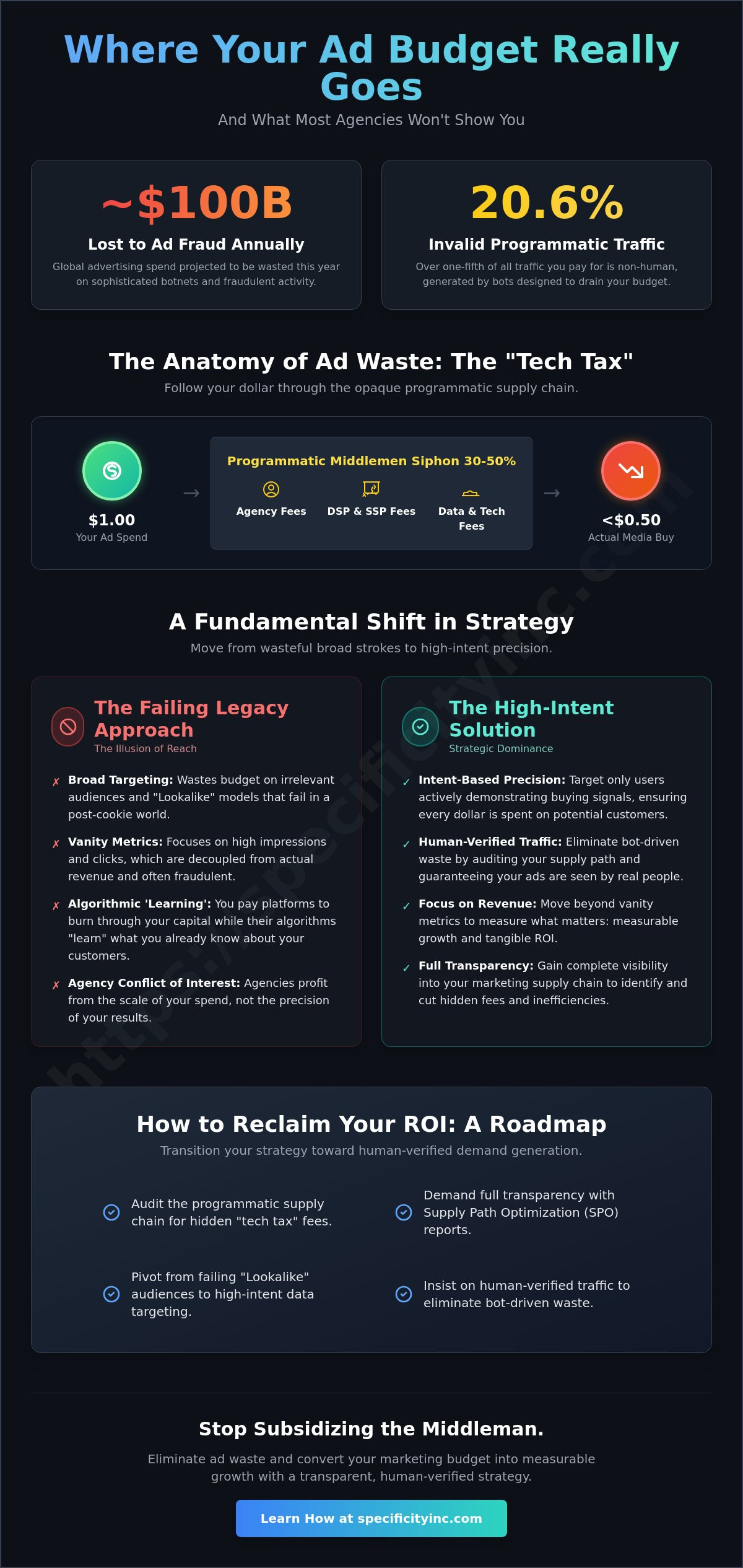
Over $100 billion in global advertising spend is projected to be lost to fraud this year. While your agency presents polished reports filled with vanity metrics, approximately 20.6% of all programmatic traffic is currently classified as invalid. This is the reality of Where Your Ad Budget Really Goes (And What Most Agencies Won’t Show You). You likely suspect that your digital spend is being cannibalized by hidden inefficiencies, and the data confirms it. Between sophisticated AI powered botnets and a programmatic supply chain that siphons 30% to 50% of every dollar as a tech tax, the path to your actual customer is narrower than ever.
You deserve full transparency into your marketing supply chain. We’re going to dismantle the illusion of broad reach and reveal the structural fees draining your ROI. This guide provides a roadmap to pivot from wasteful, broad-stroke tactics to a high-intent, human-verified strategy. We’ll examine the specific mechanisms of ad waste and show you how to leverage intent data targeting to ensure your capital drives measurable growth rather than subsidizing the programmatic middleman.
Key Takeaways
- Identify the structural “tech tax” that consumes up to 50% of programmatic budgets before a single ad is served.
- Gain full transparency into Where Your Ad Budget Really Goes (And What Most Agencies Won’t Show You) by auditing the programmatic supply chain for hidden fees.
- Discover why legacy “Lookalike” audiences are failing in a post-cookie landscape and how to pivot to high-intent precision.
- Learn to execute a rigorous agency audit using Supply Path Optimization reports to verify the human-origin of your traffic.
- Transition your strategy toward human-verified demand generation to eliminate bot-driven waste and focus on revenue.
The Illusion of Reach: Why $202 Billion in Ad Spend Evaporates Annually
Global ad waste has scaled to an industrial level. In 2026, the delta between reported impressions and actual market impact has never been wider. Legacy agencies continue to sell the “illusion of reach” as a primary success metric because it is easy to achieve and even easier to report. This deceptive focus on volume over value is exactly Where Your Ad Budget Really Goes (And What Most Agencies Won’t Show You). Ad waste in the current landscape isn’t merely the result of a weak headline or poor creative; it is a structural failure caused by bad data and unverified traffic sources.
The “Vanity Metric” trap is a calculated diversion. Agencies often celebrate high click-through rates and million-plus impression counts while your revenue remains stagnant. These numbers are frequently decoupled from actual sales outcomes because they prioritize raw quantity over intent. This creates a fundamental agency conflict of interest. Since many firms base their management fees on a percentage of total spend, they are financially incentivized to maintain high-volume, low-efficiency campaigns. They profit from the scale of your spend, not the precision of your results.
Identifying the “Invisible Leak” requires looking past the dashboard. Broad targeting strategies force you to pay for irrelevant eyeballs that have zero probability of conversion. A significant portion of this loss stems from ad fraud, where sophisticated botnets mimic human behavior to siphon capital from unsuspecting brands. When you pay for unverified traffic, you aren’t just losing money; you are feeding an ecosystem built on deception.
The Disconnect Between Impressions and Intent
A million impressions can result in zero high-intent sales conversations if the underlying data is flawed. Reach-first strategies are a liability in a saturated digital landscape where attention is fragmented. You don’t need more people to see your ad; you need the right people to see it at the moment of peak intent. The Reach Gap is the delta between paid impressions and human-verified engagement. Eliminating this gap is the only way to reclaim your ROI.
The High Cost of Algorithmic ‘Learning’ Phases
Platforms profit immensely while your budget is stuck in a “learning phase.” This period is often a “black box” where you pay for the privilege of the algorithm failing until it identifies a viable pattern. In B2B demand generation, waiting for a machine to find your audience is a mask for poor initial targeting. You are effectively subsidizing the platform’s data training with your marketing capital. True strategic dominance requires entering the market with high-intent precision from day one, not weeks after your budget has been depleted by algorithmic guesswork.
The Anatomy of Ad Waste: Hidden Fees, Bot Traffic, and the ‘Tech Tax’
The programmatic supply chain is a labyrinth of extraction. Every intermediary between your brand and the end user takes a cut, often leaving less than half of your original investment to purchase media. This is the structural reality of Where Your Ad Budget Really Goes (And What Most Agencies Won’t Show You). While your dashboard displays a total spend, it rarely reveals the 50% ad tech tax that siphons your capital before it ever hits a screen. This isn’t a glitch; it’s a feature of an opaque ecosystem designed to prioritize platform profits over your ROI.
Breaking Down the Programmatic Middlemen
The journey from your dollar to an impression involves multiple layers of fee-seeking technology. The Demand-Side Platform (DSP) charges a percentage for the interface and bidding logic. Supply-Side Platforms (SSPs) extract another fee from the publisher’s side. Data brokers then charge for audience segments that are often outdated or inaccurate. By the time verification services and ad servers take their portion, your working media ratio is decimated. This complexity hides non-viewable impressions and outright ad fraud, allowing agencies to report high activity while delivering zero business value.
Why Human-Verified Traffic is the New Gold Standard
A click is no longer a proxy for a person. Bot farms now use AI-powered agents to navigate sites, fill out forms, and trigger conversion pixels with surgical precision. These bots are designed to make your agency’s reporting look successful while your sales team starves for actual leads. In 2026, approximately 20.6% of all programmatic traffic is considered invalid. This bot traffic epidemic means that one in every five dollars you spend is effectively stolen by code.
We operate on a single, non-negotiable principle: if it isn’t human-verified, it shouldn’t be paid for. Transitioning to human verified traffic is the only way to insulate your budget from these sophisticated frauds. Agencies that refuse to provide transparent supply path optimization reports are likely hiding these inefficiencies. Some firms even engage in undisclosed media markups, buying inventory at wholesale rates and billing you at a premium. This “hidden margin” problem turns your agency into a reseller rather than a partner. Auditing your programmatic display spend is the only way to stop this bleed and ensure your capital reaches real humans.
Broad Targeting vs. Intent-Based Precision: The Death of the Lookalike Audience
Legacy agencies still cling to the “lookalike audience” as if it were 2018. It isn’t. The structural shifts in data privacy and the deprecation of third-party cookies have turned these once-effective tools into blunt instruments of waste. This reliance on broad targeting is a primary reason why your performance is declining while your costs rise. This systemic inefficiency is Where Your Ad Budget Really Goes (And What Most Agencies Won’t Show You). They hide behind algorithmic “optimization” while your capital is spent on users who have zero intention of buying. You’re paying for reach when you should be paying for resolution.
The failure of interest-based targeting is particularly visible in B2B demand generation. Demographics tell you who a person is, but they say nothing about their current position in the buying cycle. A “Director of IT” is only a lead if they are actively seeking a solution. Without intent data, you are simply shouting into a crowd and hoping the right person hears you. This “hope-based” marketing is an expensive relic of the past that has no place in a results-oriented growth strategy.
The Strategic Shift to Intent-Based Precision
Traditional demographics are a distraction. Knowing a prospect’s job title or zip code provides no insight into their immediate needs. Intent data solves this by tracking active search behaviors and content consumption patterns in real-time. This allows for B2B Marketing in 2026: The Strategic Shift to Intent-Based Precision. We prioritize what prospects are doing over who they are. By identifying buyers already in the market, we eliminate the waste associated with top-of-funnel broad reach and focus entirely on high-probability conversions.
CTV and Programmatic: The New High-Intent Power Couple
Connected TV (CTV) has evolved into a high-precision demand generation engine. With CTV ad spend reaching $72 billion globally, the channel is no longer an experimental luxury; it’s a strategic necessity. By integrating CTV with programmatic display, we create a multi-touch attribution model that captures attention across the most engaging screens in the house. CTV targeting bypasses traditional wasteful broadcast TV buy patterns by delivering ads only to verified, high-intent households. This ensures your message is un-skippable and delivered only to those with a documented interest in your offering.
How to Audit Your Agency: Exposing the Metrics That Don’t Matter
Most agencies rely on executive ignorance to maintain their margins. They bury structural inefficiencies under 40 page reports filled with “green” charts that have no correlation to your bank balance. If your agency cannot provide a line item breakdown of every intermediary in the transaction, they are likely hiding the truth about Where Your Ad Budget Really Goes (And What Most Agencies Won’t Show You). Transparency isn’t a courtesy; it’s a requirement for strategic dominance. You must demand a Supply Path Optimization (SPO) report to see the exact net cost of your media versus the gross cost you are billed.
Auditing the quality of conversion traffic is your next priority. A high volume of leads is a liability if those leads are bot-driven or low-intent. Perform a “Click-to-Lead” reality check by tracing the journey of your most recent conversions. If the data shows a high bounce rate or nonsensical form fills, you are paying for the illusion of activity. Question the “algorithm” by asking for the specific data sets being used. If they can’t define the intent signals driving the targeting, they’re simply letting a black box gamble with your capital.
Five Questions Every CEO Must Ask Their Marketing Agency
- Question 1: What exact percentage of my spend is lost to tech fees and middleman markups before the ad even serves?
- Question 2: What specific third-party tools are you using to verify that our traffic is 100% human and non-fraudulent?
- Question 3: Can you show me the raw intent signals used for this audience, or are we relying on broad interest categories?
- Question 4: Are we paying the net media cost, or is there an undisclosed markup on the inventory?
- Question 5: How does this campaign directly impact our customer acquisition cost (CAC) and lifetime value (LTV)?
Red Flags in Digital Advertising ROI Reporting
Average Click-Through Rate (CTR) is a garbage metric in 2026. High CTRs are often a mask for bot-heavy display placements where automated scripts are programmed to click ads to drain budgets. Similarly, “Brand Awareness” is frequently used as a shield to hide poor performance. If an agency prioritizes impressions over revenue, they are failing you. You need a partner that understands Digital Advertising ROI: The Definitive Guide to Strategic Dominance. Stop settling for vanity metrics that don’t drive growth. If you suspect your current partner is obfuscating the truth, it’s time to audit your programmatic spend and reclaim your marketing capital.
Strategic Dominance: Transitioning to Human-Verified, High-Intent Demand Generation
Exactness is the only antidote to market noise. We have exposed Where Your Ad Budget Really Goes (And What Most Agencies Won’t Show You), and the resolution requires a total abandonment of broad-stroke tactics. While legacy firms hide behind the illusion of reach, we prioritize the precision of intent. We don’t just buy impressions; we secure human verified traffic to ensure that 0% of your spend is sacrificed to bot activity. This transition from guesswork to data-driven certainty is the only logical path to predictable revenue. Strategic dominance is not achieved through volume. It’s achieved through the elimination of waste.
Our methodology integrates every high-intent channel into a singular, full-funnel engine. By combining programmatic display with CTV, SEM, and social media, we create a multi-dimensional presence that captures prospects at the exact moment of their buying decision. This isn’t about being everywhere. It’s about being in the right place with verified accuracy. We replace the “black box” of algorithmic learning with hard data and human verification. This ensures your capital is an investment in growth, not a donation to the programmatic supply chain.
The Specificity Advantage in 2026
We operate with a digital-first mandate because trackable precision is our primary weapon. We explicitly avoid traditional print and physical billboard placement because these channels offer no transparency and zero ability to verify human engagement. Our focus is on high-intent audience targeting across platforms where data depth allows for absolute certainty. Creative services play a critical role here, as we don’t just drive traffic; we optimize the creative to resonate specifically with high-intent segments. This synergy between data and creative ensures that every human-verified interaction has the highest possible probability of conversion.
Next Steps: Reclaiming Your Ad Budget
The path to reclamation starts with a refusal to accept opaque reporting. Transitioning from broad reach to intent-based demand generation requires a fundamental shift in how you view your marketing capital. You must stop paying for “irrelevant eyeballs” and start demanding proof of human interaction. A human-verified traffic audit is the first step in identifying exactly where your current campaigns are bleeding value. By exposing the fraud and tech fees in your existing spend, you can pivot toward a strategy that prioritizes business outcomes over vanity metrics.
Audit your ad spend with Specificity Inc. today.
Reclaim Your Strategic Advantage
The current digital marketing ecosystem is a landscape of extraction. You’ve seen how the tech tax and bot traffic cannibalize your ROI while legacy agencies hide behind vanity metrics. You now understand that lookalike models are failing in a post-cookie world. This transparency reveals exactly Where Your Ad Budget Really Goes (And What Most Agencies Won’t Show You). Continuing with broad-stroke tactics is a choice to subsidize inefficiency rather than drive revenue.
Strategic dominance requires a pivot to exactness. By leveraging human-verified traffic solutions and high-intent audience data targeting, you can eliminate the invisible leak in your marketing spend. Our expertise in CTV and programmatic display ensures your message reaches real humans at the peak of their buying cycle. It’s time to stop funding the middleman and start investing in predictable growth. Stop wasting your ad budget and start targeting high-intent buyers with Specificity Inc. Your path to measurable expansion starts with a single, data-driven decision.
Frequently Asked Questions
What is the ‘programmatic tech tax’ exactly?
The programmatic tech tax is the cumulative extraction of capital by intermediaries such as Demand-Side Platforms (DSPs), Supply-Side Platforms (SSPs), and data brokers. Research indicates that 30% to 50% of your budget is consumed by these fees before a single ad serves. This structural inefficiency siphons your marketing capital to fund the ad tech supply chain rather than reaching your target audience.
How can I tell if my agency is using human-verified traffic?
Demand a Supply Path Optimization (SPO) report and proof of third-party fraud mitigation logs. If your agency cannot provide granular data verifying the human origin of every click, they are likely relying on unverified traffic. Agencies focused on strategic dominance will proactively show you how they filter out the 20.6% of programmatic traffic currently classified as invalid.
Why is intent-based targeting better than Facebook Lookalikes?
Intent-based targeting prioritizes active search behaviors and content consumption patterns over static demographic profiles. Legacy Facebook Lookalikes have lost their precision due to privacy regulations and the decline of third-party cookies. Intent data allows you to reach buyers who are already in the market, eliminating the waste associated with broad interest-based guesswork.
Is Connected TV (CTV) advertising more expensive than traditional TV?
Connected TV is more efficient than traditional broadcast TV because it eliminates waste through household-level precision. While broadcast TV forces you to pay for massive reach regardless of intent, CTV targets only high-intent households with un-skippable ads. This precision often results in a lower effective cost per conversion despite higher initial CPMs.
What is a ‘human-verified’ click and why does it matter for B2B?
A human-verified click is an interaction confirmed by advanced bot-detection technology to originate from a real person. For B2B firms, this is critical because every bot-driven lead wastes expensive sales resources and pollutes your CRM. Exactness in traffic origin ensures your sales team spends 100% of their time on legitimate prospects rather than chasing code.
How much of my ad budget is likely being wasted right now?
Most advertisers lose approximately 50% of their investment to a combination of ad fraud and the programmatic tech tax. This is the structural reality of Where Your Ad Budget Really Goes (And What Most Agencies Won’t Show You). With global ad fraud losses projected to exceed $100 billion, failing to audit your supply path is a choice to subsidize waste.
Can I use intent data for both B2B and B2C marketing?
Yes, intent data targeting is highly effective for both B2B and B2C marketing strategies. Whether you are identifying enterprise decision-makers or consumers in a high-value purchase cycle, behavioral signals provide a more accurate prediction of conversion than simple demographics. It’s about capturing the moment of intent across all digital-first channels to drive predictable revenue.
What metrics should I prioritize for digital advertising ROI?
Prioritize quantitative business outcomes like Customer Acquisition Cost (CAC), Lifetime Value (LTV), and revenue-per-lead. Eschew vanity metrics such as total impressions or raw click-through rates, which are often inflated by bot activity. A results-oriented partner will focus on the working-media ratio to ensure your capital is driving measurable growth rather than superficial engagement.