
How to Prevent Ad Fraud on Social Media: The 2026 Strategic Playbook
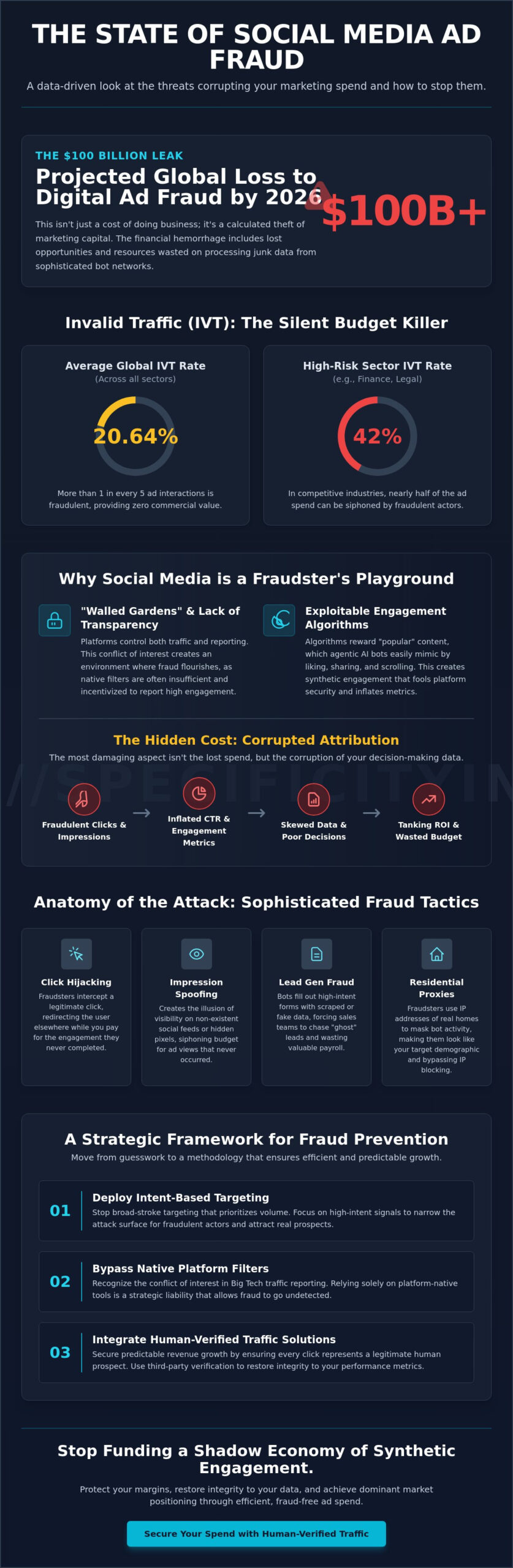
Digital advertising fraud is projected to exceed $100 billion globally in 2026, yet many organizations continue to accept a 20.64% average invalid traffic rate as an unavoidable cost of doing business. You’ve likely seen your social media engagement metrics climb while your actual revenue remains stagnant. This disconnect forces marketing leaders to explain “ghost” conversions to executive boards that demand quantitative proof of growth. It’s a high-stakes environment where sophisticated bot farms and skewed attribution data actively sabotage your scaling decisions.
Mastering how to prevent ad fraud on social media is the only way to protect your margins and secure a dominant market position. We agree that broad-stroke targeting is a liability that prioritizes volume over intent. This strategic playbook delivers a data-driven framework to eliminate budget waste and replace siphoned spend with human-verified traffic. We’ll analyze the 2026 regulatory shift, including the impacts of the SCAM Act and Meta’s latest AI-driven verification tools, to provide you with a definitive roadmap for predictable revenue growth and spend efficiency.
Key Takeaways
- Stop the $100 billion leak by identifying how sophisticated bot networks manipulate platform metrics to siphon your marketing budget.
- Learn exactly how to prevent ad fraud on social media by deploying intent-based targeting that narrows the attack surface for fraudulent actors.
- Discover why relying on native platform filters is a strategic liability and how to bypass the conflict of interest inherent in Big Tech traffic reporting.
- Secure predictable revenue growth by integrating human-verified traffic solutions that ensure every click represents a legitimate prospect.
- Transition from broad-stroke guesswork to a methodology that utilizes precision data to achieve dominant market positioning through efficient spend.
The $100 Billion Leak: The State of Social Media Ad Fraud in 2026
Social media ad fraud is the deliberate manipulation of platform metrics for illegitimate gain. It is a calculated theft of marketing capital. In 2026, global losses from digital ad fraud are projected to surpass $100 billion. This financial hemorrhage isn’t limited to the ad spend itself. It includes the cost of lost opportunities and the massive resources wasted on processing junk data. For a comprehensive overview of ad fraud and its evolution, one must understand that social media is now the primary target for sophisticated bot networks.
The average global Invalid Traffic (IVT) rate has reached 20.64% this year. In high-risk sectors like finance and legal, that number spikes to 42%. These aren’t just errors in the system. They are the result of highly organized bot farms siphoning budgets while providing zero commercial value. In 2025, consumers reported losing $2.1 billion to scams that originated on social media, an eightfold increase since 2020. This trend has accelerated in 2026, making it clear that the primary threat to your growth is no longer your competition, but the very infrastructure you use to reach customers.
Why Social Media is a Fraudster’s Playground
Social media platforms operate as “walled gardens.” They control both the traffic and the reporting of that traffic. This lack of transparency creates an environment where fraud flourishes. Engagement-based algorithms, designed to reward popular content, are easily exploited. Bots now use agentic AI to mimic human behavior, liking posts and scrolling through feeds to stay undetected by native security filters. The rise of AI-generated social profiles has escalated the problem. These deepfake accounts create the illusion of massive visibility through impression spoofing. If you don’t know how to prevent ad fraud on social media, you are essentially funding a shadow economy of synthetic engagement.
The Hidden Cost: Corrupted Attribution
The most damaging aspect of fraud isn’t the immediate loss of capital. It’s the corruption of your decision-making data. Fraudulent clicks inflate your Click-Through Rate (CTR), signaling to your team that a campaign is performing well. In reality, your ROI is tanking because those clicks come from “ghost” audiences. When you optimize toward these fraudulent signals, you move further away from real, high-intent conversions. You end up scaling campaigns that target bots rather than buyers. This creates a cycle of budget waste that is difficult to break without third-party verification. Attribution corruption is the primary threat to strategic growth. Implementing a data-driven framework on how to prevent ad fraud on social media is the only way to restore integrity to your performance metrics, providing a clean slate for agencies like WE Interactive to execute high-impact, results-driven campaigns.
Anatomy of the Attack: Sophisticated Fraud Tactics on Social Platforms
Modern fraud isn’t just a script running on a server; it’s an ecosystem of deception. Click hijacking represents a direct assault on user intent. In this scenario, a fraudster intercepts a legitimate click and redirects the user to a fraudulent ad destination. You pay for the engagement, but the user never reaches your site. Impression spoofing is equally insidious. It creates the illusion of visibility on non-existent social feeds, siphoning budget for views that never occurred. This technical manipulation is a core reason why understanding FTC Data Spotlight on social media ad fraud is critical for executive leadership. It highlights the massive losses stemming from these sophisticated schemes and the necessity of learning how to prevent ad fraud on social media through advanced verification.
For B2B organizations, lead gen fraud is a resource killer. Bots fill out high-intent forms with scraped data, forcing your sales team to chase “ghost” leads. This wastes payroll and demoralizes your top performers. Traditional defense mechanisms like simple IP blocking are now obsolete. Fraudsters use residential proxies, which are IP addresses assigned to real households, to mask their activity. They look like your target demographic because they’re using a legitimate consumer’s connection. This evolution has turned the digital landscape into a minefield of authenticated deception.
Beyond the Bot: The Rise of Device Farms
High-velocity engagement from specific geographic regions is often the first red flag. Device farms use physical hardware, sometimes hundreds of mobile devices, to simulate genuine mobile social media engagement. They scroll, like, and share content with a cadence that mimics real users. Platform-native filters struggle to differentiate this physical hardware from a legitimate customer. This is why automated tools alone fail when you’re trying to figure out how to prevent ad fraud on social media. You need a more aggressive strategy to identify these hardware-based anomalies before they drain your budget.
Pixel Spoofing and Attribution Theft
Pixel spoofing is attribution theft. Fraudsters manipulate tracking pixels to claim credit for organic conversions that would have happened regardless of your ad spend. This directly inflates your digital advertising roi on paper while your actual revenue stays flat. You must scrutinize “too-good-to-be-true” conversion windows in your social analytics. If a conversion happens within milliseconds of an impression, it’s likely a spoofed event. To protect your growth and ensure data integrity, you should transition to human-verified traffic solutions that bypass these automated traps and secure real intent.
The Myth of Platform-Native Protection: Why Big Tech Isn’t Saving You
Relying on Meta, TikTok, or LinkedIn to police their own traffic is a strategic failure. These platforms operate on a fundamental conflict of interest. They generate revenue from impressions and clicks, regardless of whether those actions come from a high-intent buyer or a sophisticated bot farm. Every fraudulent click billed is a line item of profit for them. This systemic incentive structure is exactly why George Mason University research on ad fraud characterizes these vulnerabilities as a feature of the digital landscape rather than a bug. Native filters are perpetually trapped in a reactive cat-and-mouse game, often trailing months behind the latest bot developments.
Broad targeting is not an optimization strategy. It is an open invitation for fraudulent traffic to infiltrate your funnel. When you cast a wide net, you provide the perfect camouflage for non-human agents to blend into your audience. Your platform representative will likely claim they have the situation under control. You must realize their primary KPI is your total spend, not your bottom-line efficiency. They rely on internal data that ignores the “ghost” conversions and junk leads polluting your CRM. If you want to know how to prevent ad fraud on social media, you have to stop trusting the entities that profit from the problem.
The Failure of Broad-Stroke Industry Tactics
Traditional interest-based targeting is now easily gamed. Bots use agentic AI to mimic human interests by visiting specific pages and engaging with high-velocity content, making them indistinguishable from real users to platform algorithms. Post-click analysis is a reactive relic that fails in the 2026 social media advertising environment. You don’t have the luxury of analyzing fraud after your budget is gone. You need to move from reactive detection to proactive exclusion. This shift is the cornerstone of how to prevent ad fraud on social media and secure predictable growth.
The Need for Independent Verification
Independent verification is the only path to data certainty. You cannot allow platforms to grade their own homework. Third-party audits are essential to verify traffic quality and ensure your spend reaches real humans. Owning your own data layer allows you to bypass platform-native reporting bias and see the raw reality of your engagement. Watch for red flags in your LinkedIn and Facebook ad managers, such as high Click-Through Rates (CTR) paired with zero time-on-site or identical session durations across disparate users. These anomalies are the fingerprints of fraud that native tools conveniently overlook.
A Strategic Framework for Social Media Fraud Prevention
Generic detection tools are a bandage on a bullet wound. They treat the symptom while ignoring the root cause: broad, interest-based targeting that welcomes bots into your funnel. To truly master how to prevent ad fraud on social media, you must transition from passive monitoring to aggressive exclusion. Fraudsters thrive in large, ill-defined audiences because they provide the perfect cover for non-human actors. By implementing intent-based targeting, you effectively shrink the playground for these entities. This strategy requires total alignment between your social efforts and your search engine marketing (sem) data to ensure your spend focuses on verified demand rather than synthetic activity.
Real-time data governance is your primary line of defense. You can’t wait for a monthly report to tell you that 30% of your budget went to a bot farm in a different hemisphere. You need systems that flag anomalies before budget exhaustion occurs. Leveraging high-intent audience data allows you to bypass generic filters that platforms use to inflate their reach. This framework isn’t just about security; it’s about growth efficiency. When you eliminate the noise of fraudulent traffic, your scaling decisions finally rest on a foundation of clean, actionable data.
Step 1: Shift to Intent-Based Audience Targeting
Targeting “interests” is a legacy tactic that is easily gamed by agentic AI. Bots can be programmed to simulate interests, but they can’t easily replicate the complex, multi-stage research patterns of a legitimate buyer. Utilizing high-fidelity b2b marketing data allows you to identify genuine decision-makers based on active commercial intent. This shift naturally excludes bot-heavy segments that rely on broad-stroke categorization to trigger ad impressions. Precision is the ultimate enemy of the fraudster.
Step 2: Implement Real-Time Traffic Validation
Static blacklists are useless in 2026. Fraudsters rotate residential proxies too quickly for manual lists to remain relevant. You need dynamic, behavioral traffic analysis that identifies non-human patterns as they happen. Speed-of-light form completions are a dead giveaway of lead gen fraud that platform-native tools often miss. We use time-on-site and scroll-depth as critical proxies for traffic quality. If a session records a conversion without the user ever scrolling past the fold, the data is compromised. Deploying human verified traffic solutions ensures that every dollar you spend is an investment in a real prospect, not a simulated interaction. This is the only way to maintain a dominant market position while others waste their capital on ghost conversions.
The Specificity Solution: Human-Verified Social Dominance
Broad-stroke guesswork is a liability that high-performing organizations cannot afford. Our methodology replaces hope with exactness. We don’t just discuss how to prevent ad fraud on social media; we engineer it out of your ecosystem entirely. By prioritizing precision data over platform-native estimates, we ensure every dollar targets a verified human being with genuine commercial intent. This is the antidote to the noise and waste of the broader market. We reject the traditional industry tactics that prioritize volume over value, focusing instead on the quantitative outcomes that drive substantial growth.
Automated filters are fundamentally reactive. They wait for a bot to act before attempting to block it. Specificity utilizes Human Verified Traffic to flip this script. We don’t trust the platforms to grade their own traffic quality because their incentives are misaligned with your growth. Instead, we deploy a proprietary validation layer that confirms the human identity behind every click. This process ensures that your sales team only interacts with real prospects, eliminating the demoralizing cycle of chasing lead-gen fraud. It’s a high-stakes style of management that prioritizes data depth above all else.
Multi-channel alignment is the final stage of strategic dominance. Integrating your social strategy with connected tv advertising creates a reinforced precision engine. This cross-channel verification ensures your high-intent demand generation remains insulated from the $100 billion fraud leak currently draining the broader market. You aren’t just buying ads; you’re securing a verified path to purchase. This methodology is the only logical choice for businesses seeking predictable revenue in an environment saturated with synthetic engagement.
Our No-Nonsense Approach to Traffic Quality
We prioritize logic and evidence over the superficial vanity metrics platforms use to mask poor traffic quality. High Click-Through Rates are irrelevant if they don’t map to revenue. Our approach focuses on the exactness of the customer journey, using behavioral data to prove human intent. We cut through complexity with data-driven certainty, providing executive leadership with the quantitative proof they need to scale with confidence. This elite specialist mindset ensures that your marketing spend is treated as a high-performance investment, not a creative experiment.
Securing Your 2026 Growth Strategy
A fraud-resistant marketing funnel is a dominant competitive advantage in 2026. While your rivals continue to fund bot farms, you will reclaim your budget and reinvest it in high-intent demand generation. This strategy creates a moat around your marketing spend, allowing for predictable, high-stakes revenue growth. You’ll no longer have to explain “ghost” conversions to your board because every metric will be backed by hard evidence. The era of accepting invalid traffic as a cost of doing business is over. Partner with the elite specialists in human verified traffic to secure your market position and dominate your category through efficient, data-backed spend.
Secure Your Market Dominance Through Traffic Certainty
Digital advertising in 2026 requires a shift from passive observation to aggressive, data-backed defense. You’ve seen why native platform filters fail and how sophisticated bot farms bypass traditional security measures. The path forward demands an unapologetically results-oriented methodology that prioritizes human verified traffic over synthetic engagement. Implementing these protocols is the definitive answer to how to prevent ad fraud on social media while maintaining a high-performance growth trajectory.
By deploying intent data targeting and real-time behavioral audits, you reclaim the budget previously lost to “ghost” conversions. This precision doesn’t just protect your margins; it secures a dominant market position through spend efficiency. We don’t rely on guesswork or superficial metrics. We rely on logic and evidence to drive predictable revenue. As an elite specialist in high-intent audience targeting, we ensure your spend reaches real decision-makers and genuine prospects.
Stop paying for clicks that never convert. Get human-verified traffic with Specificity Inc.
You’re now equipped to turn your social channels into a secure engine for substantial growth and long-term expansion.
Frequently Asked Questions
How much of my social media budget is likely lost to ad fraud?
Current data indicates that the average global Invalid Traffic (IVT) rate has reached 20.64% in 2026. This means one out of every five dollars in your social media budget is likely captured by non-human actors. In high-stakes sectors like finance or legal, these losses can escalate to 42%, representing a massive siphoning of marketing capital that provides zero commercial value.
Can social media platforms detect all bot-driven ad fraud?
No, platforms cannot eliminate all fraud because they operate on a fundamental conflict of interest where they profit from traffic volume. Their native filters are often reactive and fail to identify sophisticated agentic AI or residential proxies that mimic human behavior. Relying solely on platform-native protection is a strategic liability for any organization seeking predictable revenue growth.
What is the difference between click fraud and impression fraud on social media?
Click fraud involves malicious actors or bots generating fake clicks to drain your budget or steal attribution for organic conversions. Impression fraud, or spoofing, creates the illusion of visibility on non-existent or invisible social feeds. Both tactics result in zero ROI while corrupting the data you use to make critical scaling and budget allocation decisions.
How does intent-based targeting help prevent ad fraud?
Targeting intent rather than broad interests is a critical component of how to prevent ad fraud on social media. Bots easily trigger interest-based filters by visiting specific pages, but they cannot replicate the complex, multi-stage research patterns of a real buyer. This precision approach starves fraud networks of the camouflage they need to blend into your audience segments.
What are the signs that my social media campaigns are being targeted by fraudsters?
Watch for high Click-Through Rates (CTR) paired with near-zero time-on-site or identical session durations across disparate users. You should also scrutinize “speed-of-light” form completions where leads are submitted faster than a human could realistically type. Anomalous traffic spikes from geographic regions outside your primary market are also immediate red flags that require investigation.
Is human-verified traffic more expensive than standard programmatic traffic?
Human-verified traffic is a high-yield investment that eliminates the 20% to 40% waste inherent in unverified programmatic channels. While the initial CPM may vary from unverified sources, the effective cost per conversion is significantly lower because you aren’t paying for bot interactions. It’s the only logical choice for businesses that prioritize quantitative outcomes and spend integrity over vanity metrics.
How often should I conduct an ad fraud audit for my social campaigns?
Audits must be continuous and conducted in real-time to be effective in the 2026 digital landscape. Quarterly or monthly reviews are reactive failures that allow budget hemorrhaging to continue for weeks before detection. Implementing a real-time verification layer ensures that fraudulent actors are identified and excluded before they have the opportunity to exhaust your marketing budget.
What should I do if I detect high levels of fraudulent traffic in my data?
Immediately pivot your strategy from broad interest-based targeting to human-verified traffic sources to stop the capital leak. You must also scrub your attribution data to ensure you aren’t accidentally optimizing campaigns toward “ghost” audiences. Implementing independent, third-party verification is essential to bypass platform-native reporting bias and reclaim your actual marketing ROI.