
How to Stop Paying for Bot Traffic: The 2026 Executive Guide to Ad Fraud Eradication
Your current ad strategy is likely subsidizing botnets. Traditional ad inventory is saturated with non-human entities that drain your capital without any possibility of conversion. If you’re looking for how to stop paying for bot traffic, you must realize that reactive filtering is a failed methodology. Most executives watch their acquisition costs climb while lead quality falls, often unaware that a significant portion of their programmatic spend fuels automated scripts rather than human engagement.
It’s a common frustration to see strategic decisions undermined by skewed analytics and sales teams overwhelmed by trash leads from automated forms. You deserve a predictable revenue engine built on logic and evidence. This guide provides the data-driven framework to reclaim up to 40% of your wasted budget and transition to a model of 100% human-verified traffic. We’ll examine why intent data targeting must replace broad-stroke industry tactics. You’ll learn the exact steps to eliminate fraud from your balance sheet and ensure every dollar buys high-intent human interaction through precision programmatic display and search engine marketing.
Key Takeaways
- Identify the mechanics behind the multi-billion dollar drain where automated scripts now account for over 40% of global web traffic.
- Examine the platform paradox and why relying on major social networks for traffic auditing creates an inherent conflict of interest.
- Master the executive framework on how to stop paying for bot traffic through independent verification and server-side tracking.
- Transition from high-volume waste to precision targeting by leveraging human-verified traffic and intent data.
- Reclaim significant portions of your marketing budget by refusing to purchase broad-audience inventory that lacks human verification.
The Multi-Billion Dollar Drain: Why You’re Still Paying for Bot Traffic in 2026
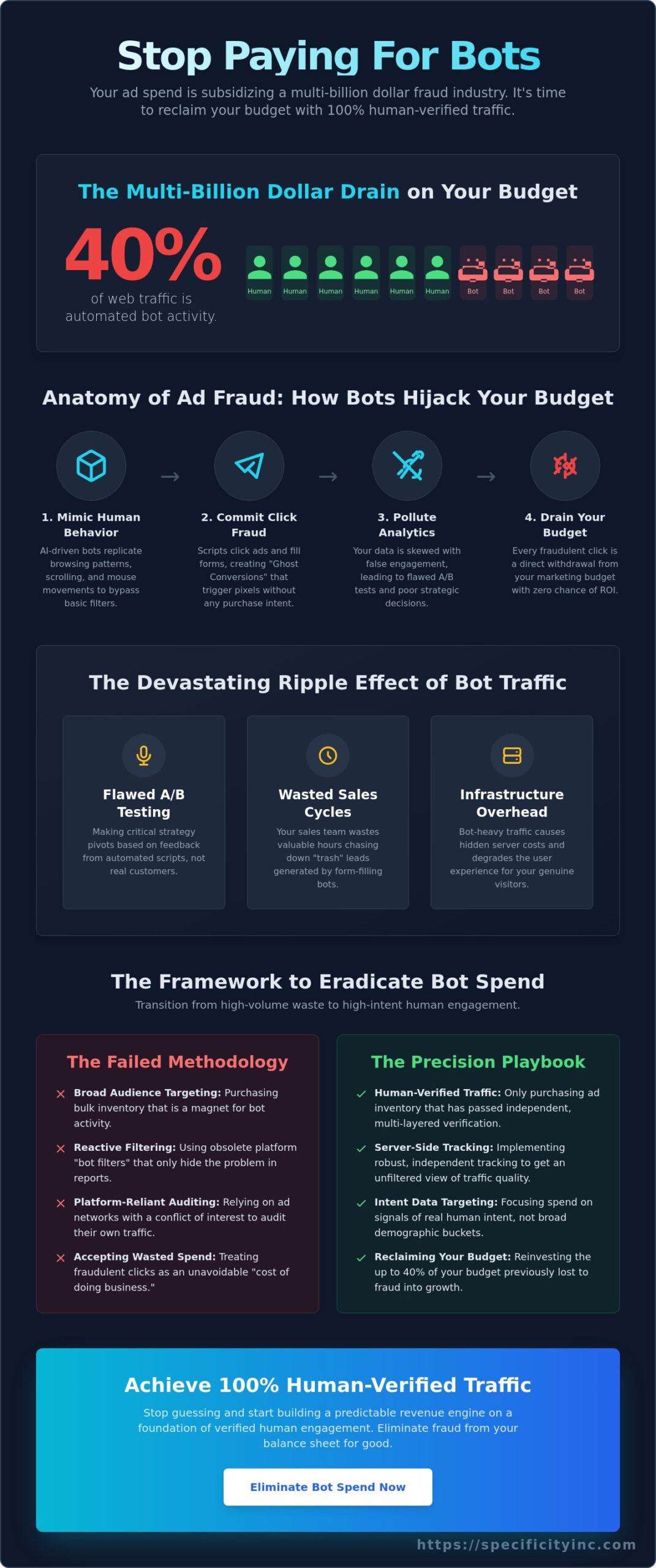
Bot traffic in 2026 represents a sophisticated, multi-billion dollar drainage system designed to siphon marketing capital into the pockets of fraudulent actors. By definition, these are automated scripts engineered to mimic human behaviors such as scrolling, clicking, and form completion. Industry data indicates that bots now account for over 40% of all web traffic, creating an environment where traditional metrics are fundamentally compromised. If you want to learn how to stop paying for bot traffic, you must first accept that broad audience targeting is effectively a subsidy for global bot farms. High engagement rates often mask “Ghost Conversions” where bot activity triggers pixels without any intent to purchase, leading to catastrophic budget waste.
The core of the problem lies in the structural incentives of the digital ecosystem. Most platforms prioritize volume over veracity. When you purchase broad-inventory display ads, you are entering a marketplace where quantity is the primary currency. For an executive focused on growth, understanding ad fraud is the first step toward reclaiming your balance sheet. Without human-verified traffic, your marketing spend is merely a contribution to a fraudulent machine that produces nothing but hollow data points.
The Sophistication Gap: Why Legacy Filters Fail
Your existing security stack is likely obsolete. Modern AI-driven bots utilize machine learning to bypass basic CAPTCHAs and render IP blacklists useless. These scripts replicate human-like browsing patterns, including randomized pause times and non-linear mouse movements, which easily fool standard platform algorithms. Relying on the simple “bot filtering” toggle in GA4 is nothing more than a cosmetic fix for your reports. It hides the noise but does not stop the financial bleed. These legacy filters operate on historical data, while modern fraud evolves in real-time to exploit new vulnerabilities in programmatic display networks.
The Real Cost of Inflated Analytics
The damage extends far beyond the initial wasted click. Bot data creates a devastating ripple effect that ruins your digital advertising roi by polluting your entire marketing funnel. Consider the following consequences of non-human traffic:
- False Positives in A/B Testing: You may be making strategic pivots based on feedback from scripts rather than your actual customers.
- Wasted Sales Cycles: Your sales team loses hours chasing “trash” leads generated by automated form fillers.
- Infrastructure Overhead: Bot-heavy traffic streams cause hidden server costs and performance lag, degrading the experience for legitimate human users.
Every non-human interaction distorts your customer journey mapping. When you fail to address how to stop paying for bot traffic, you lose the ability to make data-driven decisions with any degree of certainty. Logic dictates that you cannot build a predictable revenue engine on a foundation of fabricated engagement.
Anatomy of Ad Fraud: How Automated Bots Hijack Your Marketing Budget
Ad fraud isn’t a passive glitch. It’s a deliberate, multi-layered heist designed to extract maximum value from your marketing budget. To understand how to stop paying for bot traffic, you must first dissect the specific tactics used to inflate your costs. Malicious scripts don’t just click ads; they simulate entire user journeys to trigger your tracking pixels and fool your CRM. This systematic deception contributes to the rising threat of ad fraud, which now targets every stage of the conversion funnel. Perhaps the most insidious tactic is the Attribution Trap. Here, bots wait for a human user to reach the final stage of an organic conversion, then fire a last-minute ad click to steal credit for the sale. You end up paying for a customer you already earned through brand equity or SEO.
Fraudulent actors also exploit “Broad Match” and “Expansion” settings on major search and social platforms. These default configurations prioritize reach over relevance, providing the perfect entry point for automated scripts to trigger high-cost clicks. When your campaigns are set to maximum expansion, you’re essentially inviting bot networks to interact with your brand at your expense. High-stakes marketing requires a rejection of these broad-stroke tactics in favor of exactness.
Click Farms and Lead Injection
Click farms have evolved from manual labor centers into massive, automated server arrays. These systems perform lead injection by filling out B2B forms with stolen or fabricated data. This creates a nightmare for your sales pipeline, forcing high-performing account executives to waste time chasing “trash” leads that have zero intent. In this environment, “cheap” traffic is a liability. If you aren’t using human-verified traffic strategies, you’re likely paying for the privilege of wasting your internal resources.
The Programmatic Minefield
The programmatic space is particularly vulnerable to technical fraud like “Pixel Stuffing” and “Ad Stacking.” Pixel stuffing involves loading a full-sized ad inside an invisible 1×1 pixel, while ad stacking layers multiple ads on top of each other in a single slot. You pay for the impression, but no human ever sees the creative. Much of this occurs on “Made-for-Advertising” (MFA) sites. These are low-quality domains that exist solely to host bot traffic and capture programmatic display spend. Achieving total transparency is the only logical path for executives who want to know how to stop paying for bot traffic and start buying human attention with certainty.
The Platform Paradox: Why Google and Meta Can’t (or Won’t) Stop the Bots
Big Tech platforms operate under a fundamental conflict of interest. Their fiduciary responsibility to shareholders demands consistent revenue growth, and in the digital advertising world, revenue is a direct product of volume. Whether a click originates from a high-intent buyer or a sophisticated script, the platform collects the same fee. This is the “Black Box” problem. You’re buying inventory on trust, yet the platform provides no mechanism for independent, real-time auditing. If you want to know how to stop paying for bot traffic, you must recognize that native filters are often just cosmetic barriers. They block low-level data centers but ignore the residential proxy networks that define modern ad fraud.
Relying solely on platform-native optimization for search engine marketing (sem) is a strategic error. These algorithms are trained to maximize clicks, not human verification. When you allow an automated system to manage your bids, it prioritizes the path of least resistance. Often, that path leads directly to bot-infected inventory that meets the platform’s “engagement” criteria but fails to produce a single human lead. It’s a system designed to spend your budget, not to protect it.
Inherent Conflicts in Big Tech Ad Networks
The “Audience Network” is the industry’s largest open secret. It functions as a clearinghouse for inventory that lacks the quality control of the primary feed. When you enable “Optimized Targeting,” you’re effectively granting the platform permission to spend your budget on these lower-tier, bot-heavy sites. These networks prioritize volume as their primary KPI because volume drives billing. Adhering to industry best practices for preventing ad fraud requires moving beyond these native black boxes and demanding third-party verification that the platform cannot provide.
The Limits of Broad Match and Broad Targeting
In social media advertising, the danger of “Lookalike” audiences is real and quantifiable. If your seed data includes “Ghost Conversions” from bots, the platform’s AI will find more bots that behave just like them. It’s a self-perpetuating cycle of waste. Broad match settings act as a magnet for scripts that crawl the web looking for ad triggers. The “set it and forget it” approach isn’t just lazy; it’s a financial liability. You can’t achieve 100% human-verified traffic flow by trusting a system that profits from the noise. Exactness in targeting is the only logical antidote to this platform-level failure.
The 2026 Playbook: 5 Critical Steps to Eradicate Bot Spend
Most industry advice focuses on “filtering” bots after the click has been billed. This is a post-mortem, not a strategy. A proactive eradication framework is the only way to protect your margins and ensure growth efficiency. Understanding how to stop paying for bot traffic requires moving beyond the “buy then filter” model and adopting a strict policy of refusal. You don’t just want to see the fraud; you want to prevent the transaction entirely. Follow these five critical steps to purge automated waste from your balance sheet:
- Audit your traffic with independent, third-party verification tools. Don’t let the platforms grade their own homework. Independent auditors provide an unbiased view of traffic quality that platform-native tools cannot match.
- Transition to server-side tracking. This move bypasses browser-level bot scripts that can manipulate or block tracking pixels. It creates a secure validation layer that bots cannot easily penetrate.
- Implement aggressive IP and domain exclusion lists. Use real-time fraud data to block known malicious actors before they can interact with your ads. This is a dynamic process that requires constant updates to stay ahead of evolving bot networks.
- Shift budget to “Closed Ecosystem” channels like CTV. These environments have higher barriers to entry for bots because they lack the open-web vulnerabilities of traditional programmatic display.
- Replace broad targeting with deterministic, intent-based audience data. This ensures your ad spend is tied to known human identities rather than probabilistic guesses that bots often exploit.
Implementing Server-Side Tracking and Mitigation
Client-side verification is vulnerable to manipulation. Bots easily spoof browser signals to appear human, rendering traditional pixel tracking unreliable. Server-side bot mitigation is the process of moving traffic validation from the user’s browser to your own controlled server environment. This ensures that only verified, human interactions trigger your marketing pixels. You should also deploy “honeypots,” which are invisible form fields that only bots can see. When a script fills these out, you can instantly block that entity from your entire ecosystem. This technical shift removes the bot’s ability to interact with your tracking infrastructure and protects your data integrity.
Shifting to Intent-Based Data and Human-Verified Audiences
Modern b2b marketing requires a “human-first” data strategy to survive. Deterministic data allows you to target real people at verified companies rather than broad demographic segments. By using identity graphs, you can ensure your ads reach legitimate devices associated with actual professionals. This level of exactness is the antidote to programmatic waste. It’s the difference between buying “reach” and buying “verified human intent.” Stop guessing and start targeting with certainty by securing human-verified traffic solutions for your next campaign.
Precision Over Volume: Achieving 100% Human-Verified Traffic with Specificity
The industry standard for fraud prevention is fundamentally reactive. Most agencies wait for a post-campaign report to tell you how much of your money was stolen. We reject this passivity. Our philosophy dictates that the only way to truly solve the problem of how to stop paying for bot traffic is to refuse to purchase unverified inventory in the first place. If you’re serious about how to stop paying for bot traffic, you must demand a standard of exactness that the broader market simply isn’t equipped to provide. This shift in methodology moves your primary performance metric from a hollow Cost Per Click to a meaningful Cost Per Human Interaction.
Transitioning to 100% human-verified traffic flow requires a total abandonment of broad-stroke industry tactics. We utilize a data-driven framework that prioritizes exactness over sheer volume. This isn’t about casting a wider net. It’s about ensuring the net you cast is only visible to verified human entities. When you stop subsidizing the 40% of web traffic that is automated, your acquisition costs don’t just decrease; they normalize around actual human demand. By stripping away the noise, we allow your creative and strategic messaging to reach the people who actually have the authority and intent to buy.
The Specificity Methodology: Cutting Through the Noise
Our three-layer verification process ensures that every impression is an asset, not a liability. We start with Intent, utilizing deep-funnel data to identify active buyers. We then move to Identity, cross-referencing activity against deterministic identity graphs to confirm a human presence. Finally, we analyze Interaction, ensuring browsing patterns align with human behavior rather than scripted sequences. We execute this strategy by prioritizing programmatic display on premium, audited exchanges that maintain rigorous entry requirements. The results are undeniable. When you remove the automated noise that typically clogs a marketing funnel, your conversion rates skyrocket because your sales team is finally talking to real people.
Safe Havens for Your Ad Spend
Within the current digital ecosystem, connected tv advertising stands as the most bot-resistant medium available. The closed nature of CTV platforms creates a high barrier to entry that most automated scripts cannot scale. We integrate this precision engine with SEM and social media strategies to create a full-funnel environment where human verification is the baseline, not an afterthought. This integrated approach ensures that your brand remains visible in safe havens while avoiding the programmatic minefields that drain traditional budgets.
Your next strategic move is an audit of your current spend. Most executives are shocked to find the depth of hidden fraud in their existing campaigns. We recommend looking at the hard numbers to identify exactly where your budget is being siphoned. Achieving predictable revenue starts with the certainty that your audience is real. Logic dictates that you cannot scale a business on fabricated engagement.
Secure Your Revenue Engine with Data-Driven Exactness
Ad fraud is a sophisticated technical challenge that requires a technical resolution. You’ve seen how platform-native filters fail to address the volume of automated scripts currently saturating the open web. You’ve learned that relying on broad-match settings is a direct subsidy to bot networks that steal attribution and drain budgets. Mastering how to stop paying for bot traffic isn’t about minor adjustments to your current campaigns; it’s about a fundamental pivot toward proprietary human-verified traffic protocols and deterministic identity-based targeting.
Logic dictates that your growth should be fueled by real human intent, not synthetic engagement. By leveraging our expertise in high-intent B2B and B2C demand generation and fraud-resistant Connected TV (CTV) advertising, you can eliminate the noise and reclaim your marketing margins. The era of broad-stroke guesswork is over. It’s time to build a predictable revenue stream based on hard numbers and verified interactions.
Stop paying for ghosts. Get a human-verified traffic audit from Specificity Inc. today.
Reclaiming your budget is the first step toward total market dominance.
Frequently Asked Questions
Is it possible to completely stop all bot traffic?
You cannot eliminate bots from the internet, but you can achieve 100% human-verified traffic flow for your specific marketing campaigns. Total eradication from your balance sheet is the strategic objective. By moving away from broad programmatic exchanges and utilizing deterministic data, you ensure your budget only interacts with verified human devices rather than automated scripts.
How can I tell if my current conversion data is actually bot-driven?
Look for high conversion volume that fails to translate into sales pipeline activity. If your CRM is filled with leads that have disconnected phone numbers or gibberish names, you are seeing bot-driven data. Check your server logs for multiple conversions originating from the same IP range or identical session durations measured down to the millisecond.
Do Google and Facebook refund money for bot clicks?
Platform refunds are limited to what they classify as “invalid traffic,” which typically only covers the most basic bot signatures. Major networks have a financial incentive to maintain high volume, so they rarely offer proactive credits for sophisticated ad fraud. Learning how to stop paying for bot traffic requires independent verification rather than relying on platform-native goodwill.
What is the difference between a ‘good’ bot and a ‘bad’ bot?
The distinction lies in the bot’s objective and its interaction with your server. Good bots, such as search engine crawlers, identify themselves and provide value by indexing your site for organic visibility. Bad bots are designed for deception. These scripts mimic human engagement to drain ad budgets, scrape proprietary data, or inject fraudulent leads into your sales funnel.
How does intent-based targeting help in stopping bot traffic?
Intent-based targeting utilizes deterministic data to identify real people who have demonstrated specific buying signals. This approach bypasses the probabilistic “lookalike” models that bots easily exploit. Because bots cannot replicate complex, multi-stage human intent across different devices and platforms, this methodology ensures your spend is concentrated on legitimate prospects with actual purchasing power.
What are the first signs that my ad campaign has been targeted by a bot farm?
A primary indicator is a sudden, unexplained surge in click-through rates (CTR) that isn’t accompanied by increased time-on-site or page depth. You might also notice high bounce rates or conversions that occur at impossible speeds. These anomalies suggest a bot farm is interacting with your ads to trigger your tracking pixels and fulfill fraudulent engagement quotas.
Does using CAPTCHA actually stop sophisticated ad fraud bots?
Traditional CAPTCHAs are ineffective against the sophisticated bots seen in 2026. Modern fraud networks use machine learning to solve visual puzzles or outsource the work to human-staffed “solver” farms for minimal costs. Relying on these legacy tools provides a false sense of security while frustrating your actual human customers and degrading the user experience.
Why is Connected TV (CTV) considered safer from bot traffic than standard display ads?
Connected TV operates within a more controlled supply chain than standard display ads. Most CTV inventory is sold through direct relationships or premium, private marketplaces that require strict device authentication. This closed environment lacks the open-web vulnerabilities that allow browser-based scripts to spoof impressions and hijack programmatic spend, making it a logic-based choice for secure growth.