Omnichannel Advertising Strategy in 2026: Architecting High-Intent Funnels for Strategic Dominance
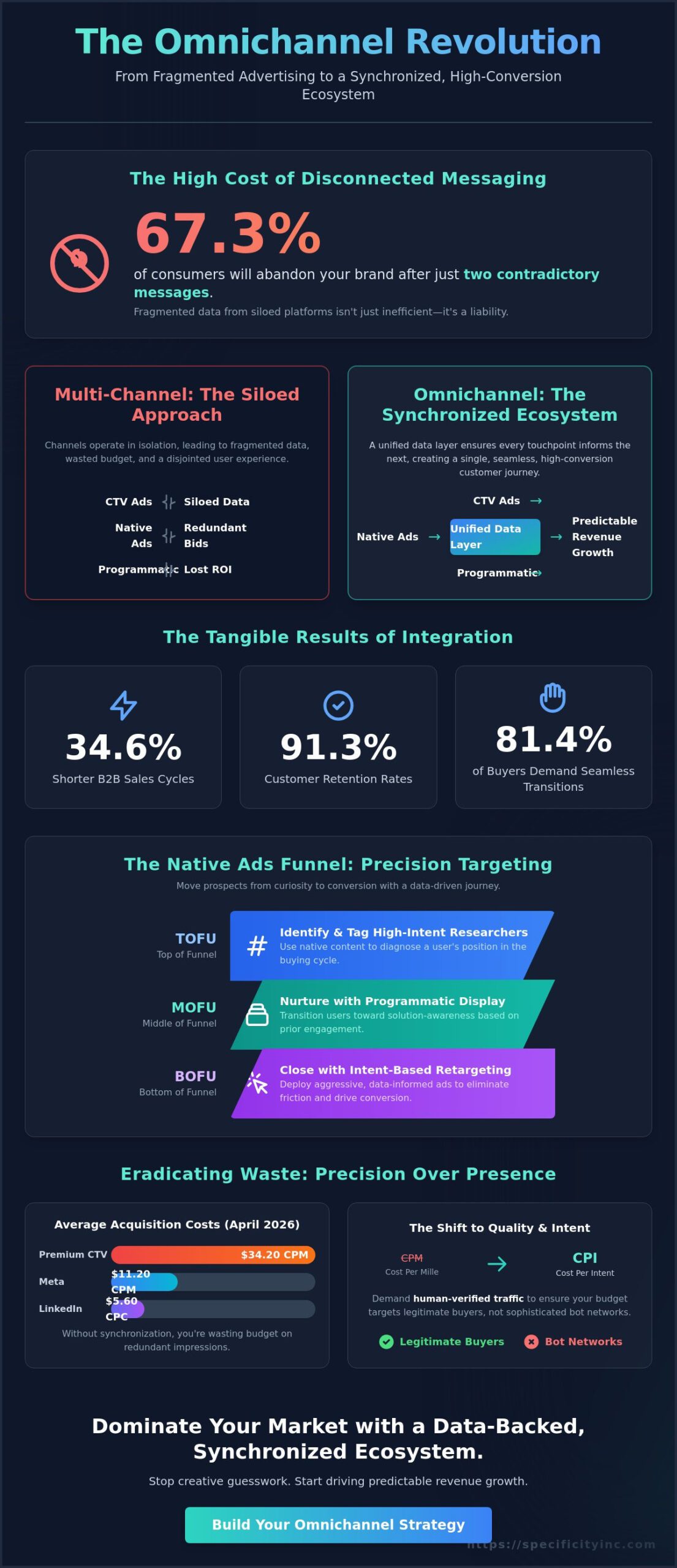
67.3% of consumers will abandon your brand after encountering just two contradictory messages. In an era where 81.4% of buyers demand seamless platform transitions, the traditional “spray and pray” model isn’t just inefficient; it’s a liability. You likely recognize that fragmented data across siloed platforms is inflating your cost-per-acquisition. You need a sophisticated omnichannel advertising strategy, native ads funnel strategy, and cross channel marketing ads that replace creative guesswork with intent-based targeting and human-verified traffic.
This guide provides the precision-driven framework to synchronize native, CTV, and programmatic ads into a single, high-conversion ecosystem. We’ll reveal the architecture required to shorten B2B sales cycles by 34.6% and achieve the 91.3% customer retention rates seen by fully integrated brands. We’ll analyze everything from $34.20 CPMs for premium CTV to the granularity of programmatic display. You’ll gain absolute clarity on which channels drive revenue, allowing you to dominate your market with data-backed certainty.
Key Takeaways
- Transition from fragmented multi-channel tactics to a unified data layer that synchronizes every touchpoint for strategic dominance.
- Architect a high-conversion omnichannel advertising strategy, native ads funnel strategy, and cross channel marketing ads to tag high-intent researchers at the top of the funnel.
- Protect your ROI by demanding human-verified traffic, ensuring your programmatic display budget targets legitimate buyers rather than sophisticated bot networks.
- Synchronize Connected TV (CTV) with Search Engine Marketing (SEM) to instantly capture second-screen intent and drive predictable revenue growth.
- Deploy a precision-first audit to identify leaks in your current ecosystem and shorten B2B sales cycles by 34.6% through data-driven certainty.
Beyond Multi-Channel: Why Omnichannel Advertising Strategy is Non-Negotiable in 2026
Siloed marketing is a financial leak you can no longer afford. In 2026, the distinction between multi-channel and omnichannel is the difference between mere presence and strategic dominance. Multi-channel tactics simply place ads on various platforms. This creates fragmented data and a disjointed user experience that frustrates 67.3% of consumers. True Omnichannel orchestration demands a unified data layer where every dollar spent on CTV, programmatic, and social media informs the next touchpoint in real time. Without this synchronization, your channels don’t just exist in isolation; they actively cannibalize your ROI by bidding against the same audience without a cohesive intent-based narrative.
The high cost of fragmentation is visible in the rising acquisition costs across the board. With Meta CPMs averaging $11.20 and LinkedIn CPCs exceeding $5.60 as of April 2026, you cannot waste budget on redundant impressions. An integrated omnichannel advertising strategy, native ads funnel strategy, and cross channel marketing ads ecosystem ensures that your top-of-funnel awareness from a $34.20 premium CTV spot immediately triggers a targeted follow-up via programmatic display. This isn’t just about being everywhere. It’s about architecting a single engine that moves a prospect from curiosity to conversion with surgical precision.
The Evolution of Cross-Channel Marketing Ads
Consumer behavior has abandoned the linear path. Today’s buyer engages with an average of six touchpoints before making a decision. This chaotic journey requires robust identity resolution to maintain a single view of the customer across devices. As 20 states now enforce comprehensive privacy laws as of early 2026, precision is your only hedge against data loss. B2B organizations that successfully integrate these cross-channel programs report 34.6% shorter sales cycles. You aren’t just buying ads; you’re buying the ability to track intent across a fractured digital landscape.
Eradicating the ‘Spray and Pray’ Mentality
Broad targeting is an intellectual failure in a data-rich environment. While 91.5% of digital display spend is now programmatic, much of that is wasted on low-intent traffic or sophisticated bot networks. We’re shifting the focus from the vanity of CPM (cost per thousand) to the reality of CPI (cost per intent). You must demand human-verified traffic to ensure your budget targets legitimate buyers. Omnichannel advertising is a data-synchronized architecture designed to capture high-intent demand. By prioritizing granularity over reach, you pinpoint the exact moment a prospect is ready to engage, ensuring your brand dominates the final decision-making phase.
The Native Ads Funnel Strategy: Precision Targeting Across the Buyer Journey
Native advertising is the intellectual anchor of a high-intent ecosystem. Unlike traditional display, which often interrupts the user experience, a sophisticated native ads funnel strategy leverages the environment to filter for genuine interest. As the native advertising market is projected to reach $125.58 billion in 2026, its role has shifted from simple brand awareness to a rigorous data-collection tool. At the Top-of-Funnel (TOFU), we use native content to identify and tag high-intent researchers. This isn’t passive; it’s a diagnostic phase where a user’s engagement with technical content signals their position in the buying cycle. By the time they reach the Middle-of-Funnel (MOFU), we transition them toward solution-awareness via programmatic display, finally closing the loop at the Bottom-of-Funnel (BOFU) with aggressive, intent-based retargeting that eliminates friction.
Execution requires more than just “seamless” placement. According to Wharton on Omnichannel Marketing, the effectiveness of any strategy hinges on how well these touchpoints are orchestrated. When you synchronize your omnichannel advertising strategy, native ads funnel strategy, and cross channel marketing ads, you ensure that the data captured during a native read informs the bid price for the subsequent CTV spot. This level of granularity is what separates market leaders from those wasting budget on unverified impressions.
Step 1: Deploying Intent-Based Native Content
Precision begins with third-party intent data. We serve native ads to users who are actively searching for your specific solution, not just those who fit a vague demographic profile. Your creative must solve a high-stakes problem. If your content doesn’t filter for intent, it’s a wasted impression. With mobile native ads achieving a 0.38% CTR compared to just 0.11% for traditional banners as of April 2026, the opportunity to capture high-quality data is immense. Every click must be a signal of intent that we can use to pinpoint your next customer with surgical accuracy.
Step 2: The Retargeting Bridge
The transition from native to other channels must be invisible to the user but mathematically precise for the advertiser. We use native engagement as the trigger for programmatic sequences on CTV and social platforms. This ensures messaging continuity. You can’t speak to a prospect like a stranger once they’ve engaged with your technical whitepapers. This logic is central to B2B Marketing in 2026: The Strategic Shift to Intent-Based Precision. By maintaining this bridge, you move prospects through the funnel faster, effectively shortening the sales cycle while maximizing the impact of every dollar spent on cross-channel marketing ads.
Cross-Channel Marketing Ads vs. Siloed Campaigns: Eradicating Waste
Siloed campaigns are a relic of a less sophisticated era. They prioritize reach over resonance and vanity metrics over verifiable ROI. In 2026, 91.5% of all digital display ad spending is programmatic, yet this scale introduces a dangerous paradox. High reach often equals high fraud. Without human verification, your budget isn’t targeting buyers; it’s subsidizing sophisticated bot networks. Traditional agencies often ignore traffic quality because high volume looks good on a report, but those numbers don’t convert. You can’t build a dominant omnichannel advertising strategy, native ads funnel strategy, and cross channel marketing ads ecosystem on a foundation of fake impressions.
Human-verified traffic is the only way to ensure your capital is deployed against actual humans with documented intent. By the time a prospect interacts with your brand, they’ve likely touched six different channels. If half of those touchpoints are bot-driven, your data layer is poisoned. This fragmentation causes you to bid against yourself, driving up your own costs while providing zero incremental value. We replace this chaos with an integrated engine that prioritizes the purity of the data over the volume of the noise.
The ROI of Verification
Human-verified traffic instantly lowers your CPA by eliminating non-human clicks that never had a chance of converting. There’s a massive technical difference between ‘standard’ programmatic, which buys broad inventory, and ‘high-intent’ programmatic, which only bids when a human user matches specific intent signals. Ad fraud accounts for billions in wasted spend globally every year, making human verification a strategic necessity for any serious organization. When you purge the bots, your conversion rates skyrocket because every dollar is finally working toward a real transaction.
Omnichannel Synergy vs. Multi-Channel Noise
Success in 2026 requires moving from a collection of ads to a synchronized ecosystem. According to Cross-Channel Marketing Insights, the goal is a seamless transition between platforms that reinforces the buyer’s journey. This creates a ‘surround sound’ effect where your brand follows the high-intent buyer with surgical precision, rather than shouting into the void. To see how this impacts your bottom line, review our Digital Advertising ROI: The Definitive Guide to Strategic Dominance.
| Feature | Siloed Multi-Channel Ads | Specificity Omnichannel |
|---|---|---|
| Traffic Quality | Unverified; high bot risk | 100% Human-Verified |
| Data Layer | Fragmented; siloed by platform | Unified; cross-channel synchronization |
| Bidding Logic | Competitive; often bids against self | Strategic; precision intent-based bidding |
| Customer Journey | Disjointed and repetitive | Seamless ‘surround sound’ experience |
The logic is simple: if you aren’t verifying your traffic, you’re subsidizing criminal bot networks. We eliminate that waste. By synchronizing your omnichannel advertising strategy, native ads funnel strategy, and cross channel marketing ads, we ensure that your brand remains the only logical choice for high-intent prospects, effectively dominating the market through data-driven certainty.
Architecting the Flow: Integrating CTV, Programmatic, and Social
Dominance in a crowded market requires more than just presence; it requires a synchronized flow that captures intent at every friction point. In 2026, U.S. CTV ad spending is projected to reach $38 billion. This isn’t just a branding play. Connected TV (CTV) has evolved into the primary anchor for high-intent demand generation within a sophisticated omnichannel advertising strategy, native ads funnel strategy, and cross channel marketing ads. By the time a prospect sees your message on the largest screen in the house, our data layer has already identified them as a high-value target. This isn’t broad-stroke broadcasting. It’s surgical household targeting that triggers immediate second-screen behavior.
When a viewer sees a premium 30-second CTV spot, which currently averages a $34.20 CPM, they often reach for a mobile device. We synchronize this moment with Search Engine Marketing (SEM) to capture that immediate search intent. If you aren’t bidding on the terms your CTV creative inspires, you’re handing your leads to competitors. Social media then enters the loop, not for discovery, but as a high-frequency retargeting engine. We use Meta, where CPMs average $11.20 as of April 2026, to stay in front of human-verified leads who have already engaged with our native and CTV content. The final catalyst is email marketing, delivering the specific technical data required to move from solution-awareness to a signed contract.
Connected TV: The Precision Engine
We leverage B2B intent data to target specific households, ensuring your $34.20 CPM is never wasted on unqualified viewers. This precision allows us to measure the halo effect of CTV on direct traffic and search volume with absolute clarity. Unlike traditional agencies that view television as a top-of-funnel luxury, we treat it as a performance channel that ignites the entire ecosystem. For a deeper dive into this methodology, read Connected TV Advertising: The Precision Engine for Modern Demand Gen (2026). You need a partner who can pinpoint high-intent households before your competitors even know they’re in the market.
The Programmatic-to-Social Handshake
We use programmatic display inventory, which averages a $3.50 CPM in the US as of March 2026, to warm up audiences before deploying higher-cost social ads. This sequential messaging creates a narrative: Ad A on CTV establishes authority, Ad B on a native platform provides technical value, and Ad C on LinkedIn drives the final conversion. Every touchpoint reinforces your brand as an intellectual powerhouse. This flow eradicates the waste of siloed campaigns and ensures that 100% of your budget focuses on moving verified humans through the funnel with data-driven certainty.
Strategic Dominance: How Specificity Inc. Synchronizes Your Ecosystem
Specificity Inc. doesn’t just manage campaigns; we architect high-intent environments. Traditional agencies rely on vanity metrics and creative guesswork that leads to 67.3% consumer abandonment. Our philosophy serves as the antidote to this noise. We replace broad-stroke tactics with a data-synchronized omnichannel advertising strategy, native ads funnel strategy, and cross channel marketing ads. We begin with a ‘Precision First’ audit to identify exactly where your current multi-channel setup is leaking capital. Whether it’s fragmented data or unverified impressions, we pinpoint the inefficiencies that prevent you from achieving the 91.3% customer retention rate possible with a fully integrated strategy.
Our full-scale demand generation suite bridges the gap between creative services and technical execution. We don’t just produce assets; we engineer them to trigger specific intent signals. By combining human-verified traffic with granular intent data, we ensure your message reaches actual decision-makers. Serious growth in 2026 requires an unapologetically data-driven partner who prioritizes ROI over artistic awards. We move your business from a state of reactive spending to a position of strategic dominance where every touchpoint is an intentional step toward a conversion.
Precision-Driven Demand Generation
We leverage third-party intent data to pinpoint your exact buyer before a single ad is served. This eliminates the ‘spray and pray’ mentality that inflates acquisition costs. Our ‘Human-Verified’ guarantee ensures you stop funding bot networks and start engaging with legitimate prospects. You can scale your ad spend with absolute certainty because every dollar is tied to a verified human interaction. This methodology is why B2B organizations using our integrated programs report 34.6% shorter sales cycles as of May 2026. We provide the granularity required to dominate your vertical without the waste of traditional programmatic models.
Ignite Your Sales Funnel
Marketing shouldn’t be a cost center; it’s a predictable revenue engine when engineered correctly. We provide the intellectual power and technical infrastructure to outpace your competition. The transition to strategic dominance starts with a high-stakes consultation to evaluate your current omnichannel readiness and identify the data gaps holding you back. It’s time to stop guessing and start dominating. Dominate your market with Specificity Inc.’s high-intent advertising strategies.
Architect Your Strategic Dominance with Intent-Based Precision
The era of fragmented marketing is over. To thrive in 2026, you must replace siloed campaigns with a data-synchronized architecture that prioritizes intent over impressions. By integrating a robust omnichannel advertising strategy, native ads funnel strategy, and cross channel marketing ads, you can achieve the 34.6% shorter sales cycles reported by industry leaders. Human verification isn’t optional; it’s the only way to protect your capital from the billions lost to ad fraud each year. Synchronizing CTV with high-frequency retargeting ensures your brand remains the only logical choice for high-intent buyers.
Specificity Inc. serves as your direct C-suite strategic partner, providing the high-intent data targeting expertise required to ignite your revenue engine. We offer the human-verified traffic solutions necessary to eliminate waste and pinpoint your exact audience with surgical precision. It’s time to move beyond guesswork and embrace the certainty of hard numbers. Ready to stop wasting ad spend? Partner with Specificity Inc. for a precision-driven omnichannel strategy. Your path to strategic dominance begins with data-driven certainty.
Frequently Asked Questions
What is the difference between an omnichannel and a cross-channel marketing strategy?
Omnichannel is defined by data synchronization; cross-channel is defined by platform presence. While cross-channel marketing involves being on multiple platforms, it often lacks the unified data layer required for a seamless journey. An omnichannel advertising strategy ensures that every interaction on CTV or social informs the next bid. This level of orchestration creates a single customer view that prevents redundant messaging and maximizes budget efficiency.
How does a native ads funnel strategy improve B2B lead generation?
It improves lead generation by filtering for genuine interest through technical content. A native ads funnel strategy uses high-stakes problem-solving articles to identify researchers in the early stages of the buyer journey. Instead of broad awareness, you capture intent signals that trigger specific retargeting sequences. This ensures your sales pipeline is populated with human-verified leads who have already engaged with your intellectual property.
Can Connected TV (CTV) be used for performance marketing, or is it just for branding?
CTV is a performance driver that triggers immediate second-screen behavior. By targeting specific households using B2B intent data, we treat the 30-second spot as a direct response tool. We track the lift in search and direct traffic following a CTV impression. This allows you to treat the $34.20 premium CPM as a surgical demand generation tactic rather than a broad branding exercise.
What is human-verified traffic and why is it critical for programmatic advertising?
Human-verified traffic is traffic that has been scrubbed of bot activity through rigorous technical validation. It’s critical because 91.5% of display spend is programmatic; this is a landscape rife with sophisticated fraud. If you aren’t verifying your traffic, you’re paying for clicks that will never convert. Verification ensures your cross channel marketing ads reach legitimate decision-makers, instantly lowering your cost-per-acquisition.
How do you measure ROI in a complex omnichannel advertising ecosystem?
You measure ROI through multi-touch attribution and incremental lift. We move away from last-click models to see how every channel contributes to the final conversion. By tracking the acceleration of the sales cycle, which B2B firms report can be 34.6% faster with integrated programs, we pinpoint the exact value of each touchpoint. This data-driven clarity allows you to scale the channels that drive actual revenue.
Is an omnichannel strategy too expensive for mid-sized businesses?
It’s the most efficient choice for mid-sized firms because it eliminates the waste of broad-stroke marketing. Precision targeting allows you to compete with larger budgets by only bidding on high-intent users. By synchronizing your efforts, you create a surround sound effect within your niche. This maximizes your ROI by ensuring every dollar spent is directed at a verified, interested prospect.
How do intent data and native advertising work together in a funnel?
Intent data serves as the compass, while native advertising acts as the engagement engine. We use third-party data to identify prospects actively searching for solutions and then serve them native content that addresses their specific pain points. This synchronization ensures your funnel starts with high-intent demand rather than cold outreach. It’s a mathematical approach to capturing attention before your competitors even know the lead exists.
What are the common mistakes businesses make when implementing cross-channel marketing ads?
The most frequent failure is maintaining siloed data across platforms. When your social ads don’t know what your CTV ads are doing, you risk repetitive messaging that frustrates 67.3% of consumers. This fragmentation leads to bidding against yourself and inflating your own costs. Strategic dominance requires a unified data layer that ensures every ad reinforces a single, cohesive narrative across the entire buyer journey.