

How to Prove Marketing ROI to Your CEO: The Executive Framework for Strategic Dominance
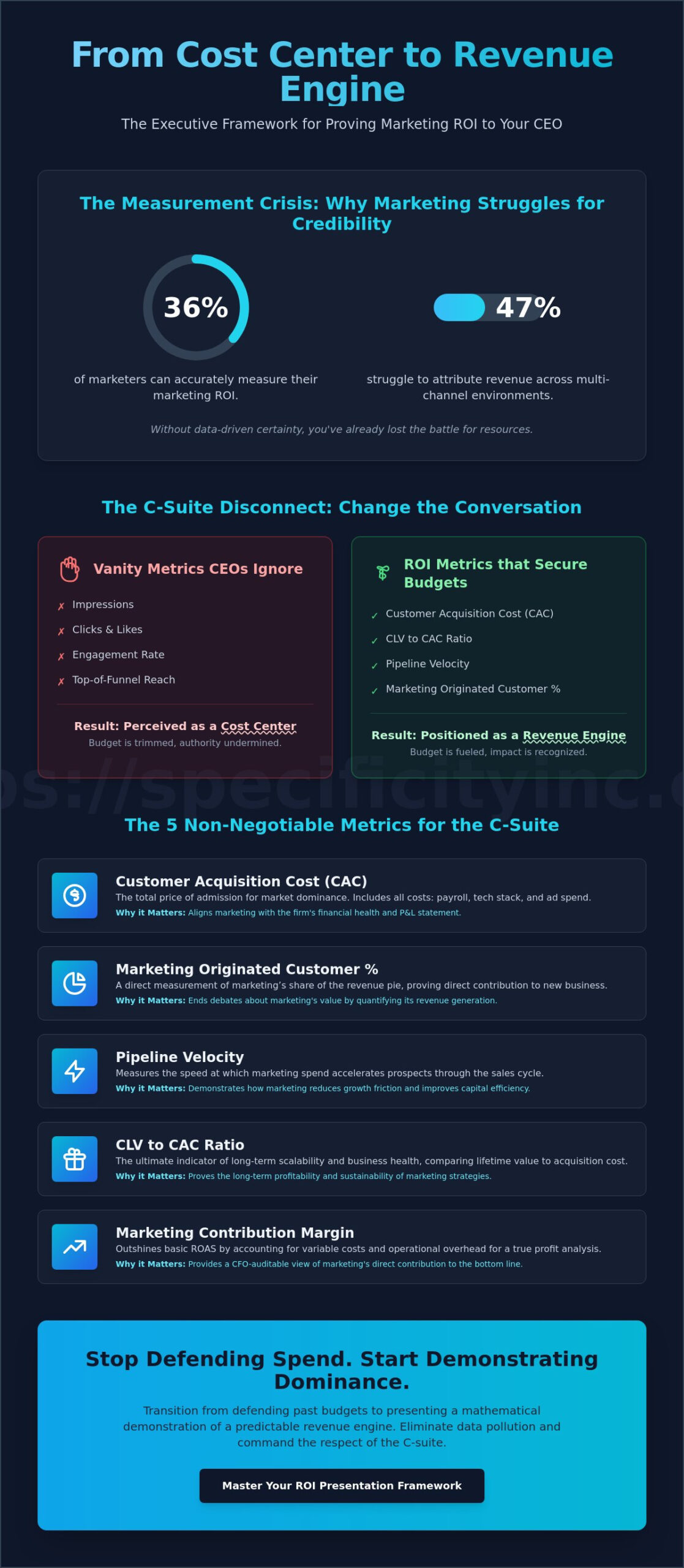
Only 36% of marketers can accurately measure their marketing ROI, and 47% struggle to attribute revenue across complex, multi-channel environments. If you walk into board meetings armed with impressions and engagement rates, you’ve already lost the battle for resources. You need to master how to prove marketing roi to my ceo by speaking the language of the C-suite: predictable revenue and growth efficiency. The era of creative guesswork is dead, replaced by a mandate for exactness and data-driven certainty.
It’s frustrating when your strategic impact is obscured by vanity data that leadership ignores or by the noise of the 2026 privacy landscape. We recognize that managing 20 different state privacy laws and universal opt-out mandates makes attribution feel like a moving target. This article provides the executive framework you need to command respect and secure your budget allocation. You’ll learn to eliminate data pollution, leverage human-verified intent data, and transform tactical metrics into a mathematical demonstration of strategic dominance.
Key Takeaways
- Stop treating marketing as a cost center. Learn why vanity metrics are liabilities that undermine your authority during high-stakes board meetings.
- Identify the five non-negotiable metrics, such as Customer Acquisition Cost, that translate tactical activity into the language of growth capital.
- Protect your budget by eliminating data pollution. Use human-verified traffic to ensure your performance data reflects real revenue potential.
- Follow a battle-tested presentation framework to learn how to prove marketing roi to my ceo and secure increased budget allocations.
- Discover how to transition from defending past spend to presenting a mathematical demonstration of a predictable revenue engine.
Stop Defending Spend: Why Your CEO Ignores Vanity Metrics
The CEO views every dollar through the lens of capital allocation. If you present impressions, you aren’t talking about capital; you’re talking about noise. Clicks, likes, and reach are liabilities in a board meeting because they consume budget without providing a direct correlation to equity value. This is the Vanity Metric Trap. It creates a systemic disconnect where leadership views marketing as a cost center to be trimmed rather than a revenue engine to be fueled. To change the conversation, you must master Return on Marketing Investment (ROMI) as a core financial discipline.
Traditional, broad-stroke industry tactics fail executive scrutiny because they prioritize activity over outcomes. When you focus on how to prove marketing roi to my ceo, you must stop defending past spend and start demonstrating a predictable growth model. Mid-market companies are often advised to allocate approximately 16% of their total revenue to marketing to achieve strong efficiency, according to 2025 data from Keen. However, that allocation only remains secure when the data is exact. CEOs ignore “noisy” data because it lacks the technical accuracy required for high-stakes decision-making.
The Fatal Flaw of Top-of-Funnel Obsession
High volume masks low intent. An obsession with top-of-funnel reach often results in “garbage” traffic that creates a significant drag on sales team efficiency. When marketing delivers thousands of low-quality leads, the sales department spends valuable hours chasing dead ends, which increases operational waste. The Intent Gap is the mathematical distance between a passive content consumer and a high-value prospect ready to convert. Closing this gap requires moving away from programmatic “black boxes” and toward human-verified precision that ensures every dollar targets a legitimate buyer.
EBITDA and the Marketing Connection
Marketing efficiency directly impacts company valuation. Your CEO cares about the P&L statement, not your social media engagement rate. When you translate “Cost Per Lead” into “Customer Acquisition Cost” (CAC), you align your department with the financial health of the firm. High marketing efficiency improves EBITDA margins, making the company more attractive to investors and stakeholders. To prove marketing roi to my ceo, you must demonstrate how your strategies reduce the friction of growth. Every metric you present should serve as evidence that marketing is a primary driver of the company’s bottom-line performance. If you are looking to refine your digital strategy to better reflect these values, you can visit Exclusive Business Marketing for expert guidance on performance-driven marketing.
The 5 Non-Negotiable ROI Metrics for the C-Suite
The C-suite demands financial rigor. If your reporting lacks the technical depth to survive a CFO audit, your budget will always be the first item on the chopping block. Only 36% of marketers state they can accurately measure their marketing ROI according to 2026 data. This lack of precision is why CEOs remain skeptical of marketing budgets. To master how to prove marketing roi to my ceo, you must move beyond superficial reporting and adopt these five high-stakes metrics that prioritize making marketing more accountable to the bottom line.
- Customer Acquisition Cost (CAC): The total price of admission for market dominance.
- Marketing Originated Customer Percentage: A direct measurement of marketing’s share of the revenue pie.
- Pipeline Velocity: The speed at which marketing spend accelerates the sales cycle.
- CLV to CAC Ratio: The ultimate indicator of long-term scalability and business health.
- Marketing Contribution Margin: A metric that outshines basic ROAS by accounting for variable costs and operational overhead.
Calculating CAC with Precision
Vague CAC calculations are a liability. To present a defensible number, you must include all costs: payroll, tech stack, and ad spend. Differentiating between blended CAC and channel-specific CAC allows you to identify which high-intent channels are driving efficient growth and which are merely burning capital. For a deeper dive into these calculations, consult our Digital Advertising ROI: The Definitive Guide to Strategic Dominance. Precision here is the difference between a cost center and a strategic partner.
Pipeline Velocity: The CEO’s Secret Weapon
Speed is a competitive advantage. Pipeline Velocity measures how fast prospects move through your funnel using the formula: (Number of Leads x Deal Value x Win Rate) / Length of Sales Cycle. High-intent targeting reduces the denominator by cutting the time required to close a deal. For example, search engine marketing (sem) fuels velocity by capturing users at the exact moment of decision. This metric proves that marketing isn’t just generating leads; it’s accelerating the entire business. If your current attribution model fails to account for high-intent CTV and programmatic touchpoints, you are likely underreporting your team’s impact. Strategic growth requires a partner who understands the nuances of intent data targeting to maintain this momentum.
Eliminating Data Pollution: The Human-Verified Traffic Mandate
Data pollution is the silent killer of marketing credibility. If your reporting includes bot traffic or unverified clicks, your ROI is a fiction that your CEO will eventually dismantle. To master how to prove marketing roi to my ceo, you must first secure the integrity of your data stream. Traditional programmatic display has become a black box where efficiency is sacrificed for volume, leading to metrics that look impressive on a dashboard but fail to manifest as revenue on the balance sheet. You can’t build a defensible growth strategy on a foundation of polluted data.
Executive leadership demands a strategic approach to quantify the impact of every marketing dollar. This requires a pivot from broad-stroke industry tactics to human-verified precision. When you present data that has been scrubbed of bot interference, you signal to the C-suite that you prioritize exactness over vanity. This level of technical accuracy is the only way to transform marketing from a speculative expense into a predictable revenue engine. Intent-based audience data removes the guesswork, allowing you to project ROI with a degree of certainty that commands professional respect.
The High Cost of Bot Waste
In 2026, data pollution is a significant financial and legal risk. With new privacy mandates active in states like Indiana and Oregon, data collected without explicit, verifiable consent is a liability. Bot-driven “ghost” leads skew conversion metrics and frustrate sales teams who waste time chasing non-existent prospects. This operational friction erodes the trust between departments. Achieving exactness in audience targeting isn’t just about performance; it’s about protecting the firm’s capital from fraudulent actors. By eliminating bot waste, you ensure that every lead presented to the CEO represents a legitimate opportunity for expansion.
Validating the Buyer Journey
Proving the value of multi-channel campaigns requires a sophisticated attribution model that accounts for every high-stakes touchpoint. You must demonstrate the influence of connected tv advertising and its “Halo Effect” on search engine performance. Programmatic display and CTV often generate the high-intent demand that eventually converts through other channels. Human verification is the only methodology that ensures these touchpoints are authentic. When you validate the buyer journey with clean data, you provide the CEO with a clear, mathematical narrative of how marketing spend accelerates the sales cycle. This transparency is the antidote to the noise and waste of the broader market.
The ROI Presentation Framework: A Step-by-Step Execution Plan
Execution is the final barrier to budget security. Even the most sophisticated data will fail if it’s presented without a structured, high-stakes narrative. To master how to prove marketing roi to my ceo, you must move away from tactical reporting and adopt a framework that mirrors executive financial planning. Your objective is to present a mathematical demonstration of a predictable revenue engine. Follow this five-step sequence to command the room and secure the commitment for your next phase of expansion.
- Step 1: Anchor to the Primary Objective. Start by stating the CEO’s top-line goal, such as 20% revenue growth. Do not lead with marketing metrics; lead with the business outcome.
- Step 2: Present the ‘Delta’. Clearly isolate the difference between the company’s current state and the growth specifically driven by marketing initiatives. This demonstrates your department’s unique contribution to the firm’s equity.
- Step 3: Deploy the Efficiency Ratio. Show how intent-driven data is lowering Customer Acquisition Cost (CAC) over time. Efficiency is the metric that builds long-term confidence in your strategy.
- Step 4: The ‘Future State’ Projection. CEOs care about scalability. Present a data-backed forecast of what happens to the revenue engine if the budget is doubled.
- Step 5: The Call to Action. End by requesting a specific commitment for the next phase of strategic dominance. Never leave a board meeting without a clear decision on resource allocation.
Visualizing the Revenue Funnel
Static funnels are obsolete. High-performing firms now visualize growth through “revenue loops” that account for the ongoing influence of multi-channel touchpoints. Use multi-channel maps to demonstrate how social media advertising feeds high-intent demand into the sales pipeline. These visualizations should prioritize clarity over complexity, showing exactly where a prospect enters the ecosystem and how they are nurtured toward a conversion. Heatmaps and attribution paths provide the visual evidence that your strategy is a cohesive system rather than a series of disconnected tactics.
Addressing the #1 Objection: ‘It’s Too Expensive’
Cost is a relative concept. When a CEO says marketing is too expensive, they are actually saying they don’t see the connection to market share. Reframe this objection by comparing the cost of strategic expansion against the much higher cost of inaction. If you stop investing, your competitors will capture the high-intent audience you’ve ignored. Purchasing cheap, unverified traffic is the most expensive mistake a firm can make because it subsidizes operational waste while poisoning your sales pipeline. To truly understand how to prove marketing roi to my ceo, you must defend the value of precision over the illusion of low-cost volume. Secure your strategic dominance by implementing intent data targeting to ensure every dollar is an investment in legitimate growth.
Strategic Dominance: Partnering for Predictable Revenue
Internal teams often possess the tactical drive but eventually hit a structural data ceiling. They rely on broad-stroke tools that aggregate noise instead of isolating high-value intent. To truly master how to prove marketing roi to my ceo, you must transcend standard internal capabilities and leverage specialist intervention. Specificity Inc. provides this breakthrough by deploying human-verified traffic and intent-based precision. This methodology shifts the paradigm from speculative spending to a mathematical certainty of outcomes. You don’t have to wait for the end of a quarter to see results; you know the ROI potential before the campaign even launches.
In the high-stakes environment of b2b marketing, your strategy must function as the ultimate competitive advantage. It’s not enough to participate in the market. You must dominate it by capturing demand that competitors don’t even see. This level of strategic dominance requires a refusal to accept the black box of traditional programmatic efficiency. It demands a partnership rooted in logic, evidence, and hard numbers. By cutting through complexity with data-driven certainty, you position marketing as the primary driver of company valuation.
The Power of High-Intent Targeting
Programmatic display and CTV are no longer silos; they are a unified engine for capturing high-intent audiences. When these channels work in tandem, they create a surround-sound effect that validates your brand at every critical decision point. Our creative services team ensures that this technical precision is matched by high-performance messaging that drives engagement. Demand generation has evolved into the new standard for B2B and B2C success. It’s about building long-term demand by targeting the 58% of the budget that enterprise brands are now allocating to top-of-funnel activities to ensure future revenue stability. High-intent targeting ensures that this spend isn’t just reach; it’s an investment in qualified pipeline.
Take Command of Your Marketing ROI
Executive accountability is the final word in professional services. If you can’t defend your data, you can’t defend your budget. The regulatory shift in 2026, including the Delete Act and expanded definitions of sensitive data, means that unverified data is now a legal and financial liability. You must initiate a performance audit of your current channels to identify where bot pollution is draining your capital. This isn’t just a tactical adjustment; it’s a strategic imperative. Take command of your narrative by presenting a defensible, revenue-backed framework that leaves no room for CEO skepticism. Execute your strategy with Specificity Inc. and transform your marketing department into a powerhouse of predictable growth.
Secure Your Strategic Dominance
The gap between marketing activity and executive approval is bridged by exactness. You’ve learned that vanity metrics are liabilities and that true authority stems from mastering financial rigor through metrics like Customer Acquisition Cost and Pipeline Velocity. By eliminating data pollution and anchoring every campaign to the CEO’s primary business objectives, you transform your department into a predictable growth engine. Mastering how to prove marketing roi to my ceo is no longer a defensive maneuver; it’s a demonstration of your command over the market.
Strategic growth requires an elite partner who values logic and evidence over creative guesswork. We are specialists in high-intent audience targeting and human-verified traffic solutions. Our unapologetically results-oriented methodology ensures your data is scrubbed of waste and prepared for high-stakes scrutiny. It’s time to stop defending past spend and start leading the charge for expansion.
Stop Guessing and Start Dominating: Consult with Specificity Inc. Today
You now possess the framework to command the board room. Take the lead today and secure the budget your performance deserves.
Frequently Asked Questions
How do I explain the long-term ROI of brand awareness to a CEO?
You must reframe brand awareness as future demand generation that directly lowers future Customer Acquisition Costs (CAC). CEOs ignore vanity reach, but they value a strategic moat that makes future sales cycles faster and more efficient. Show how increased brand equity correlates with a rise in branded search volume and a decrease in the cost per lead over time. This approach transforms awareness from a vague creative concept into a measurable financial asset.
What is the best way to handle a ‘failed’ campaign when presenting to the board?
You handle a failed campaign by framing it as a high-stakes data acquisition phase that identified a specific market inefficiency. Present the exact technical reason the campaign underperformed and immediately provide the data-backed pivot you’ve already implemented. Executive leadership respects the ability to identify waste and reallocate capital based on hard evidence. Never hide the numbers; use them to demonstrate your commitment to exactness and continuous optimization.
How much of our revenue should be marketing-sourced?
The specific percentage varies by industry, but mid-market companies often target a model where marketing spend accounts for 16% of total revenue to maintain strong growth. When learning how to prove marketing roi to my ceo, you should demonstrate that marketing-originated customers represent a growing share of the total revenue pie. This proves that your department is a primary engine of expansion rather than a support function for the sales team.
Is multi-touch attribution actually accurate in 2026?
Multi-touch attribution is only accurate when it’s built on a foundation of human-verified traffic and clean data. With 20 states now enforcing comprehensive privacy laws, traditional tracking methods have failed. You must rely on first-party intent data and deterministic modeling to map the buyer journey across channels like CTV and social media. Accuracy in 2026 requires a refusal to accept the “black box” metrics provided by broad-stroke ad platforms.
How do I calculate ROI for Connected TV (CTV) advertising?
You calculate CTV ROI by measuring its “Halo Effect” on high-intent search performance and direct website traffic. Use IP-matching and household-level attribution to link CTV impressions to specific conversion events in your sales funnel. This methodology proves that programmatic video is a precision engine for demand generation. It moves the conversation away from “views” and toward the mathematical demonstration of how video accelerates the sales cycle.
What is a ‘good’ CLV to CAC ratio for a high-growth company?
A ratio of 3:1 is the standard benchmark for sustainability, but strategic dominance requires a ratio of 5:1 or higher. This level of efficiency proves that your marketing model is highly scalable and that each customer delivers value that far exceeds the cost of acquisition. If your ratio is below 3:1, you must audit your audience targeting to eliminate data pollution and focus on high-intent prospects who offer higher lifetime value.
Can I prove ROI without a full-scale CRM integration?
You can prove ROI by using match-back analysis and lead-to-close mathematical modeling even without a deep CRM integration. By manually comparing your marketing lead data against sales records, you can demonstrate a clear correlation between spend and revenue. This process is more labor-intensive but remains defensible if your lead data is human-verified. It allows you to provide a strategic approach to quantify the impact while you scale your technical infrastructure.
How does human-verified traffic impact my bottom-line ROI?
Human-verified traffic protects your bottom line by eliminating the capital waste associated with bot fraud and data pollution. When you remove fraudulent clicks and “ghost” leads, your sales team spends their time only on legitimate prospects, which significantly increases conversion rates. This level of precision is essential when learning how to prove marketing roi to my ceo with data that can survive an executive audit. It ensures that every dollar spent is an investment in real human intent.