Homeowner Targeting Strategies: Dominating the Market with Consumer Intent Data in 2026
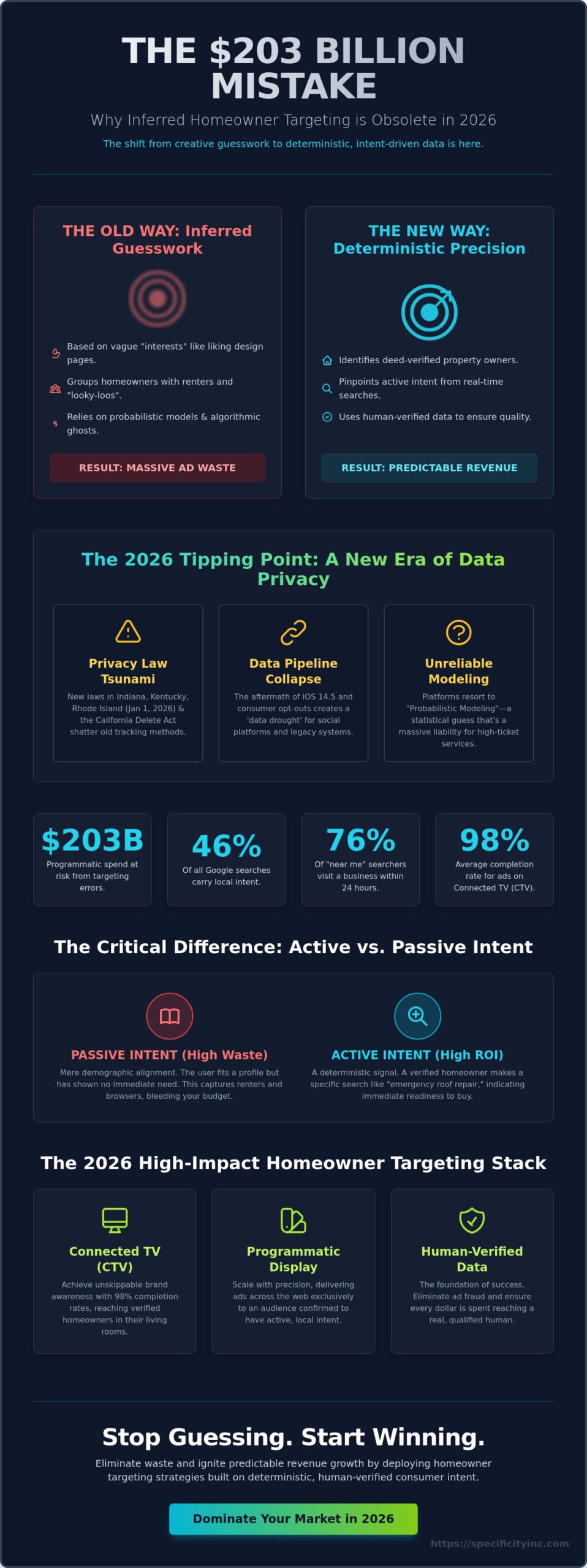
In 2026, targeting “homeowners” based on their interest in interior design pages is a $203 billion mistake. With programmatic spending surging and 46% of Google searches carrying local intent, the margin for error has vanished into the noise of fragmented data. You’ve likely felt the sting of high ad waste as your budget bleeds out on renters or non-qualified leads. New privacy laws in Indiana, Kentucky, and Rhode Island, effective January 1, 2026, have shattered traditional tracking models. You need homeowner targeting strategies that scale local intent marketing to a national level using human-verified consumer intent data without losing granularity.
We’re ending the era of creative guesswork and inferred interests. This article proves how to pinpoint ready-to-act homeowners with surgical precision. Stop settling for vanity metrics and start building a funnel that ignites predictable revenue. We will show you how to dominate high-impact channels like CTV, where completion rates hit 98%, to create a cross-channel presence that converts intent into market dominance. It’s time to stop guessing and start winning with deterministic data.
Key Takeaways
- Eliminate the waste of interest-based targeting by shifting to deterministic signals that identify property owners based on real-time actions.
- Deploy advanced homeowner targeting strategies that combine local intent marketing with consumer intent data to pinpoint high-value leads at a national scale.
- Differentiate between passive demographic alignment and active intent to ensure your ad spend only reaches prospects who are ready to act.
- Build a high-impact 2026 media stack using Connected TV and programmatic display to achieve unskippable awareness and predictable revenue growth.
- Secure your ROI with human-verified traffic solutions that cut through the noise of ad fraud and creative guesswork.
The Death of Inferred Homeowner Targeting: Why Your Current Strategy is Bleeding ROI
Most marketing budgets are currently funding a high-stakes guessing game. Legacy homeowner targeting strategies rely on “inferred interests,” which is a polite way of saying the algorithm is making an educated guess based on who likes a “Modern Farmhouse” post or follows a renovation influencer. This approach is dead. Real homeowner targeting requires deterministic data, identifying property owners based on real-time, human-verified actions rather than passive interests. If your strategy doesn’t start with a hard signal of ownership, you’re not marketing; you’re gambling.
Strategic dominance in 2026 requires a rejection of broad-stroke guesswork. As programmatic display spending exceeds $203 billion this year, the cost of an “interest-based” mistake has never been higher. Identifying a prospect as a “Home Improvement Enthusiast” is a budget-killing fallacy. It groups the high-net-worth homeowner ready for a $100,000 kitchen remodel with the apartment dweller pinning DIY decor tips. To ignite true growth, you must pinpoint the individual behind the screen using consumer intent data that bridges the gap between digital behavior and physical property records.
The evolution of Targeted advertising has moved past the era of simple demographics. We’ve entered a phase where precision is the only defense against rising CPMs and dwindling attention spans. You don’t need more impressions. You need the right impressions delivered to a verified audience with the financial capacity to convert.
The iOS 14.5 Aftermath: Why Social Platforms are Guessing
Social platforms are blind. Since the iOS 14.5 update and the subsequent rollout of state privacy laws on January 1, 2026, in Indiana, Kentucky, and Rhode Island, the traditional data pipeline has collapsed. Platforms now rely on “Probabilistic Modeling,” a method that uses statistical patterns to fill in the gaps left by consumers who opt out of tracking. For high-ticket services, a statistical guess is a liability. The California Delete Act, which took full effect on August 1, 2026, further accelerates this data drought. We replace these noisy signals with surgical precision, ensuring your local intent marketing reaches actual humans, not algorithmic ghosts.
The Hidden Cost of ‘Looky-Loos’ and Renters
Broad targeting captures “Looky-Loos” and renters who browse HGTV content but lack the equity to pull the trigger. This lack of granularity leads to massive ROI bleed. When your campaigns lack the ability to filter for deed-verified homeownership, you’re subsidizing clicks from non-qualified leads. Adopting the principles of B2B marketing in 2026 provides the blueprint for high-intent precision. By focusing on homeowner targeting strategies that prioritize deterministic ownership data, you eliminate the waste and focus your spend on the 46% of searches that carry local intent and the 76% of “near-me” searchers who visit a business within 24 hours.
Weaponising Consumer Intent Data: Moving Beyond Probabilistic Guesswork
Consumer intent data is the collection of deterministic signals, such as specific searches, clicks, and physical visits, that indicate a homeowner’s immediate readiness to buy. In the high-stakes environment of 2026, this data is the intellectual powerhouse of every successful campaign. We don’t rely on demographic mirages. Instead, we pinpoint homeowners by analyzing the digital breadcrumbs they leave before they even enter a traditional sales funnel. This methodology allows you to identify “In-Market” prospects with a level of granularity that legacy platforms simply cannot match.
The distinction between active and passive intent determines whether your budget ignites growth or evaporates. Passive intent is mere demographic alignment; it’s a person who fits the profile of a homeowner but hasn’t signaled a need. Active intent is a homeowner searching for “emergency roof repair” or “best kitchen remodelers near me.” While 46% of Google searches have local intent, only deterministic signals tell you which of those searchers own the deed to their property. By focusing on active signals, you execute local intent marketing that converts at a significantly higher rate than broad-stroke awareness campaigns.
Human verification is the final safeguard against the noise of the digital landscape. With programmatic display spending expected to exceed $203 billion in 2026, ad fraud and bot-driven “intent” are rampant. We use human-verified data to ensure your homeowner targeting strategies are based on real people making real decisions. This level of certainty is essential for maintaining compliance with FTC guidelines on online advertising, ensuring your data practices are as ethical as they are effective.
Deterministic vs. Probabilistic Data: The ROI Difference
Deterministic data consists of verified facts, such as tax records matched with recent high-intent search behavior. In contrast, probabilistic data relies on statistical “maybes” that frequently lead to 40% or more in ad waste. When you use consumer intent data that is deterministic, you eliminate the guesswork that plagues traditional agencies. You’re no longer hoping a lead is a homeowner; you’re operating with the certainty of property deed verification and real-time behavioral triggers.
Identifying the ‘Pre-Listing’ and ‘High-Value’ Signals
The most lucrative homeowner targeting strategies identify prospects before the “For Sale” sign hits the lawn. By tracking life-event data like marriages, inheritances, or professional relocations, you can predict a major renovation or a home listing weeks before your competitors. Leveraging established digital advertising ROI frameworks allows you to measure the impact of these high-intent segments with surgical precision. If you’re ready to stop wasting budget on non-qualified leads, it’s time to partner with an elite specialist that prioritizes data-driven certainty over creative guesswork.
Local Intent Marketing at National Scale: Precision Without Geofencing Limitations
Radius targeting is a strategic relic. In 2026, the geographic “fence” has been replaced by the psychological “trigger.” True local intent marketing is not defined by a broad zip code or a five-mile radius around a storefront. It is defined by reaching a specific person in a specific mindset, regardless of their broad geography. We reject the limitation of physical boundaries in favor of mindset targeting. We use consumer intent data to identify homeowners based on their immediate needs rather than their proximity to a cell tower.
Executing national campaigns that feel local requires dynamic creative fueled by intent-based triggers. When a homeowner in Seattle searches for sustainable home tech and another in Miami looks for indoor-outdoor living solutions, they shouldn’t see the same ad. Programmatic display, which accounts for 90% of global display ad spending in 2026, allows us to deliver hyper-local precision at a national volume. By understanding the role of real-time consumer intent data, we pinpoint the exact moment a prospect transitions from passive browsing to active buying. This ensures your message hits when the intent is highest.
The Fallacy of Simple Geofencing
Targeting a wealthy zip code is no longer enough to win market share. This broad-stroke approach captures everyone in the neighborhood, including the renters or the homeowners who just finished a renovation. You need to layer intent data over geographic filters to find the one house on the block that actually needs your service. Our homeowner targeting strategies ignore the noise of the “average” neighbor. We focus exclusively on the individual whose recent behavior signals a high-value opportunity. With actions on Google Business Profile listings increasing by 41% year-over-year, the data exists to find these ready-to-act leads if you have the tools to extract it.
Mindset Over Map: Scaling High-Intent Campaigns
Scaling requires moving beyond the map. We use search engine marketing (sem) to capture the “now” moment at a national scale. By integrating local signals into national CTV and social media ads, we make large-scale campaigns feel intimately relevant. This strategic shift ensures that your brand isn’t just present; it’s dominant. We use creative services to adapt messaging in real-time. This ensures that a national brand speaks with a local voice to every verified homeowner in the funnel. Since 87% of consumers read online reviews for local businesses in 2026, your national strategy must leverage these local trust signals to convert effectively.
The 2026 Homeowner Targeting Stack: CTV, Programmatic, and Social Media
Execution is the difference between a strategy and a hallucination. In 2026, the homeowner targeting stack requires a five-step integration process that prioritizes deterministic data over algorithmic guesswork. First, ingest your consumer intent data to build a foundation of verified property owners. Second, deploy Connected TV (CTV) to secure unskippable awareness. Third, layer programmatic display and social media advertising to maintain the frequency required for high-ticket conversions. Fourth, apply human-verified traffic filters to eliminate the bot noise that inflates costs. Finally, optimize based on conversion data. Stop chasing clicks; start chasing revenue.
This multi-channel approach ensures your local intent marketing isn’t just a series of isolated ads. It’s a dominant ecosystem. With programmatic display accounting for 90% of global display spending in 2026, your homeowner targeting strategies must be executed with surgical precision across every screen the prospect touches. We reject the “spray and pray” methodology of traditional agencies in favor of a data-driven certainty that converts.
Connected TV (CTV): The New Living Room Dominance
Connected TV (CTV) is the new anchor of the modern living room. In 2026, CTV ad spending is projected to reach $38 billion, a 14% increase from the previous year. This isn’t just about reach; it’s about verified household targeting. CTV ads achieve staggering completion rates of 90-98%, making it the ultimate high-impact channel for reaching homeowners. By integrating connected tv advertising into your mix, you bypass the fragmentation of traditional cable and pinpoint specific households based on deterministic data. You aren’t buying a network; you’re buying a verified prospect’s attention.
Programmatic Display and Retargeting: Closing the Loop
Programmatic display and retargeting close the loop. High-ticket homeowner decisions, like roof replacements or solar installations, rarely happen on the first touch. Frequency is vital. We use programmatic display to follow the intent-verified user across the web, maintaining a dominant presence without inducing ad fatigue. Dynamic creative rotation ensures that your message stays fresh while the intent remains hot. If your current agency still relies on basic retargeting without human-verified filters, you’re paying for bot traffic. Dominating your market requires an elite partner that values logic and hard numbers over creative guesswork.
Specificity: The Antidote to Broad-Stroke Marketing Chaos
Broad-stroke marketing is a relic of a less competitive era. Specificity Inc. functions as the intellectual powerhouse that rejects creative guesswork in favor of data-driven certainty. In 2026, where programmatic display accounts for 90% of global spending, the risk of fraud is at an all-time high. We implement homeowner targeting strategies that prioritize deterministic consumer intent data, ensuring every dollar spent targets a verified property owner. This isn’t just marketing; it’s a strategic operation designed for total market dominance. We replace the “hope and pray” model with a narrative of constant action and forward momentum.
Logic wins in the B2B space. When you stop chasing vanity metrics and start focusing on conversion optimization, your revenue becomes predictable. Our methodology cuts through the noise of the general advertising industry by delivering the “what” with a hammer blow and the “how” with surgical precision. We don’t just participate in the market; we ignite it by leveraging local intent marketing to find the homeowners who are ready to act right now.
Human-Verified Traffic: The Final Frontier of ROI
The “Specificity” difference is rooted in verification. Most agencies buy traffic and hope for the best; we verify the human behind the click. Ad fraud is an epidemic in 2026, but our unique solution filters out the bots before they can bleed your budget. This level of granularity transforms your lead quality. When your sales team only handles human-verified leads with active intent, their closing efficiency improves by measurable margins. This is the only logical choice for businesses seeking scalability without the waste associated with traditional, broad-stroke tactics.
Ignite Your Growth with Data-Driven Certainty
Stop spending and start investing. In 2026, the margin for error has vanished. You need a partner that understands the nuances of the digital landscape better than your competitors. We move past the surface-level data that fails high-ticket home services. We focus on the hard numbers that drive predictable revenue. This transition from creative guesswork to intent-based precision is the hallmark of a serious partner. It’s time to cut through the chaos with data-backed certainty and secure your position as a dominant force in your industry. Dominate your market with Specificity Inc.
Secure Strategic Dominance in the 2026 Homeowner Market
The era of guessing is over. With US programmatic spending exceeding $203 billion in 2026, every misallocated dollar is a gift to your competitors. Strategic dominance requires a shift to deterministic signals that identify property owners with surgical precision. By integrating Connected TV with high-intent programmatic display, you secure the 98% completion rates necessary to move high-ticket leads through a fragmented media landscape.
Your future growth depends on homeowner targeting strategies that prioritize local intent marketing and human-verified consumer intent data. We are the elite specialists who reject creative guesswork in favor of logic and hard numbers. Our human-verified traffic solutions eliminate the bot waste that currently compromises global display spending. Stop subsidizing non-qualified leads and start investing in data-driven certainty.
Ignite Your Sales Funnel with Intent-Based Precision. Build the predictable revenue stream your business demands today.
Frequently Asked Questions
What are the most effective homeowner targeting strategies in 2026?
The most effective homeowner targeting strategies prioritize deterministic data over inferred interests. In a market where programmatic display accounts for 90% of global spending, you must use data that identifies owners by deed records rather than “home decor” likes. Integrating these verified audiences across Connected TV and high-intent programmatic display ensures your message reaches actual property owners with the financial capacity to convert.
How does consumer intent data differ from traditional demographic targeting?
Traditional targeting guesses based on who a person is, while consumer intent data identifies what they’re doing right now. Demographics rely on static traits like age or income, which often lead to 40% ad waste on non-qualified leads. Intent data tracks real-time digital actions, such as low-funnel searches or competitor site visits, providing a surgical look at a prospect’s immediate needs.
Can I still target homeowners on Facebook after the privacy updates?
You can still reach homeowners, but native interest clusters are now a liability. Since the January 1, 2026, privacy law rollouts in states like Indiana and Kentucky, social algorithms have lost significant tracking visibility. To win, you must ingest human-verified intent data directly into the platform. This bypasses the platform’s probabilistic guessing and ensures your ads only appear to verified property owners.
What is local intent marketing and how does it scale nationally?
Local intent marketing targets the specific mindset of a user rather than their broad geography. While 46% of Google searches carry local intent, scaling nationally requires using behavioral triggers that signal a need for services regardless of the user’s city. By deploying these triggers across a national programmatic stack, you maintain the intimacy of a local ad with the volume of a country-wide campaign.
Why is Connected TV (CTV) considered a high-intent channel for homeowners?
CTV is a high-intent channel because it offers household-level granularity with unskippable 90-98% completion rates. Unlike traditional broadcast, CTV allows you to target the specific living room of a verified deed-holder. This precision ensures your high-impact video assets are only seen by homeowners, making it a critical component for any brand seeking strategic dominance in the home services sector.
How do I ensure my digital ad traffic is human-verified and not bot-driven?
You must implement deterministic filtering that rejects non-human signatures at the point of entry. With programmatic spending surging, ad fraud is rampant. Using a partner that provides human-verified traffic solutions ensures your budget isn’t evaporated by bots. This verification process is the only logical way to protect your ROI and ensure your leads are actual prospects ready to buy.
What signals indicate a homeowner is in ‘active intent’ mode?
Active intent is signaled by specific, low-funnel search queries and visits to high-relevance service pages. For example, a user searching for “emergency roof repair” or visiting a “kitchen remodel cost calculator” is in active mode. This contrasts with passive intent, where a person might fit a homeowner profile but hasn’t demonstrated an immediate problem that requires your specific solution.
How do I calculate the ROI of an intent-based marketing campaign?
Calculate ROI by measuring the lift in high-intent lead volume and bottom-line revenue rather than vanity metrics. While actions on Google Business Profiles increased 41% year-over-year by 2026, these numbers only matter if they convert. Focus on the cost per verified acquisition. Intent-based campaigns should show a significant reduction in ad waste by eliminating non-homeowners from your funnel entirely.