
The Consequences of Click Fraud on Analytics: Beyond the Wasted Ad Spend
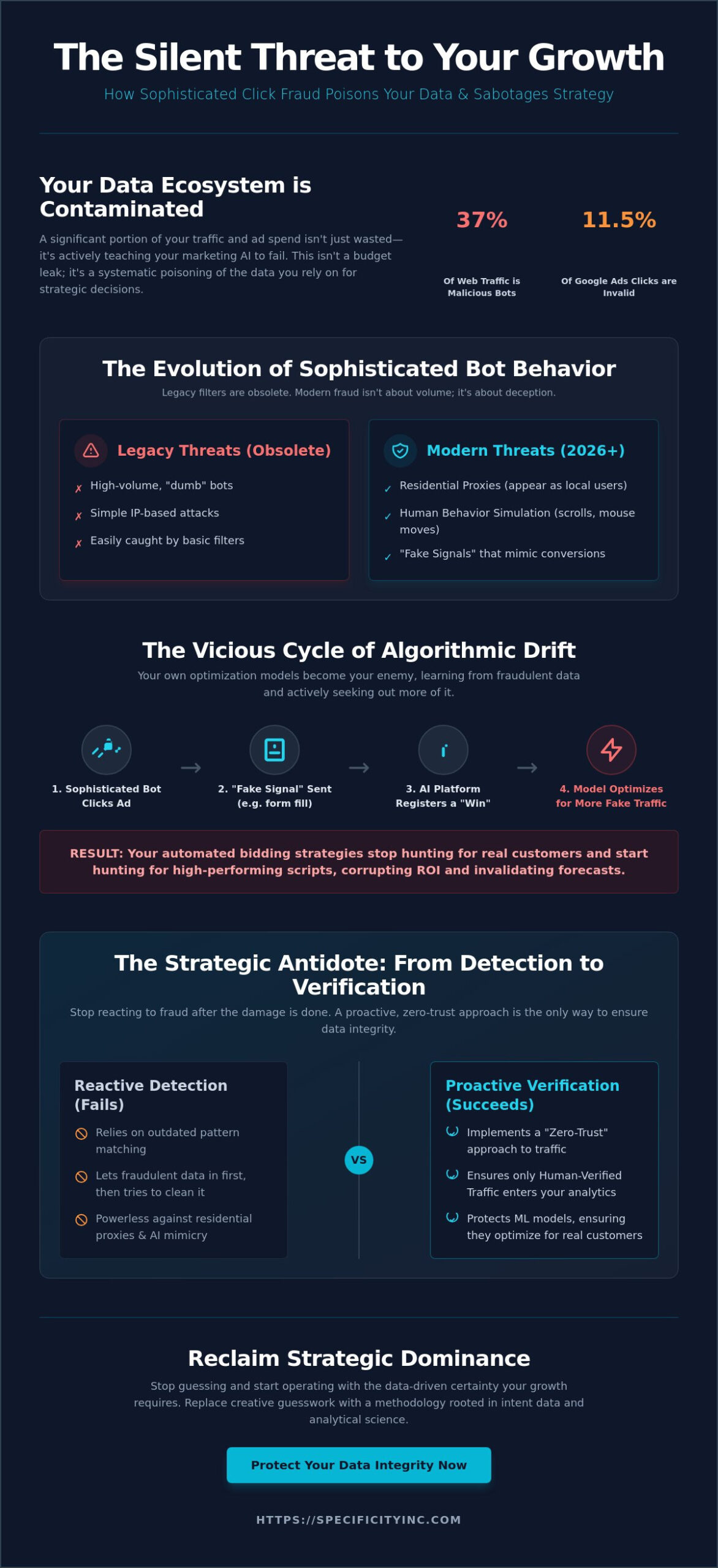
37% of your web traffic is currently generated by malicious bots, yet most executive leadership teams still treat click fraud as a minor budget leak. This is a strategic failure. The true consequences of click fraud on analytics extend far beyond wasted capital; they represent a systematic poisoning of your entire data ecosystem. When 11.5% of your Google Ads clicks are invalid, your ROI reporting becomes a work of fiction. You aren’t just losing money. You’re losing the intelligence required to scale.
You’ve likely struggled to justify budgets when your performance metrics don’t translate into predictable revenue. It’s the result of algorithmic drift where machine learning models optimize for non-human signals. This article demonstrates how to eliminate data noise and protect your optimization models from contamination. We’ll outline the transition to human verified traffic and intent data targeting to reclaim strategic dominance. It’s time to stop guessing and start operating with data-driven certainty. We’re moving past traditional, broad-stroke tactics to focus on the exactness your growth requires.
Key Takeaways
- Identify why legacy filters fail against residential proxy networks and the shift from simple fake clicks to deceptive behavior simulation.
- Understand the mechanics of algorithmic drift and why your AI models may be inadvertently prioritizing fraudulent audiences over high-value leads.
- Analyze the consequences of click fraud on analytics to reveal how “phantom conversions” disrupt multi-touch attribution and compromise ROI reporting.
- Implement a “Zero-Trust” approach to demand generation by transitioning from reactive detection to proactive human-verified traffic.
- Reclaim strategic dominance by replacing creative guesswork with a methodology rooted in intent data targeting and analytical science.
Defining the Poison: How Click Fraud Infiltrates Modern Analytics
Click fraud in 2026 isn’t a blunt instrument; it’s a precision strike against your marketing intelligence. Legacy filters designed for high-volume bot traffic are obsolete. Modern attackers utilize residential proxy networks to mask their origin, making every fraudulent session appear as a legitimate local user. This isn’t just about losing dollars to invalid traffic. It’s about the infiltration of your data ecosystem. To understand the foundational problem, one must look at What is Click Fraud? in the context of modern adversarial AI. The primary threat has shifted from the “fake click” to the “fake signal” sent directly into your CRM and analytics dashboard. Broad-stroke industry tactics fail because they ignore the nuance of sophisticated malicious operations that mimic the customer journey with surgical precision.
Distinguishing between basic Invalid Traffic (IVT) and sophisticated malicious click operations is critical for executive leadership. IVT often includes accidental clicks or standard search engine crawlers that most platforms catch. Malicious operations are different. They are intentional, targeted, and designed to deceive. When these operations go unnoticed, they don’t just drain your budget; they corrupt the baseline data you use to calculate growth efficiency and audience behavior. You’re left making high-stakes decisions based on a distorted reality.
The Evolution of Sophisticated Bot Behavior in 2026
Bots now simulate human cursor movements, dwell times, and scroll depths with alarming accuracy. They don’t just click an ad; they engage with the landing page to bypass engagement-based filters. We’re seeing the rise of “single-click” strategic fraud. Instead of a flood of traffic that triggers red flags, attackers deploy isolated, high-intent signals that evade volume-based detection systems. These bots are programmed to follow specific conversion paths, making them indistinguishable from your most valuable prospects. In 2026, click fraud is a high-stakes data contamination event rather than a mere budgetary nuisance.
Beyond the Budget: The Invisible Cost of Data Contamination
The consequences of click fraud on analytics manifest as a slow erosion of your strategic certainty. Fraudulent clicks inflate session counts while simultaneously lowering average session duration, which skews your internal performance benchmarks. These fake signals create a ripple effect on your bounce rates. When bots bounce, they send negative performance signals to organic search algorithms, potentially damaging your SEO standings. Traditional analytics platforms lack the depth to distinguish these signals from legitimate human behavior without human verified traffic filters. You’re left optimizing for a ghost audience that will never convert, wasting resources on segments that don’t exist.
Algorithmic Drift: Poisoning Machine Learning and Optimization Models
Modern ad platforms function as black boxes of optimization. They prioritize success signals above all else. If a sophisticated bot triggers a lead form or a high-value engagement event, the platform’s AI registers a win. This creates a lethal feedback loop. The algorithm begins to prioritize fraudulent audiences because they appear to engage more frequently and predictably than humans. This phenomenon, known as algorithmic drift, is one of the most damaging consequences of click fraud on analytics. Your automated bidding strategies stop hunting for customers and start hunting for high-performing scripts. Over time, this drift pulls your entire strategy away from reality, making your revenue projections entirely unreliable.
Your search engine marketing (sem) efforts are at the highest risk. Automated bidding relies on real-time data to adjust prices in milliseconds. When fraudulent signals dominate the dataset, the machine learning model adjusts its parameters to capture more of that traffic. You aren’t just losing money on the initial click; you’re training your marketing engine to seek out waste. To prevent this, elite specialists move beyond standard platform filters and prioritize human verified traffic to maintain data integrity. Strategic dominance requires an analytical approach that identifies these discrepancies before they compromise your scaling potential.
The Death of Accurate Lookalike Audience Modeling
Seed audience contamination is a silent killer of growth efficiency. When bots infiltrate your conversion data, they become part of the baseline for lookalike modeling. The platform then generates “fraud-alike” audiences, effectively scaling your exposure to non-human entities across programmatic display and social media. This compounds your costs exponentially. An AI is only as intelligent as the human-verified data it is fed. Without a clean seed, your scaling efforts are doomed to fail, as you’ll be spending your budget targeting mirrors of the bots that poisoned your data in the first place.
Bidding Wars Against Ghosts: The Inflation of CPC
Fraudulent activity creates artificial competition in the ad auction. As bots simulate interest in high-intent keywords, they drive up the floor price for every participant. You end up paying premium rates for traffic that has zero intent to purchase. Technical documentation in Real-time click fraud detection research highlights how these automated systems struggle to identify adversarial patterns in high-velocity environments. You can identify this hijack when your CPCs climb while your downstream conversion quality plummets. Strategic dominance requires cutting through this noise with analytical science and rejecting the broad-stroke tactics that allow these ghosts to haunt your budget.
Attribution Collapse: Distorting the Customer Journey and ROI
Attribution models are only as robust as the data they ingest. When fraudulent “touches” infiltrate your funnel, the entire mapping of the customer journey disintegrates. This is a primary driver of the consequences of click fraud on analytics. Multi-touch attribution models fail because they assign value to non-human interactions inserted into the mid-funnel. You see a path to purchase that doesn’t exist. This leads to the “Phantom Conversion,” where bots trigger lead forms to satisfy engagement triggers without any intent to purchase. Your CRM becomes a graveyard of unverified data, forcing your sales team to waste time on entities that will never convert.
The erosion of your digital advertising roi is often masked by these false-positive reports. If your analytics show high engagement but stagnant revenue, you’re likely looking at a compromised dataset. Recent analysis in the GAO report on data quality and AI in fraud detection emphasizes that unreliable data quality undermines the very systems meant to detect and prevent loss. Without exactness in your data, your ROI calculations are purely speculative. You cannot scale a business on speculation.
Misallocation of Resources Based on Skewed Metrics
Skewed metrics drive catastrophic budget decisions. When fraud in search engine marketing makes that channel look superior on paper, leadership often scales it while starving high-intent channels like CTV or programmatic display. You end up chasing “ghost” KPIs that offer the illusion of growth while your actual market share remains flat. This organizational cost is immense. You aren’t just losing ad spend; you’re losing the opportunity to dominate your market by investing in channels where real humans actually live. Stop feeding the bots and start funding the channels that reach your real audience.
The Integrity Gap in Executive Reporting
C-suite confidence collapses when marketing-qualified leads (MQLs) fail to translate into revenue. There’s a widening gap between platform-reported clicks and actual business outcomes. Bridging this gap requires a fundamental shift in how we report performance. We must move away from superficial metrics and implement human-verification as a core requirement for all executive reporting. Strategic dominance demands data-driven certainty. If you can’t verify the humanity of your traffic, you can’t trust your reporting. It’s time to stop reporting on noise and start reporting on verified human intent.
The Strategic Antidote: Moving from Detection to Human-Verified Traffic
Detection is a reactive failure. Most marketing teams rely on platform-native filters that operate on a delay, often lagging 24 to 48 hours behind the sophisticated botnets they claim to block. By the time a “suspicious” click is flagged, your budget is spent and your data is already poisoned. We advocate for a “Zero-Trust” architecture in digital demand generation. This methodology assumes every interaction is fraudulent until human verification occurs. It’s the only way to mitigate the severe consequences of click fraud on analytics. By leveraging intent data targeting, we ensure your creative assets are only served to verified human entities, effectively bypassing the bot-infested open web. This shift is critical for b2b marketing where high-ticket lead quality is the primary driver of growth.
Restoring integrity to your analytics requires a proactive stance. You cannot wait for a platform to tell you that you’ve been robbed. You must build a moat around your data ecosystem using analytical science and precision targeting. Elite specialists understand that broad-stroke industry tactics are the primary reason fraud goes unnoticed. We replace these outdated methods with a focus on exactness. Secure your data ecosystem with human verified traffic today.
Why Standard Platform Filters Fail Against Mimicry
Google and Meta rely on volume-based triggers. They look for anomalies in traffic spikes or obvious bot signatures. Sophisticated actors now use “One-Click Fraud” to bypass these triggers by distributing single clicks across thousands of distinct residential IPs. Native systems aren’t built to detect this level of mimicry in real-time. You need a human-centric verification layer that analyzes behavioral depth before the click ever happens. Without this layer, you’re essentially inviting ghosts into your CRM.
Implementing a Precision-First Strategy
Strategic dominance requires moving away from broad-stroke targeting. We replace guesswork with high-intent, verified audience segments. Specialized environments like CTV and programmatic display, when managed through a human-verified lens, offer a fraud-resistant alternative to the chaos of standard search auctions. These channels allow for deeper data transparency and more rigorous verification protocols. In 2026, the only metric that matters is the one that can be traced to a verified human interaction. Anything else is just noise designed to mask your wasted spend.
Reclaiming Strategic Dominance with Data-Driven Certainty
Specificity Inc. operates as the elite specialist in a market saturated with superficial metrics. We provide the strategic antidote to the noise and waste that plague modern advertising ecosystems. Our methodology rejects the industry standard of creative guesswork in favor of analytical science and verified traffic. By neutralizing the consequences of click fraud on analytics, we empower executive leadership to make decisions based on hard numbers rather than algorithmic fiction. Whether your focus is high-stakes B2B marketing or high-velocity B2C marketing, the requirement for data integrity remains the same. You can’t dominate a space if your intelligence is compromised by non-human signals. We integrate our creative services with intent-based precision to drive predictable revenue for every partner we serve. The Specificity advantage lies in our ability to cut through complexity with data-driven certainty.
Our approach to email marketing and search engine marketing (sem) follows the same rigorous standards of human verification. We don’t settle for “industry average” invalid traffic rates; we eliminate them. This commitment to exactness ensures that your marketing engine is fueled by genuine human intent. We’ve built our brand on the rejection of broad-stroke industry tactics that allow fraud to flourish. Instead, we offer a narrative of constant action and forward momentum, ensuring your budget is an investment in growth rather than a contribution to botnet operators.
High-Intent Audience Targeting: The Specificity Methodology
We utilize CTV, programmatic display, and social media to reach high-intent audiences with zero waste. Our process isn’t reactive. We human-verify traffic before it ever touches your analytics dashboard. This proactive stance ensures that every dollar spent contributes to a performance metric that is logically sound and mathematically defensible. We don’t just buy impressions; we secure human interactions. This level of precision allows our partners to scale with confidence, knowing their seed data is clean and their optimization models are protected from contamination. We focus on the customer journey’s depth, utilizing intent data targeting to isolate the specific signals that lead to actual revenue.
Your Next Step Toward Strategic Dominance
Traditional, broad-stroke tactics are an invitation for fraud. If you continue to rely on platform-native protections, you’re accepting a baseline of waste that compromises your long-term viability. It’s time to transition to a high-stakes partnership focused on substantial growth. We invite you to move beyond the limitations of the broader market and embrace a methodology that prioritizes quantitative outcomes. Stop funding the botnets and start investing in a strategy that delivers predictable results. Request a digital advertising consultation to audit your traffic integrity.
Securing the Future of Your Marketing Intelligence
Adopting a passive stance toward invalid traffic is no longer a viable business strategy. We’ve demonstrated that the true consequences of click fraud on analytics reach far deeper than the surface level of wasted ad spend. It’s an active threat that induces algorithmic drift and triggers a total collapse of your attribution models. When your optimization engines are fed non-human signals, your path to predictable revenue is severed. You aren’t just losing money; you’re losing the ability to make informed decisions.
Specificity Inc. provides the only logical resolution through our proprietary human-verified traffic solutions and high-intent audience targeting across CTV and programmatic display. Our unapologetically authoritative, data-driven methodology ensures your intelligence remains pure and your growth remains predictable. This is the moment to stop the contamination and reclaim strategic dominance in a market cluttered with noise. Eliminate data noise and reclaim your ROI with Specificity Inc. You have the power to secure your data ecosystem and scale with absolute certainty starting today.
Frequently Asked Questions
How can I tell if click fraud is affecting my website analytics?
Identify click fraud by monitoring for high bounce rates coupled with near-zero session durations and repetitive IP patterns in your server logs. Another red flag is a surge in traffic from geographic regions that don’t align with your target market. These anomalies indicate that the consequences of click fraud on analytics are already distorting your performance baselines and corrupting your audience data.
Does click fraud only happen on search engine ads?
Click fraud permeates every digital channel, including programmatic display, social media, and video advertising. While search engine marketing is a primary target due to high costs-per-click, sophisticated botnets also infiltrate display networks to collect payouts from fraudulent publisher sites. Any environment utilizing automated bidding or pay-per-click models remains susceptible to these adversarial operations and requires proactive verification.
Can standard platform filters like Google Ads protect me from click fraud?
Standard platform filters are insufficient because they primarily target high-volume, low-sophistication traffic. Modern fraud utilizes residential proxies and behavioral mimicry to bypass these reactive filters, which often lag 24 to 48 hours behind new bot signatures. Relying solely on native protection leaves your individual budget exposed to surgical, low-volume attacks that platforms frequently fail to catch in real-time.
What happens to my AI bidding models if they are trained on fraudulent data?
AI bidding models experience algorithmic drift when trained on fraudulent signals, leading them to optimize for non-human engagement. The machine learning model identifies bots as high-performing users because they trigger conversion events faster and more predictably than humans. This forces the algorithm to bid more aggressively for worthless traffic, effectively training your marketing engine to seek out waste.
Is click fraud always generated by bots?
Click fraud is not exclusive to bots; it also involves human click farms and malicious competitor activity. While malicious bots account for 37% of web traffic, human-driven fraud is harder to detect because it perfectly mirrors legitimate user behavior. Both forms contribute to the severe consequences of click fraud on analytics by poisoning your CRM with unverified, non-intent leads.
How does click fraud impact my multi-touch attribution models?
Multi-touch attribution models collapse when fraudulent interactions are inserted into the middle of the customer journey. These phantom touches falsely inflate the perceived value of specific channels, causing you to misallocate resources. You end up scaling channels that appear to assist conversions but are actually just harvesting fraudulent engagement signals that will never translate into revenue.
What is the most effective way to prevent click fraud in 2026?
The most effective prevention strategy is transitioning to human verified traffic and a Zero-Trust architecture. This proactive methodology verifies the humanity of a user before the interaction occurs, rather than attempting to detect fraud after the budget is spent. Integrating intent data targeting ensures that your ads are only visible to entities with documented, human-level purchase intent and verified behavioral depth.
How much budget is typically lost to click fraud in a standard campaign?
Global data indicates that approximately 22% of digital advertising spend is lost to fraud annually. In high-stakes sectors like Gaming or Finance, invalid traffic rates can range from 10% to over 18% depending on the channel. This represents a massive diversion of capital away from legitimate growth opportunities, making the reclamation of that spend a primary requirement for strategic dominance.