

Marketing Reporting That Executives Understand: A Guide to Strategic Clarity
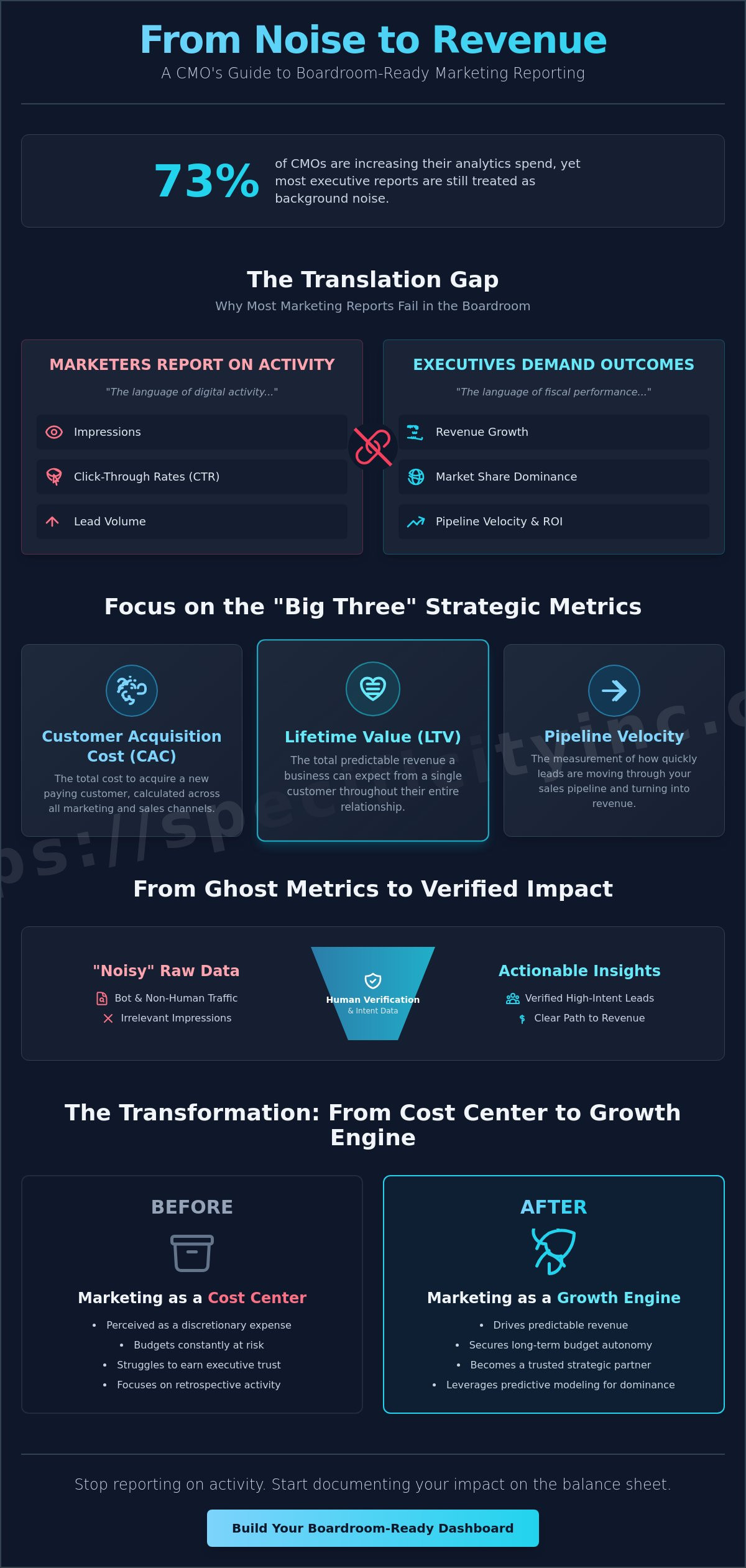
Recent data indicates 73% of CMOs are increasing their analytics spend, yet most executive teams still treat marketing reports as background noise. If your boardroom sessions feel like a defense of “waste” rather than a strategic review of growth, your data isn’t the problem; your translation is. Most leaders don’t care about click-through rates or impressions. They demand marketing reporting that executives understand, which means connecting every digital touchpoint to the bottom line.
You’ve likely felt the pressure of proving attribution across fragmented channels while trying to justify high-spend initiatives. It’s a high-stakes environment where technical accuracy matters less than strategic relevance. This guide bridges that gap, offering a framework focused on predictable revenue and absolute market dominance. We’ll show you how to build boardroom-ready dashboards that secure budgets for high-intent channels like CTV and create a permanent alignment between marketing activity and sales revenue. It’s time to stop reporting on activity and start documenting your impact on the balance sheet.
Key Takeaways
- Eliminate vanity metrics like CTR and impressions to align marketing output with fiscal reality and boardroom priorities.
- Focus on the “Big Three” strategic metrics: CAC, LTV, and Pipeline Velocity to drive high-level decision-making.
- Deploy a structured framework for marketing reporting that executives understand, starting with a business-first narrative.
- Secure executive trust by utilizing human-verified traffic and intent data to remove bot-driven noise from your performance dashboards.
- Transition from retrospective reporting to predictive modeling to secure long-term budget autonomy and strategic dominance.
The Translation Gap: Why Executive Reporting Often Falls Flat
Most marketing reports are dead on arrival. They fail because they speak a language of digital activity while the boardroom speaks the language of fiscal performance. High click-through rates (CTR) and millions of impressions are nothing more than vanity metrics if they don’t correlate with revenue growth. Reporting on activity instead of outcomes creates a dangerous perception of marketing as a discretionary expense rather than a growth engine. When the data doesn’t align with the CEO’s view of the balance sheet, the reporting process becomes a friction point rather than a strategic asset.
This lack of marketing accountability erodes executive trust at a fundamental level. When you present activity as success, you lose the authority to defend your budget during quarterly reviews. Executives see high spend without clear outcome tracking as pure waste. Over time, this disconnect leads to slashed budgets and reduced marketing autonomy. To fix this, you must build marketing reporting that executives understand by focusing on quantitative outcomes that impact the balance sheet. Stop counting actions and start measuring value.
The C-Suite Perspective on Marketing Spend
CEOs prioritize risk mitigation and revenue predictability. They don’t want to hear about “brand awareness” if it can’t be measured against customer acquisition costs or lifetime value. When reports focus on surface-level metrics, marketing remains a cost center in the eyes of leadership. You must execute a psychological shift from a campaign manager to a revenue partner. This means framing every programmatic display or SEM campaign through the lens of sales pipeline velocity. If your data doesn’t help an executive predict next quarter’s revenue, it’s irrelevant to their decision-making process.
Identifying the Noise in Your Current Data
Executive trust is fragile. It shatters the moment your data is revealed as “noisy” or technically flawed. Non-human traffic accounts for a massive portion of web activity, yet many reports count these bot clicks as genuine engagement. This creates “ghost metrics” that fail to convert into leads or sales. Broad targeting further dilutes reporting, showing high reach with zero strategic depth. Credible marketing reporting that executives understand requires human verified traffic and intent data targeting as a foundation. Without these filters, your reports are built on logic and evidence rather than creative guesswork.
Decoding the Executive Mindset: Metrics That Drive Boardroom Decisions
The boardroom is not a classroom. Executives don’t need a tutorial on how digital platforms function; they need to know how capital is being converted into market share. To deliver marketing reporting that executives understand, you must apply the 80/20 rule to your data. This means filtering out the operational noise of daily campaign management to focus on the 20% of metrics that drive 80% of business outcomes. High-level leadership prioritizes the “Big Three” of strategic reporting: Customer Acquisition Cost (CAC), Lifetime Value (LTV), and Pipeline Velocity. These figures provide a clear narrative of fiscal health that vanity metrics simply cannot match.
Strategic dominance requires presenting Digital Advertising ROI as a competitive advantage rather than a line-item expense. When you link Programmatic Display and Connected TV (CTV) spend directly to bottom-line growth, you transform marketing from a cost center into a predictable revenue engine. When you build an executive marketing report, you aren’t just summarizing the past month. You’re defending a capital allocation strategy that justifies future investment in high-intent channels. If your current reporting doesn’t demonstrate this level of certainty, it’s time to refine your data-driven methodology.
Efficiency Metrics: CAC and ROAS Reimagined
Standard Return on Ad Spend (ROAS) often masks inefficiency by blending high-performing organic traffic with paid efforts. Executives demand clarity on incremental growth. You must calculate CAC across multi-channel funnels to show exactly what it costs to acquire a new customer in today’s landscape. Use Search Engine Marketing (SEM) data to prove immediate intent conversion while showing how these high-intent touchpoints lower the overall CAC by capturing ready-to-buy audiences.
Growth Metrics: LTV and Market Penetration
Reporting on LTV allows you to justify higher top-of-funnel spend by proving the long-term value of the customers you’re capturing now. This is particularly critical in B2B Marketing, where sales cycles are longer and require sophisticated long-tail attribution. Instead of reporting on broad reach, report on “Share of Voice” within high-intent audience segments. This shift shows executives exactly how much of the addressable market you’re dominating, turning your marketing reporting into a tool for market expansion rather than just a performance summary.
A 5-Step Guide to Building High-Impact Executive Reports
Building marketing reporting that executives understand requires a departure from standard analytical exports. You aren’t just moving data from a CRM to a slide deck. You’re constructing a narrative of growth. To achieve this, your reporting process must move beyond retrospective summaries and into the realm of strategic decision support. This framework ensures that every data point serves a commercial purpose.
Step 1: Establish the Narrative. Every report must answer: what business problem are we solving? If you’re tackling a market share deficit, your report should reflect penetration and competitive displacement rather than just generic impressions. Step 2: Clean the Pipeline. Executive trust evaporates when data is tainted by bot activity or non-human traffic. You must verify traffic through rigorous filtering before it ever hits the dashboard. Step 3: Map the Journey. Connect high-intent touchpoints to the final sale through multi-touch attribution. This validates the spend on top-of-funnel channels like Programmatic Display. Step 4: Visualize for Speed. Executives have minutes, not hours. Use trend lines and heatmaps to show directionality and momentum at a glance. Step 5: Provide the “So What?”. Close with an executive summary that dictates the next logical move for the business based on the data presented.
Structuring the Executive Summary
Follow the one-page rule. Senior leaders prioritize strategic insights over granular operational details. Lead with high-impact wins, back them with quantitative evidence, and conclude with specific resource requirements. This structure forces you to focus on outcomes rather than activity. Frame these requests as investment opportunities rather than departmental costs. To successfully report marketing results to senior executives, you must prove that more capital equals more predictable revenue and market expansion.
Visualizing Multi-Channel Attribution
Show the synergy between different platforms. A waterfall chart can effectively demonstrate how Social Media Advertising feeds high-intent search demand or how CTV drives direct-to-site traffic. This level of clarity is the hallmark of marketing reporting that executives understand. Don’t overlook the role of creative services. High-performing creative isn’t subjective; it’s a quantitative driver of engagement and conversion that belongs in your performance modeling. When you visualize the funnel as a cohesive unit, you eliminate the perception of marketing spend as fragmented or wasteful.
Eliminating the Noise: The Role of Intent Data and Human Verification
Executive trust is a fragile asset. It collapses when your data lacks integrity. If your dashboard shows 10,000 clicks but zero sales impact, you aren’t reporting success; you’re documenting failure. To deliver marketing reporting that executives understand, you must eliminate the non-human noise that plagues standard digital analytics. Human-verified traffic is the only standard that matters in high-stakes environments. By stripping away bot-driven anomalies, you ensure that every metric presented in the boardroom represents a genuine interaction with a potential customer. This isn’t just about accuracy; it’s about survival in a data-saturated market.
Precision matters more than volume. Connected TV Advertising offers a significantly cleaner data set than traditional programmatic display because it operates in a more controlled, high-intent environment. When you combine this with intent data targeting, your reporting moves from guesswork to mathematical certainty. You no longer have to explain away “vanity spikes” that don’t convert. Instead, you provide a clear view of how specific audience behaviors translate into fiscal outcomes. This predictability is what transforms a standard report into a strategic growth engine.
The Hidden Cost of Broad Targeting
Broad-stroke tactics are the primary source of reporting friction. They inflate impressions and reach while diluting your conversion rates. This creates the “reporting nightmare” where a marketing team must explain massive traffic numbers that result in zero revenue. It makes marketing look like an expensive gamble. Transitioning to high-intent audience data allows you to focus on the small percentage of the market actually ready to buy. This shift produces cleaner attribution and a report that aligns perfectly with sales reality. Stop reporting on who saw your ad; report on who is actually in-market to buy.
Verification as a Strategic Moat
Clean data is superior to big data. Executives don’t want a spreadsheet of a million rows; they want ten rows of verified truth. Implementing human-verified traffic protocols serves as a strategic moat that protects your budget and your reputation. It allows you to present a “waste-free” report to the CFO, proving that capital is only being deployed against real humans with demonstrated intent. This level of exactness is the only logical choice for businesses seeking predictable revenue. If you are ready to secure your strategic dominance, you must leverage human-verified traffic as the foundation of your growth strategy.
Strategic Dominance: Transforming Reports into a Growth Engine
Elite reporting doesn’t just catalog the past. It models the future. When you provide marketing reporting that executives understand, you’re handing them a map of upcoming revenue cycles rather than a history book of spent capital. Predictive modeling allows the boardroom to move from reactive defense to proactive offense. This transition is essential for any department seeking long-term marketing autonomy. By demonstrating how current market signals dictate future sales, you position your team as an intellectual powerhouse that values logic over guesswork. This shift in perception turns every report into a catalyst for expansion.
The goal is to move beyond the limitations of retrospective summaries. Most businesses are stuck in a loop of defending last month’s spend. Strategic dominance requires a framework where data dictates the next move with mathematical certainty. When your reports show a clear line between high-intent audience behavior and predictable revenue, the boardroom stops questioning the “cost” of marketing. They start asking how much more capital they can deploy to accelerate the engine. This is how you secure the budget for high-stakes channels like CTV and programmatic display.
The Future of Reporting: AI and Real-Time Intent
By June 2026, the standard for reporting has evolved beyond static monthly reviews. We now operate in an era of real-time demand generation. Your “Marketing Dashboard” must function as a “Revenue Command Center” that integrates real-time intent data. Programmatic display data is no longer just a post-campaign metric; it’s a proactive tool for identifying market shifts before they manifest in your sales pipeline. This level of technical accuracy allows for rapid pivots that protect your growth efficiency. It ensures your strategy remains aligned with actual audience behavior rather than outdated projections.
Partnering for Precision
Strategic dominance requires a partner that understands the nuances of the digital landscape better than the competition. Specificity Inc. focuses exclusively on the metrics that matter to the C-suite. We don’t hide behind superficial numbers or broad-stroke tactics that create noise in the boardroom. Our methodology is designed for businesses seeking national-scale dominance through exactness and data-driven certainty. If your current reporting stack feels like a liability, it’s time for a rigorous audit. You can schedule a consultation to audit your high-intent targeting strategy and start building a framework that secures your boardroom authority.
Auditing your current reporting stack is the first step toward executive alignment. Examine your data flow for bot-driven anomalies and verify that your attribution models actually reflect the customer journey. If your reports don’t immediately signal a serious partnership focused on substantial growth, they’re a liability. Cut through the complexity. Replace creative guesswork with hard numbers. This is the only path to predictable revenue and permanent strategic dominance in your industry.
Mastering the Boardroom Narrative
Strategic dominance in the professional services space isn’t a byproduct of volume; it’s a result of exactness. You’ve seen how the translation gap between digital activity and fiscal reality can erode budget authority and stall expansion. By pivoting to a framework built on human verified traffic and high intent audience targeting, you eliminate the noise that compromises executive trust. This shift ensures that every data point in your dashboard serves as a catalyst for predictable revenue rather than a defense of past spend.
Achieving marketing reporting that executives understand requires a commitment to data integrity and national scale demand generation expertise. It’s time to stop reporting on impressions and start documenting your impact on the balance sheet with mathematical certainty. Ready to dominate your market with reports that drive action? Contact Specificity Inc. today. We specialize in transforming raw data into boardroom ready strategic assets that secure your marketing autonomy and fuel substantial growth. Your path to market leadership begins with clarity.
Frequently Asked Questions
What is the single most important metric for executive marketing reports?
The Customer Acquisition Cost (CAC) relative to Lifetime Value (LTV) is the primary indicator of fiscal health. Executives use this ratio to determine if the growth engine is efficient or merely burning capital. While clicks are operational metrics, the CAC/LTV ratio provides the strategic clarity required for capital allocation decisions and long-term scaling.
How often should I report digital marketing results to the C-suite?
Strategic reports should occur monthly to maintain alignment with revenue targets. While real-time dashboards allow for tactical adjustments, the C-suite requires a monthly cadence to evaluate trend lines and pivot resources effectively. Quarterly reports should focus on deeper shifts in market penetration and multi-channel attribution to guide annual growth strategies.
Why do executives ignore standard marketing metrics like CTR and CPC?
Leadership ignores these because they are activity-based rather than outcome-based. CTR and CPC describe how much effort was spent, not how much value was created for the balance sheet. To deliver marketing reporting that executives understand, you must bypass these vanity metrics and focus on how digital activity translates into sales pipeline velocity.
How can I prove the ROI of Connected TV (CTV) in my reports?
CTV ROI is proven by measuring the direct lift in high-intent search volume and direct site traffic following ad exposure. Unlike traditional television, CTV allows for precise audience tracking through digital identifiers. You must show how CTV serves as a top-of-funnel catalyst that lowers the overall cost per lead across your other digital channels.
What is the best way to handle ‘negative’ data in an executive report?
Negative data should be presented as a strategic pivot to mitigate risk. Executives value logic and evidence over creative guesswork or defensive excuses. If a channel underperforms, identify the specific technical inefficiency, explain the data-backed reason for the outcome, and present a corrective action plan that reallocates capital to high-performing, high-intent channels.
How does human-verified traffic impact reporting accuracy?
Human-verified traffic is the foundation of reporting accuracy because it removes bot-driven anomalies that inflate reach and deflate conversion rates. By stripping out non-human interactions, you provide a clean data set that instills immediate confidence in executive leadership. This exactness prevents the reporting friction caused by high traffic numbers that fail to produce revenue.
Can intent-based data help predict future revenue in my reports?
Intent-based data allows you to move from retrospective reporting to predictive modeling. By identifying consumers actively searching for specific solutions, you can forecast future revenue based on current demand signals. This level of certainty is a core component of marketing reporting that executives understand, as it allows for proactive market positioning before competitors react.
How much detail should be included in an executive summary?
The executive summary should follow a strict one-page rule. It must contain high-level wins, primary KPIs like CAC and Pipeline Velocity, and specific resource requirements. Avoid granular technical explanations or platform-specific jargon. Focus on the strategic implications of the data, explaining how the current performance dictates the next steps for business expansion.