

Filling the Sales Pipeline with Qualified Leads: A Strategic Framework for 2026
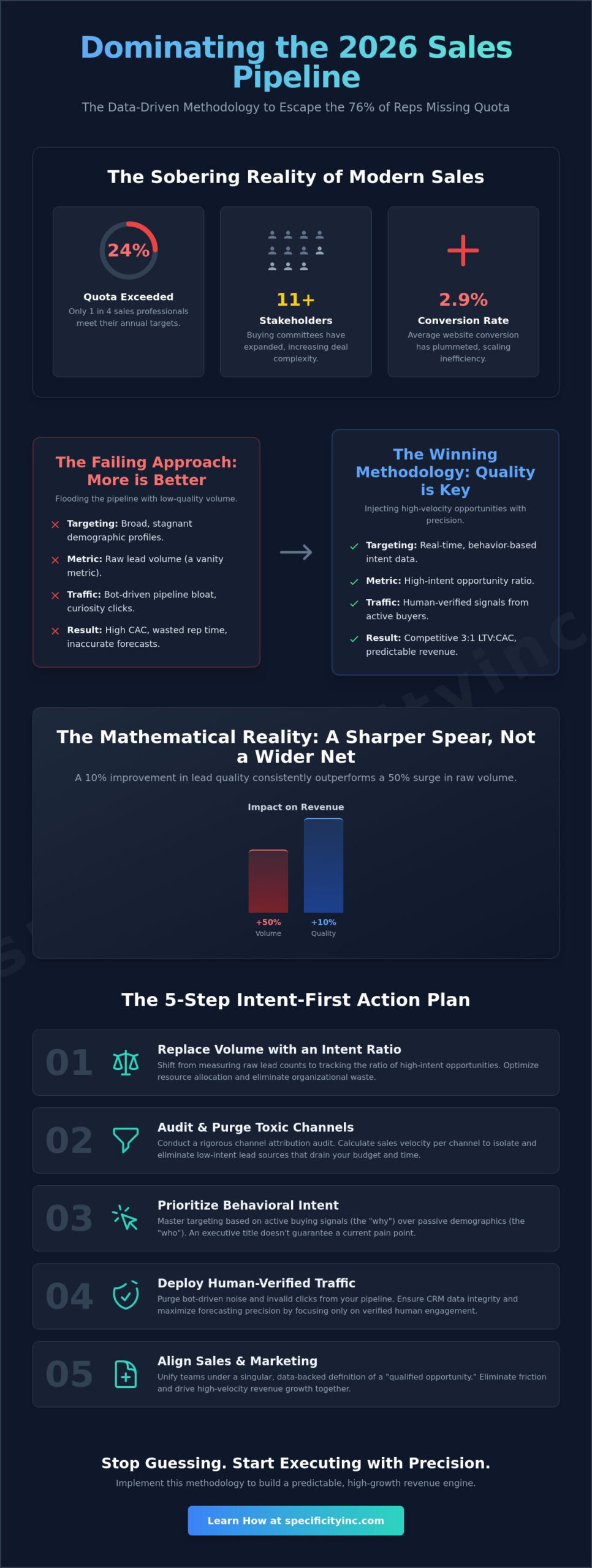
Only 24% of sales professionals are exceeding their annual quotas in 2026, a direct consequence of buying committees expanding to 11 stakeholders and average website conversion rates dropping to a mere 2.9%. Your sales team is likely drowning in low-intent noise while your acquisition costs climb and revenue remains stagnant. You recognize that high lead volume is a worthless vanity metric if it results in wasted rep time and inaccurate forecasting. It’s time to stop guessing and start executing with precision.
This article provides the exact, data-driven methodology for filling the sales pipeline with qualified leads by prioritizing human-verified traffic and intent data targeting over broad demographics. You’ll learn how to inject high-velocity opportunities into your funnel to achieve predictable revenue growth and maintain a competitive 3:1 LTV to CAC ratio. We’ll examine the strategic shift toward behavior-based identification and the technical frameworks required to dominate the 2026 market.
Key Takeaways
- Replace broad volume metrics with a high-intent opportunity ratio to optimize resource allocation and eliminate organizational waste.
- Deploy a rigorous channel attribution audit to isolate and eliminate toxic lead sources that currently drain your sales velocity.
- Master the methodology for filling the sales pipeline with qualified leads by prioritizing behavioral intent over stagnant demographic profiles.
- Purge bot-driven pipeline bloat through human-verified traffic to ensure CRM integrity and maximize forecasting precision.
- Align marketing and sales under a singular, data-backed definition of a qualified opportunity to drive high-velocity revenue growth.
Beyond Volume: Redefining Sales Pipeline Quality for 2026
High lead volume is often a mask for strategic failure. In 2026, executive leadership must stop measuring success by the sheer number of entries in a CRM. True pipeline quality is the ratio of high-intent opportunities to total leads. If your conversion rate from visitor to lead has dropped to the 2026 average of 2.9%, increasing the top-of-funnel volume only scales your inefficiency. Broad-stroke lead generation creates a veneer of activity that hides a stagnant revenue engine. Modern precision demand generation replaces this noise with high-velocity, human-verified signals.
Designing these workflows requires a commitment to Sales process engineering, where every stage of the funnel is optimized for data integrity rather than cosmetic growth. Filling the sales pipeline with qualified leads demands a total rejection of the “more is better” fallacy. Traditional tactics focus on demographic clusters that may or may not be in a buying window. Modern methodology uses real-time intent data to identify active buyers. Pipeline bloat carries a heavy financial penalty. It forces expensive sales talent to chase phantoms, driving up the cost per acquisition while revenue remains flat.
The Mathematical Reality of Quality Over Quantity
A 10% improvement in lead quality consistently outperforms a 50% surge in raw volume. Mathematical models prove that increasing volume without maintaining quality creates a bottleneck that slows sales velocity. When you flood the system with low-intent data, you escalate the “Cost of Pursuit.” This metric accounts for the cumulative salary and overhead costs of your account executives spent on discovery calls that were doomed from the start. Efficiency isn’t found in a larger net; it’s found in a sharper spear.
Pipeline Quality is the predictive probability of conversion based on verified intent.
Identifying the Symptoms of a Low-Quality Pipeline
Low-quality pipelines exhibit specific, measurable symptoms. You’ll see deals that enter the funnel with momentum only to stall indefinitely in the “Discovery” or “Proposal” stages. With buying committees now involving 11 stakeholders, the margin for error in lead qualification has vanished. If your “Closed Lost” reports are dominated by “no decision” or “lack of budget,” it’s rarely a sales execution problem. It’s a targeting failure at the source of your lead generation.
Forcing sales teams to work through low-intent marketing leads leads to rapid burnout and high turnover. They’re professionals, not data cleaners. Filling the sales pipeline with qualified leads ensures that every minute of their time is spent on revenue-generating activity. Organizations that ignore these symptoms face a fractured revenue engine where sales and marketing interests diverge. Protecting your reps’ time by delivering only human-verified, high-intent opportunities is the only logical choice for maintaining a competitive 3:1 LTV to CAC ratio.
The 5-Step Pipeline Audit: Diagnosing Inefficiencies at the Source
A broken pipeline isn’t a volume problem; it’s a diagnostic failure. Most organizations throw more capital at the same toxic channels, expecting a different outcome. To stop the bleed, you must audit your entry points with surgical precision. Diagnosis must precede treatment. If you don’t identify where the “junk” enters, you’re simply scaling your inefficiencies. Filling the sales pipeline with qualified leads requires a cold, hard look at the data that fuels your CRM. This five-step audit provides the framework to purge the noise and isolate the signals that actually drive revenue.
Step 1 & 2: Channel Attribution and Velocity
Stop treating all digital channels as equal. Identifying where low-intent leads enter your system is the first step toward strategic dominance. You must calculate Sales Velocity, the speed at which a lead moves from initial contact to close, per channel. This metric identifies high-intent pathways that deserve your budget. Low-velocity channels often indicate a mismatch between the offer and the audience. For a deeper analysis of channel performance and how to weigh these entry points, review our framework on Digital Advertising ROI: The Definitive Guide to Strategic Dominance. Velocity serves as the ultimate proxy for prospect intent and fit.
Step 3 & 4: Intent and Verification Checks
Distinguish between curiosity clicks and high-intent engagement. Demographic targeting is failing in modern B2B environments because it focuses on “who” rather than “why.” An executive title doesn’t guarantee a current pain point. You need to evaluate the Intent Profile of every entry point. This requires human-verified traffic to purge the bot-driven data that currently saturates the market. To effectively manage your sales pipeline, you must ensure that every signal is rooted in genuine human behavior, not algorithmic noise. In an AI-saturated market, human verification is the only way to protect your sales team’s time from being wasted on automated clicks.
Finally, map your pipeline stages against actual buyer behavior data. If your sales reps are losing deals to “no decision,” your pipeline stages don’t reflect the reality of the buyer’s journey. Filling the sales pipeline with qualified leads is a proactive exercise in data integrity. It’s about capturing the 98% of anonymous high-intent traffic that traditional forms miss. If you’re ready to stop the waste and start scaling with certainty, you should analyze your current targeting accuracy to find where your revenue is leaking. Your sales cycle length is a direct reflection of your lead quality at the source.
Intent Data vs. Demographics: Shifting to High-Precision Targeting
Demographic targeting is a relic of a low-data era. Knowing a prospect’s job title, age, or location provides zero insight into their current purchasing cycle. Filling the sales pipeline with qualified leads requires a fundamental shift to behavioral intent data. You must prioritize what a prospect is doing over who they are. While demographic profiles offer a static snapshot, intent data provides a dynamic map of the buyer’s journey in real-time. This methodology allows you to optimize your sales process by engaging only those who exhibit active buying signals.
High-precision targeting relies on capturing demand where it originates. Search Engine Marketing (SEM) remains the gold standard for capturing active demand because it targets users at the exact moment of inquiry. Contrast this with standard “Lookalike” audiences, which are merely statistical guesses based on proximity to current customers. “In-Market” behavioral audiences represent a superior tier of data. They consist of individuals whose recent digital footprints suggest an imminent transaction. By focusing on these high-precision signals, you eliminate the friction of educating a cold audience and move directly to deal progression.
Connected TV (CTV) as a B2B Precision Engine
Connected TV has evolved into a high-stakes precision engine for B2B demand generation. It allows you to reach decision-makers in a lean-back environment where engagement is significantly higher than on mobile devices. Modern Connected TV Advertising utilizes cross-device tracking to link high-definition views to specific pipeline entries. This creates a cohesive narrative across the prospect’s entire digital ecosystem. You’re no longer just running ads; you’re orchestrating a multi-touch sequence that validates intent before a sales rep ever picks up the phone.
Programmatic Display and Behavioral Triggers
Programmatic Display provides the infrastructure to nurture leads based on specific content consumption patterns. This isn’t about broad-stroke banner ads; it’s about deploying behavioral triggers that respond to a prospect’s research habits. The technical process involves mapping real-time intent data directly to your CRM accounts, ensuring that your outreach is always contextual. Filling the sales pipeline with qualified leads in this environment requires human-verified programmatic traffic. Without verification, you’re paying for bot impressions that inflate your metrics without contributing to revenue. Human-verified signals ensure your pipeline integrity remains absolute, protecting your sales velocity from the noise of the broader market.
Combatting Pipeline Bloat: The Role of Human-Verified Traffic
Revenue leaders often complain that they have plenty of leads, but those leads simply don’t convert. This is the hallmark of pipeline bloat. Most digital marketing strategies prioritize raw engagement metrics without questioning the authenticity of the traffic. Automated clicks and sophisticated scripts now create a massive volume of false signals within CRMs, leading to inaccurate forecasting and wasted marketing spend. Filling the sales pipeline with qualified leads is impossible if your top-of-funnel data is polluted by non-human actors.
Traditional social media and broad display networks suffer from a massive “Verification Gap.” These platforms optimize for clicks to lower their reported cost-per-click, but they rarely distinguish between a genuine human decision-maker and a bot. This lack of oversight results in a bloated pipeline that looks healthy on a dashboard but fails to produce revenue at the bottom of the funnel. Human-verified traffic acts as the ultimate filter, ensuring that every entry in your CRM represents a legitimate opportunity rather than an algorithmic ghost.
Why Bots are Killing Your Sales Productivity
Forcing account executives to follow up on non-human leads is an expensive mistake. AEs are your most expensive resource; their time should be reserved for high-stakes negotiation, not data cleaning. Every hour spent chasing a bot-generated form fill is an hour taken away from a legitimate high-intent opportunity. Beyond the salary drain, bot traffic skews your conversion data. It makes it nearly impossible to identify which channels actually drive ROI, which often leads to poor strategic pivots based on phantom data. In 2026, human-verified traffic is the foundational requirement for any sales pipeline that claims to be high-quality.
The Specificity Methodology: Human-First Data
Specificity Inc. solves the quality crisis by treating human verification as a non-negotiable standard. We don’t just target by title or industry; we deploy a proprietary filtering layer that validates the human identity behind every interaction. This approach transforms Social Media Advertising from a volume play into a precision instrument. By removing automated engagement from the funnel, we reduce pipeline bloat and ensure your sales team only interacts with verified prospects. Filling the sales pipeline with qualified leads requires a partner that values data integrity over vanity metrics. If you want to eliminate bot-driven waste and focus your team on revenue-generating activity, you need to deploy human-verified targeting today.
Executing the Pivot: Building an Intent-First Sales Pipeline
Transitioning to an intent-first architecture is a cultural shift as much as a technical one. You must dismantle the legacy mindset that celebrates lead volume and replace it with a focus on deal velocity. Filling the sales pipeline with qualified leads in 2026 requires a unified definition of a “Qualified Opportunity” shared by both marketing and sales teams. This alignment ensures that marketing resources are allocated to high-precision B2B Marketing efforts that pre-qualify prospects before they reach a sales rep. When both departments operate on the same data set, the friction between lead generation and sales execution disappears.
Success in this new framework is measured by the metrics that actually impact the bottom line: Win Rate and Average Deal Size. Raw lead count is irrelevant if those leads don’t convert. When you prioritize intent data and human verification, you naturally see an increase in deal size because you’re targeting organizations with immediate, high-value needs rather than speculative interest. This shift in KPIs forces your organization to focus on revenue efficiency rather than superficial growth.
Aligning the Revenue Team for Strategic Dominance
Strategic dominance requires a tight feedback loop between sales outcomes and marketing inputs. Sales teams must provide qualitative feedback on lead quality, which marketing then uses to refine intent-based targeting parameters in real-time. This synergy accelerates pipeline velocity by ensuring that only the most relevant prospects receive high-touch engagement. High-impact Creative Services play a critical role here. They must communicate value with surgical precision to ensure your message resonates with intent-rich prospects who are already deep in their research phase. This isn’t about being seen; it’s about being the only logical choice for a buyer ready to act.
Partnering for Growth Efficiency
Executing high-precision, intent-based targeting is a specialized discipline that most internal teams aren’t equipped to handle. It requires access to sophisticated data layers and human-verification technologies that sit outside the standard tech stack. A specialist partner is necessary to cut through the complexity and deliver data-driven certainty. Filling the sales pipeline with qualified leads shouldn’t be a gamble or a numbers game. It’s a calculated exercise in audience behavior analysis and technical verification.
This degree of technical verification is essential in many high-stakes fields; for instance, those who explore Special Risk Life Insurance Policies rely on specialized data to navigate complex underwriting requirements for high-risk individuals.
The Specificity Inc. methodology is built for executive leadership that values hard numbers over creative guesswork. We eliminate the noise and waste of the broader market by focusing exclusively on verified human intent. If you’re ready to replace vanity metrics with predictable revenue growth, schedule a consultation to audit your pipeline quality with Specificity Inc. today. Your growth depends on the exactness of your data.
Securing Your Competitive Advantage through Precision Pipeline Engineering
The 2026 market doesn’t reward volume; it rewards exactness. You’ve seen how auditing your channels and shifting from demographic guessing to high-intent behavioral data can transform your revenue engine. Filling the sales pipeline with qualified leads is no longer about casting a wider net. It’s about deploying a surgical methodology that prioritizes human-verified traffic and isolates active buyers in real-time. Organizations that continue to rely on broad-stroke tactics will find themselves paralyzed by rising acquisition costs and stagnant growth.
Specificity Inc. stands as an intellectual powerhouse in the professional services space, specializing in B2B demand generation. We leverage high-intent audience targeting across CTV and programmatic display to ensure your message reaches decision-makers in high-stakes environments. Our human-verified traffic solutions eliminate the bot-driven noise that currently stalls your sales productivity. We provide the data-driven certainty required to scale with confidence and achieve predictable revenue growth.
Request a Strategic Consultation to Optimize Your Sales Pipeline. Your growth is a mathematical certainty when you stop chasing vanity metrics and start targeting verified human intent.
Frequently Asked Questions
How do you define sales pipeline quality in 2026?
Pipeline quality is the predictive probability of conversion based on verified behavioral signals. In 2026, we define this as the ratio of high-intent opportunities to total entries. It’s a shift from measuring database size to measuring revenue potential. High-quality pipelines prioritize prospects who are actively researching solutions. This methodology ensures your sales team spends every hour on deals that have a high statistical likelihood of closing.
What are the key metrics for measuring pipeline health?
Sales velocity and Win Rate are the primary indicators of a healthy pipeline. You must also track the ratio of marketing-sourced leads that reach the proposal stage. These metrics expose inefficiencies that raw volume hides. If your velocity is stagnant despite a full funnel, your data integrity is compromised. Focus on Average Deal Size to confirm your intent-based targeting is reaching high-value stakeholders rather than low-level researchers.
Can you improve pipeline quality without decreasing lead volume?
Improving quality often requires a strategic reduction in raw lead volume to eliminate noise. Filling the sales pipeline with qualified leads means purging the toxic, low-intent sources that waste rep time. While you can maintain volume through aggressive intent-based scaling, the initial focus must be on conversion efficiency. Scaling a broken process only accelerates your losses. Quality must be the foundational requirement before you pursue high-volume expansion.
How does intent data differ from standard demographic targeting?
Demographic targeting identifies who a person is, while intent data identifies what they are doing. Title and industry are static data points that don’t signal a buying window. Intent data tracks behavioral triggers, such as specific content consumption or search patterns, to find active demand. This high-precision approach allows you to engage prospects exactly when they are ready to transact, bypassing the friction of cold outreach.
What is human-verified traffic and why does it matter for sales?
Human-verified traffic is digital engagement that has been filtered to exclude bots and automated scripts. It matters because bot traffic creates false signals in your CRM, leading to inaccurate forecasting and wasted sales productivity. By ensuring that every click and form fill originates from a real human, you protect your sales reps from chasing phantoms. This verification layer is essential for maintaining pipeline integrity in an AI-saturated market.
How long does it take to see results from a pipeline quality improvement strategy?
You’ll see immediate improvements in lead quality and rep engagement within the first 30 days of implementation. However, the full impact on win rates and revenue growth typically mirrors your standard sales cycle. If your typical deal takes six months to close, expect a six-month window to see the complete ROI. The primary objective is to build a sustainable, predictable revenue engine, which requires consistent data-driven optimization.
Is Connected TV (CTV) effective for B2B sales pipelines?
Connected TV is a high-stakes precision engine for reaching B2B decision-makers. It places your message in a lean-back, high-engagement environment where stakeholders are more receptive to complex value propositions. By using cross-device tracking, we link CTV views directly to pipeline entries. This provides a cohesive narrative across the buyer’s journey. CTV allows you to dominate the digital landscape while capturing high-intent signals at scale.
What is the most common reason for sales pipeline bloat?
Pipeline bloat is most commonly caused by a reliance on broad-stroke lead generation and unverified traffic sources. Filling the sales pipeline with qualified leads is the only antidote to this systemic waste. When organizations prioritize vanity metrics like total lead count, they inadvertently flood their CRM with low-intent noise and bot-driven data. This creates a veneer of activity that masks a fundamental failure to identify and engage legitimate human buyers.