Reducing Customer Acquisition Cost with Programmatic: The 2026 Precision Playbook
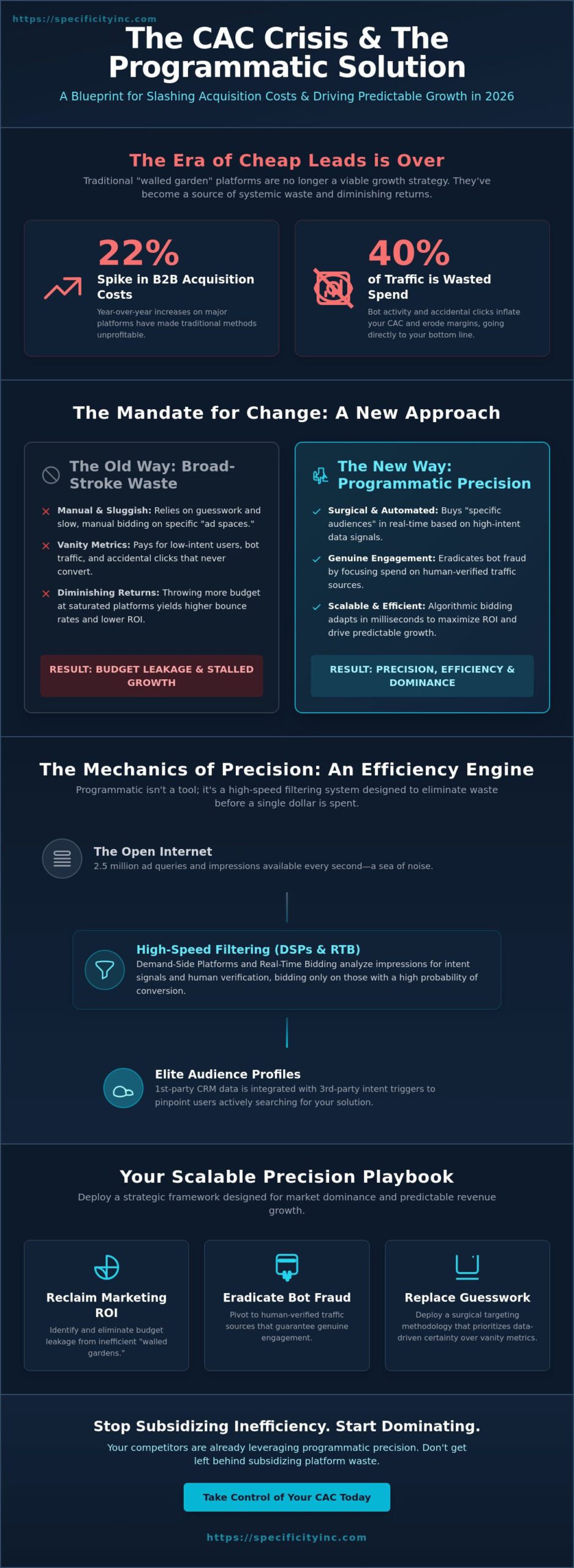
The era of cheap leads on walled-garden platforms ended in 2023 when B2B acquisition costs spiked by 22% across major digital channels. If your growth strategy still relies on broad-stroke social algorithms, you aren’t scaling; you’re subsidizing inefficiency. Reducing customer acquisition cost with programmatic is no longer an optional tactic for the 2026 fiscal year. It’s a strategic mandate for executives who demand surgical precision over creative guesswork. Every dollar spent on unverified bot traffic is a direct hit to your bottom line that your competitors aren’t willing to take.
You’ve likely realized that throwing more capital at saturated platforms only yields diminishing returns and higher bounce rates. It’s a frustrating cycle that prevents true market dominance. This article provides the blueprint to break that cycle by leveraging high-intent targeting and human-verified traffic to slash your CAC. We’ll dismantle the traditional, wasteful approach to digital spend and replace it with a data-driven methodology designed for predictable, scalable revenue growth. You’ll learn exactly how to pinpoint your highest-value prospects and ignore the noise that’s currently draining your budget.
Key Takeaways
- Identify and eliminate the budget leakage inherent in inefficient “walled gardens” to reclaim your marketing ROI.
- Master the strategic framework for reducing customer acquisition cost with programmatic by leveraging high-intent user data and real-time bidding precision.
- Eradicate the hidden CAC bleed caused by bot fraud by pivoting to human-verified traffic sources that guarantee genuine engagement.
- Replace broad-stroke marketing guesswork with a surgical targeting methodology that prioritizes data-driven certainty over vanity metrics.
- Deploy a scalable precision playbook designed to dominate saturated markets and drive predictable revenue growth in 2026.
The CAC Crisis: Why Traditional Targeting Fails in 2026
In 2026, Customer Acquisition Cost (CAC) has evolved from a standard marketing metric into a survival indicator for the enterprise. It represents the total capital required to move a prospect from initial awareness to a signed contract within a saturated digital environment. Average CPCs across major search platforms have surged by 22% year-over-year since 2024, creating a landscape where traditional methods no longer yield a profit. The “walled gardens” of Meta and Google have become expensive echo chambers. These platforms prioritize their own ecosystem health over your bottom line, often forcing brands into the “Broad-Stroke” trap. This tactical failure forces you to bid on low-intent users who look like customers on paper but lack any genuine intent to purchase. Reducing customer acquisition cost with programmatic is the only viable path forward for brands that refuse to subsidize platform inefficiency.
Programmatic technology serves as the surgical response to this systemic waste. It replaces the guesswork of manual bidding with data-driven certainty. While traditional agencies throw more budget at a problem, elite specialists use programmatic display advertising to pinpoint high-value targets with mathematical precision. You don’t need a bigger budget; you need a more lethal one.
The Escalating Cost of Inefficiency
The 2024 collapse of third-party cookies and the tightening of global privacy regulations have left traditional tracking in ruins. Marketers relying on legacy pixels are now flying blind, often paying for “vanity clicks” that never reach the bottom of the funnel. Industry data shows that up to 40% of standard display traffic is now attributed to accidental clicks or bot activity. This lack of granularity inflates your CAC and erodes your margins. Programmatic CAC reduction is the elimination of irrelevant ad impressions.
Programmatic vs. Traditional Ad Buying
Traditional ad buying is a manual, sluggish process that focuses on buying “ad space” on specific websites. It’s a legacy mindset that assumes the environment defines the visitor. Programmatic execution flips this dynamic by buying “specific audiences” regardless of where they browse. It utilizes algorithmic speed to evaluate millions of impressions per second, ensuring your brand only appears when a high-intent user is present. This shift is fundamental to maximizing your digital advertising roi. By moving away from manual bidding and embracing automated precision, you stop paying for the crowd and start paying for the customer. Reducing customer acquisition cost with programmatic isn’t just a strategy; it’s a mandate for strategic dominance in 2026.
- Precision: Targeting based on real-time intent, not historical profiles.
- Scalability: Algorithmic bidding that adapts to market shifts in milliseconds.
- Efficiency: Zero spend on bot traffic or low-intent demographics.
The Mechanics of Precision: How Programmatic Infrastructure Slashes CAC
Programmatic infrastructure isn’t a luxury; it’s a precision weapon. While traditional buying relies on broad strokes and hope, Demand Side Platforms (DSPs) operate as high-speed filters. These platforms process over 2.5 million queries per second to isolate the 0.1% of users who actually matter to your bottom line. By filtering for high-intent signals before a single cent is spent, you stop subsidizing the “noise” of the open internet. This is the first step in reducing customer acquisition cost with programmatic advertising.
Real-Time Bidding (RTB) functions as the ultimate efficiency engine. It ensures you pay the exact market value for a specific impression, determined by its individual probability of conversion. You’re no longer locked into flat-rate CPMs that overcharge for low-value traffic. Instead, the system uses 1st and 3rd party data integration to build elite audience profiles. We combine your CRM data with external intent triggers to pinpoint users who are actively searching for your solution. To maximize this impact, Dynamic Creative Optimization (DCO) swaps headlines and imagery in milliseconds to match the user’s specific stage in the funnel. Precision wins. Waste loses.
- DSPs: Act as the gatekeeper, rejecting 99% of available inventory to find high-intent targets.
- RTB: Eliminates fixed-cost waste by bidding only on impressions that meet strict ROI criteria.
- Data Fusion: Merges your internal customer insights with global behavioral data for surgical targeting.
- DCO: Automates the relevance of your message, driving down the cost of engagement.
Intent-Based Targeting: Buying the Outcome, Not the Impression
In the high-stakes environment of b2b marketing, buying impressions is a strategy for bankruptcy. You must buy outcomes. Contextual relevance means your brand appears exactly where a decision-maker is conducting research. We move beyond basic demographics to target behavioral triggers, such as specific whitepaper downloads or search queries. This approach ensures that your budget is focused entirely on users currently in a buying cycle. If you want to dominate your vertical, you need a partner who understands data-driven certainty over creative guesswork.
Granular Frequency Capping
Over-exposure is a silent CAC killer. Data from 2024 industry benchmarks shows that after the third exposure, conversion probability often drops by 40% while costs continue to climb. Programmatic infrastructure uses cross-device identity graphs to enforce strict frequency caps across mobile, desktop, and CTV. This technical mechanism prevents ad fatigue and protects your brand reputation. By limiting how many times a single user sees your ad, you maintain high click-through rates and keep your CPC low. You redirect that saved budget toward fresh, high-intent prospects who haven’t yet entered your funnel. This level of granularity is essential for reducing customer acquisition cost with programmatic at scale.
5 Steps to Reducing Customer Acquisition Cost with Programmatic Execution
Strategy without execution is just overhead. Reducing customer acquisition cost with programmatic requires a shift from broad-reach tactics to surgical precision. Most B2B enterprises lose roughly 32% of their digital budget to friction and poor targeting. You can’t afford to guess. You need to dominate the funnel by isolating high-intent behaviors and eliminating the noise that inflates your spend.
Auditing Your Funnel for Waste
Stop subsidizing platforms that don’t perform. Audit your spend to identify exactly where capital evaporates. You must identify which channels have the highest cost-per-qualified-lead rather than just looking at total lead volume. Look for high-spend, low-intent keywords in your search engine marketing (sem) campaigns that drain resources without producing revenue. Determine a strict CAC Ceiling for each product line. If a channel consistently exceeds this limit, reallocate that capital to programmatic channels where granularity is guaranteed.
Refining the Audience Model
Stop targeting personas and start targeting verified behaviors. Use human-verified intent data to pinpoint users actively searching for your specific solutions. Integrate this high-precision data with your social media advertising to create a unified, high-frequency front. Precision in the MOFU stage is the fastest way to lower BOFU costs. When you refine the audience model at the top, you stop paying for the 90% of the market that will never buy from you.
Execution follows a rigorous five-step framework designed for 2026 market conditions:
- Audit existing spend: Identify “leakage” in non-programmatic channels where tracking is opaque.
- Define high-intent segments: Utilize human-verified data to ensure you’re reaching decision-makers, not bots.
- Deploy multi-channel campaigns: Surround your targets across CTV, display, and social platforms simultaneously.
- Implement aggressive negative targeting: Exclude non-converting segments immediately to preserve budget for high-yield targets.
- Iterate based on conversion data: Ignore surface-level engagement metrics like CTR; optimize only for bottom-funnel actions.
Success in reducing customer acquisition cost with programmatic depends on your willingness to kill underperforming tactics. Deploy your campaigns with a focus on conversion data. Vanity metrics like impressions are a trap for the ill-informed. High-stakes growth requires a no-nonsense approach to data science where every dollar spent is a calculated move toward a predictable ROI.
The Hidden CAC Bleed: Eradicating Bot Fraud with Human-Verified Traffic
Your programmatic budget is under attack. Juniper Research reported that ad fraud reached $120 billion in 2023, a figure that continues to climb as bad actors deploy increasingly sophisticated scripts. If you aren’t filtering for humans with surgical precision, you aren’t marketing; you’re subsidizing criminal enterprises. This invisible drain is the single biggest obstacle to reducing customer acquisition cost with programmatic. Every dollar spent on a non-human impression is a dollar that fails to move the needle on your revenue targets.
The Anatomy of Bot Waste
Bots don’t just steal your media spend; they poison your entire data ecosystem. When a sophisticated bot interacts with a B2B lead generation ad, it triggers your optimization algorithms to find more “users” with similar profiles. You end up spending more money to find more bots. It’s a death spiral for your ROI. Click farms and server-side scripts now mimic human mouse movements and scrolling patterns with enough accuracy to bypass basic filters. This creates a false floor for your metrics. You might believe your CAC is $200, but if 35% of your traffic is invalid, your actual cost to acquire a living, breathing human is nearly double what your dashboard claims.
Implementing Verification Protocols
Stop accepting “industry standard” brand safety as a solution. Basic blocklists and keyword filters are reactive and insufficient. You need human-verification protocols integrated at the bid request level. This level of scrutiny is a non-negotiable prerequisite for connected tv advertising, where high CPMs make your campaigns a primary target for SIVT (Sophisticated Invalid Traffic) schemes. We utilize multi-layered telemetry to verify the presence of a real person before a single cent is committed to a bid.
The math isn’t complicated. Paying a 10% premium for human-verified inventory is a strategic win when it eliminates a 30% waste factor from bot traffic. By cleaning the funnel at the point of entry, you ensure that your conversion data is untainted. This allows for genuine optimization and is the only logical path toward reducing customer acquisition cost with programmatic in a landscape saturated with fraud. Logic and data must dictate your spend, not vanity metrics or unverified impressions.
Stop wasting your budget on ghost traffic and start scaling with certainty. Secure your programmatic funnel today.
Dominating the Funnel: Why Specificity Inc. is the Antidote to Broad-Stroke Waste
Broad-stroke marketing is a liability. It’s a gamble that most B2B enterprises can no longer afford in a high-stakes economy. Specificity Inc. provides the antidote by replacing “spray and pray” tactics with data-backed certainty. We target individuals based on real-time intent, not just vague personas. This transition from broad reach to granular precision is how we’ve helped clients eliminate the 30% of ad spend typically lost to bot traffic and misaligned targeting. Reducing customer acquisition cost with programmatic isn’t a theory here; it’s our operational standard.
Our methodology focuses on high-intent audience targeting that identifies buyers at the exact moment of decision. We don’t just buy impressions. We acquire customers. By synchronizing high-performance creative services with surgical programmatic execution, we ensure every asset serves a conversion goal. This synergy removes the friction between “brand” and “performance,” creating a unified engine for growth. We prioritize logic, evidence, and hard numbers over the creative guesswork that plagues traditional agencies.
Precision as a Competitive Advantage
Lowering your CAC does more than pad your margins; it provides the capital necessary to outspend and outmaneuver competitors for market share. When your programmatic model is built on intent rather than demographics, scalability becomes predictable. We’ve seen firms reduce waste by 35% simply by shifting from broad audience segments to granular, behavior-based targeting. At Specificity Inc., “specificity” isn’t just a name. It’s a core financial strategy designed to maximize ROI through several key pillars:
- Eliminating non-converting bot traffic and fraudulent inventory.
- Identifying buyers at the peak of their decision-making cycle through intent signals.
- Optimizing bid strategies in real-time based on 2026-level conversion probability data.
This level of granularity allows you to dominate your niche without the bloated budgets required by traditional methods. It turns your marketing spend into a precision instrument rather than a blunt object.
Next Steps for Strategic Dominance
Transitioning from a traditional agency model to a precision-first approach requires a shift in mindset. You must prioritize logic over vanity metrics. Stop celebrating clicks and start measuring revenue impact. Partnering with Specificity Inc. means entering a no-nonsense relationship focused on one thing: results. We don’t offer flowery reports or excuses. We provide the technical infrastructure and strategic oversight needed for total market dominance.
The path to reducing customer acquisition cost with programmatic starts with a rejection of the status quo. If you’re ready to stop the bleeding of inefficient ad spend and start capturing high-intent leads with surgical accuracy, it’s time to change your trajectory. Our elite specialists are ready to audit your funnel and pinpoint exactly where your budget is being wasted. Don’t let another quarter pass with sub-optimal returns. Ignite your growth with Specificity Inc.
Command Your Market with Data-Driven Certainty
The era of broad-stroke advertising died a decade ago. By 2026, the only path to sustainable growth is through surgical precision and 100% human-verified traffic. You’ve seen how legacy tactics bleed budgets through bot fraud and misaligned targeting. Success now requires a pivot toward high-intent audience targeting that filters out the noise. We’ve proven that reducing customer acquisition cost with programmatic isn’t a theory; it’s a mechanical inevitability when you eliminate the 40% ad waste identified in recent industry audits. You need a partner that values granularity over guesswork. Specificity Inc. delivers the data-driven ROI optimization required to scale in a high-stakes B2B environment. We don’t just participate in the market; we engineer its outcomes. It’s time to leverage infrastructure that prioritizes hard numbers and conversion optimization over vanity metrics. You have the 2026 playbook in your hands. Now, execute with the precision your revenue goals demand. The market is waiting for a leader; it’s time you took that spot.
Stop wasting ad spend and start dominating your market with Specificity Inc.
Frequently Asked Questions
How exactly does programmatic advertising reduce CAC?
Programmatic advertising slashes CAC by automating the purchase of ad inventory based on real-time data rather than broad demographics. It eliminates the 40% waste typical in manual buys by utilizing AI to bid only on impressions that meet specific conversion criteria. This level of precision ensures your budget targets active buyers, directly reducing customer acquisition cost with programmatic strategies that prioritize conversion over visibility.
Is programmatic advertising better than Google Ads for lowering acquisition costs?
Programmatic outperforms Google Ads when scaling past the saturation point of search intent. While Google dominates the 15% of the market actively searching, programmatic accesses 98% of the open internet. It allows for deeper data granularity and cross-channel optimization that Google’s walled garden restricts. You gain total control over your supply path, preventing the inflated CPCs found in competitive search auctions.
What is the role of intent data in programmatic targeting?
Intent data acts as the engine for precision targeting by identifying prospects based on active behavioral signals. Instead of targeting a broad B2B category, we pinpoint users who visited a competitor’s pricing page or searched for specific software integrations within the last 24 hours. This data allows us to ignite the sales funnel by engaging prospects who’ve already demonstrated a high propensity to purchase.
Can programmatic advertising work for B2B companies with long sales cycles?
Programmatic is the most effective tool for B2B cycles that often exceed 6 to 12 months. It maintains constant, relevant touchpoints with key decision makers across multiple devices and platforms. By utilizing account-based marketing data, we dominate the prospect’s digital environment. This persistent presence ensures your brand remains the logical choice when the final procurement decision occurs.
How does ad fraud impact my customer acquisition cost?
Ad fraud directly inflates CAC by siphoning up to 22% of global digital ad spend into non-human traffic, according to Juniper Research. Every dollar spent on a bot is a dollar that fails to generate a lead. This waste forces you to spend more to reach your actual conversion goals. Eliminating this noise is the first step toward achieving true scalability and predictable revenue.
What is human-verified traffic and why does it matter for ROI?
Human-verified traffic is the gold standard for digital advertising, ensuring that every impression is served to a real person. We use multi-layered verification tools to filter out the 37% of internet traffic that is automated or malicious. This surgical precision guarantees your budget is spent on actual prospects. Higher quality traffic leads to higher conversion rates and a significantly improved ROI.
How long does it take to see a reduction in CAC after switching to programmatic?
Expect to see a measurable decrease in CAC within the first 90 days of implementation. The initial 30 days focus on data ingestion and baseline establishment, followed by 60 days of aggressive optimization. During this period, our algorithms pinpoint high-performing segments and prune underperforming inventory. This rapid refinement cycle accelerates your path to reducing customer acquisition cost with programmatic precision.
Is programmatic advertising more expensive than traditional display ads?
Programmatic often carries a higher nominal CPM than bulk display buys, but it delivers a lower effective CAC. Traditional display relies on a spray and pray methodology that wastes 60% of the budget on irrelevant audiences. Programmatic’s higher entry cost buys you the intelligence to ignore low-value impressions. You’re not paying for more ads; you’re paying for the certainty of reaching the right buyer.