
Local Service Ads Strategy: Reducing Spend Waste Through Intent-Based Marketing
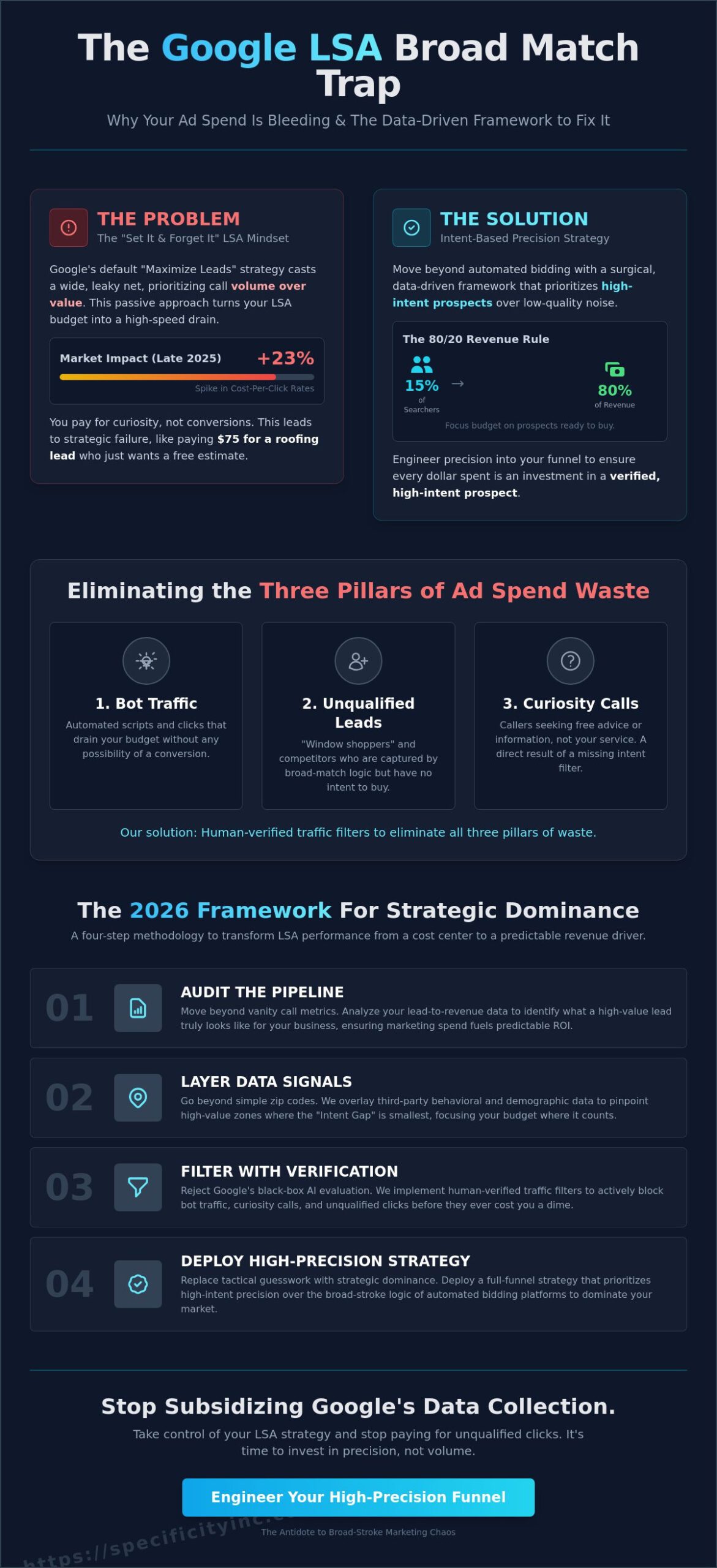
The Google Verified blue checkmark isn’t a badge of honor; it’s a license for Google to bill you for every curious caller who isn’t ready to hire. Since the manual “Report a Problem” button was removed in August 2024, your lead quality now depends on an AI-driven evaluation system that inherently favors volume over value. You’ve likely felt the impact of the 23% spike in cost-per-click rates that hit the market in late 2025. It’s frustrating to watch your capital vanish into broad-match logic while your conversion rates stagnate.
We know that paying $75 for a roofing lead who just wants a free estimate is a strategic failure. This article will teach you how to reduce ad spend waste with intent based targeting by moving beyond default “maximize leads” settings. You’ll learn the methodology required to dominate competitive markets with surgical precision. We’re going to dismantle the broad-stroke approach and replace it with a data-driven framework that prioritizes high-intent prospects over expensive, low-quality noise.
Key Takeaways
- Move beyond the “set it and forget it” LSA mindset to prevent budget bleed from unqualified window shoppers and low-intent calls.
- Learn how to reduce ad spend waste with intent based targeting by layering third-party data signals over standard geographic parameters.
- Eliminate the three pillars of waste-bot traffic, unqualified leads, and curiosity calls-using human-verified traffic filters.
- Audit your lead-to-revenue pipeline to ensure your marketing spend fuels predictable ROI instead of vanity call metrics.
- Deploy a high-precision strategy that prioritizes high-intent precision over the broad-stroke logic of automated bidding platforms.
Beyond the Google Guarantee: Why Traditional LSA Strategies Bleed ROI
Local Service Ads (LSAs) are frequently pitched as the ultimate low-risk lead generation tool. On the surface, the pay-per-lead model seems foolproof. You only pay when a prospect picks up the phone or sends a message. However, the “set it and forget it” mentality prevalent in traditional agencies has turned this platform into a high-speed drain for corporate capital. Most marketers treat LSAs as a passive bucket for calls rather than a surgical instrument for growth. This passivity is exactly what Google’s automated systems count on to maximize their own revenue at your expense.
The “Broad Match Trap” is the primary engine of this waste. Google’s default “maximize leads” bidding strategy, which became the standard for new campaigns in early 2026, prioritizes volume over granularity. It casts a wide net that captures window shoppers and unqualified callers who have no intention of buying. To truly reduce ad spend waste with intent based targeting, you must reject the idea that more calls equal more profit. Visibility is a commodity in 2026; precision is the only path to a sustainable ROI.
The Illusion of High-Intent Traffic
A phone call is a vanity metric if it doesn’t lead to a signed contract. There’s a massive psychological chasm between a user who is merely researching a problem and a prospect who is ready to deploy capital. Successful lead generation requires a deep understanding user intent to filter out the noise. When you rely on Google’s automated logic, you’re paying for curiosity. Broad targeting is the primary cause of ad spend waste because it treats every searcher as a buyer, regardless of their actual position in the sales funnel.
The Rising Cost of Tactical Guesswork
The competitive landscape has shifted aggressively. By the end of 2025, average cost-per-click rates for local services spiked by 23%, driven by increased seasonal competition and platform saturation. In this high-stakes environment, tactical button-pushing is a liability. You can’t solve a strategic deficit with better ad copy alone. Dominance in national markets requires a comprehensive b2b marketing strategy that replaces guesswork with hard data. We use Strategic Dominance as the antidote to lead-gen noise, ensuring that every dollar spent is an investment in a verified, high-intent prospect. If you aren’t engineering precision into your funnel, you’re just subsidizing Google’s data collection.
Intent-Based Targeting: Engineering Precision into the LSA Ecosystem
Keywords are no longer the primary indicator of a valuable lead. In the 2026 ecosystem, relying solely on what a user types into a search bar is a reactive, expensive strategy. To truly reduce ad spend waste with intent based targeting, you must pivot toward audience data signals that precede the search itself. This involves identifying behavioral patterns that signal a high-intent need before the prospect even triggers an LSA. By engineering precision into your targeting, you can dominate national markets without the scattergun waste of traditional agencies.
Integrating LSAs with high-performance search engine marketing (sem) allows for full-funnel coverage. This synergy ensures you capture prospects at the exact moment of intent. Implementing sophisticated intent-based marketing strategies means you aren’t just waiting for a call; you’re positioning your brand in front of the 15% of searchers who represent 80% of your potential revenue. We pinpoint the moment of intent to capture prospects with surgical precision, ensuring your budget isn’t used to educate the market, but to close it.
Data Over Guesswork: Qualifying the Who
Behavioral data allows you to qualify a prospect before they ever engage with your ad. We look at granularity beyond simple zip codes. We analyze service areas to identify high-value zones where the “Intent Gap”-the space between a generic inquiry and a ready-to-buy prospect-is smallest. This data-first approach ensures your budget isn’t consumed by low-value zones. Since the October 2025 shift to the unified “Google Verified” blue checkmark, intent is the differentiator that saves your budget.
The Full-Funnel Synergy
LSAs shouldn’t exist in a vacuum. Your LSA performance data should directly inform your social media advertising. When a prospect sees your brand on social and then sees your Google Verified badge at the top of search results, trust is established instantly. This multi-channel presence increases click-through rates and lowers overall acquisition costs. For those seeking a data-driven marketing partner, this integration is the only logical choice for growth.
Eliminating Ad Spend Waste with Human-Verified Traffic
Ad spend waste in the LSA ecosystem isn’t a single leak; it’s a structural failure caused by three distinct pillars of inefficiency: unqualified leads, bot traffic, and chronic window shoppers. Most agencies try to fix this by simply pausing ads during off-hours. This is a surface-level band-aid that ignores the underlying quality of the traffic itself. To truly reduce ad spend waste with intent based targeting, you must implement human-verified traffic as the ultimate filter for your performance data. If you aren’t verifying the human behind the click, you’re just funding a digital ghost hunt.
The lead dispute process has become a significant trap for the unwary. Since Google transitioned to an AI-driven automated credit system in August 2024, many businesses have focused on chasing refunds for invalid leads. This is a losing game. Winning a refund for a $50 lead is fundamentally less valuable than winning a $5,000 contract from a high-intent prospect. We shift the focus from reactive dispute management to proactive Negative Intent Profiling. This methodology excludes low-value search patterns before they ever trigger a billable event, ensuring your capital is preserved for ready-to-buy prospects.
Human-Verified Traffic vs. Automated Noise
Sophisticated bot networks have evolved beyond simple click-fraud; they now mimic human behavior to trigger lead forms and phone calls. In 2026, automated filters alone are insufficient to protect your digital advertising roi. You need a human element in your verification stack to pinpoint genuine intent. Bot traffic on national LSA campaigns can account for up to 30% of total spend without generating a single legitimate sales opportunity. We use human-verified traffic to prune these anomalies, ensuring that your sales team only interacts with real people who have real needs.
Negative Intent: The Power of Exclusion
Your success is defined by what you choose not to bid on. Broad-match logic often pulls in research-only search terms that drain budgets without any chance of conversion. A deeper understanding intent-based marketing allows you to identify these “looky-loos” early. We use granular job type filters within the LSA dashboard to exclude generic inquiries. By refining these parameters with surgical precision, we stop the bleed from curiosity-driven searches. This isn’t about casting a wide net; it’s about building a spear that only hits the highest-value targets in your industry.
The 2026 Framework for Strategic LSA Dominance
Google’s setup wizard is a trap designed to maximize platform revenue, not your bottom line. Following the default “recommended” settings ensures your budget is spread thin across low-intent searches and broad geographic zones. To achieve strategic dominance, you must ignore the automated suggestions and implement a rigorous, data-driven framework. This is the only way to reduce ad spend waste with intent based targeting while maintaining a competitive edge in national markets.
Our 2026 framework replaces tactical guesswork with surgical execution through five critical steps:
- Step 1: Audit the Lead-to-Revenue Pipeline. Stop measuring success by the Lead-to-Call metric. A call is a liability until it converts. You must track every LSA lead through to final revenue to identify which job types actually fuel growth.
- Step 2: Layer 3rd-Party Intent Data. Geographic targeting is too blunt. Layer behavioral intent signals over your service areas to pinpoint prospects who are actively in-market for high-value services.
- Step 3: Implement Aggressive Negative Job-Type Filtering. Use your ROI data to prune job types that generate high call volume but zero profit. Granularity is your best defense against budget bleed.
- Step 4: Establish 24/7 Lead-Qualification. Speed to lead is a non-negotiable requirement. Implement a protocol for immediate engagement to ensure high-intent prospects don’t bounce to a competitor.
- Step 5: Train the Platform Algorithm. Use the AI-driven dispute system introduced in August 2024 to aggressively flag unqualified leads. This forces the system to learn your specific quality standards, refining your traffic over time.
Transitioning from Tactical to Strategic
Strategic dominance requires moving away from cost-per-lead (CPL) as your primary KPI. In 2026, CPL is a distraction. Focus instead on cost-per-acquisition (CPA). This shift allows you to allocate budget based on market-specific intent density rather than simple population counts. High-density intent zones deserve aggressive bidding, while low-intent zones should be blacklisted. Additionally, elite creative services play a vital role in this transition. Your LSA profile must differentiate itself from the generic noise of competitors to capture the attention of sophisticated buyers.
Scalability Through Precision
Scaling an LSA campaign isn’t as simple as increasing your daily budget. Broad-stroke scaling leads to diminishing returns as the algorithm reaches for lower-quality traffic to fill the spend. Real scalability comes from intent-based precision. By maintaining extreme granularity as you expand into new national territories, you ensure that every dollar of increased spend is directed toward verified prospects. This method allows you to ignite growth without sacrificing the margins that make your business viable. If you’re ready to stop the waste and start dominating, it’s time to partner with an elite marketing specialist who understands the science of intent.
Specificity Inc.: The Antidote to Broad-Stroke Marketing Chaos
Specificity Inc. exists to solve the fundamental inefficiency of modern digital advertising. Most agencies are content to manage budgets; we’re here to dominate markets. Traditional LSA management relies on Google’s black-box automation, which inherently prioritizes platform revenue over client profit. We reject this passivity. Our philosophy is built on Intent-Based Precision, a methodology that treats data as the only valid source of truth. We don’t guess. We execute based on hard numbers and verified behavioral signals.
We provide the infrastructure needed to reduce ad spend waste with intent based targeting across both B2B and B2C sectors. By deploying human-verified traffic, we eliminate the 30% budget bleed common in national campaigns that we identified earlier. We don’t just hope for a lead; we engineer a pipeline of verified, high-intent prospects who are ready to engage. This level of granularity is the only logical choice for C-suite executives who value predictable revenue over vanity metrics. It’s the difference between throwing capital at a problem and investing it in a solution.
Our Methodology: Surgical Precision in Lead Gen
We ignite sales funnels by pinpointing high-intent audiences with surgical precision. Our approach replaces creative guesswork with elite data science. While other agencies focus on “brand awareness,” we focus on scalability and conversion optimization. We look at the data signals that matter, filtering out the noise to ensure your capital is only deployed where it has the highest probability of return. We dominate the high-intent landscape because we understand the nuances of the digital funnel better than the competition. Logic and evidence are our primary tools for driving growth.
Dominate Your Market Today
Market saturation is a reality in 2026. The window for adopting intent-based strategies before your competitors catch up is closing. Strategic dominance isn’t a suggestion; it’s a requirement for survival in high-stakes industries. Moving beyond the chaos of traditional ads requires a commitment to data-driven certainty. It’s time to audit your lead-gen pipeline and eliminate the broad-stroke waste that’s eroding your margins. Ignite your high-intent growth strategy with Specificity Inc. and secure your position at the top of the search results with absolute certainty.
Secure Your Strategic Dominance
The 2026 digital landscape doesn’t reward participation; it rewards precision. Every dollar lost to a curious caller or a sophisticated bot represents capital that should’ve fueled a high-value contract. We’ve shown that the shift to unified Google Verified signals and automated AI disputes has made the platform a minefield for broad-stroke strategies. Success now requires a pivot to a methodology that prioritizes hard data over platform-driven guesswork.
Implementing these strategies allows you to reduce ad spend waste with intent based targeting by qualifying the human behind the search. By leveraging our human-verified traffic solutions and high-intent audience data targeting, you transform your sales funnel into a high-performance asset. Our no-nonsense, ROI-driven methodology is the only logical choice for executives who demand predictable growth instead of vanity call metrics.
It’s time to stop subsidizing the noise and start capturing the market. Stop wasting ad spend and start dominating with Specificity Inc. You have the framework; now it’s time for surgical execution.
Frequently Asked Questions
What is the difference between Local Service Ads and Google Ads?
Local Service Ads operate on a pay-per-lead model while traditional Google Ads use pay-per-click. LSAs appear at the absolute top of the search results page, sitting above PPC and organic listings. You only pay for a direct call or message from a prospect. This model shifts the financial risk from the advertiser to the platform, provided you maintain the Google Verified blue checkmark.
How can I reduce ad spend waste in my LSA campaigns?
You can reduce ad spend waste with intent based targeting by implementing aggressive negative job-type filters and layering behavioral data over your geographic settings. Since the August 2024 removal of manual disputes, you must use the “Rate This Lead” tool to train the algorithm. Eliminating broad-match logic ensures you aren’t paying for curiosity-driven inquiries that never convert into revenue.
Is an LSA strategy effective for national B2B companies?
LSA strategies are highly effective for national B2B professional services, including law and real estate. The unified Google Verified signal, introduced in October 2025, provides a standardized trust marker across national markets. Scaling these campaigns requires a surgical approach to market-specific intent density rather than simply increasing a daily budget across a broad, unrefined territory.
What are the most important ranking factors for Local Service Ads in 2026?
Ranking in 2026 depends on proximity, responsiveness, and your unified Google Business Profile review score. Businesses with 50 or more reviews and a rating of at least 4.7 stars significantly outrank their competitors. Your responsiveness to calls and messages is a critical signal that the AI-driven algorithm uses to determine ad placement and lead frequency.
How does intent-based marketing improve my LSA ROI?
Intent-based marketing improves ROI by qualifying the prospect’s psychological state before the call occurs. Instead of bidding on every searcher, we pinpoint the 15% of users who exhibit high-intent behavioral patterns. This granularity ensures your capital is deployed only on prospects ready to buy, effectively lowering your cost-per-acquisition and increasing your overall sales velocity.
What happens if I receive a fraudulent lead through an LSA?
Google uses an AI-driven system to automatically evaluate lead quality and issue credits for fraudulent leads within 72 hours. The manual “Report a Problem” button was retired in August 2024. You must actively use the “Rate This Lead” tool to provide feedback. This feedback loop is essential for training the algorithm to recognize and filter out sophisticated bot traffic.
Can I use LSAs for a national service area without a physical office in every city?
You must have a verified presence in the service areas you target. Google’s verification process through Evident requires documentation for the regions you claim. However, you can dominate national markets by strategically prioritizing high-intent zones. We use data signals to identify which specific markets offer the highest intent density, allowing for a more efficient allocation of your national budget.
How long does it take to see results from a refined LSA strategy?
Visibility is often immediate, but a refined strategy takes approximately 30 to 60 days to reach peak efficiency. This window allows the AI-driven algorithm to process your lead quality feedback and optimize for high-intent prospects. During this period, we transition from the “maximize leads” default to a surgical framework focused on predictable revenue and strategic dominance.