

Signs of Ad Fraud in Analytics: The 2026 Strategic Audit Checklist
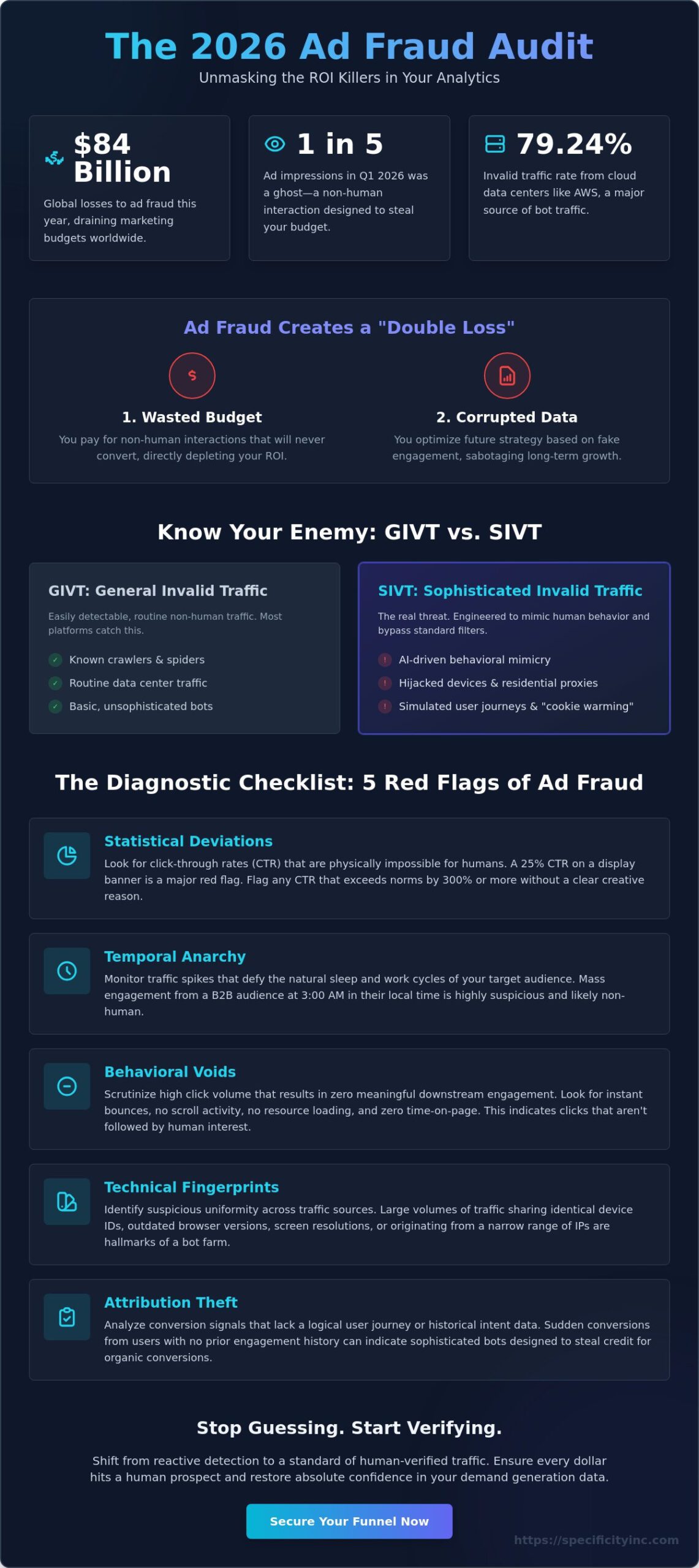
Globally, one in every five ad impressions in Q1 2026 was a ghost; a non-human interaction engineered to drain your budget. While the industry fixates on vanity metrics, global losses to ad fraud are hitting $84 billion this year. You’ve likely noticed the signs of ad fraud in analytics through inflated click-through rates that fail to produce pipeline or suspicious traffic spikes from cloud data centers like AWS, which currently shows a staggering 79.24% invalid traffic rate. This isn’t just a budget leak. It’s a data corruption event that destroys the integrity of your intent-based targeting strategy.
You’re right to be skeptical of your current reporting when non-human traffic skews every KPI you present to stakeholders. We’ll help you pinpoint these deceptive patterns and eliminate the noise with a surgical diagnostic framework. This 2026 strategic audit checklist provides the granularity needed to identify sophisticated bot networks and Made-for-Advertising sites. We’ll move you from guesswork to precision, ensuring every dollar hits a human prospect and restores absolute confidence in your demand generation data.
Key Takeaways
- Stop treating ad fraud as a minor nuisance; it is a sophisticated ROI killer engineered to mimic high-intent human behavior and bypass standard filters.
- Deploy a surgical diagnostic checklist to pinpoint the subtle signs of ad fraud in analytics that corrupt your SEM and programmatic data.
- Decode the technical fingerprints of advanced deception, specifically the SSAI spoofing patterns currently eroding Connected TV performance.
- Eliminate the risk of scaling budgets on false positive signals by shifting from reactive detection to a standard of human-verified traffic.
The Strategic Threat: Why Ad Fraud in Analytics is an ROI Killer
Ad fraud is a sophisticated, multi-billion dollar operation engineered to mimic high-intent human behavior with terrifying accuracy. It’s not just a budget leak; it’s an assault on your strategic intelligence. When you analyze your performance, you’re likely seeing the signs of ad fraud in analytics disguised as genuine engagement. Understanding what is ad fraud in the context of 2026 requires moving past the idea of simple “bot clicks.” Modern fraud involves coordinated networks that simulate complex user journeys to steal attribution and drain budgets.
Basic filters are no longer sufficient against 2026-era bot farms. These operations utilize decentralized residential proxy networks and advanced behavioral modeling to bypass traditional verification. This creates a “Double Loss” for your organization. First, you pay for the non-human interaction. Second, and more dangerously, you optimize your future strategy based on fake data. This corruption of your baseline requires a ruthless digital advertising roi mindset that prioritizes data integrity over vanity metrics.
The Evolution of Sophisticated Invalid Traffic (SIVT)
Distinguishing between General Invalid Traffic (GIVT) and Sophisticated Invalid Traffic (SIVT) is critical for modern marketers. GIVT includes known crawlers and routine data center traffic that most platforms catch easily. SIVT is the real threat. AI-driven bots now simulate mouse movements, varying scroll speeds, and even “hesitation” patterns to appear human. SIVT is the primary adversary for modern B2B demand gen, lurking within your most expensive campaigns.
The Corruption of Intent-Based Targeting
Fraudsters now engage in “cookie warming,” where bots visit high-intent B2B sites to build a profile that looks like a high-value prospect. When these bots later visit sites within an ad network, they trigger high-cost bids because they appear to be “in-market” buyers. The ripple effect is devastating. Your retargeting lists become bloated with non-human entities, causing you to chase ghosts with increasingly higher bids. This cycle destroys the precision required for effective b2b marketing. Without identifying the signs of ad fraud in analytics, you’re essentially subsidizing the very bot networks that are sabotaging your scalability.
The Diagnostic Checklist: Primary Indicators of Invalid Traffic
Identifying the signs of ad fraud in analytics isn’t a passive exercise; it’s a surgical audit of your entire demand generation infrastructure. You need more than surface-level observations. You need a data-driven diagnostic framework that isolates non-human activity from your genuine pipeline. This process aligns with the Federal Trade Commission’s truth-in-advertising laws, which emphasize transparency and accountability in digital placements. To maintain strategic dominance, your audit must contextualize every anomaly against your search engine marketing (sem) benchmarks to ensure your high-intent traffic remains pure.
Your audit should focus on five critical “Red Flag” categories that signal deceptive patterns:
- Statistical Deviations: Click-through rates that defy the physics of human behavior.
- Temporal Anarchy: Traffic spikes that ignore the sleep and work cycles of your target audience.
- Behavioral Voids: High-volume clicks that result in zero downstream engagement or resource loading.
- Technical Fingerprints: Suspicious uniformity in device IDs, browser versions, and IP ranges.
- Attribution Theft: Conversion signals that lack a logical entry path or historical intent data.
Anomalous Click-Through Rates (CTR) and Patterns
Flag any CTR that exceeds industry norms by 300% or more without a clear creative catalyst. A 25% CTR on a programmatic display banner is a mathematical impossibility in a human-centric environment. Monitor your logs for “Click Spikes” that occur during non-business hours in your target geography. Real human prospects in North American B2B markets don’t engage in mass volume at 3:00 AM. Pinpoint uniformity in click timing. Real humans exhibit chaotic behavior. Bots click at perfect, rhythmic intervals. If your data shows a recurring 2-second gap between clicks, your campaign is being harvested by a bot farm.
Engagement Gaps and High-Speed Bounces
Analyze the disconnect between high CTR and zero session duration. This is the hallmark of bot-driven arbitrage. Look for “Instant Bounces” where the server log shows no secondary resource loading, meaning the “user” never actually rendered the page elements. A 100% bounce rate from a specific referring domain is a definitive bot signal that requires immediate blacklisting. When your data lacks granularity, you’re flying blind. You can audit your current traffic quality to see exactly where your budget is leaking into these non-human voids and reclaim your ROI.
Sophisticated Deception: Identifying Advanced Fraud Patterns
Surface metrics are merely the bait. To protect your capital, you must look for the technical fingerprints left by sophisticated actors who operate at the protocol level. These entities don’t just mimic human clicks; they engage in signal spoofing to deceive even advanced attribution models. Industry leaders like Google provide a baseline for defining invalid traffic, but 2026-era fraud requires a level of granularity that standard platforms simply don’t provide. You are no longer fighting simple scripts. You are fighting coordinated “Device Farms” where thousands of physical handsets are programmed to simulate the high-density traffic patterns of a corporate office, effectively poisoning your intent data.
IP Clustering and Subnet Anomalies
If 90% of your B2B traffic originates from a narrow IP range belonging to a commercial data center, you aren’t reaching prospects. You are reaching a server rack. Traffic from Amazon Web Services (AWS) currently shows a staggering 79.24% IVT rate, yet many advertisers continue to bid on these signals without second thought. While residential proxies and VPNs are frequently used to mask bot activity, a surgical audit reveals the lack of diversity in the underlying subnets. Genuine high-intent traffic from verified corporate networks exhibits specific behavioral signatures that bots cannot replicate. We pinpoint these deviations by analyzing the connection between IP reputation and downstream conversion events, ensuring your spend remains focused on human buyers.
The CTV Attribution Trap
Fraudsters have pivoted to connected tv advertising with aggressive intent, exploiting Server-Side Ad Insertion (SSAI) to spoof millions of household impressions. This “SSAI Spoofing” allows a single fraudulent server to pretend it is a fleet of unique televisions. One of the most glaring signs of ad fraud in analytics is “Device ID Reset” fraud, where a single physical device generates thousands of unique viewer IDs in a matter of hours. You must also monitor for “Always On” traffic. If a device is recorded “watching” ads 24 hours a day, 7 days a week, it is a bot, not a consumer. Specificity Inc. pinpoints these anomalies in CTV campaigns by cross-referencing impression data with human-verified behavioral patterns, cutting through the noise of spoofed signals to secure your ROI.
The Funnel Impact: How Fraud Skews Performance Intelligence
Ad fraud doesn’t just steal your capital; it poisons the well of your performance intelligence. It creates a “false positive” environment where marketing teams celebrate high engagement metrics while the revenue engine stalls. This is the most dangerous consequence of ignoring the signs of ad fraud in analytics. When you scale budgets based on fraudulent conversion signals, you aren’t growing your business. You’re subsidizing a sophisticated criminal enterprise. This data corruption leads to a strategic hall of mirrors where every decision is based on a lie.
The damage extends deep into your organizational alignment. When Sales receives a batch of “leads” that are actually bot-filled forms, internal trust evaporates. These non-human interactions create friction that stalls your go-to-market momentum and wastes the time of your most expensive human assets. Precision is the only antidote to this marketing noise. You must verify the human at the other end of the click before you commit your strategic resources to a lead or a campaign. Without this verification, your scalability is an illusion built on a foundation of invalid traffic.
Corrupted Retargeting Pools
Bot clicks do more than waste the initial impression. They inject “fake” users into your high-value retargeting audiences by triggering tracking pixels. This forces you to bid premium rates to serve ads to non-existent prospects across the internet. It’s a strategic failure often seen in broad-stroke social media advertising where volume is prioritized over intent. The hidden cost of chasing these ghosts can consume a massive portion of your retargeting spend without ever reaching a human eye. You’re essentially paying to follow a script around the web.
Skewed Attribution Models
Fraudulent actors specialize in “Last Click” theft. They monitor for high-value conversion events and fire a last-second click to steal attribution from your legitimate top-of-funnel channels. This corrupts your entire Media Mix Modeling. It makes underperforming, bot-heavy channels look like winners while your most effective human-centric campaigns appear to fail. Human-verified traffic is the only way to generate a clean attribution signal that reflects reality. You can eliminate these false positives and restore the integrity of your funnel by implementing a human-verified traffic standard today.
Securing the Funnel: Moving to Human-Verified Traffic
Identifying the signs of ad fraud in analytics is a necessary defensive posture, but detection alone won’t reclaim your lost ROI. Defensive strategies are inherently reactive. To win in 2026, you must shift from a model of detection to one of absolute prevention. This requires an immediate transition to Human-Verified Traffic. This is the elite standard for B2B and B2C campaigns that prioritizes the integrity of the individual prospect over the volume of the placement. You don’t just want to block fraud; you want to make your infrastructure invisible to it.
The solution isn’t a better filter. It’s a better targeting philosophy. By moving your budget away from open-exchange “spray and pray” tactics, you remove the primary incentive for bot networks to target your campaigns. Fraud thrives in the shadows of broad-stroke marketing. It dies when confronted with the light of surgical precision. When every impression is tied to a human-verified identity, the economic model of ad fraud collapses. You aren’t just securing a funnel; you’re dominating a market by ensuring every dollar spent is an investment in a real human relationship.
The Power of Intent Data Targeting
Intent data targeting bypasses bot networks by focusing on verified human actions rather than passive cookies or broad demographics. Bots are experts at simulating interest, but they struggle to replicate the complex, multi-layered behavioral history of a genuine B2B buyer. Specificity’s data-driven methodology uses surgical precision to pinpoint individuals who have already demonstrated real-world intent. This approach creates a closed-loop system where only verified humans can trigger an ad serving event. Contrast this with broad reach tactics that act as magnets for sophisticated invalid traffic. By narrowing your focus to high-intent humans, you eliminate the noise and waste that characterize the general advertising industry.
Implementing a Zero-Trust Traffic Architecture
Strategic dominance requires a C-suite audit of your current agency partners. You must adopt a zero-trust architecture where no traffic is assumed human until proven otherwise. Ask your current providers hard questions about their human verification protocols. If they rely solely on platform-native filters or basic third-party verification tools, they’re leaving you exposed to the sophisticated deceptive patterns we’ve discussed. Demand granularity. Demand proof of human interaction. It’s time to stop subsidizing bots and start investing in growth. You can ignite your growth with human-verified precision and ensure your demand generation engine is fueled by real prospects, not digital ghosts.
Reclaiming Your Strategic Dominance
The era of passive monitoring is over. You’ve identified the signs of ad fraud in analytics, but recognizing the threat is only half the battle. Real strategic dominance requires a ruthless commitment to data integrity and the elimination of non-human noise. By implementing a zero-trust architecture and prioritizing high-intent audience targeting, you move from reactive defense to proactive market leadership.
We don’t just block fraud; we out-target it. This unapologetically data-driven ROI focus ensures that every dollar you deploy hits a verified human prospect. It’s time to purge the digital ghosts from your funnel and restore absolute confidence in your pipeline. You have the framework; now it’s time to execute with surgical precision. Your growth depends on the clarity of your data and the human verification of your traffic.
Stop paying for bots and start dominating with human-verified traffic.
Frequently Asked Questions
How can I tell if my Google Analytics data is being skewed by bots?
Pinpoint 100% bounce rates from specific referring domains or sudden traffic spikes from cloud data centers like AWS. Check for session durations of 0:00 seconds paired with unusually high click-through rates. These are primary signs of ad fraud in analytics that indicate non-human scripts are corrupting your engagement metrics and inflating your vanity data.
What is the difference between General Invalid Traffic (GIVT) and Sophisticated Invalid Traffic (SIVT)?
GIVT consists of routine, non-malicious crawlers and known data center traffic that standard platform filters catch easily. SIVT is a malicious operation specifically engineered to mimic human behavior through simulated mouse movements and scroll patterns. SIVT is the primary threat to your ROI because it bypasses basic detection by mimicking high-intent user journeys with surgical precision.
Is ad fraud more common in Social Media or Programmatic Display?
Both channels face severe threats, but programmatic display often exhibits higher vulnerability due to the complexity of the digital supply chain. While social platforms struggle with bot accounts and engagement farms, programmatic environments are plagued by domain spoofing and Made-for-Advertising (MFA) sites. You must audit both environments to ensure your intent-based targeting remains untainted by non-human interactions.
Can Connected TV (CTV) advertising be affected by ad fraud?
CTV currently has the highest fraud rate among all advertising channels, reaching 18% in early 2026. Fraudsters exploit Server-Side Ad Insertion (SSAI) to spoof millions of household impressions from a single server. If your CTV analytics show “Always On” devices recording ad views 24 hours a day, you’re paying for bot-driven impressions rather than human attention.
How does ad fraud impact the accuracy of my B2B intent data?
Ad fraud poisons your intent data by injecting “fake” high-intent signals into your CRM and retargeting pools. Bots “warm up” cookies by visiting high-value B2B industry sites, making them appear as qualified prospects to your bidding algorithms. This corruption causes you to scale budgets toward non-existent buyers, destroying the granularity and precision required for effective demand generation.
What are the most common signs of click fraud in SEM campaigns?
Monitor for rhythmic click patterns and geographic anomalies where traffic originates from regions outside your target territory. A major indicator is a high volume of clicks from IP ranges associated with cloud infrastructure, which showed an IVT rate of nearly 80% for AWS in Q1 2026. If your SEM data shows a massive CTR spike without a corresponding lift in pipeline, you’re seeing signs of ad fraud in analytics.
Why is human-verified traffic better than standard ad fraud software?
Standard software is reactive and frequently fails against AI-driven SIVT that mimics human behavior patterns. Human-verified traffic is a proactive standard that ensures every impression is tied to a real person through identity-based targeting. It moves your strategy from simple detection to absolute prevention, securing your funnel against sophisticated deceptive patterns that software alone misses.
What should I do if I find high levels of invalid traffic in my analytics?
Immediately blacklist the offending IP ranges and subnets, specifically those originating from commercial data centers. Shift your budget toward human-verified traffic sources and intent-based targeting models that bypass open-exchange vulnerabilities. Conduct a surgical audit of your current agency partners to ensure they use granular verification protocols rather than relying on basic, ineffective platform filters.