Consumer Intent Data & Audience Targeting: The 2026 Strategy for Strategic Dominance
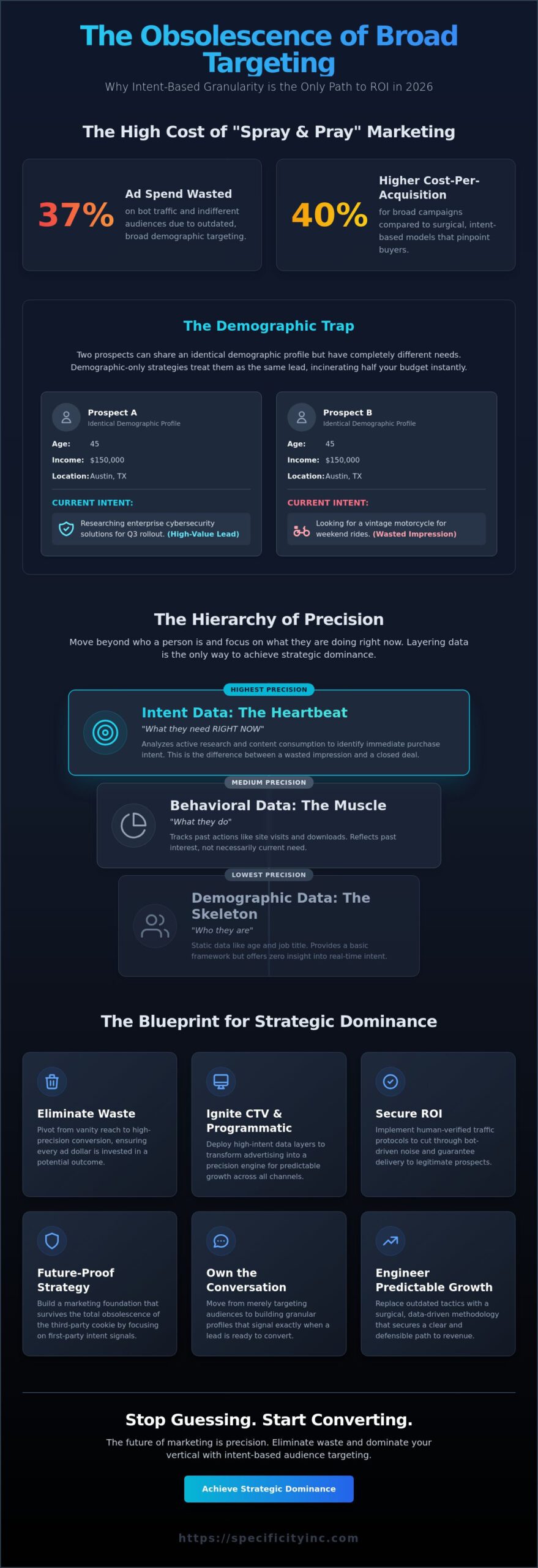
Broad demographic targeting is the fastest way to incinerate a 2026 marketing budget. If you’re still chasing personas based on age or job title, you’re likely losing 37% of your ad spend to bot traffic and indifferent audiences. To achieve strategic dominance, you must leverage consumer intent data, demographic vs behavioral targeting, audience targeting strategies, and data driven marketing to pinpoint high-value prospects. This transition isn’t just a trend; it’s the only way to identify buyers before your competitors even realize they’re in-market. High-precision granularity is now the baseline for any organization that expects to survive the total obsolescence of the third-party cookie.
You already know that vanity metrics like impressions don’t pay the bills. You’re tired of seeing 1.5% conversion rates while your C-suite demands a clear path to ROI. We promise to show you how to move from broad-stroke guesses to a surgical methodology that ignites conversion rates and secures predictable revenue growth. This article provides a comprehensive blueprint for replacing outdated tactics with intent-based granularity that eliminates waste. We’ll explore the tools and logic required to dominate your vertical through the rest of the decade.
Key Takeaways
- Eliminate the “professional malpractice” of broad demographic targeting and pivot to a strategy that prioritizes high-precision conversion over vanity reach.
- Master the hierarchy of demographic vs behavioral targeting to build elite audience targeting strategies that utilize consumer intent data and data driven marketing to pinpoint the exact destination of the buyer’s journey.
- Ignite demand across Connected TV (CTV) by deploying high-intent data layers that transform programmatic advertising into a precision engine for growth.
- Secure your ROI by implementing human-verified traffic protocols that cut through bot-driven noise and ensure every ad dollar reaches a legitimate prospect.
- Shift from merely targeting audiences to owning the conversation by building granular profiles that signal exactly when a lead is ready to convert.
Beyond Demographics: Why Broad Targeting is Professional Malpractice in 2026
The era of “spray and pray” marketing is dead. By 2026, any brand still dumping capital into broad-reach campaigns is committing professional malpractice. This isn’t a gradual transition; it’s a total collapse of traditional methodology in a hyper-fragmented digital landscape. Relying on static markers like age, gender, and income leads to catastrophic ad waste. These metrics don’t predict behavior. They only describe a person’s history, not their future intent. Strategic dominance in 2026 requires a shift from reach to precision. If you aren’t using consumer intent data to drive every dollar spent, you’re subsidizing your competitor’s growth.
The 2026 standard for data driven marketing demands surgical accuracy. High-stakes environments leave no room for vanity metrics like impressions or clicks that fail to move the needle on revenue. Modern audits show that broad-stroke campaigns can result in a 40% higher cost-per-acquisition compared to intent-based models. We don’t settle for “awareness” when we can pinpoint conversion. Specificity is the only hedge against a market that increasingly ignores generic noise.
The Demographic Trap
Demographics are a facade. Two individuals might share an identical profile: 45-year-old male, $150,000 annual income, residing in Austin, Texas. One is actively researching enterprise cybersecurity solutions for a Q3 rollout; the other is looking for a vintage motorcycle. A demographic-only strategy treats them as the same lead, wasting half your budget instantly. This is the fundamental failure of demographic vs behavioral targeting. Static data is a snapshot of the past, while intent is a live feed of the present. Moving from “who they are” to “what they need right now” is the difference between a wasted impression and a closed deal. In 2026, Targeted advertising must be rooted in real-time action, not outdated census data.
The 2026 Reality of Audience Fragmentation
The proliferation of platforms has shattered the unified consumer journey. With users interacting across 20+ digital touchpoints daily, broad targeting has become a liability. You can’t dominate a market by being everywhere poorly. You dominate by being in the right place at the exact moment of need. Granular audience targeting strategies are now the only way to maintain a competitive digital advertising roi. Every dollar must be indexed against high-intent signals to ensure scalability without dilution.
The Precision Gap is the widening chasm between the massive datasets brands collect and their actual ability to activate that data at the specific moment of purchase intent.
To bridge this gap, organizations must abandon the safety of large numbers. Reach is a comfort metric for the insecure. Precision is the metric of the elite. By prioritizing consumer intent data, we eliminate the guesswork that plagues traditional agencies. We don’t hope for a conversion; we engineer it through logic, evidence, and hard numbers.
The Hierarchy of Precision: Demographic vs. Behavioral vs. Intent Data
Broad-stroke marketing is a fiscal liability. In a market where 68% of B2B buyers prefer to research independently before engaging a sales rep, relying on static profiles is a recipe for obsolescence. We categorize audience targeting strategies into a strict hierarchy: demographic, behavioral, and intent. Demographics provide the skeleton; behavior adds the muscle; intent provides the heartbeat. To achieve strategic dominance, you must move beyond who a person is and focus on exactly what they’re doing right now.
Psychographics layer emotional resonance over this technical framework. While data driven marketing identifies the “what,” psychographics explain the “why.” This allows for a level of granularity that transforms generic ads into surgical strikes. You aren’t just targeting a CEO; you’re targeting a CEO who values disruptive innovation and fears stagnation. That distinction is the difference between a 0.5% and a 5.0% conversion rate.
Demographic vs. Behavioral Targeting: A Tactical Comparison
Demographic targeting is the baseline, yet it’s often where weak agencies stop. Targeting a “VP of Sales” at a Fortune 500 company tells you their budget, not their need. Behavioral targeting acts as the bridge between curiosity and commitment by tracking digital body language. It monitors whitepaper downloads, webinar attendance, and repeated site visits. A prospect searching for “best CRM for enterprise scaling” is 10 times more valuable than a list of 1,000 job titles. Behavior reveals the journey, allowing you to pinpoint the exact moment a lead becomes a legitimate opportunity.
Consumer Intent Data: The Pinnacle of the Funnel
Consumer intent data represents the highest form of intelligence in the modern sales funnel. It aggregates search queries, content consumption patterns, and dark social signals to identify active buyers. High-intent signals occur when a prospect consumes 3 or more pieces of bottom-funnel content within a 48-hour window. This is the ultimate weapon for demand generation because it eliminates guesswork.
The battle for market share is won by those who master High-Value Intent Data. First-party intent data, harvested from your own properties, offers the highest accuracy. Third-party data provides the scale necessary for aggressive expansion. By synthesizing both, you identify high-intent signals before your competitors even know the prospect is in-market. This isn’t just demographic vs behavioral targeting; it’s the implementation of a predictive system that mandates growth through mathematical certainty.
Strategic Dominance Through Intent-Based Audience Targeting
Building a high-intent audience profile isn’t about casting a wide net; it’s about surgical extraction. By 2026, the gap between demographic vs behavioral targeting will widen into a chasm that swallows unprepared brands. Demographic data tells you who someone might be, but consumer intent data tells you exactly what they’re doing right now. We don’t just target audiences; we own the conversation by intercepting prospects the moment they signal a need. Integrating this level of intelligence into b2b marketing allows firms to shorten sales cycles by as much as 25% by engaging decision-makers during the critical 70% of the research phase that happens before they ever contact a salesperson.
The Mechanics of Intent Extraction
Modern programmatic display platforms process intent signals in under 100 milliseconds. This speed allows for the deployment of audience targeting strategies that bypass the fluff of broad interest categories. We use keyword-level intent to identify users searching for specific solutions, not just people who “like” an industry. AI filters out the 85% of “window shoppers” who lack the behavioral velocity of a ready-to-buy prospect. This ensures that your message only reaches the 15% of the market currently in an active buying cycle.
Eliminating Waste with Surgical Precision
Waste is the silent killer of ROI. We reallocate budget from low-performing broad segments to high-intent clusters with documented conversion potential. The Specificity philosophy is clear: if the intent isn’t verified through recent, high-value behavioral data, the impression is a wasted expense. Broad reach is the enemy of conversion optimization because it prioritizes vanity metrics over the hard reality of a closed sale. This data driven marketing approach ensures every dollar fuels a direct path to revenue. Consider these pillars of precision:
- Granular Filtering: Pinpointing decision-makers based on 48-hour search history rather than 30-day cookie pools.
- Budget Reallocation: Moving capital from 0.05% CTR broad segments to 1.5% CTR intent clusters.
- Verified Interaction: Only bidding on impressions where the user has crossed a specific threshold of research intensity.
The result is a streamlined funnel where the noise is silenced and the signal is amplified. When you stop chasing everyone, you finally start catching the people who matter. This isn’t just marketing; it’s a calculated strike on the most profitable segments of your market.
Multi-Channel Execution: Deploying Intent Data Across CTV and Programmatic
Intent data dies in a vacuum. To dominate the 2026 landscape, you must weaponize consumer intent data across the entire digital ecosystem to see real-world returns. Strategic growth in this environment requires rigorous market research and media buying. While firms like Reality Marketing Group specialize in these foundational growth strategies, we prioritize surgical precision because execution is where strategy meets ROI, and it requires a ruthless focus on where high-value leads actually spend their time.
CTV: The Precision Engine for High-Intent Audiences
Traditional television was a gamble; connected tv advertising is a precision strike. By Q1 2026, 87% of US households will be reachable via CTV, yet most brands still treat it like a top-of-funnel branding tool. This is a strategic failure. We move beyond “living room reach” to target individual-level intent on the largest screen in the house.
We transform CTV into a performance channel by layering high-intent data directly onto the ad server. This means your 15-second spot doesn’t play for a generic demographic; it plays for the specific user who researched your product category 48 hours ago. This closed-loop strategy integrates CTV with mobile and desktop retargeting. When a lead sees your ad on their TV, their mobile device is simultaneously primed for a follow-up programmatic display banner. This creates a surround-sound effect that forces conversion.
Omnichannel Intent Synchronization
Your audience targeting strategies must be fluid. A lead might trigger an intent signal on a professional forum, search for a solution on Google, and then browse industry news. You must follow the intent, not just the platform. We synchronize every touchpoint to ensure the message remains consistent as the lead moves through the funnel.
- Search engine marketing (sem) captures the immediate “I need this now” demand. It’s the ultimate capture point for active searchers.
- Social media advertising nurtures intent that hasn’t yet reached the search stage. It builds the fire before the lead even types a query.
- Programmatic display maintains top-of-mind awareness across 98% of the open web, ensuring your brand is the only logical choice when the lead is ready to buy.
The debate of demographic vs behavioral targeting is over. Behavioral data wins every time because it’s rooted in action, not assumptions. This data driven marketing approach ensures that your budget is never wasted on “likely” buyers, only on those who have demonstrated a clear path to purchase. We pinpoint these high-intent leads and dominate their digital experience until they convert.
Dominate your market with precision intent execution today.
Scaling Certainty: Human-Verified Traffic and the Specificity Inc. Edge
The intent data marketplace is currently a minefield of artificial signals. In 2023, reports from cybersecurity firms like Imperva confirmed that 49.6% of all internet traffic originated from bots. This means nearly half of the “intent” signals purchased by standard marketing departments are digital ghosts. Buying unverified data is a fast track to budget depletion. Specificity Inc. eliminates this risk by applying a rigorous filter to every lead. We don’t trade in volume; we trade in verified human action. This is the only way to ensure your data driven marketing efforts result in a positive return on investment.
The Human-Verified Difference
Verification is more than a simple bot check. It’s a technical mandate to ensure you’re reaching the right person at the right time. We scrub programmatic feeds with surgical precision to remove the noise that plagues most audience targeting strategies. While other agencies rely on broad-stroke demographic vs behavioral targeting, we focus on the purity of the signal. Our process involves cross-referencing behavioral triggers with verified identity markers. This eliminates the 25% to 30% of data waste typically found in standard intent feeds. When we deliver a lead, it represents a human being currently engaged in a high-value research journey. This level of granularity protects your brand and ensures your sales team spends their time on prospects that actually exist.
Dominating Your Market with Intent-Based Precision
Dominance in 2026 isn’t about who spends the most. It’s about who possesses the most accurate map of the consumer journey. Specificity Inc. provides that map by combining elite data science with aggressive sales enablement. We position your brand as the logical, inevitable conclusion to the consumer’s research. Our methodology replaces the traditional “spray and pray” approach with a tactical strike. We use consumer intent data to pinpoint exactly where a prospect sits in the funnel. This allows for a level of scalability that guesswork can’t match. We don’t just find your audience; we own the data that defines them.
The transition from guesswork to data-driven certainty is the only path to predictable revenue. If your current strategy relies on outdated personas or broad interest categories, you’re leaving money on the table. We provide the precision required to ignite your sales funnel and dominate your vertical. Stop paying for clicks that don’t convert. Contact Specificity Inc. for a high-intent audit today.
Capture the 2026 Market With Surgical Precision
Broad targeting is a liability that your budget can’t sustain. As we approach 2026, the divide between market leaders and struggling firms will be defined by their mastery of consumer intent data, demographic vs behavioral targeting, audience targeting strategies, data driven marketing, and the precision of their execution. Traditional programmatic models often lose 60% of their efficiency to bot traffic and misaligned placements. Specificity Inc. solves this through human-verified traffic solutions that ensure zero-waste advertising. We don’t settle for creative guesswork. Instead, we deploy elite specialists in CTV and high-intent B2B targeting to pinpoint your most profitable prospects. Our independent agency was built on the philosophy of surgical precision because we know that ROI is the only metric that matters to your C-suite. It’s time to stop shouting into the void and start engaging the buyers who are ready to act.
Ignite your demand gen with intent-based precision, Contact Specificity Inc.
The future of your growth is waiting. We’re ready to help you claim it.
Frequently Asked Questions
What is the difference between consumer intent data and behavioral data?
Consumer intent data identifies active purchase signals while behavioral data focuses on historical actions. Behavioral data might tell you a user visited a car blog in 2023; consumer intent data tells you they searched for “best SUV lease deals” 10 minutes ago. We focus on these real-time triggers to capture the 3% of the market currently in a buying window, ensuring zero budget is wasted on past interest.
How does demographic targeting compare to intent-based targeting in 2026?
Demographic targeting identifies a profile, but intent-based targeting identifies a specific need. By 2026, 85% of leading CMOs will prioritize intent over traditional demographic vs behavioral targeting models. Intent signals produce a 400% increase in lead quality because they ignore who the person is in favor of what they’re trying to solve right now. It’s the difference between guessing and knowing.
Can I use intent data for B2B demand generation?
Intent data is the foundation of modern B2B demand generation. It allows your team to pinpoint accounts interacting with specific technical keywords or competitor comparison pages. This data driven marketing strategy ensures your sales reps only call the 10% of prospects who are actively seeking a solution. You’ll maximize efficiency by focusing resources on accounts that are already 70% through the buyer’s journey.
Is behavioral targeting still effective without third-party cookies?
Behavioral targeting is thriving through the use of 1st-party data and identity resolution. Google began its 1% cookie phase-out in Q1 2024, forcing brands to adopt server-side tracking. These audience targeting strategies use hashed emails and device IDs to maintain precision without relying on invasive 3rd-party tracking scripts. You don’t need cookies to track actions if you own the data relationship with your audience.
What are the best audience targeting strategies for Connected TV (CTV)?
The most effective CTV strategy involves mapping household IP addresses to real-time search intent. Traditional TV ads suffer from 60% waste due to broad demographic buys. By targeting specific households that have already demonstrated intent on other devices, you ignite your brand presence exactly where the decision-maker lives. This cross-device precision ensures your high-impact video assets reach people who are actually in the market for your services.
How does human-verified traffic improve digital advertising ROI?
Human-verified traffic increases ROI by removing the 25% of ad spend typically lost to bot activity. Sophisticated invalid traffic (SIVT) inflates vanity metrics but never results in a conversion. By ensuring 100% of your traffic is human, you stabilize your conversion data and ensure every cent is spent on a legitimate prospect. This verification process is the only way to protect your margins from digital fraud.
What is the most effective way to collect first-party intent data?
You collect the best first-party intent data by offering interactive tools that solve immediate problems. Tools like ROI calculators or diagnostic audits reveal a prospect’s specific challenges and budget constraints. This creates a proprietary stream of consumer intent data that gives you a permanent competitive advantage. You’ll stop relying on rented lists and start building an asset that your competitors cannot buy or replicate.
How do I integrate demographic and behavioral targeting into a single campaign?
You integrate both by using intent as the primary trigger and demographics as the qualifying filter. This demographic vs behavioral targeting strategy ensures you don’t spend money on high-intent users who don’t fit your Ideal Customer Profile. You pinpoint the active buyer first, then verify they have the authority and revenue to close. This dual-layer approach eliminates the noise and focuses your spend on high-value conversions.