Click Fraud Prevention Software: Eliminating Waste in High-Stakes Digital Campaigns
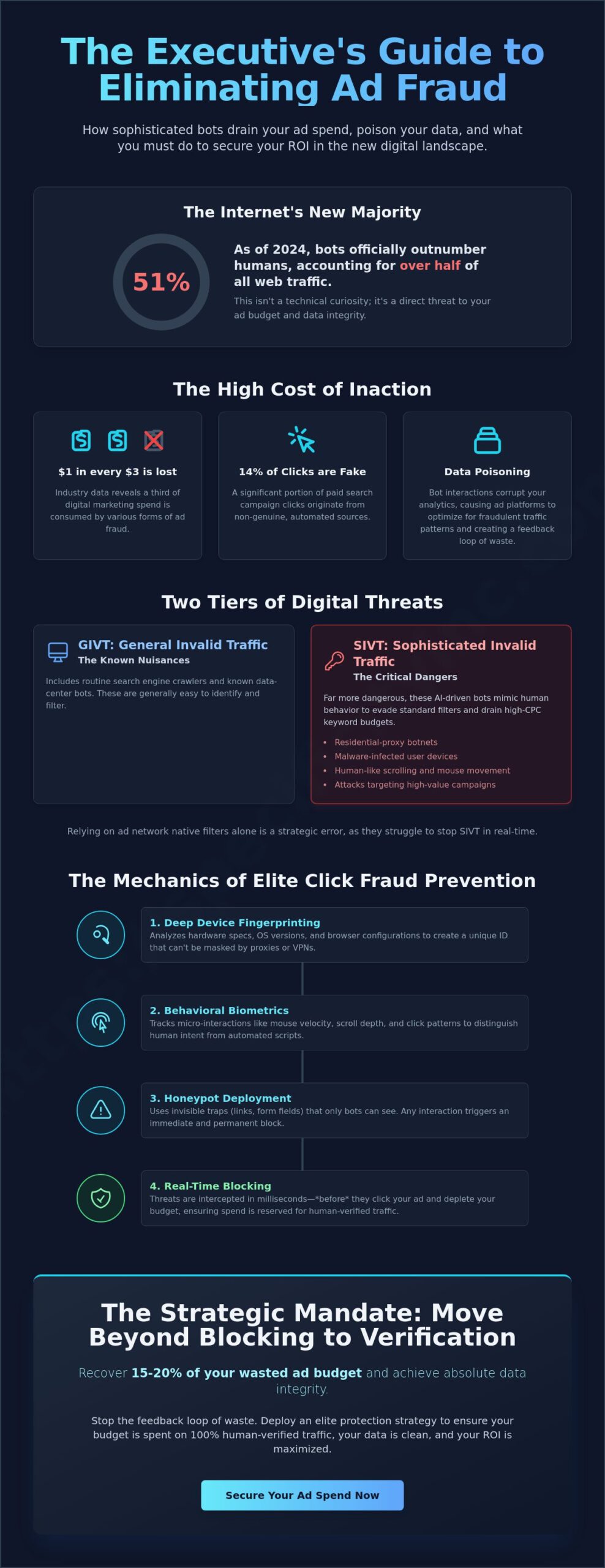
Did you know that as of 2024, bots officially outnumbered humans on the internet, accounting for 51% of all web traffic? For high-stakes advertisers, this isn’t just a technical quirk; it’s a direct assault on your bottom line. Every dollar funneled into non-human interactions is a dollar stolen from your growth. Deploying elite click fraud prevention software is no longer a luxury for the cautious. It’s a strategic mandate for any executive who demands 100% human-verified traffic and absolute data integrity in their SEM and programmatic display campaigns.
You likely suspect that your current conversion data is skewed by aggressive competitors or sophisticated botnets that mimic human behavior. You’re right to be concerned. This guide will show you how to move beyond basic IP blocking to master a methodology that recovers 15 to 20 percent of your wasted ad budget. We’ll examine the technical mechanics of human-verified traffic and the data-driven strategies elite brands use to secure dominant ROI through precise accuracy.
Key Takeaways
- Analyze the evolution of modern ad fraud and why traditional blocking methods aren’t enough to stop 2026 bot technology.
- Master the mechanics of click fraud prevention software including the use of behavioral biometrics to distinguish human intent from automated scripts.
- Identify the critical features required in a protection suite to stop “Lead Fraud” from polluting your sales pipeline with fake data.
- Discover why elite advertisers are abandoning reactive blocking in favor of proactive, human-verified traffic and intent-data targeting.
What is Click Fraud Prevention Software and Why is it Critical in 2026?
Ad fraud is no longer a peripheral nuisance; it’s a systemic drain on enterprise capital. Click fraud prevention software functions as a sophisticated layer of real-time behavioral analysis, designed to intercept malicious interactions before they deplete your daily budget. While early iterations of fraud relied on basic scripts, the 2026 landscape is dominated by sophisticated click farms and AI-powered botnets that effectively mimic human engagement. Understanding What is Click Fraud? requires looking past simple automated clicks to the complex systems designed to siphon revenue from high-stakes campaigns.
The financial impact remains staggering. Industry data indicates that 14% of all clicks on paid search campaigns originate from non-genuine sources. For every $3 spent on digital marketing, $1 is lost to ad fraud. When automated traffic accounts for 51% of all web traffic, the probability of your SEM or programmatic display ads being served to a bot is a statistical certainty. Beyond the immediate loss of capital, these fraudulent interactions cause “Data Poisoning.” When your tracking pixels ingest bot data, your platform algorithms optimize for the wrong signals. This creates a feedback loop of waste where the machine learning models of major ad networks prioritize fraudulent traffic patterns over actual human intent.
The Mechanics of Modern Ad Fraud
Distinguishing between General Invalid Traffic (GIVT) and Sophisticated Invalid Traffic (SIVT) is essential for strategic defense. GIVT includes routine search engine crawlers and known data-center bots. SIVT is far more dangerous. It leverages residential-proxy botnets and malware-infected devices to appear as legitimate users. Modern AI-driven bots are programmed to mimic human scrolling, cursor pauses, and dwell times, making them invisible to standard filters. These attacks specifically target high-CPC keywords where the payout for fraudulent publishers or the damage to competitors is maximized.
Why Platform Native Filters are Insufficient
Relying solely on ad networks to police fraud is a strategic error. Platforms face an inherent conflict of interest; they’re essentially grading their own homework. While they offer some protection, their systems often operate with a significant lag time. You might receive a refund weeks after the event, but that doesn’t recover the lost opportunity cost of your daily budget being exhausted by noon. Third-party click fraud prevention software provides an independent audit layer. It blocks threats in real-time, ensuring your budget remains available for human-verified traffic that actually converts.
How Click Fraud Prevention Software Executes Protection
Effective click fraud prevention software operates as a high-speed filtration system, executing thousands of technical checks in the milliseconds between a click and a landing page load. This process begins with device fingerprinting. Rather than relying on easily masked IP addresses, the software analyzes deep-level attributes such as hardware specifications, OS versions, and browser configurations to create a unique identifier for every visitor. This level of exactness ensures that even if a fraudster cycles through thousands of proxies, their underlying hardware signature remains flagged and blocked.
Behavioral biometrics provide the second layer of defense. Modern software tracks micro-interactions, including mouse movements, scroll depth, and click velocity. Humans exhibit erratic, non-linear patterns. Bots, conversely, move with mathematical precision or pre-programmed randomness that fails to replicate genuine user intent. Many agencies are now combating click fraud by integrating these behavioral signals directly into their bidding logic. To further trap automated scripts, the software deploys “Honeypots.” These are invisible form fields or links that only a bot can see. Any interaction with these elements results in an immediate, permanent exclusion of that entity from your campaign ecosystem.
Real-Time vs. Post-Click Analysis
In the era of Performance Max (PMax), post-click analysis is a recipe for budget exhaustion. PMax automates placements across diverse networks at high speed, making real-time blocking the only viable defense. Server-side tagging is the preferred technical standard here. Unlike client-side scripts that can be blocked or bypassed, server-side tagging captures data directly at the source, providing a more resilient and accurate signal for machine learning models to identify emerging fraud signatures before they scale. If your current setup allows for even a small margin of error, you’re leaving revenue on the table. Consider auditing your traffic with human-verified precision to stop the leak immediately.
Cross-Platform Synchronization
A unified defense requires cross-platform synchronization. When a fraud signature is identified on a Search Engine Marketing (SEM) campaign, the software automatically pushes that exclusion to your programmatic display and social media accounts. This prevents the same botnet from attacking you through different channels. Cross-Device Fingerprinting is a critical 2026 defense mechanism, allowing the software to link a bot’s mobile activity to its desktop presence. A unified dashboard aggregates these signals, providing executive leadership with a single source of truth for traffic quality across the entire digital landscape.
Software vs. Strategy: Why Blocking is Only Half the Battle
Many executives treat click fraud prevention software as a passive utility. They install the tool, check a box, and assume the problem is solved. This “set and forget” mentality is a fundamental strategic liability. While real-time blocking is essential for survival, it remains a reactive measure. If your digital strategy relies on broad, loosely defined audiences, you’re effectively subsidizing the botnets you’re trying to stop. Strategic dominance requires a shift from reactive defense to proactive, intent-based precision.
The core issue is that fraud thrives in the noise of high-volume, low-intent environments. Relying solely on a software layer to catch every malicious interaction is a losing game. You must pair your technology with a targeting strategy that inherently excludes low-quality environments. This approach doesn’t just block fraud; it starves it of the opportunity to interact with your budget in the first place.
The High Cost of Broad Targeting
“Spray and pray” tactics maximize your exposure to sophisticated bot networks. These scripts thrive in the chaos of massive, undifferentiated audience pools. When you prioritize reach over relevance, you create an expansive attack surface for fraudsters. Niche, high-intent targeting acts as a natural filter. By concentrating your spend on verified intent signals, you force malicious traffic to work harder to find you. Audience depth is the enemy of fraud. The more specific your targeting parameters become, the higher your traffic purity rises.
Data Integrity as a Growth Lever
Clean traffic data is the primary driver of aggressive scaling. When every conversion signal is human-verified, you gain the confidence to increase bids and capture more market share. This is particularly critical in Search Engine Marketing (SEM). Fraudulent clicks poison the data pool, causing platform algorithms to optimize for bot behavior rather than buyer behavior. This creates a cycle of waste that ruins your efficiency.
By ensuring data integrity, you unlock the compounding interest of accurate machine learning. This precision allows for a superior Digital Advertising ROI that competitors using broad-stroke tactics simply cannot match. You aren’t just saving a percentage of your budget; you’re building a foundation for predictable, scalable revenue. Fraud prevention, when executed as a strategy rather than just a tool, becomes your most potent growth lever.
Critical Features to Demand in a Prevention Suite
Selecting click fraud prevention software is a high-stakes procurement decision that dictates the integrity of your entire marketing stack. You cannot rely on surface-level tools that only address the most obvious bot signatures. Elite suites must offer deep-funnel conversion tracking to identify “Lead Fraud.” This is a sophisticated form of SIVT where bots don’t just click; they complete forms with stolen or synthesized data, polluting your CRM and wasting your sales team’s time. Your protection must extend beyond the click to the point of conversion.
A non-negotiable feature set for 2026 includes:
- Real-time automated IP and User Agent blocking: Instant, bi-directional synchronization with ad platform exclusion lists to stop repeat offenders.
- CTV and Programmatic Display verification: Specialized checks to ensure ads are viewable by humans rather than hidden in 1×1 pixels or served to non-existent screens.
- Customizable thresholds: The ability to toggle between aggressive and passive blocking based on specific campaign risk profiles and keyword volatility.
The PMax and Programmatic Challenge
Standard blockers frequently fail in the “black box” environment of Performance Max. Because Google automates placements across Search, YouTube, and Display, you need a suite that provides granular channel-level exclusion. Without this, your budget will inevitably leak into low-quality mobile apps and junk sites. In the CTV space, SSAI (Server-Side Ad Insertion) fraud is an emerging threat. Fraudsters spoof the server-to-server communication to report ad views that never happened. Demand a suite that can validate the device-level signal behind every CTV impression.
Reporting and Transparency Requirements
Transparency is the antidote to guesswork. You must demand raw data access to verify exactly why specific clicks were flagged. “Reason Codes” are essential for auditing and securing ad spend refunds from major networks. An executive-level dashboard should quantify “Recovered Budget” in real-time, providing a clear metric for the software’s impact on your bottom line. If your current provider hides behind proprietary scores without showing the underlying data, they’re likely missing a significant portion of the threat. Secure your pipeline with human-verified traffic solutions to ensure every dollar drives genuine growth.
The Specificity Approach: Beyond Software to Human-Verified Traffic
Standard click fraud prevention software is a reactive shield. It waits for a bot to strike before attempting to block the source. While this is a necessary baseline, it’s not a strategy for dominance. Specificity shifts the paradigm from reactive blocking to proactive human verification. We don’t just ask if a click is fake; we demand proof that the user is real. Our human-verified traffic protocol represents the 2026 gold standard for advertisers who refuse to compromise on data integrity.
This methodology is particularly transformative for B2B Marketing. In high-stakes enterprise sales, a single fraudulent lead can waste weeks of executive time. By utilizing intent-data targeting, we bypass the broad, vulnerable audience pools where bots thrive. We target specific individuals based on verified professional behaviors and purchase signals. This precision creates an environment where malicious scripts have no place to hide, ensuring your budget is spent exclusively on high-value human prospects.
Intent-Data Targeting vs. Traditional SEM
Traditional search campaigns are inherently susceptible to fraud because they rely on open-ended keyword triggers. If a bot can search, it can click. Our approach targets the individual behind the search. We layer intent data with human-verification protocols to ensure that your programmatic display and search ads are only visible to confirmed targets. This strategy is equally effective in CTV, where we reach high-intent audiences in fraud-resistant, authenticated environments.
The synergy between human verification and Social Media Advertising further strengthens your defense. By serving ads only to users with verified identity and behavioral history, we eliminate the noise of synthetic profiles and automated engagement. You aren’t just buying reach; you’re buying access to a curated pool of human intent.
Securing Your Growth Engine
The transition from “preventing loss” to “guaranteeing quality” is the hallmark of a sophisticated digital strategy. Most brands accept a certain level of waste as the cost of doing business. We don’t. We treat your ad spend as a precision instrument that must deliver a predictable ROI. By removing the influence of non-human traffic, we provide the clean data your machine learning models need to optimize for actual revenue rather than empty clicks.
Your current traffic purity is likely lower than your platform reports suggest. It’s time to audit your ecosystem and stop the invisible drain on your capital. We invite you to a consultation to analyze your current traffic quality and discuss a transition to a human-verified model. Partner with Specificity to secure your growth engine and dominate your market with data-driven certainty.
The Mandate for Traffic Precision
The era of passive ad protection is over. As bots continue to dominate web traffic, relying on standard click fraud prevention software is merely a defensive baseline. True strategic dominance requires a shift toward exactness. You’ve seen how sophisticated SIVT and lead fraud can poison your data pipeline and skew your optimization algorithms. Resolving this inefficiency demands a transition from reactive blocking to a proactive methodology centered on human-verified traffic.
By integrating high-intent data targeting with precise programmatic execution, you ensure that every dollar spent engages a legitimate prospect. This isn’t just about saving budget; it’s about guaranteeing the integrity of your growth engine. Specificity remains the authority in CTV and programmatic precision, providing the elite partnership required for brands that value hard numbers over superficial reach. You don’t have to accept waste as a cost of business.
It’s time to stop the invisible drain on your capital. Audit Your Traffic Purity with Specificity Inc. to reclaim your competitive advantage. Secure your revenue with the certainty that only human-verified precision can provide.
Frequently Asked Questions
Does click fraud prevention software really pay for itself?
Yes. Recovering 15 to 20 percent of your ad spend directly funds the software’s implementation. This isn’t just a cost-saving measure; it’s a budget reallocation toward human-verified traffic. By eliminating non-genuine interactions, you lower your customer acquisition cost and increase the efficiency of every dollar deployed in your SEM campaigns. The ROI is immediate and measurable through recovered capital.
Can click fraud software accidentally block real customers?
False positives are rare when using behavioral biometrics rather than simple IP blocking. Modern systems analyze micro-interactions like mouse movements and scroll patterns to distinguish humans from scripts. You can also adjust aggressive or passive thresholds to ensure that high-value prospects are never excluded while still maintaining a robust defense against automated traffic. Precision is the priority in every detection event.
How does click fraud software handle Performance Max (PMax) campaigns?
PMax requires real-time automated exclusion lists to be effective. Because Google’s “black box” automates placements across diverse networks, click fraud prevention software must push identified bot signatures to the account level instantly. This prevents the algorithm from wasting your budget on low-quality mobile apps or junk sites within the PMax ecosystem. It provides the transparency that native platform tools lack.
Is there a difference between ad fraud and click fraud?
Yes, click fraud is a specific subset of the broader ad fraud landscape. While click fraud focuses on malicious interactions with search and display ads, ad fraud encompasses wider issues like impression fraud, server-side ad insertion spoofing, and lead fraud. Effective software must address these sophisticated variants to ensure complete traffic purity across all programmatic display and social media channels.
Do I need click fraud software if I only run ads on LinkedIn?
LinkedIn has higher barriers to entry, but it isn’t immune to sophisticated botnets. If you are running high-stakes B2B marketing campaigns, the cost of a single fraudulent lead is significant. Intent-data targeting and human verification protocols provide an essential layer of certainty that closed-platform filters don’t guarantee on their own. Protecting your sales pipeline requires independent verification regardless of the platform.
How long does it take to see results from click fraud prevention?
Protection begins the moment the script is active. You’ll see immediate blocking of known malicious IPs and bot signatures. However, the full impact on your ROI typically stabilizes over 30 to 60 days. This period allows your platform algorithms to re-optimize using the clean, human-verified data signals provided by the software. Real-time blocking starts instantly; strategic growth follows.
Can competitors bypass click fraud software using VPNs?
No. VPNs only mask IP addresses, which is a surface-level tactic. Advanced suites utilize device fingerprinting to identify hardware and browser configurations that remain constant regardless of the proxy used. Behavioral analysis further identifies the mechanical patterns of a competitor’s clicks, rendering VPN-based attacks ineffective against modern detection. We track the behavior, not just the location.
What happens if the software identifies fraud after I have already been charged?
You use the software’s raw data and “Reason Codes” to demand refunds from the ad networks. While real-time blocking prevents most charges, any fraud that slips through is documented with technical evidence. This independent audit layer provides the transparency required to secure credits for invalid traffic that platform-native filters frequently overlook. It’s your evidence for financial recovery.