
Ad Spend Waste Calculator: Quantifying the Cost of Low-Intent Traffic
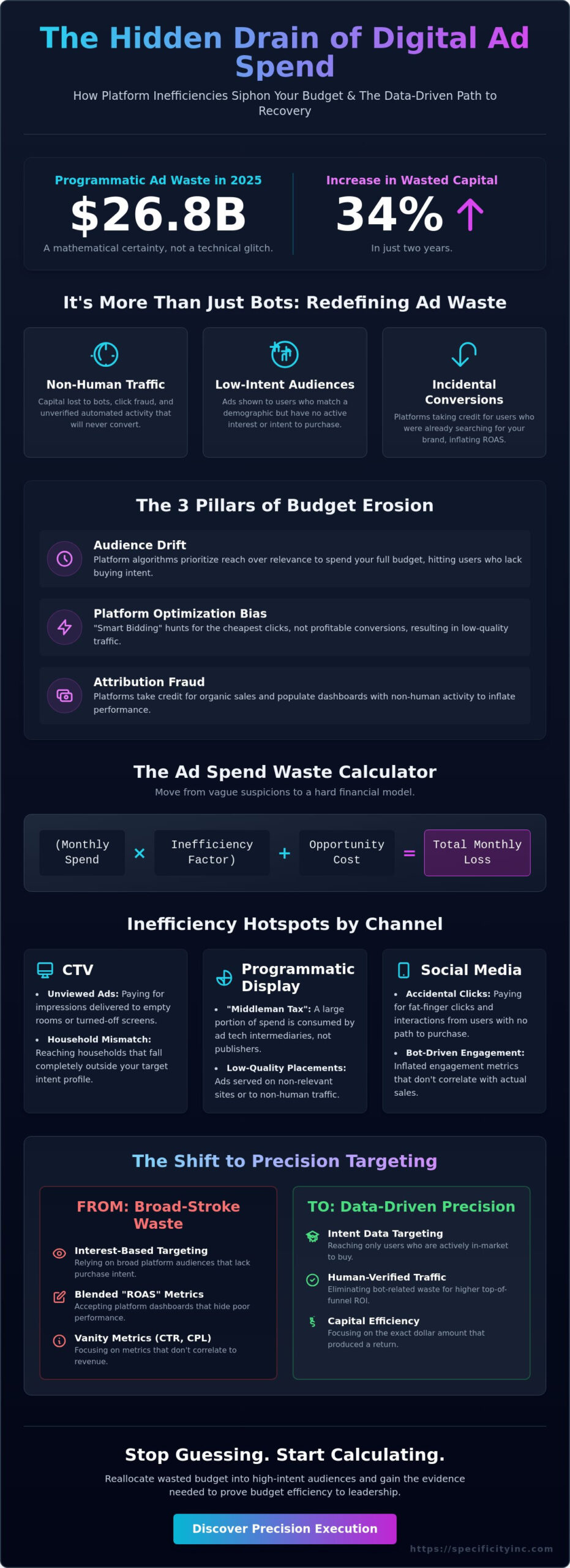
In 2025, programmatic ad waste surged to $26.8 billion, a 34% increase in capital lost to the ad tech supply chain in just two years. This isn’t a technical glitch. It’s a mathematical certainty when you rely on broad-stroke platform targeting and unverified traffic. You need a precise ad spend waste calculator to stop the bleeding and identify exactly where your budget is failing. Most executives are tired of looking at inflated dashboard metrics that don’t match their bank deposits.
It’s frustrating to pay for clicks from users who will never buy, especially when you can’t prove ROI on top-of-funnel channels like CTV. This article promises to help you stop guessing and start calculating the exact dollar amount lost to inefficient targeting. We’ll provide a clear roadmap to reallocate that waste into high-intent audiences, giving you the evidence needed to prove budget efficiency to leadership. We’re moving past creative guesswork toward data-driven certainty and human-verified results.
Key Takeaways
- Define ad spend waste beyond simple bot traffic to include any capital deployed toward low-intent, non-converting audiences.
- Quantify your specific monthly loss by applying an inefficiency factor to your current channels with our ad spend waste calculator.
- Expose the “incidental conversion” trap where platforms inflate ROAS by claiming credit for users who were already searching for your brand.
- Shift from broad interest-based targeting to intent data targeting to ensure your budget only reaches users actively in the market.
- Implement human-verified traffic solutions to eliminate bot-related waste and secure a higher ROI on top-of-funnel channels like CTV and Social Media.
The Reality of Ad Spend Waste in 2026
Ad spend waste is any capital deployed toward non-converting, low-intent, or non-human audiences. By 2026, global digital ad spend is projected to reach $835.82 billion, accounting for nearly 69% of all advertising worldwide. Within this massive volume of capital, inefficiency has become a standard operating cost. Broad-stroke targeting is no longer a growth strategy; it is a direct subsidy to ad platforms. These platforms are designed to spend your budget, not necessarily to maximize your profit.
Google and Meta dashboards are incentivized to hide waste through “blended” metrics. They combine high-performing brand search with low-performing discovery or display traffic to present an acceptable average ROAS. This obfuscation masks the fact that a significant portion of your budget is likely hitting users who have zero intention of buying. High-intent precision is the only antidote to this systematic budget drainage. Utilizing an ad spend waste calculator is the first step toward identifying exactly how much of your revenue is being siphoned off by platform-level inefficiencies.
The Three Pillars of Budget Erosion
- Audience Drift: This occurs when your ads reach individuals who fit a demographic profile but lack active buying intent. Platform algorithms often prioritize reach over relevance to ensure full budget delivery.
- Platform Optimization Bias: “Smart Bidding” and automated features often prioritize easy clicks over profitable conversions. These systems hunt for the lowest cost-per-click, which frequently results in low-quality traffic that never moves past the landing page.
- Attribution Fraud: Platforms frequently take credit for organic sales that would have happened regardless of the ad. To understand the technical side of budget depletion, executives must grasp what click fraud is and how it populates dashboards with non-human activity.
Why Traditional Benchmarks Fail Executives
Industry average click-through rates (CTRs) are vanity metrics that mask poor traffic quality. A high CTR is irrelevant if the traffic is non-human or low-intent. Relying on “last-click” data is equally dangerous in a multi-channel environment involving CTV and social media. This narrow view fails to account for the complex customer journey and often leads to over-investing in channels that don’t drive incremental growth. “Cost per lead” is another metric that provides a false sense of security. If those leads are unverified or come from low-intent sources, you’re simply paying to fill your CRM with noise. An ad spend waste calculator shifts the focus back to what matters: the exact dollar amount of capital that failed to produce a return.
The Mechanics of the Ad Spend Waste Calculator
Efficiency is a metric, but loss is a dollar amount. To stop budget depletion, you must move from vague suspicions to hard financial modeling. The core formula for an effective ad spend waste calculator is: (Monthly Spend x Inefficiency Factor) + Opportunity Cost = Total Monthly Loss. This equation identifies the capital currently being siphoned away by non-human traffic and low-intent audiences, providing a clear figure that platform dashboards intentionally obscure.
The “Inefficiency Factor” is a variable based on the inherent flaws of specific digital channels. For display ads, this factor includes the cost of non-human traffic. Bots don’t buy products, yet they account for a staggering percentage of programmatic impressions. Recent regulatory action against data brokers highlights the systemic instability of the data used for targeting, which often results in your ads reaching irrelevant or non-existent users. Quantifying the “Opportunity Cost” is the final step; this represents the revenue your business loses by not deploying that wasted capital into high-intent segments that actually convert.
Calculating Waste Across Channels
- CTV Waste: Quantify “unviewed” ads and household mismatching. In the CTV space, spend is often wasted on devices playing to empty rooms or households that fall outside your target intent profile.
- Programmatic Display: Identify the “middleman tax.” A significant portion of your dollar never reaches the publisher, instead getting consumed by layers of ad tech intermediaries and low-quality site placements.
- Social Media: Factor in “accidental clicks” and bot-driven engagement. Social platforms often prioritize engagement metrics that don’t correlate with sales, leading you to pay for interactions from users with no path to purchase.
The ROI of Recovery
Eliminating the bottom 30% of your inefficient spend doesn’t just save money; it drastically lowers your customer acquisition cost (CAC). By removing the noise of low-intent traffic, your remaining budget works harder, focusing exclusively on human-verified audiences. This shift from broad-reach to high-intent precision creates a leaner, more aggressive growth engine. You can begin this process by using an ad spend waste calculator to audit your current channel performance and identify immediate recovery opportunities. The Recovery Ratio is the percentage of wasted budget successfully reallocated to human-verified traffic. Mastering this ratio is the difference between a stagnant marketing department and a high-performance revenue center.
Beyond the Calculator: Identifying Hidden Leaks
“My dashboard says my ROAS is high” is the most common defense for a failing strategy. It’s a false sense of security. Platforms inflate these numbers by claiming “Incidental Conversions.” This occurs when an ad platform serves an impression to a user who was already going to purchase via direct or organic search. They take the credit, and you pay for a sale you already earned. An ad spend waste calculator exposes these overlaps by stripping away the noise of brand-heavy attribution and revealing the true incremental value of your spend.
Beyond attribution, you face the problem of non-human leaks. Sophisticated bot networks now mimic mouse movements and scroll depth to bypass traditional filters. If you aren’t using human-verified traffic, you’re subsidizing automated scripts. Data decay adds another layer of erosion. Audience lists lose accuracy quickly as people change jobs, locations, or interests. If you’re targeting a list that hasn’t been refreshed with real-time intent, a significant portion of your budget is hitting dead ends before the first impression is even served. Precision requires constant verification, not just historical data.
The Myth of Platform Self-Reporting
You can’t trust a platform to grade its own performance. Google and Meta prioritize “Reach,” but in a competitive national campaign, reach is a vanity metric. What matters is “Relevant Reach,” which is the number of high-intent humans who actually see your message. To establish a baseline of truth, you need to use Digital Advertising ROI: The Definitive Guide to set internal benchmarks that exist outside the platform’s ecosystem. This allows you to measure performance based on bank deposits rather than platform-generated clicks.
B2B vs. B2C Waste Dynamics
Waste manifests differently depending on your business model. In B2C, the primary leaks are excessive frequency caps and “zombie” retargeting, where ads follow a user long after they’ve purchased or lost interest. Conversely, B2B waste is usually a data problem. You’re often paying to reach the wrong job titles or companies because of poor third-party intent data. To stop the bleed, B2B Marketing in 2026 requires a hard shift to intent-based precision. An ad spend waste calculator provides the quantitative proof that your current broad-match approach is failing your sales pipeline by reaching the wrong people at the wrong companies.
Strategic Recovery: Reducing Waste Through Intent Data
Identifying a loss with an ad spend waste calculator is only the diagnostic phase. Recovery requires a structural shift in how data is utilized to drive conversions. You must move from passive observation to aggressive reallocation. This framework eliminates the systemic leaks that platforms ignore and redirects capital toward high-intent human audiences.
- Step 1: Audit current traffic sources for human verification. Stop paying for impressions that never reach a person. You must verify that your clicks are originating from actual users rather than automated scripts.
- Step 2: Replace broad interest-based targeting with high-intent audience data. Interest is a suggestion; intent is a signal. Shift your budget away from users who “might” like your category to those currently exhibiting buying behaviors.
- Step 3: Implement multi-channel synchronization between CTV and SEM. High-intent signals from search should inform your visual storytelling on television. This creates a unified front that captures demand across the entire funnel.
- Step 4: Establish a “Zero-Waste” threshold for programmatic display placements. Blacklist low-quality sites and “Made for Advertising” (MFA) domains that provide zero incremental value to your brand.
- Step 5: Continuously monitor for “Audience Creep.” Algorithms naturally expand targeting to maintain spend levels. You must manually enforce guardrails to prevent your ads from drifting toward low-intent segments.
Leveraging Intent Data for Precision
Stop targeting “people interested in X” and start targeting “people actively searching for Y.” Intent data filters out the 90% of the market that isn’t currently in a buying cycle, ensuring your budget isn’t wasted on cold prospects. This level of granularity allows for the seamless integration of Search Engine Marketing (SEM) with your display and social efforts. By capturing high-intent demand at the moment of search, you eliminate the guesswork associated with traditional demographic profiles. It’s about dominating the market segment that is ready to transact today.
The Role of Connected TV in Waste Reduction
Precision is the primary advantage of modern video. Connected TV Advertising is the most precise way to reach households without the inherent waste of linear TV. You can now use IP-level targeting to ensure your CTV spend matches your high-intent audience lists exactly. This eliminates the “empty room” problem, where ads play to unengaged or irrelevant viewers. By synchronizing your television spend with verified intent data, you transform a traditionally broad-reach channel into a high-performance demand generation engine. You can optimize your media mix by reallocating recovered waste into these high-precision channels to drive immediate growth.
Precise Execution with Specificity Inc.
Identifying your loss with an ad spend waste calculator is a diagnostic exercise. It provides the cold, hard number that should disturb any executive focused on growth. However, knowing you have a leak isn’t the same as sealing it. Specificity Inc. exists as the antidote to the broad-stroke marketing noise that has characterized the industry for the last decade. We don’t settle for platform-reported averages or creative guesswork. We deploy a methodology rooted in analytical science to ensure every dollar you spend is an investment in human-verified demand.
Our approach is built on a no-nonsense focus on quantitative outcomes. We are elite specialists who prioritize logic and evidence over the superficial metrics that ad platforms use to mask inefficiency. While other agencies are content to report on clicks and impressions, we focus on data depth and audience behavior. We understand that the digital landscape is cluttered with invalid traffic and low-intent noise. Our role is to cut through that complexity with data-driven certainty, providing a serious partnership for leadership teams that demand substantial growth. We don’t just manage your spend; we optimize your entire market position.
The Specificity Advantage
One of our primary weapons against budget erosion is our human verified traffic solution. By eliminating bot-related waste at the source, we ensure your programmatic display and social media campaigns are actually reaching people with the capacity to buy. This isn’t just about cleaning up a spreadsheet. It’s about a fundamental shift from “managing ads” to “dominating markets.” When you remove the bottom 30% of your wasted spend, you suddenly have the capital required to outspend your competition in high-intent segments. Our intent data targeting protocols are designed to find the buyers who are currently in-market, not just those who fit a vague demographic profile. This level of exactness is what separates a market leader from a company that is simply subsidizing the bottom line of major ad platforms.
Take the Next Step Toward Strategic Dominance
Don’t just calculate your waste. Eliminate it. The ad spend waste calculator reveals the scale of the problem, but a full strategic audit with our team provides the solution. We invite you to move beyond the calculator to a bespoke analysis of your current traffic sources and audience targeting. We’ll show you the intent data your competitors are missing and help you build a roadmap to predictable revenue. This is the only logical choice for businesses seeking to scale without the friction of unverified traffic and stale data. Request a consultation today to see how we can reallocate your budget toward the audiences that matter most. Stop wasting ad spend and start driving high-intent demand with Specificity Inc.
Secure Strategic Dominance through Data-Driven Certainty
Ad waste is a mathematical certainty for those who ignore the mechanics of low-intent traffic. You’ve seen how platform self-reporting creates a false sense of security while siphoning capital into bot networks and irrelevant reach. Utilizing an ad spend waste calculator provides the baseline evidence you need to challenge the status quo. However, numbers alone don’t drive revenue. You must replace broad interest-based targeting with intent data precision to ensure your budget only reaches human buyers ready to transact.
Specificity Inc. provides the elite specialized expertise required to reclaim your budget and dominate your market. We leverage human-verified traffic solutions and intent data targeting to establish strategic dominance across CTV, programmatic, and social media. It’s time to stop subsidizing ad platforms and start investing in predictable growth. Request a High-Intent Audience Audit to Eliminate Ad Waste and secure your position as a market leader. You have the data to transform your marketing into a high-performance revenue engine; now it’s time to execute.
Frequently Asked Questions
How accurate are platform-provided ROAS numbers?
Platform-provided ROAS numbers are frequently inflated by incidental conversions and biased attribution models. These dashboards often claim credit for users who were already committed to a purchase through organic or brand-direct channels. To gain a true understanding of performance, you must look at incremental lift and human-verified engagement rather than trusting the platform’s self-reported metrics which are designed to justify continued spend.
What is a typical percentage of ad spend waste for a national campaign?
Programmatic ad waste reached $26.8 billion in 2025, suggesting that a typical national campaign loses approximately 30% of its budget to the ad tech supply chain. This waste includes non-human traffic, low-viewability placements, and low-quality websites. Without a rigorous ad spend waste calculator, these losses remain hidden within blended performance averages that mask the true cost of inefficiency and platform-level drainage.
Can an ad spend waste calculator account for bot traffic?
A sophisticated ad spend waste calculator accounts for bot traffic by integrating invalid traffic benchmarks across programmatic and social channels. By applying a weighted inefficiency factor to your monthly spend, the tool isolates the dollar amount lost to non-human scripts. This allows leadership to visualize the financial impact of sophisticated bot networks that mimic human behavior to bypass standard, broad-stroke platform filters.
How does intent data reduce budget waste compared to demographic targeting?
Intent data reduces waste by prioritizing active signals over passive demographic characteristics. While demographic targeting reaches users who might be interested, intent data identifies those currently exhibiting buying behaviors. This methodology filters out the majority of the market that isn’t in an active buying cycle. It ensures your capital is only deployed toward prospects with a high probability of conversion rather than unengaged audiences.
Is it possible to achieve zero waste in digital advertising?
Achieving absolute zero waste is technically impossible, but reaching a “Zero-Waste Threshold” is a realistic strategic goal. This involves using human-verified traffic and IP-level targeting to eliminate the most egregious sources of budget erosion. By focusing on high-intent precision rather than broad reach, you can ensure that the vast majority of your impressions are served to relevant, human audiences with actual buying power.
How do I explain ad spend waste to my executive leadership team?
Explain ad spend waste as a capital efficiency problem rather than a creative failure. Use hard numbers to show how much budget is hitting non-human or low-intent audiences. Framing the conversation around recovery ratios and the cost of lost opportunity resonates more with executive leadership than discussing vanity metrics like click-through rates or platform-reported ROAS which don’t match bank deposits.
What are the first signs that my ad budget is being wasted?
The primary sign of waste is a divergence between dashboard metrics and actual revenue growth. If your impressions and clicks are rising while your bank deposits and CRM pipeline remain stagnant, your targeting is likely drifting into low-intent segments. High engagement from non-converting sources often indicates that your ads are being served to bots or unengaged audiences on low-quality site placements.
How often should I run an ad spend waste analysis?
You should conduct a comprehensive analysis at least once per quarter to identify audience creep. For high-volume national campaigns, monthly audits are necessary to prevent algorithms from expanding targeting beyond your core high-intent buyer. Regular monitoring ensures that your budget remains focused on human-verified traffic and that your intent data lists haven’t suffered from the data decay that leads to immediate waste.