
How to Detect Invalid Traffic: A Strategic Guide to Eliminating Ad Waste (2026)
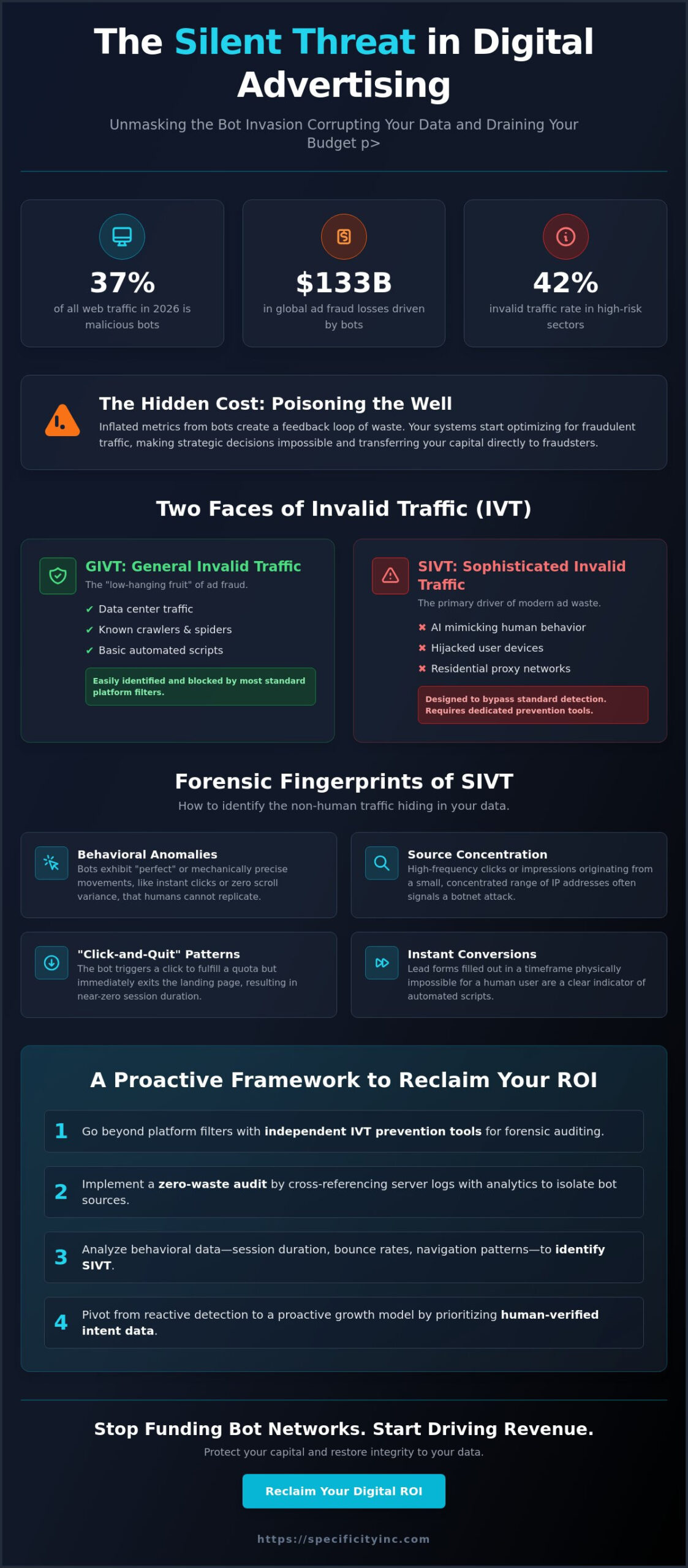
In 2026, malicious bots account for 37% of all web traffic, driving global ad fraud losses toward a staggering $133 billion. You aren’t just losing money; you’re operating on corrupted data that makes strategic decision-making impossible. Most executives suspect their programmatic spend is inefficient, but the reality is often worse than they imagine. With invalid traffic rates in high-risk sectors like finance and real estate hitting 42%, the traditional “set and forget” approach to digital advertising is a recipe for fiscal negligence.
You need more than basic platform filters to protect your capital. This guide delivers the forensic techniques required to identify sophisticated invalid traffic and reclaim your digital advertising ROI. We’ll examine how to deploy modern invalid traffic prevention tools to purge non-converting bots from your funnel and restore integrity to your CRM. You’ll master a clear framework for auditing existing campaigns and gain the data-backed certainty needed to justify a pivot toward human-verified intent data. It’s time to stop funding bot networks and start driving predictable revenue through exactness and technical dominance.
Key Takeaways
- Distinguish between GIVT and SIVT to understand the specific mechanisms corrupting your performance metrics and ROI reporting.
- Identify the forensic fingerprints of automated traffic through behavioral analysis of session duration, bounce rates, and navigation anomalies.
- Evaluate the limitations of native platform filters and the strategic necessity of independent invalid traffic prevention tools for forensic auditing.
- Implement a zero-waste audit framework that cross-references server logs with analytics to isolate and eliminate high-risk traffic sources.
- Pivot from reactive fraud detection to a proactive growth model by prioritizing human-verified traffic and precision intent data.
The IVT Crisis: Why Standard Filters Fail Your Performance Metrics
Invalid Traffic (IVT) is a strategic drain on corporate capital. We define it as any engagement, click, or impression that doesn’t originate from a real human with genuine intent. In 2026, this isn’t a minor marketing discrepancy. It’s a board-level efficiency failure. While platforms claim to protect your budget, their native filters are often incentivized to prioritize reach and volume over verified quality. This systemic failure erodes your digital advertising ROI across every channel you deploy. You can’t scale what you can’t verify.
General vs. Sophisticated Invalid Traffic
GIVT (General Invalid Traffic) represents the low-hanging fruit of the fraud world. It includes data center traffic, routine crawlers, and basic automated scripts. These are easily identified and filtered by most basic systems. SIVT (Sophisticated Invalid Traffic) is where the real war is fought. It utilizes residential proxy networks, hijacked user devices, and AI that mimics human browsing patterns like scrolling and hesitation. Click fraud has evolved into a high-tech industry. SIVT is the primary driver of modern ad waste in 2026 because it’s designed specifically to bypass standard detection. Relying solely on platform-provided security is insufficient. You need dedicated invalid traffic prevention tools to identify these nuanced behavioral anomalies before they drain your budget.
The Hidden Cost of Inflated Metrics
High click-through rates (CTR) often signal a bot infection rather than a successful campaign. When bots engage with your ads, they artificially inflate engagement metrics. This leads your team to believe a campaign is performing while actual revenue remains stagnant. We call this the “poisoning of the well.” When junk data enters your CRM and analytics, it corrupts your algorithmic bidding models. Your systems begin optimizing for bots that look like high-value users. This creates a feedback loop of waste. Paying for impressions in bot-heavy programmatic environments is a direct transfer of wealth from your balance sheet to fraudsters. Without robust invalid traffic prevention tools, your strategic decisions are based on fiction. Ad platforms operate on a volume-based revenue model. Their primary goal is to fulfill budgets, not to protect your margins. Total transparency would reveal that a significant portion of their inventory is non-human, which would force a downward adjustment in CPMs. They won’t fix this for you.
Forensic Data Analysis: Identifying the Fingerprints of SIVT
Detecting Sophisticated Invalid Traffic (SIVT) requires a forensic mindset that looks beyond the surface level of a dashboard. Standard analytics provide a sanitized version of reality. To find the truth, you must analyze the raw interaction data that bots attempt to mimic. These entities have become adept at bypassing basic filters, but they still leave digital fingerprints that reveal their non-human nature. Relying on legacy filters is a liability; elite teams utilize invalid traffic prevention tools to maintain a clean lead pipeline and protect their capital.
Behavioral Anomalies and Interaction Patterns
Behavioral anomalies are the first indicators of a compromised campaign. While humans exhibit erratic browsing patterns, bots often default to “perfect” mouse movements or a total lack of scroll depth variance. They move with a mechanical precision that no human can replicate. You might see high-frequency interactions originating from concentrated IP ranges, which often signal a coordinated botnet attack rather than a surge in genuine interest. A common red flag is the “click-and-quit” pattern, especially prevalent in programmatic display. In these scenarios, the bot triggers the click event to fulfill a quota but exits the page before any meaningful engagement occurs. This behavior violates the Invalid Traffic (IVT) Detection and Filtration Standards set by the MRC, yet many advertisers fail to monitor it at the session level.
Conversion path irregularities provide even more damning evidence. The “instant conversion” bot pattern involves a lead form being filled within milliseconds of page load. No human can read a landing page, process the value proposition, and input data that quickly. When you see a high volume of leads from geographic regions that don’t match your targeting parameters, your campaign is likely being drained by residential proxy networks. These networks route bot traffic through home-based IP addresses to appear legitimate and bypass traditional blacklists.
Technical Markers: Beyond the User Agent
Technical markers extend far beyond the user agent string. Modern fraudsters use browser spoofing and inconsistent hardware fingerprints to deceive your tracking scripts. They simulate specific device types while their underlying hardware signals tell a different story. Log file analysis uncovers hidden traffic sources by exposing the raw server requests that bypass client-side tracking scripts. Without a rigorous data integrity strategy, you’re essentially flying blind. You need invalid traffic prevention tools that integrate directly with your server logs to spot these technical inconsistencies in real time. If your reporting shows 100% bounce rates or session durations of exactly zero seconds, you aren’t just seeing poor performance; you’re seeing a bot infection. Forensic analysis is the only way to safeguard your capital and ensure your growth strategy is built on a foundation of human intent.
Platform Filters vs. Third-Party Verification: The Walled Garden Conflict
Ad platforms operate as both the auctioneer and the quality control inspector. This dual role creates a fundamental conflict of interest. While native tools claim to protect your spend, they’re built to fulfill budgets first and verify quality second. Relying on a platform to grade its own performance is a strategic error. You need independent invalid traffic prevention tools to provide an objective layer of forensic auditing. Without a third-party perspective, you’re trapped in a “walled garden” where transparency is sacrificed for aggregated, self-serving metrics.
The distinction between pre-bid prevention and post-bid detection is critical for capital preservation. Native filters often rely on post-bid detection, meaning they identify fraud after the impression has been served and the budget has been allocated. You’re then left to negotiate for credits that rarely cover the full scope of the waste. High-stakes B2B marketing requires a more aggressive stance. In these environments, every lead carries a high acquisition cost, and a single bot-driven data corruption event can derail an entire sales cycle. Transitioning to human-verified traffic ensures that your intent data is rooted in actual human behavior, not automated simulations.
The Conflict of Interest in Self-Reporting
Ad platforms define “invalid” through a narrow lens that often excludes high-level SIVT. Their definitions favor their own inventory availability. An executive’s definition of waste is much broader; it includes any click that has zero probability of conversion. This gap is where your ROI disappears. You must leverage third-party data to challenge inaccurate platform billing. When your internal invalid traffic prevention tools flag a 20% discrepancy that the platform ignores, you have the quantitative evidence needed to demand accountability and shift spend to higher-quality channels.
Transparency and Audit Trails
Granular reporting is your only defense against programmatic opacity. Aggregated dashboards hide the specific site placements and IP ranges where fraud thrives. You must demand a traffic verification partner that provides session-level audit trails and raw log access. Transparency is the only antidote to programmatic opacity. Look for partners that offer real-time blocking capabilities and deep integration with your server-side analytics. If a partner can’t show you exactly why a click was flagged as non-human, they aren’t providing security; they’re just providing another black box. Exactness in reporting allows you to purge low-performing networks and double down on placements that deliver verified human engagement.
Building a Zero-Waste Audit: Steps to Uncover Hidden Bot Activity
A passive approach to ad security is a liability. While invalid traffic prevention tools provide a necessary defensive layer, a manual zero-waste audit is required to expose the gaps in automated systems. You must begin by establishing a rigid baseline for traffic segmentation. Categorize every visitor by source, medium, and specific campaign ID to isolate the origin of every dollar spent. This granular view allows you to spot outliers that aggregated dashboards intentionally obscure.
The next phase involves a forensic cross-reference of your analytics data against raw server logs. Automated platforms often report successful clicks that never actually reach your server. These volume discrepancies are the smoking gun of click-level fraud. You should also analyze “Time to Action” (TTA) metrics for every lead conversion. If a user completes a complex multi-field form in under three seconds, you aren’t dealing with a high-intent buyer; you’re dealing with a bot. Implementing hidden honeypot fields in your lead forms acts as a silent trap for automated scrapers that “read” and fill invisible data points, providing immediate proof of non-human activity.
Don’t ignore your social channels. You must audit social media advertising for engagement-to-follower ratio anomalies. A sudden spike in likes from accounts with zero followers or suspicious geographic origins indicates a bot-driven inflation tactic that drains your budget without contributing to your sales pipeline. Exactness in these audits is the only way to reclaim control over your marketing spend.
Isolating High-Risk Traffic Sources
Junk placements within the Google Display Network (GDN) are notorious for high IVT rates. You must identify and exclude sites that exhibit “made-for-advertising” (MFA) characteristics. In 2026, we’re seeing increased IVT risks in Connected TV (CTV) through Server-Side Ad Insertion (SSAI) spoofing. Fraudsters mimic legitimate device signals to steal high-CPM video budgets. You should also evaluate the authenticity of third-party audience segments. Many “high-intent” lists are actually populated by bot activity, leading you to pay a premium for worthless data. If you want to stop the bleeding, you need a comprehensive traffic audit to identify these leaks.
Validating Lead Authenticity
Lead fraud corrupts your CRM and wastes your sales team’s time. You need technical filters to identify disposable email domains and fake phone numbers at the point of entry. Manual lead scoring remains a critical component of this process. By analyzing the qualitative data within lead submissions, you can spot the repetitive syntax and nonsensical patterns typical of sophisticated bot-driven fraud. Human verification is the final step in any audit because it replaces probability with certainty. It transforms your marketing from a game of chance into a precision engine for growth. Stop guessing and start verifying every interaction that hits your balance sheet.
Beyond Detection: Transitioning to Human-Verified Intent Data
Detection is a reactive trap. It’s a perpetual game of cat-and-mouse where the fraudster holds the first-mover advantage. While most invalid traffic prevention tools focus on identifying the bot after the engagement occurs, this methodology still allows for data corruption and capital leakage. You’re playing a defensive game with your own balance sheet. Proactive strategic dominance requires a shift to human-verified traffic. This isn’t just about blocking bad actors; it’s about ensuring every dollar targets a verified human being with documented intent. You don’t need more filters; you need a cleaner source.
Precision search engine marketing (SEM) evolves when you add a human-first verification layer. Instead of bidding blindly on high-cost keywords and hoping the platform filters catch the scrapers, you target specific, verified audiences. This shift transforms your marketing from a speculative expense into a precision engine. Specificity Inc. acts as the strategic partner for businesses that demand predictable, human-driven revenue. We replace the “black box” of programmatic auctions with a transparent ecosystem of verified intent.
The Power of Human-Verified Audiences
Probabilistic targeting is a relic of a bot-polluted era. It relies on patterns that AI-driven bots can now replicate with ease. You must move to deterministic human verification. This involves confirming the identity and intent of the user before they enter your sales funnel. When you remove bots from the equation, your conversion rates don’t just improve; they stabilize. You gain the ability to forecast growth with exactness. In the 2026 landscape, intent data is your most valuable asset. If that data is corrupted by automated engagement, your entire strategic foundation is compromised. Human verification ensures your data depth is rooted in reality.
Executing a High-Intent Strategy
A fragmented approach to ad security is a recipe for failure. You need to integrate CTV, programmatic display, and social media into a single human-verified ecosystem. This unified front prevents fraudsters from finding weak points in your multi-channel strategy. While the cost per impression might appear higher on paper, the long-term ROI of paying for audience quality far outweighs the “savings” of impression quantity. You’re buying outcomes, not just eyeballs.
- Eliminate the “poisoning of the well” by purging bot data from your CRM.
- Optimize algorithmic bidding for real human behavior rather than simulated clicks.
- Reclaim wasted spend and reallocate it to high-performing, verified segments.
Stop auditing the past and start engineering the future with human-verified traffic. The noise of the broader market is a distraction from the goal of expansion. Specificity Inc. provides the technical dominance and forensic certainty required to cut through that complexity. It’s time to demand a higher standard of data integrity and secure your position as a market leader.
Reclaim Your Strategic Advantage through Data Integrity
In 2026, ad fraud isn’t just a technical nuisance; it’s a direct threat to your market position. We’ve established that while invalid traffic prevention tools are essential for forensic auditing, they’re only the first step in a broader capital preservation strategy. True growth requires moving beyond the reactive game of bot detection and embracing deterministic, human-verified intent data. You must demand exactness in your reporting and transparency in your traffic sources to protect your digital advertising ROI.
Specificity Inc. provides the technical powerhouse needed to purge non-human engagement from your funnel. Our expertise in CTV and programmatic display ensures your high-intent targeting is backed by logic and hard numbers. It’s time to leverage human-verified traffic solutions and data-driven high-intent targeting to secure your strategic dominance. Stop paying for bots and start reaching real humans with Specificity Inc. your commitment to data integrity today will drive the predictable revenue you need to lead your industry tomorrow. You have the tools and the framework to eliminate waste; now is the time to execute with precision.
Frequently Asked Questions
Is all bot traffic considered invalid traffic?
Yes, any traffic not originating from a genuine human is considered invalid traffic. This includes helpful bots like search engine crawlers, categorized as General Invalid Traffic (GIVT), and malicious actors, known as Sophisticated Invalid Traffic (SIVT). While search engines require crawlers to index content, these hits must not trigger ad spend or corrupt your performance metrics. Distinguishing between these automated entities is a core function of modern invalid traffic prevention tools.
How much ad spend is typically lost to invalid traffic in 2026?
Global ad fraud losses are projected to reach $133 billion in 2026. This represents a staggering drain on corporate capital across all digital channels. In specific high-risk sectors like finance, legal, and real estate, the invalid traffic rate can hit as high as 42%. These losses extend beyond wasted budget; they represent a systemic corruption of CRM data and strategic decision-making integrity.
Can I get a refund from Google or Meta for invalid traffic clicks?
You can receive credits for identified invalid activity, but the burden of proof usually falls on the advertiser. While Google and Meta utilize internal filters to remove some IVT, they often fail to catch sophisticated SIVT. To secure a refund for significant discrepancies, you must present independent forensic evidence from third-party invalid traffic prevention tools to challenge their self-reported metrics and reclaim your capital.
What is the difference between click fraud and invalid traffic?
Invalid traffic is the broad umbrella term for all non-human engagement, while click fraud is a specific, malicious subset. Click fraud involves deliberate attempts to drain a competitor’s budget or generate illicit revenue for a publisher. IVT encompasses these malicious acts alongside non-malicious occurrences, such as routine data center traffic and automated scrapers that aren’t necessarily designed to steal ad spend.
How do I detect invalid traffic in my Connected TV (CTV) campaigns?
CTV fraud detection requires Server-Side Ad Insertion (SSAI) analysis and hardware signal verification. Fraudsters frequently spoof device IDs to make bot traffic appear as legitimate household viewing on high-CPM platforms. You must monitor for impossible viewing patterns, such as 24-hour continuous activity from a single IP, and cross-reference hardware fingerprints to ensure the signals originate from verified CTV hardware rather than data centers.
What are the most common signs that my traffic is being faked?
The most common indicators include “instant conversions” where complex lead forms are completed in milliseconds and high click-through rates (CTR) that result in zero revenue. You should also monitor for concentrated IP ranges and a total lack of scroll depth variance on your landing pages. If your traffic exhibits mechanical precision or originates from geographic regions outside your targeting parameters, it’s likely automated.
Does human-verified traffic completely eliminate the need for IVT detection?
Human-verified traffic acts as a proactive shield that drastically reduces the surface area for fraud. By targeting only verified human audiences, you prevent the “poisoning of the well” before it occurs. However, ongoing IVT detection remains a necessary secondary layer for auditing and identifying emerging threats. This dual-layered approach ensures your bidding algorithms are optimized for real human behavior rather than sophisticated simulations.
How often should a business perform a traffic quality audit?
You should perform a comprehensive traffic quality audit at least once per month for high-stakes B2B or high-spend campaigns. Standard campaigns should undergo a forensic review at least once per quarter. Waiting too long between audits allows bot infections to corrupt your bidding algorithms and CRM data, making it significantly harder to restore data integrity once the leakage has become systemic.