Programmatic Ad Fraud Solutions in 2026: The Executive Guide to Strategic Dominance
In 2026, global ad fraud losses have climbed to a staggering $100.2 billion, representing a direct siphoning of your growth capital. Sophisticated “Agentic AI” now mimics human browsing patterns with enough precision to bypass standard filters, leaving executives with siphoned budgets and zero ROI. You already know that current programmatic display models are leaking value. It’s impossible to make strategic decisions when your data is skewed by an invalid traffic rate that now averages over 20 percent across the industry.
This guide delivers the strategic framework for programmatic ad fraud solutions designed to reclaim your media spend and ensure every dollar drives human-verified growth. We’ll move beyond reactive detection to establish a zero-trust supply chain that prioritizes total transparency. By the end of this executive briefing, you’ll master the methodology required to neutralize fraud at the source. This approach results in clean, actionable data and significantly higher conversion rates through intent-based precision. We’re replacing creative guesswork with a data-driven certainty that forces accountability across your entire media supply chain.
Key Takeaways
- Identify the $100 billion leakage caused by sophisticated AI bots that bypass legacy verification checkboxes.
- Deploy advanced programmatic ad fraud solutions that prioritize pre-bid prevention over the delayed reporting of traditional software.
- Integrate human-verified traffic and intent data targeting to ensure your budget only engages high-value, real-world prospects.
- Execute a rigorous audit of your current supply chain to eliminate the siphoned spend and skewed data caused by residential proxies.
- Shift your media strategy toward a zero-trust model that mandates total transparency from every DSP and SSP partner.
The $100 Billion Leak: Programmatic Ad Fraud in 2026
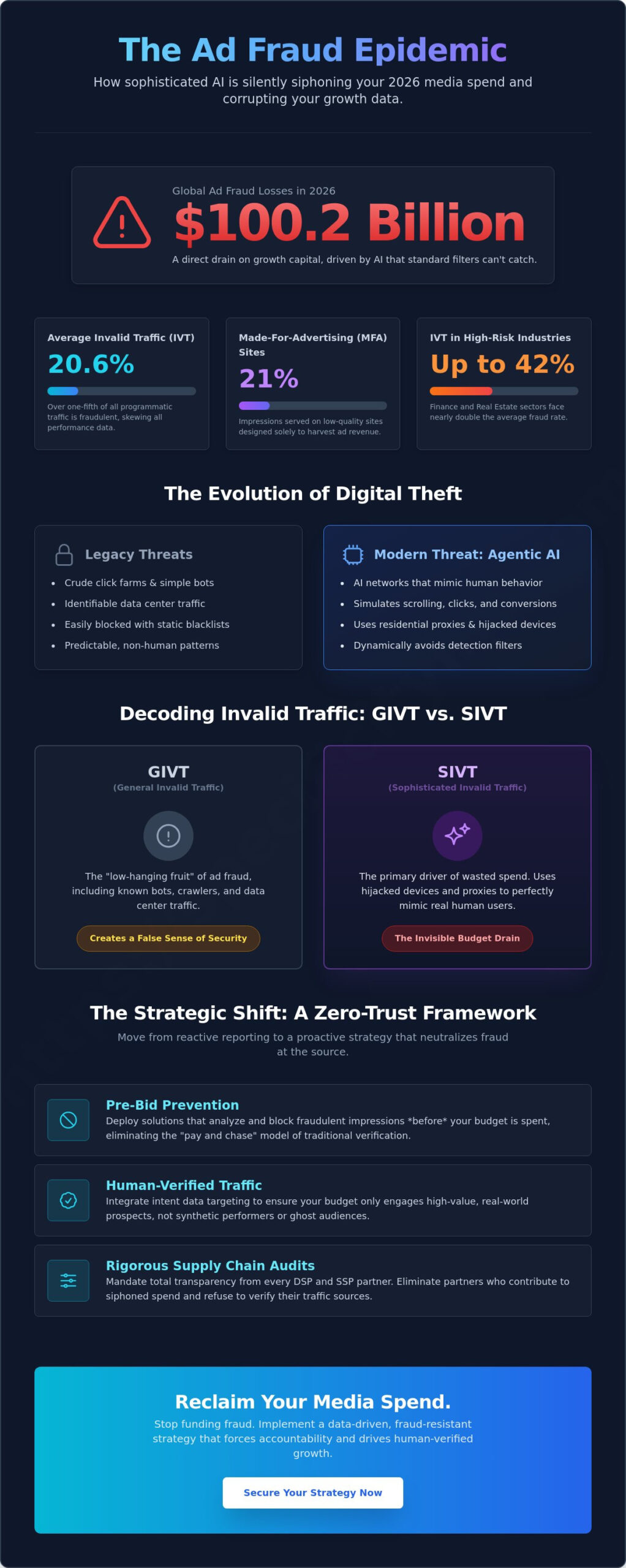
Programmatic ad fraud is not a technical glitch; it is the deliberate corruption of the digital media supply chain to siphon capital into the hands of bad actors. By mid-2026, global losses have officially eclipsed $100.2 billion. This figure represents a catastrophic drain on corporate scalability. For executive leadership, this isn’t an “industry tax” or an acceptable cost of doing business. It’s a direct threat to growth. When 20.6 percent of all programmatic traffic is invalid, your strategic decisions are based on data that is fundamentally broken. A foundational step in understanding ad fraud involves recognizing it as a professionalized criminal enterprise that exploits the lack of transparency in current DSP and SSP partnerships. Implementing robust programmatic ad fraud solutions is the only way to restore the integrity of your performance metrics and protect your bottom line. The psychological impact on CMOs is severe. Trust in digital-first strategies is eroding as siphoned budgets fail to produce human-verified growth.
The Evolution of Digital Theft
The days of crude click farms are over. In 2026, we’re facing agentic AI networks that mimic human behavior with terrifying precision. These botnets don’t just click; they scroll, linger on pages, and simulate intent to trigger high-value conversions. Traditional blacklists are obsolete because these attacks are dynamic. They move through residential proxies and hijacked devices that appear entirely legitimate to standard filters. This hidden supply chain siphons both B2B and B2C budgets, leaving brands with ghost audiences and zero market penetration. Relying on legacy programmatic ad fraud solutions that only scan for known bots is a recipe for failure in an era of synthetic performers and AI-orchestrated theft.
Why 2026 is the Tipping Point for Ad Spend
The explosion of Connected TV (CTV) and programmatic display has expanded the attack surface for fraudsters. CTV fraud alone reached $3.8 billion this year. Fraudsters follow the money. The rapid shift toward automated buying has outpaced the industry’s ability to secure the perimeter. Many organizations prioritize “efficiency” through broad-stroke targeting, yet this very breadth creates the vulnerability. High-risk industries like finance and real estate now face IVT rates as high as 42 percent. Made-for-Advertising (MFA) sites now account for 21 percent of programmatic impressions, further diluting the quality of the media supply chain. Efficiency without verification is merely the accelerated delivery of waste. Strategic dominance in this environment requires a move away from broad-stroke tactics toward exact, human-verified traffic.
Decoding the Threat: From GIVT to Sophisticated Invalid Traffic (SIVT)
Strategic dominance in the digital landscape requires a granular understanding of the mechanics used to drain your budget. Ad fraud is not a monolithic problem. It is a bifurcated threat consisting of General Invalid Traffic (GIVT) and Sophisticated Invalid Traffic (SIVT). While many legacy programmatic ad fraud solutions focus on the former, the latter is what creates The $100 Billion Leak impacting global markets in 2026. Catching simple bots is no longer a competitive advantage; it is the bare minimum for survival. To protect your growth capital, you must identify the invisible killers that bypass standard verification checkboxes by mimicking human behavior with surgical precision.
GIVT: The Low-Hanging Fruit
General Invalid Traffic represents the “easy” fraud that most platforms claim to block. This category includes known data center traffic, search engine crawlers, and simple non-human bots. Catching GIVT is the entry fee for any digital participation. However, relying on high GIVT detection rates creates a dangerous false sense of security. Fraudsters often use GIVT as a smokescreen, allowing simple bots to be caught while their more advanced counterparts operate undetected. If your current partners only report on GIVT, they’re leaving the door wide open for sophisticated actors to siphoning your spend through more complex channels.
SIVT: The Invisible Budget Drain
Sophisticated Invalid Traffic is the primary driver of wasted spend in 2026 programmatic campaigns. Unlike simple bots, SIVT utilizes residential proxies and hijacked devices to appear as legitimate human users. These entities don’t just load a page; they scroll, click, and interact with content to generate “intent signals” that trick Demand-Side Platforms (DSPs) into bidding higher for worthless impressions. This is particularly lethal in high-CPM environments like Connected TV (CTV) and Premium Display, where a single fraudulent impression carries a significant price tag.
The tactics are diverse and professionalized:
- Domain Spoofing: Making low-quality or fraudulent inventory appear as a premium site to steal high-value bids.
- Pixel Stuffing: Serving ads in a 1×1 pixel area that is invisible to humans but counted as a “viewable” impression by software.
- Ad Stacking: Layering multiple ads on top of each other so only the top one is visible, while all advertisers are billed for the impression.
These methods are designed to evade the “set it and forget it” mentality of traditional verification software. Executive teams must move beyond surface-level metrics to identify these invisible drains, starting with a rigorous focus on human-verified traffic. Without a methodology that accounts for SIVT, your programmatic display campaigns are essentially subsidizing criminal botnets rather than reaching real prospects. True strategic dominance requires programmatic ad fraud solutions that go beyond the checkbox to neutralize these sophisticated threats before they enter your supply chain.
Why Standard Ad Fraud Detection Software Is No Longer Enough
Executive leadership often treats ad fraud detection as a simple checkbox exercise. This “set it and forget it” mentality is exactly what sophisticated fraudsters exploit. Standard programmatic ad fraud solutions rely on static databases and reactive logic. By the time a software update patches a vulnerability, botnets have already evolved. This creates a permanent lag time that siphons your capital. Passive reliance on software isn’t a strategy; it’s a liability. You need a methodology that moves faster than the criminal networks stealing your budget.
The Illusion of Verification
You see a dashboard reporting 99 percent human traffic. Yet, your conversion rates remain flat. This is the illusion of verification. There’s a massive gulf between traffic that isn’t a known bot and high-intent human traffic. Fraudsters routinely test their code against industry-standard tools to ensure they can bypass them. If a bot can mimic a scroll and a click, it passes the “human” test. It’s technically “valid” traffic, but it’s commercially worthless. Dominance in the market requires a shift from identifying what isn’t a bot to identifying what actually is a qualified human buyer.
The Failure of Post-Bid Dashboards
Most programmatic ad fraud solutions operate on a post-bid basis. This is a strategic absurdity. You’re essentially paying for a report that tells you your money was stolen yesterday. In a high-stakes demand generation environment, retrospective detection is a failure of leadership. Pre-bid prevention is the only logical path. You must verify the human and the intent before the auction occurs. This shift in methodology is critical for protecting your digital advertising roi and ensuring every dollar spent contributes to actual revenue.
We must also address the conflict of interest inherent in platform-native protection tools. When a DSP or SSP provides its own fraud detection, they’re incentivized to maintain high volume. Trusting a vendor to grade its own homework is a risk no executive should take. True strategic dominance requires independent, third-party verification that prioritizes performance metrics over platform vanity. The noise of the broader market often hides deep-seated ineffectiveness. Cutting through that complexity requires data-driven certainty and a vocal rejection of broad-stroke industry tactics that prioritize reach over reality.
The Specificity Framework: Human-Verified Traffic and Intent Precision
Strategic dominance in 2026 requires a fundamental pivot from reactive detection to proactive human verification. The Specificity Inc. methodology rejects the broad-stroke industry tactics that prioritize reach over reality. We replace the ambiguity of legacy programmatic ad fraud solutions with data-driven certainty. This framework centers on the concept of human-verified traffic, ensuring that your capital is deployed only when a legitimate, qualified individual is on the other side of the screen. By integrating Connected TV (CTV), social media, and programmatic display ads into a single, verified ecosystem, we eliminate the cross-channel leakage that typically drains executive budgets.
Human-Verified Traffic: Beyond the Bot Filter
Our methodology moves past the limitations of traditional bot filters. Instead of simply identifying what isn’t a known bot, we confirm what actually is a human through multi-point validation. This shift fundamentally changes the conversion math for both B2B and B2C brands. When you remove the 20.6 percent industry-average invalid traffic from your auction pool, your cost per acquisition drops and your ROI scales predictably. Human-verified traffic is the only way to achieve predictable revenue growth in 2026. This approach forces accountability across the entire media supply chain, ensuring that every impression has the potential to become a customer.
Intent-Based Targeting as a Fraud Barrier
Bots are highly efficient at clicking, but they struggle to replicate the complex, multi-stage journeys of high-intent b2b marketing prospects. We utilize search engine marketing (sem) data to inform and isolate real buyers before they even enter the programmatic auction. By narrowing the targeting to specific intent signals, we create a natural barrier against fraud. Fraudsters focus on broad, high-volume keywords to maximize their reach; intent-based precision makes your campaigns an unattractive target for botnets. This synergy between human verification and intent-based programmatic execution allows you to cut through the noise of the broader market with surgical exactness. Secure your supply chain and drive growth with human-verified traffic that translates directly to revenue.
Executing a Fraud-Resistant Programmatic Strategy
Strategic dominance is the result of aggressive, data-driven execution. Identifying the leak is only the beginning. To neutralize the threat, you must overhaul your operational framework to prioritize pre-bid human verification over reactive reporting. In a high-stakes environment where AI botnets evolve hourly, passive defense is equivalent to surrender. You need a unified strategy that forces accountability across every channel, from Connected TV to social media, ensuring your growth capital is never siphoned by synthetic performers. Implementing elite programmatic ad fraud solutions requires a shift from broad-stroke buying to intentional, human-verified precision.
The Audit: Identifying the Leak
The first stage of recovery is a ruthless audit of your existing media spend. SIVT leakage often hides behind vanity metrics that look too good to be true. If your campaigns show a 15 percent click-through rate but zero conversion lift, you aren’t reaching customers; you’re feeding a botnet. Impossible metrics are the primary signal of fraud. You must analyze session duration and bounce rates as proxies for traffic quality. A human user with intent lingers and interacts. A bot triggers a pixel and vanishes. Demanding site-level transparency is non-negotiable. If your current partners cannot provide a granular list of exactly where your ads appeared, they’re likely hiding a corrupt supply chain.
Executing a fraud-resistant strategy involves five critical steps:
- Step 1: Audit all programmatic spend to identify SIVT leakage and statistically impossible performance spikes.
- Step 2: Transition your entire budget from post-bid reporting to pre-bid human-verified execution.
- Step 3: Consolidate CTV, Display, and Social channels into a single ecosystem for unified attribution and fraud monitoring.
- Step 4: Mandate total transparency in site-level reporting and hold SSP partners accountable for inventory quality.
- Step 5: Partner with an elite specialist who manages the complexity of high-stakes growth through proprietary methodology.
Strategic Dominance through Partnership
Internal teams often lack the technical bandwidth and specialized tools required to combat 2026-level fraud. Managing the nuances of residential proxies and agentic AI is a full-time defensive operation. Many organizations attempt to solve this by stacking multiple software vendors, but this only increases complexity and creates data silos. A unified agency approach is the only logical choice for businesses seeking predictable revenue. You need a partner that prioritizes quantitative outcomes and performance metrics above all else. We cut through the noise of the broader market with data-driven certainty, replacing creative guesswork with a methodology focused on substantial growth. Connect with Specificity Inc. for a high-intent traffic audit and stop paying for bots today.
Securing Strategic Dominance in the Media Supply Chain
The era of passive media buying is over. You’ve seen how $100 billion in annual leakage isn’t just an industry metric; it’s a direct threat to your corporate scalability. Legacy software can’t keep pace with the agentic AI networks that now dominate the fraudulent landscape. True strategic dominance requires a shift from reactive reporting to proactive, human-verified execution. By implementing advanced programmatic ad fraud solutions that prioritize intent-based precision, you remove the noise of synthetic performers and reclaim your growth capital.
Specificity Inc. provides the elite methodology needed to navigate this high-stakes environment. Our expertise in high-intent audience targeting and human-verified traffic solutions ensures every impression is an opportunity for revenue. We deliver strategic dominance in CTV and programmatic display by enforcing a zero-trust model across the entire supply chain. It’s time to stop subsidizing botnets and start driving human growth.
Dominate your market with human-verified programmatic ads from Specificity Inc.
The path to predictable revenue starts with data-driven certainty. Take control of your budget and lead your industry into a transparent, high-performance future.
Executive FAQ: Strategic Fraud Prevention
What is the difference between ad fraud detection and ad fraud prevention?
Detection is a reactive autopsy while prevention is a proactive shield. Detection software identifies fraud after the impression is purchased, whereas effective programmatic ad fraud solutions neutralize threats pre-bid. This distinction is critical for maintaining a clean media supply chain. You don’t need a report on where your money went; you need a system that ensures it never leaves your control.
How much of my programmatic budget is likely lost to fraud in 2026?
Expect a loss of approximately 20.6 percent of your programmatic spend to invalid traffic if you lack advanced protections. Global losses have surpassed $100.2 billion this year, making fraud the single largest drain on digital growth. High-risk industries like finance or real estate face even higher exposure, with IVT rates reaching 42 percent. This isn’t an industry tax; it’s a direct siphoning of your corporate scalability.
Is CTV advertising safe from programmatic ad fraud?
CTV is currently a primary target for sophisticated fraud networks due to its high CPMs. Losses in the CTV space have reached $3.8 billion in 2026. Fraudsters use device spoofing and inventory fabrication to trick buyers into paying premium prices for non-existent audiences. Strategic dominance in CTV requires the same rigorous human verification used in display and social channels to ensure your budget reaches real viewers.
What is Sophisticated Invalid Traffic (SIVT) and why does it matter?
SIVT refers to sophisticated non-human traffic that utilizes hijacked devices and residential proxies to simulate human intent. Unlike simple crawlers, SIVT mimics scrolling, clicking, and page lingering to bypass standard verification checkboxes. It matters because it creates a false reality in your dashboards. You can’t make logical strategic decisions when your performance data is skewed by synthetic performers mimicking real audience behavior.
Can I rely on my DSPs built-in fraud protection tools?
Relying solely on platform-native tools is a strategic risk because they operate with an inherent conflict of interest. Platforms are incentivized to maintain high liquidity and volume, which can lead to a passive approach to fraud. Independent programmatic ad fraud solutions provide the necessary third-party oversight to ensure performance metrics are based on human-verified traffic rather than platform-friendly vanity numbers that hide deep-seated ineffectiveness.
How does human-verified traffic improve campaign ROI?
Human-verified traffic eliminates the 20.6 percent of baseline waste that plagues traditional programmatic buys. When every impression reaches a qualified individual, your conversion math fundamentally changes. This precision leads to lower cost-per-acquisition and higher lifetime value. It replaces creative guesswork with a data-driven methodology that produces predictable, scalable revenue growth for both B2B and B2C brands by focusing on real human engagement.
What are the most common signs that my ads are being targeted by bots?
Look for statistically impossible performance metrics, such as high click-through rates that result in immediate bounces. If your dashboard shows thousands of clicks but zero session duration or conversion lift, you’re likely being targeted by botnets. Site-level reporting often reveals that these clicks originate from Made-for-Advertising (MFA) sites. These sites account for 21 percent of programmatic impressions and offer zero commercial value to your brand.
Why is intent-based targeting more effective at preventing fraud than blacklisting?
Blacklisting is a reactive tactic that fails as soon as fraudsters rotate their domains or IP addresses. Intent-based targeting is superior because it isolates real human buyers based on complex behavioral signals that bots cannot easily replicate. By narrowing the auction pool to individuals showing genuine interest, you create a natural barrier against automated theft. This methodology prioritizes exactness over broad-stroke reach, making your budget an unattractive target for fraud networks.