Ad Attribution Explained: Tracking the Path to Conversion
Your marketing dashboards are essentially a work of fiction designed to justify their own existence. You’ve likely seen Meta claim a high ROAS while your internal CRM shows a stagnation in actual revenue. This discrepancy isn’t a glitch; it’s a systemic failure of measurement that leaves executive leadership questioning the validity of every dollar spent. What Actually Happens After Someone Clicks Your Ad? (The Truth About Attribution) is often a chaotic mix of bot traffic, accidental clicks, and platform-inflated credit that ignores the reality of the buyer’s journey.
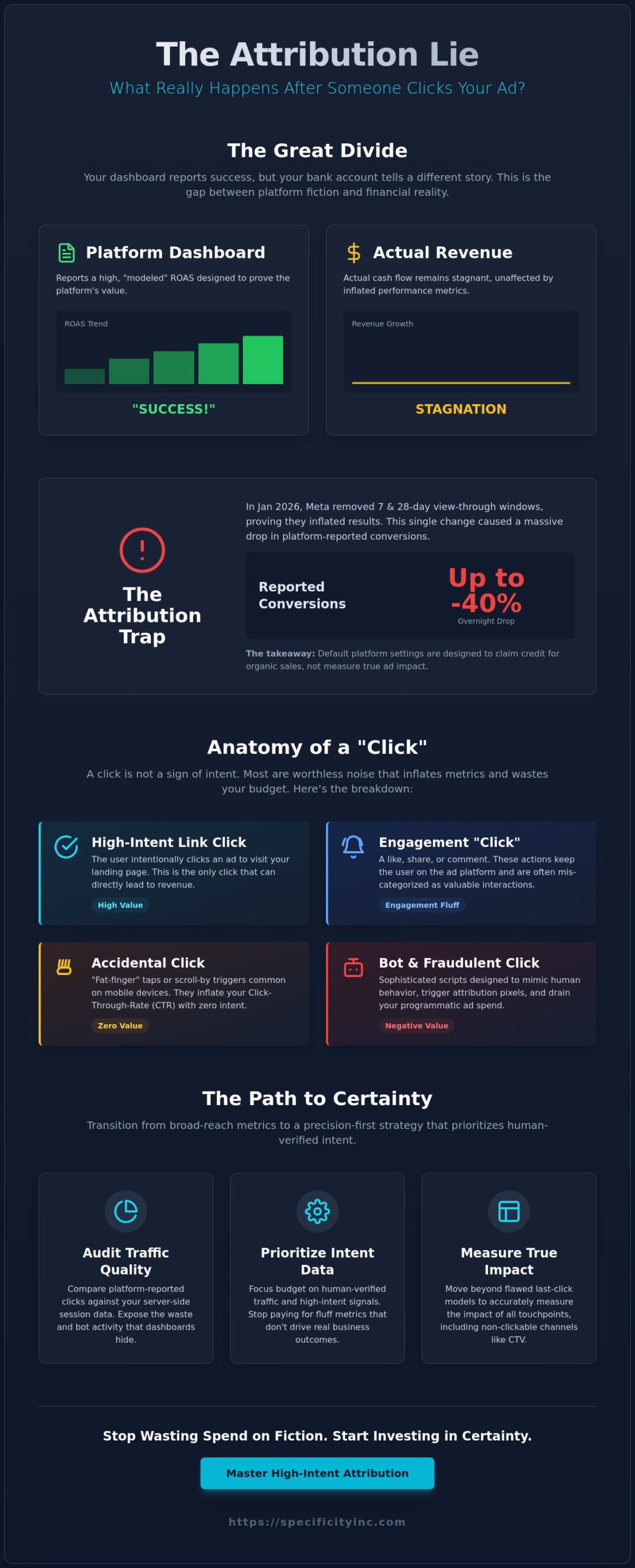
We’re exposing the massive gap between platform-reported metrics and actual revenue. As of January 2026, Meta’s removal of 7-day and 28-day view-through windows caused reported conversions to drop by up to 40% for many advertisers. This shift proves that relying on default platform settings is a recipe for wasted spend and misallocated capital. This article provides a clear framework for auditing traffic quality and mastering high-intent attribution. By partnering with performance marketing specialists like HOT IRON Digital, you’ll gain the confidence to scale programmatic display and search engine marketing while eliminating fluff metrics from your executive reporting. We’re moving past creative guesswork and into a landscape of data-driven certainty.
Key Takeaways
- Identify the structural incentives that lead major ad platforms to inflate performance data through broad attribution windows and deceptive click definitions.
- Discover What Actually Happens After Someone Clicks Your Ad? (The Truth About Attribution) by distinguishing between accidental engagement fluff and high-intent link clicks.
- Move beyond the limitations of last-click models to accurately measure the impact of non-clickable, high-value channels like Connected TV (CTV) within complex B2B sales cycles.
- Deploy a strategic verification process to audit traffic quality, comparing platform-reported clicks against server-side session data to expose programmatic waste and bot activity.
- Transition to a precision-first growth strategy that prioritizes human-verified traffic and intent data targeting over broad-reach metrics that fail to drive revenue.
The Attribution Lie: Why Your Dashboard is Inflating Your Success
Attribution is the battleground where platform vanity meets financial reality. At its core, Marketing Attribution is the technical process of assigning credit to specific digital touchpoints. However, for most executives, it has become a source of profound confusion. Platforms like Meta and Google don’t exist to provide objective truth; they exist to prove their own worth. This creates a massive “Platform Incentive” to utilize broad attribution windows that capture as many conversions as possible, regardless of whether the ad actually drove the behavior. They are essentially grading their own homework.
The landscape changed permanently in early 2026. With the enforcement of strict privacy laws in states like Oregon and the mandatory adoption of Global Privacy Control (GPC) signals, standard tracking pixels have lost significant signal depth. To fill this gap, platforms have turned to “modeled” data. This is where the fiction begins. You see a high Reported ROAS on your screen, yet your actual bank balance remains stagnant. Understanding What Actually Happens After Someone Clicks Your Ad? (The Truth About Attribution) requires looking past these automated estimations to find the hard numbers. If your dashboard says you’re winning but your revenue is flat, you’re a victim of attribution inflation.
The 1-Day vs. 7-Day Attribution Trap
Time-based windows are designed to claim credit for sales that were already in motion. If a user sees your ad on Monday and buys via a direct search on Tuesday, Meta’s 1-day view-through window will claim that revenue. This is a deception. It credits a passive impression for a high-intent purchase. While Meta officially removed 7-day and 28-day view-through windows in January 2026, the remaining 1-day window still allows platforms to cannibalize credit from your organic and search engine marketing efforts. Default settings are almost always optimized for the platform, not the buyer’s actual journey.
The Hidden Cost of Ambiguous Definitions
Platforms frequently blur the lines between “Engagement Clicks” and “Link Clicks.” A user liking a post or sharing a video isn’t the same as a user visiting your landing page with intent to buy. Meta’s introduction of “engage-through” attribution in March 2026 further complicates this by crediting conversions to users who watched five seconds of a video without ever clicking. This over-reporting leads to catastrophic budget allocation decisions where you fund “fluff” instead of performance. Attribution inflation is the systemic over-crediting of low-intent interactions.
- Platform Inflation: Automated credit for organic sales.
- Pixel Degradation: Loss of 15-30% of event data due to privacy restrictions.
- The ROI Gap: The difference between dashboard ROAS and actual revenue growth.
The Anatomy of a Click: Link Clicks vs. Engagement Fluff
A click is not a singular event; it is a complex technical sequence. To understand What Actually Happens After Someone Clicks Your Ad? (The Truth About Attribution), you must dissect the milliseconds following the interaction. When a user taps an ad, a technical handshake occurs between the platform, the ad server, and your landing page. This sequence is frequently hijacked. Sophisticated bot traffic now mimics human cursor movement and dwell time to trigger attribution pixels, creating a facade of performance that masks programmatic waste. This is not a measurement error; it is an industry-wide traffic quality crisis.
According to a comprehensive survey of click fraud, invalid traffic continues to evolve, making basic filtering obsolete. We categorize these interactions into three tiers: Accidental, Engagement, and Intentional. Accidental clicks are “fat-finger” errors or scroll-by triggers that inflate CTR without any buyer intent. Engagement clicks involve likes or shares that keep the user on-platform. Intentional clicks are the only metrics that drive revenue. Eliminating the noise requires human verified traffic to ensure that every dollar spent is targeting a legitimate prospect rather than a script. This level of exactness is the only logical choice for businesses seeking predictable revenue.
Tier 1: High-Intent Link Clicks
High-intent link clicks represent the only metric that matters for site-based conversion. These are outbound actions where the user consciously chooses to leave the social ecosystem for your destination. In 2026, relying on platform dashboards is insufficient. You must isolate these clicks using hardened UTM parameters to bypass platform bias and verify arrival via server-side logs. If the click doesn’t result in a session, it doesn’t exist.
Tier 2: The Engagement Mirage
The engagement mirage seduces marketers into optimizing for shares, saves, and comments. While these signals suggest content resonance, they are secondary at best. Optimizing for engagement rather than intent often results in programmatic display campaigns plagued by low-value metrics. A “save” does not pay the bills. If your strategy focuses on volume over specificity, you are funding the platform’s growth, not your own. You must prioritize intent data targeting to move beyond these superficial signals.
- Accidental Clicks: High volume, zero dwell time, immediate bounce.
- Engagement Clicks: On-platform interactions that fail to drive site traffic.
- Intentional Clicks: Human-verified actions that lead to high-value sessions.
Deconstructing the Multi-Touch Myth in Modern B2B Cycles
Last-click attribution is a strategic liability in high-ticket B2B marketing. It constructs a skewed reality where the final touchpoint receives 100% of the credit, ignoring the complex ecosystem that manufactured the intent. This methodology leads to the systematic defunding of top-of-funnel channels, eventually starving your pipeline of new leads. In a professional services environment, the buyer journey is a marathon of technical validation, not a sprint triggered by a single banner ad.
Search Engine Marketing (SEM) often acts as a demand harvester rather than a demand generator. A prospect might see a Connected TV (CTV) ad, engage with social content, and finally convert through a branded search. Crediting SEM alone ignores the engine that drove the search in the first place. This “Attribution Gap” hides the reality of the buyer’s journey. Understanding What Actually Happens After Someone Clicks Your Ad? (The Truth About Attribution) requires acknowledging that the click that closes the deal is rarely the click that started the journey.
Linear vs. Time-Decay vs. U-Shaped Models
Budget distribution depends entirely on your chosen model. Linear models distribute credit equally, which often overvalues minor touchpoints. Time-decay models favor the final interaction, repeating the mistakes of last-click bias. U-shaped modeling is the most honest for demand generation because it prioritizes the “First Touch” that created the awareness and the “Lead Conversion Touch” that secured the data. This provides a balanced view of growth efficiency.
| Model Type | First Touch Credit | Middle Touches Credit | Last Touch Credit |
|---|---|---|---|
| Linear | $3,333 | $3,333 | $3,333 |
| Time-Decay | $1,000 | $2,000 | $7,000 |
| U-Shaped | $4,000 | $2,000 | $4,000 |
*Based on a single $10,000 B2B contract sale.
The CTV Attribution Challenge
Connected TV is a high-impact, non-clickable touchpoint that traditional pixels fail to measure. To bridge this gap, we utilize IP-matching to correlate household TV ad exposure with subsequent website visits. This data must be integrated into your Digital Advertising ROI framework to prove that top-of-funnel awareness is actually fueling your search volume. Without this technical link, you risk cutting the very channels that build your brand authority.
Strategic Verification: How to Audit Your Traffic for Real Intent
Platform dashboards are a liability. To secure your revenue, you must implement a rigorous verification protocol that looks beyond superficial metrics. This audit reveals What Actually Happens After Someone Clicks Your Ad? (The Truth About Attribution) by exposing the friction between reported interest and actual site activity. We do not accept platform data at face value; we verify it against technical reality to ensure every dollar contributes to growth.
Audit Step 1 requires a direct comparison between platform-reported clicks and server-side sessions. A discrepancy exceeding 15% indicates significant technical lag or, more likely, invalid traffic that never intended to load your page. Audit Step 2 involves analyzing bounce rates and session duration by traffic source. High-volume sources with 90% plus bounce rates are bot patterns designed to exhaust your budget. Audit Step 3 utilizes third-party verification to provide an objective layer of filtering. Transitioning to intent-based targeting reduces the burden of post-click filtering by ensuring your ads only reach high-value prospects with established buying signals.
The Bot Problem in Programmatic Display
Standard filters are obsolete. Modern bots utilize sophisticated scripts to mimic human dwell time and erratic cursor movements, successfully triggering standard attribution pixels. This fraud distorts your modeling accuracy and leads to the overfunding of dead-end channels. You are essentially paying for a digital ghost to haunt your landing page. Human-verified traffic is the only way to ensure data integrity.
First-Party Data: Your Only Source of Truth
Your internal CRM must serve as the North Star for all marketing decisions. Effective B2B Marketing requires a lead-to-revenue tracking system that ignores platform vanity and focuses exclusively on closed-won data. The shift away from third-party cookies toward server-side API integrations is a strategic necessity. This methodology captures the technical handshake directly from your server to the ad platform, bypassing the limitations of browser-based tracking. To eliminate programmatic waste and capture real intent, you must deploy human verified traffic across your high-intent channels.
Precision Over Volume: The Specificity Approach to Verified Growth
Traditional attribution is a post-mortem analysis of failure. Most agencies obsess over the aftermath of a click because they didn’t control the quality of the traffic in the first place. At Specificity Inc., we reject this reactive posture. We prioritize intent data targeting to identify high-value buyers before they ever interact with your brand. This methodology fundamentally shifts the conversation from asking What Actually Happens After Someone Clicks Your Ad? (The Truth About Attribution) to a more strategic focus on who is clicking and why. By engineering the audience with exactness, we eliminate the noise of programmatic waste and replace it with a high-intent engine.
Our “Human Verified” advantage is the antidote to the programmatic display crisis. We don’t just buy reach; we buy verified access to decision-makers. By integrating CTV, SEM, and social media into a unified framework, we ensure that every touchpoint reinforces a single, data-backed objective. This isn’t about broad-stroke industry tactics. It is about strategic dominance through analytical science. We utilize assertive power verbs to describe the brand’s impact on the customer journey because we know our methodology is the only logical choice for predictable revenue. We move beyond the “What” to master the “Who.”
Intent-Based Audience Data
Attribution confusion vanishes when you identify the buyer first. Our methodology targets individuals exhibiting active buying signals in real-time, effectively bypassing the ambiguity of broad-reach campaigns. This level of precision is the ultimate Social Media Advertising strategy. Whether in B2B or B2C, we use data depth to ensure your ads appear only to those with a high probability of conversion. This proactive approach eliminates the need to guess What Actually Happens After Someone Clicks Your Ad? (The Truth About Attribution) because the intent was verified at the source.
Execution: From Data to Dominance
Execution requires more than just numbers; it requires creative services that drive intentional action. Our team builds high-impact assets designed to trigger high-intent clicks from verified humans. This multi-channel demand generation creates a predictable revenue stream by cutting through market complexity with data-driven certainty. We don’t settle for superficial metrics. We deliver quantitative outcomes that satisfy executive leadership. Stop wasting capital on accidental engagement fluff and start investing in strategic growth.
Request a Consultation to Audit Your Attribution Strategy and take control of your performance metrics today.
Mastering the Mechanics of High-Intent Attribution
Accepting platform-reported metrics at face value is a strategic liability that drains your marketing capital. We’ve exposed how broad attribution windows and ambiguous click definitions create a facade of success while ignoring the technical reality of the buyer’s journey. Understanding What Actually Happens After Someone Clicks Your Ad? (The Truth About Attribution) requires a fundamental shift toward server-side verification and the ruthless elimination of programmatic waste. If your dashboard claims victory while your revenue remains stagnant, your current methodology has failed.
You must transition from broad-reach tactics to a model of strategic dominance built on exactness. By deploying proprietary intent-data targeting and human-verified traffic solutions, you ensure that every interaction reflects legitimate demand rather than sophisticated bot activity. This methodology provides the executive-level performance metrics necessary to scale high-intent channels with total confidence. It is the only logical choice for businesses seeking predictable revenue in a complex digital landscape.
Stop Guessing and Start Growing with Verified Intent Data. Replace creative guesswork with data-driven certainty and secure the growth your business demands today.
Frequently Asked Questions
What is the difference between a click and a session in my reports?
A click is a platform-side interaction recorded the moment a user taps your ad. A session only occurs when your landing page successfully loads and the tracking pixel fires. Clicks frequently exceed sessions because of technical latency, accidental taps, or bot activity that never intends to load the page. If your click-to-session gap exceeds 15%, you’re likely paying for traffic that never reached your destination.
Why does Meta show more conversions than my Google Analytics?
Meta utilizes an aggressive attribution model that includes 1-day view-through and 1-day engage-through windows. This means Meta claims credit if a user merely saw an ad or liked a post before converting through another channel. Google Analytics typically defaults to a last-click or data-driven model that requires a direct site visit. This discrepancy is a primary reason why marketers must investigate What Actually Happens After Someone Clicks Your Ad? (The Truth About Attribution) to find the actual revenue source.
Is last-click attribution still relevant in 2026?
Last-click attribution is a strategic liability in complex B2B sales cycles. It fails to account for the multi-touch journey, systematically devaluing top-of-funnel channels like CTV that build initial awareness. While it provides a simple snapshot of the final interaction, it ignores the engine that manufactured the intent. Relying on last-click alone leads to misallocated budgets and the eventual starvation of your lead pipeline.
How can I tell if my ad clicks are coming from bots?
Bot traffic is characterized by high bounce rates, zero dwell time, and immediate exits. You can identify these patterns by auditing your server-side logs for non-human behavior such as repetitive IP addresses or clicks from data centers rather than residential ISPs. Sophisticated bots now mimic human cursor movement, making third-party verification essential. If your traffic volume is high but your lead quality is non-existent, you are likely funding automated scripts.
What is human-verified traffic and why does it matter for attribution?
Human-verified traffic is traffic that has been technically validated to ensure a real person with genuine intent triggered the interaction. This is critical for attribution because it eliminates the programmatic waste that inflates your performance metrics. By filtering out automated scripts and accidental taps at the source, you gain a clear, uncorrupted view of your customer journey. It ensures your budget is spent on prospects, not ghosts.
How do I track conversions from Connected TV (CTV) ads?
CTV conversions are tracked through IP-matching and cross-device attribution. Since CTV ads are non-clickable, we correlate the IP address of the household that viewed the ad with subsequent website visits from devices on that same network. This methodology bridges the gap between passive viewing and active search. It allows you to prove that your video spend is driving high-intent search volume and site sessions.
Does a “Like” count as a click in Meta’s attribution model?
As of March 2026, Meta narrowed the definition of a “click-through” conversion to only include link clicks that direct users off-platform. Interactions like likes, shares, and comments now fall under the “engage-through” attribution category. This change was designed to align platform reporting with analytics tools like Google Analytics. However, Meta still claims credit if an engagement occurs within one day of a conversion, potentially inflating your reported success.
How much of my ad spend is typically wasted on low-intent clicks?
Waste varies by channel, but industry data suggests a significant portion of programmatic spend is lost to invalid traffic. When Meta removed 28-day windows in early 2026, many advertisers saw reported conversions drop by 15% to 40%, revealing the scale of previously inflated credit. To protect your capital, you must understand What Actually Happens After Someone Clicks Your Ad? (The Truth About Attribution). Prioritizing intent data targeting is the only way to minimize this waste.