Brand Safety in Programmatic Advertising: Beyond Filters to Strategic Dominance
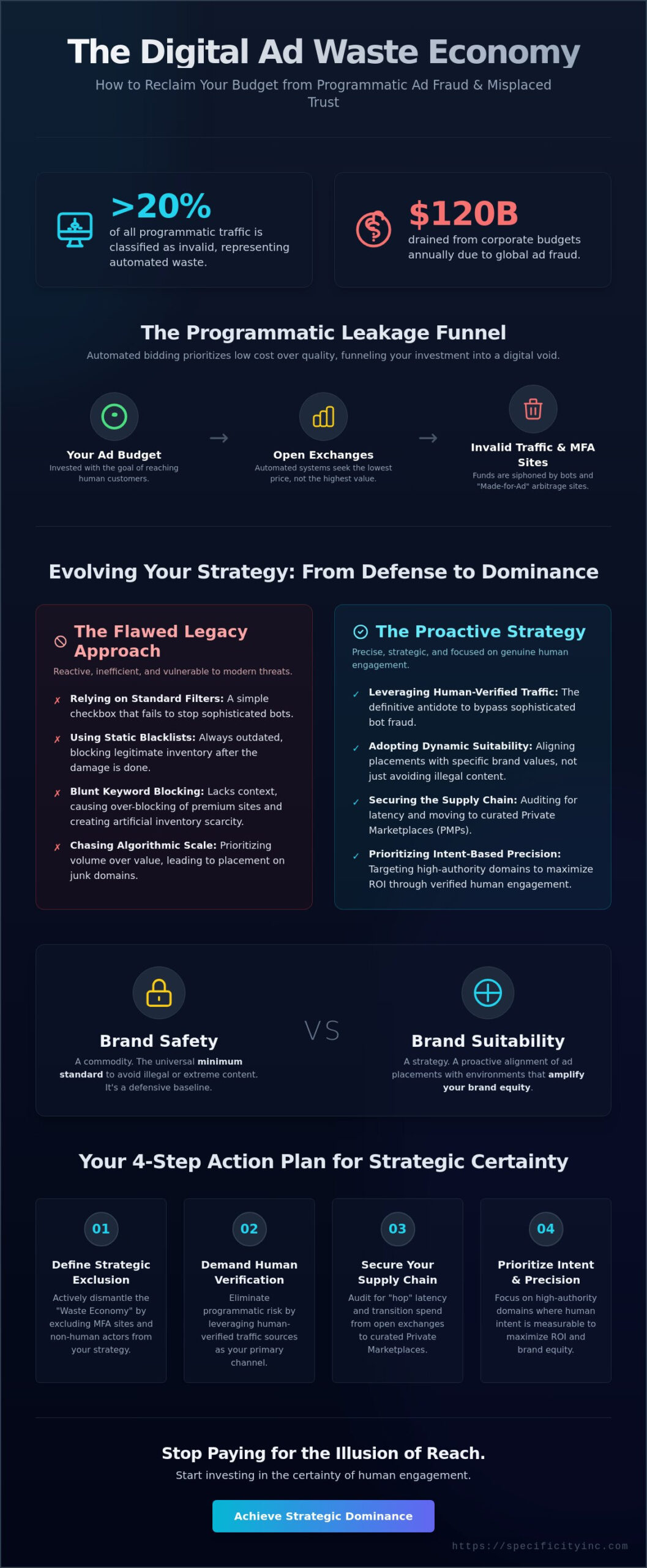
Over 20% of all programmatic traffic is currently classified as invalid, fueling a global ad fraud crisis that drains up to $120 billion from corporate budgets annually. Most executives rely on standard automated filters to protect their investments, yet these tools consistently fail to identify sophisticated bots and low-quality sites designed solely for ad arbitrage. Achieving brand safety in programmatic advertising requires more than a defensive checkbox; it demands a proactive strategy of exclusion.
You’ve likely seen the impact of wasted spend on bot-driven clicks and the risk of brand association with offensive content. This guide explains how to eliminate programmatic waste and protect your brand equity by utilizing human-verified traffic and intent-based precision. We’ll detail a methodology that prioritizes quantitative outcomes over superficial metrics. By targeting high-intent humans rather than chasing algorithmic scale, you’ll maximize ROI and establish strategic dominance over your digital placements.
Key Takeaways
- Define brand safety as a strategic exclusion protocol to dismantle the “Waste Economy” that siphons budgets into low-quality MFA sites.
- Replace static blacklists with dynamic suitability standards to ensure consistent alignment between your ad placements and specific brand values.
- Leverage human-verified traffic to eliminate the inherent risks of brand safety in programmatic advertising and bypass sophisticated bot fraud.
- Secure your supply chain by auditing for “hop” latency and transitioning spend from open exchanges to curated Private Marketplaces.
- Prioritize intent-based precision over broad-stroke metrics to capture high-authority domains and maximize ROI through human engagement.
The Crisis of Brand Safety in Programmatic Advertising: Defining the Waste Economy
The current programmatic ecosystem is built on a foundation of systemic inefficiency. Most marketers view brand safety as a defensive shield against illegal content, but this narrow definition is a liability. True What is Brand Safety? involves the strategic exclusion of detrimental environments and non-human actors that erode capital without providing value. We’re witnessing the rise of a Waste Economy where billions of dollars in national ad spend are siphoned into digital voids. This isn’t just a safety issue; it’s a fundamental breakdown in reputation management. Traditional programmatic models prioritize volume over placement integrity, treating every impression as equal. They aren’t. Achieving brand safety in programmatic advertising requires a total rejection of the “more is better” philosophy.
The High Cost of Blind Scale
Automated bidding systems are designed to seek the lowest clearing price. This incentive structure naturally pushes ads toward junk domains that offer high-volume placements at a fraction of the cost of premium publishers. These environments provide zero real-world value. This blind pursuit of scale directly impacts your digital advertising ROI by inflating vanity metrics while delivering bot-driven engagement. We’ve entered the final stage of the “Decade of Delusion.” Advertisers have spent ten years trusting open exchanges that are essentially black boxes of invalid traffic. With average invalid traffic rates reaching 20.64% in programmatic environments, the trust has completely broken down. Automated scale is frequently just automated waste.
MFA Sites and the Programmatic Leakage
Made-for-Advertising (MFA) sites represent the most sophisticated leak in the programmatic funnel. These platforms exist only to host ads, using aggressive tactics to lure traffic that they then resell to unsuspecting brands. Standard filters often misidentify these sites as high-performing because they generate high click-through rates and low bounce times. The reality is that the traffic is largely non-human or entirely accidental. MFA sites exploit the programmatic auction by manufacturing artificial signals of engagement to capture high-intent spend from premium budgets.
Effective brand safety in programmatic advertising demands that you look past these fabricated numbers. You must prioritize placements on high-authority domains where human intent is verified and measurable. Stop paying for the illusion of reach. Start investing in the certainty of human engagement.
Safety vs. Suitability: Moving Beyond Static Blacklists
Standard brand safety is a commodity. It establishes a universal floor designed to avoid illegal or extreme content. Brand suitability is a strategic differentiator. It aligns your presence with specific environments that amplify your brand equity. Relying on static blacklists is a legacy tactic that fails in a 24-hour news cycle. By the time a list is updated, the damage is done. Worse, these blunt tools often trigger an over-blocking crisis. You end up blocking millions of high-value impressions on premium news sites because of a single, misunderstood keyword. True brand safety in programmatic advertising requires moving beyond reactive filters toward intent-based precision.
The Failure of Keyword Blocking
Blunt keyword filters are a primitive instrument. They don’t understand context. A cooking site discussing a “shot of espresso” or a sports recap describing a “brutal attack on the rim” gets flagged by the same filters intended to block violence. This creates an artificial scarcity of quality inventory. You pay a programmatic tax when high-quality inventory is unnecessarily excluded. You’re forced into lower-tier exchanges because your filters have locked you out of the world’s most reputable publishers. Semantic analysis must replace simple string matching to ensure you aren’t sacrificing reach for a false sense of security.
Developing a Brand Suitability Framework
Dominance requires a Tiered Risk model. National advertisers must categorize environments based on their specific tolerance levels. This is especially critical in b2b marketing where the environment dictates the perceived authority of the message. If your ad appears next to low-quality clickbait, your value proposition is instantly cheapened. You lose the trust of executive leadership before they even read your headline.
Transitioning from open auctions to curated Private Marketplaces (PMPs) is the only logical move for those seeking strategic certainty. PMPs allow for pre-vetted, high-authority domains that meet your suitability standards before a single cent is bid. This shift moves you away from broad contextual scraping toward high-intent precision. If you want to stop guessing and start scaling with certainty, you need to evaluate your current supply path for these systemic leaks. Brand safety in programmatic advertising isn’t about what you block; it’s about the quality of the environments you proactively choose to dominate.
Human-Verified Traffic: The Specialist Antidote to Programmatic Fraud
Advertisers are currently losing an expensive arms race. AI-only fraud detection tools are no longer sufficient because the botnets they fight are trained on the same machine-learning models used to detect them. This creates a feedback loop where sophisticated scripts learn to bypass filters in real time. True brand safety in programmatic advertising requires a shift from reactive filtering to the elite standard of human-verified traffic. By prioritizing behavioral intent over simple IP blacklisting, you ensure your capital targets actual buyers rather than scripted simulations. This methodology serves as a core differentiator for social media advertising and display campaigns where bot density is highest.
Why Sophisticated Botnets Bypass Standard Filters
Sophisticated Invalid Traffic (SIVT) is the primary threat to national programmatic budgets. These modern botnets don’t just refresh pages; they mimic human behavior by executing mouse hovers, scrolling at varied speeds, and maintaining realistic dwell times. They generate fake engagement metrics that look perfect on a dashboard but never result in a conversion. Standard filters often miss these patterns because they rely on static databases of known bad actors. A bot click is a scripted event designed to trigger a pixel; human-verified intent is a measurable sequence of behavioral actions that confirm a living user’s interest. Relying on automated filters alone is an admission of defeat in an environment where fraud is a feature, not a bug.
The Specificity Inc. Approach to Traffic Integrity
We reject the industry’s reliance on broad-stroke automation. Our methodology centers on verifying human intent before ad delivery occurs. By analyzing the depth of audience behavior and cross-referencing intent data, we eliminate the top-of-funnel noise that typically inflates programmatic reports. This process directly improves conversion rates by ensuring your creative assets only reach high-intent humans who are actively navigating the customer journey.
This level of integrity is essential for the long-term performance of search engine marketing (sem) and multi-channel display strategies. When you remove the 20.64% of traffic that is statistically invalid, your performance metrics finally reflect reality. You stop paying for the appearance of growth and start investing in the certainty of human engagement. Strategic dominance is impossible without traffic integrity. It’s time to stop funding the bot economy and start demanding verified human demand.
Implementing a Dominant Brand Safety Strategy in 2026
Execution is the only metric that matters in a high-stakes environment. To achieve absolute brand safety in programmatic advertising, you must dismantle the opaque layers of the traditional supply chain. You cannot rely on third-party vendors to police their own inventory. A dominant strategy requires a systematic, multi-step transition from passive filtering to active exclusion. This process ensures that your capital is never exposed to the systemic risks of the open exchange.
- Step 1: Audit existing supply paths. Identify “hop” latency and transparency gaps. Every intermediary between your bid and the publisher is a potential point of failure where fraud can enter the stream.
- Step 2: Transition to curated Private Marketplaces (PMPs). Abandon the open auction’s “race to the bottom.” Secure your presence on pre-vetted, high-authority domains that guarantee environment suitability.
- Step 3: Deploy pre-bid intent verification. Filter non-human actors in real-time before a single cent is committed. This prevents your budget from being siphoned by sophisticated botnets that mimic human behavior.
- Step 4: Continuous post-bid optimization. Shift your focus from abstract “safety” scores to hard conversion data. If a placement isn’t driving measurable human engagement, it’s a liability, regardless of what the automated reports claim.
Supply Path Optimization (SPO)
Intermediaries invite domain spoofing. Every additional layer in the programmatic chain obscures the origin of the traffic. In the 2026 landscape, maintaining updated ads.txt and sellers.json files is the bare minimum for survival. True strategic dominance requires direct connected tv advertising relationships. By reducing the number of “hops” in the supply path, you eliminate the shadows where invalid traffic thrives. Directness is the ultimate defense against programmatic leakage.
The Role of Real-Time Intent Data
Intent data targeting acts as a powerful secondary layer of security. Bots are designed to mimic clicks, not complex human behavioral patterns. When you target specific, data-backed intent signals, you naturally exclude the randomness and noise of open-exchange fraud. This synergy between high-intent data and performance security ensures that your ads only appear when a verified human is actively moving through the customer journey. You stop paying for impressions and start buying outcomes. To begin this transition, you must audit your supply path for strategic certainty and eliminate the intermediaries draining your ROI.
Strategic Certainty: Why Specificity Inc. is the Only Logical Choice
The programmatic market operates on a model of misaligned incentives. Most agencies prioritize broad-stroke tactics because high-volume spend maximizes their internal margins. Your ROI is often a secondary concern. We reject this legacy approach entirely. Specificity Inc. functions as the intellectual powerhouse for brands that demand exactness. We don’t just manage spend; we engineer growth through the strategic exclusion of waste. Achieving absolute brand safety in programmatic advertising requires a partner who values logic and evidence over creative guesswork. We provide the antidote to market noise by replacing ambiguity with data-driven certainty.
A Partnership Focused on Substantial Growth
We prioritize quantitative outcomes. Superficial metrics like reach or impressions are irrelevant if they don’t originate from a high-intent human actor. By utilizing human-verified traffic, we create a cleaner, more efficient sales funnel that converts at a higher velocity. This isn’t about incremental gains; it’s about substantial growth driven by mathematical certainty. We eliminate the top-of-funnel friction caused by bot-driven clicks and MFA site leakage. We invite executive leadership to engage in a strategic consultation to audit their current supply path. We’ll identify the exact points of capital leakage and provide a roadmap for strategic dominance.
The Future of Programmatic Dominance
The industry is moving toward “Human-Only” ad ecosystems. The era of funding botnets and junk sites is ending. In a high-stakes digital market, precision is the only sustainable competitive advantage. You can either continue funding the noise of the open exchange or you can choose the certainty of verified demand. There is no middle ground for brands seeking predictable revenue. High-intent audience targeting is the only logical choice for businesses that value performance over vanity. Precision isn’t just a tactic; it’s a requirement for survival. Dominate your market with human-verified precision traffic and secure your brand’s future today.
Commanding the Human-Centric Programmatic Future
Passive defense is no longer a viable strategy for national brands. Protecting your reputation requires a pivot toward the proactive exclusion of non-human actors and low-authority environments. By moving beyond blunt keyword filters and adopting dynamic suitability frameworks, you reclaim control over your digital supply chain. Achieving absolute brand safety in programmatic advertising isn’t just about avoiding risk; it’s about ensuring every dollar targets a high-intent human who is ready to engage.
Specificity Inc. operates as an independent powerhouse focused on performance over vanity volume. We utilize elite human-verified traffic protocols and intent-based precision to dismantle the waste economy that drains traditional budgets. You don’t have to accept the industry standard of systemic leakage. It’s time to transition to a methodology where logic and data-backed certainty drive every placement. Our approach as a high-intent audience targeting specialist ensures that your capital works only in environments that amplify your market position.
Secure your brand with Specificity Inc.’s human-verified programmatic solutions and eliminate the noise from your funnel. Take the first step toward strategic dominance and watch your ROI reflect the power of verified human demand.
Frequently Asked Questions
What is the difference between brand safety and brand suitability?
Brand safety establishes a universal baseline to avoid illegal or extreme content that could cause immediate reputational harm. Brand suitability is a strategic alignment that ensures your presence appears only in environments that amplify your specific brand equity. While safety prevents damage, suitability drives performance by matching messaging with high-authority contexts that resonate with your target demographic. Suitability moves beyond the “floor” of safety to reach a performance “ceiling.”
How does programmatic ad fraud impact my marketing ROI?
Programmatic ad fraud siphons capital into a “waste economy” by charging for impressions that never reach a human eye. This directly erodes marketing ROI by inflating vanity metrics while delivering zero bottom-line growth. When invalid traffic rates reach 20.64% in some programmatic environments, your reported performance is essentially a statistical fiction. Fraud doesn’t just waste money; it distorts your data, leading to flawed strategic decisions based on non-human engagement.
Can AI-driven brand safety tools be trusted to stop all bot traffic?
AI-driven tools are insufficient because modern botnets are trained on the same machine-learning models used to detect them. This creates a feedback loop where scripts bypass automated filters in real time. Relying solely on these tools is an admission of failure in a market where fraud is a feature. True brand safety in programmatic advertising requires human-verified intervention to confirm real intent and bypass the limitations of automated detection.
What are MFA (Made-for-Advertising) sites and why are they dangerous?
Made-for-Advertising (MFA) sites are arbitrage platforms designed solely to host ads rather than provide quality content. They are dangerous because they use aggressive tactics to manufacture artificial engagement signals that fool standard programmatic filters. These sites siphon billions in national spend by masquerading as high-performing inventory. They offer zero real audience value and cheapen your brand by placing your creative alongside low-quality, high-clutter content.
How does human-verified traffic improve programmatic campaign performance?
Human-verified traffic improves campaign performance by ensuring your creative assets only reach living users with measurable behavioral intent. This protocol eliminates the top-of-funnel noise caused by sophisticated invalid traffic (SIVT) that typically inflates programmatic reports. By targeting verified humans rather than algorithmic simulations, you secure higher conversion rates and ensure your data reflects actual market demand. It’s the only way to achieve predictable revenue growth in a bot-heavy landscape.
Is brand safety more difficult to manage in Connected TV (CTV) than display?
Brand safety in CTV presents unique challenges due to the lack of standardized transparency protocols compared to traditional display. The complex supply path in CTV often includes multiple intermediaries, which increases the risk of domain spoofing and ad injection. Protecting your spend in this channel requires direct publisher relationships and rigorous supply path optimization. Without these controls, your ads may run on unvetted apps or “ghost” channels that provide no real viewership.
What steps should a national brand take to audit their programmatic supply chain?
A national brand must start by auditing its supply path to identify “hop” latency and transparency gaps where fraud enters the stream. The next step involves transitioning from open exchanges to curated Private Marketplaces (PMPs) that guarantee environment suitability. Finally, you must deploy pre-bid intent verification to filter non-human actors in real time. This systematic approach ensures brand safety in programmatic advertising by replacing passive filtering with a proactive strategy of active exclusion.