

Measuring CTV Ad Effectiveness: The Definitive Guide to High-Intent Attribution
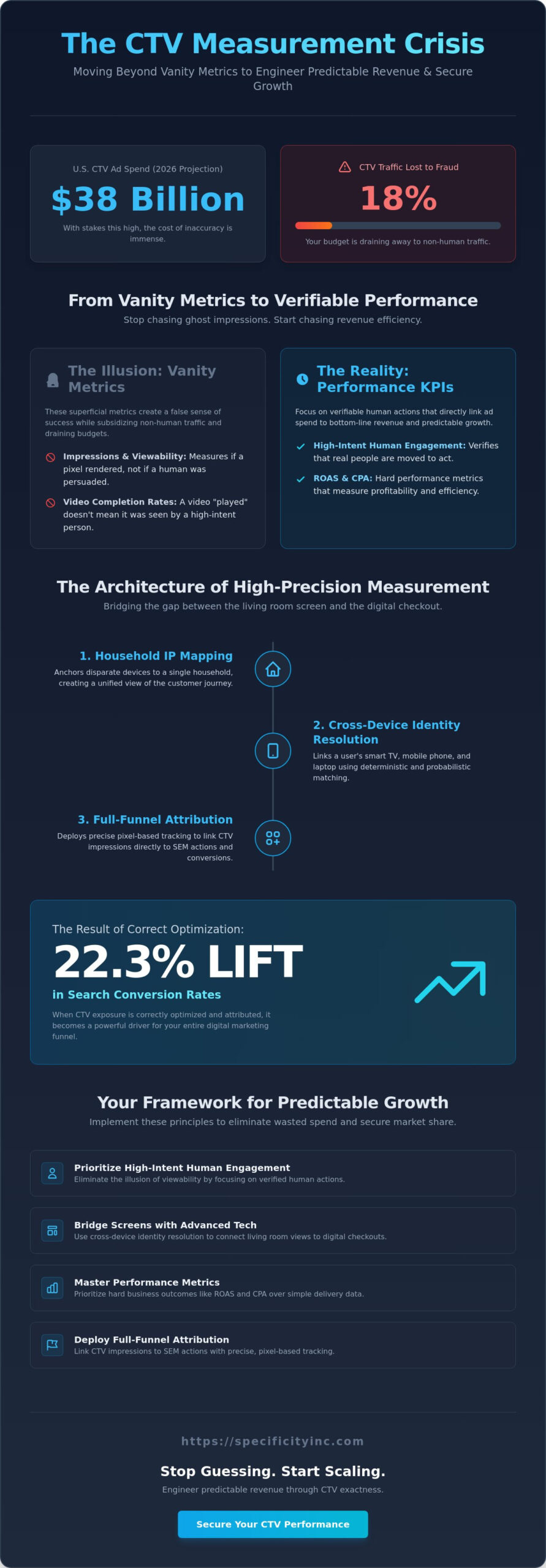
Eighteen percent of CTV traffic is currently lost to fraud, making it the most compromised channel in the digital ecosystem as of 2026. With U.S. CTV ad spend projected to reach 38 billion dollars this year, the cost of inaccuracy has never been higher. Measuring ctv ad effectiveness requires more than superficial metrics; it demands a rigorous accounting of high-intent actions. If you’re still relying on video completion rates to justify your budget, you’re likely subsidizing non-human traffic while your competitors capture actual market share.
You’ve likely felt the frustration of fragmented reporting and the persistent gap between a TV impression and a digital conversion. This guide provides the antidote to that uncertainty. You’ll learn how to move beyond vanity metrics and implement a precision-based measurement framework that links Connected TV spend directly to bottom-line revenue. We’ll examine the data-driven methodology required to verify that your traffic is human and high-intent. By the end of this article, you’ll have a clear attribution model that capitalizes on the 22.3 percent lift in search conversion rates that occurs when CTV exposure is correctly optimized. It’s time to stop guessing and start scaling with mathematical certainty.
Key Takeaways
- Eliminate the illusion of viewability by prioritizing high-intent human engagement over traditional, superficial impressions.
- Bridge the gap between living room screens and digital checkouts using advanced cross-device identity resolution and household IP mapping.
- Master the science of measuring ctv ad effectiveness by prioritizing hard performance metrics like ROAS and CPA over simple delivery data.
- Deploy a full-funnel attribution framework that links CTV impressions to Search Engine Marketing (SEM) actions through precise pixel-based tracking.
- Secure predictable growth by leveraging human-verified traffic and intent data targeting to isolate high-value prospects and eliminate wasted spend.
The Fallacy of Vanity Metrics in Connected TV Advertising
Impressions are a ghost metric. They represent a technical handshake, not a business outcome. In a market where U.S. CTV ad spend is climbing toward 38 billion dollars in 2026, relying on “total views” is a recipe for capital destruction. Measuring ctv ad effectiveness requires a surgical strike on data, not a broad-stroke hope for visibility. The industry standard of viewability is fundamentally broken. It measures if a pixel was rendered, not if a human was persuaded. If your growth strategy depends on these vanity numbers, you’re building on sand.
The Problem with Legacy Measurement
Traditional Nielsen-style ratings were built for a broadcast era that no longer exists. They rely on extrapolated samples rather than census-level data. This creates a massive visibility gap. A video might be “played” on a device while the viewer is in another room or the TV is off. Worse, programmatic environments are plagued by non-human traffic. With CTV fraud rates hitting 18 percent in 2026, an “impression” is often just a bot draining your budget. Modern brands need a TV advertising platform strategy that prioritizes verification over volume. You can’t scale a business on fraudulent data. The gap between a video being played and a video being seen by a high-intent human is where most ad spend disappears.
Moving from Awareness to Performance
Stop chasing reach. Start chasing revenue efficiency. The shift from awareness to performance isn’t just a trend; it’s a survival requirement for executive leadership. High-intent audience data is the only foundation for true measurement. Broad-stroke targeting creates an illusion of success because it fills reports with big numbers that never hit the bank account. We reject these traditional industry tactics. True effectiveness is defined by exactness. It’s the ability to map a specific living room view to a subsequent digital action. By focusing on intent data targeting, you eliminate the noise and isolate the prospects who actually drive growth.
Measuring ctv ad effectiveness is about engineering predictable revenue through technical accuracy and human-verified traffic. This requires a total rejection of creative guesswork. Every dollar spent must be tied to a verifiable human action. When you move beyond the fallacy of vanity metrics, you stop spending and start investing. This transition requires a rigorous measurement framework that values logic, evidence, and hard numbers above all else. Success isn’t measured by how many people saw your ad, but by how many of the right people were moved to act.
The Technical Architecture of High-Precision CTV Measurement
Precision measurement isn’t a luxury; it’s a technical requirement. While competitors talk vaguely about “unifying data,” they often fail to explain the underlying mechanics of the device graph. High-precision measurement relies on household IP mapping to anchor disparate devices to a single geographic and digital point. This architecture allows us to track a user who sees a 30-second spot on their smart TV and subsequently searches for the product on their mobile device. By integrating first-party data, we validate these connections with real-world identifiers rather than relying on the creative guesswork common in the broader market.
Sophisticated analytics and data management platforms are the future of digital advertising because they replace speculation with mathematical certainty. We use these tools to close the attribution loop. When you understand the technical bridge between screens, you stop treating CTV as a silo. Instead, you treat it as a high-impact driver for your broader programmatic display and search strategies. This level of exactness is the only way to achieve predictable revenue in a fragmented ecosystem.
Cross-Device Attribution Mechanics
The journey from a living room impression to a digital conversion is rarely linear. Deterministic matching utilizes logged-in data to create a 1:1 link between devices, providing the highest level of accuracy available. Probabilistic matching uses secondary signals like IP addresses and timing to estimate connections across the household. Identity resolution is the technical anchor that transforms fragmented data points into a cohesive, measurable customer journey. Without this bridge, measuring ctv ad effectiveness remains an exercise in speculation rather than a data-driven science.
The Necessity of Human Verification
Programmatic environments are high-value targets for sophisticated bot nets. If your measurement model doesn’t include a filter for human verified traffic, your ROAS calculation is a fiction. Bot traffic inflates video completion rates and skews machine learning models, leading to automated waste. High-intent attribution requires clean data. When you eliminate non-human interactions, your optimization algorithms focus on real behavioral signals. This precision ensures that your spend is directed toward actual people who have the capacity to convert. Measuring ctv ad effectiveness accurately is impossible if your data set is poisoned by 18 percent fraud rates. You must demand verification to protect your bottom line and ensure every dollar fuels actual growth.
Performance KPIs: Distinguishing Signal from Noise
Data volume is not data value. In the high-stakes environment of programmatic growth, executive leadership must distinguish between cost metrics and performance outcomes. Measuring ctv ad effectiveness requires a hierarchy of KPIs that prioritizes bottom-line revenue over superficial delivery. If your reporting dashboard leads with impressions, you’re looking at the wrong numbers. We focus on the exactness of Return on Ad Spend (ROAS) and Cost Per Acquisition (CPA) to validate every dollar deployed. Success is found in the delta between what you spent and what you earned, not in the volume of pixels rendered.
Hard Metrics vs. Soft Metrics
CPM is a measure of expense; it tells you nothing about efficiency. While premium non-skippable 30-second spots averaged 34.20 dollars in early 2026, the cost is irrelevant without a corresponding conversion. We treat Video Completion Rate (VCR) as a proxy for attention rather than a success metric on its own. While CTV boasts a 95 percent VCR compared to 72 percent for standard online video, completion only matters if it precedes a high-intent action. The ultimate validator is the conversion rate. By utilizing intent data targeting, we ensure that these views come from prospects with a high probability of purchase. Calculating the true cost of a customer acquired through CTV involves tracking the entire journey from the living room to the digital checkout with mathematical certainty.
Understanding Incremental Lift
Are you actually driving growth or just paying to reach people who would have bought anyway? Incremental reach is the critical delta between organic baseline performance and campaign-driven expansion. We use rigorous control groups to measure the true impact of CTV spend on your broader ecosystem. This is especially vital for reinforcing search engine marketing (SEM) efforts. Research shows that paid search conversion rates increase by 22.3 percent when supported by CTV exposure. We also monitor view-through conversions to capture the 51 percent of heavy CTV viewers who search online after seeing an ad. Frequency capping prevents audience fatigue and ensures your budget isn’t wasted on redundant impressions. True dominance in the CTV space requires this level of analytical science to isolate the signal of growth from the noise of the market.
Implementing a Full-Funnel CTV Attribution Framework
Connected TV is not an island. Treating it as a standalone channel is a strategic error that ignores the 51 percent of viewers who take their search queries online immediately after exposure. Implementing a full-funnel framework means deploying pixel-based tracking to capture every digital action that follows a living room view. Measuring ctv ad effectiveness requires this multi-channel visibility to prove how top-of-funnel awareness translates into bottom-line demand. By establishing a unified reporting dashboard, you replace fragmented reports with a single source of truth that accounts for the entire customer journey. We reject the industry obsession with siloed data, opting instead for a methodology where measuring ctv ad effectiveness is the central nervous system of your growth engine.
The Multi-Channel Synergy
The most significant impact of CTV is its ability to prime high-intent channels. Exposure on the large screen significantly increases the click-through rate (CTR) in search engine marketing (SEM). When a prospect sees a verified impression, their subsequent search behavior is more focused and more likely to convert. We use this data to close the loop through social media advertising, retargeting exposed households with precision. This synergy ensures that your CTV spend isn’t just floating in the ether; it’s actively driving performance across your entire digital stack. It transforms a passive viewing experience into an active lead generation engine that feeds your programmatic display and email marketing efforts.
Optimization and Iteration
Real-time measurement allows for rapid budget reallocation. If a specific creative isn’t driving post-view digital actions, it’s a liability. We perform A/B testing on CTV creatives based on hard conversion data rather than subjective viewability scores. This is where our Creative Services team excels, engineering visual assets designed specifically to trigger quantitative outcomes. Optimization is a continuous cycle of intent data analysis where we refine audience cohorts based on actual behavior. You don’t just set a campaign and wait for a report; you iterate with the speed of the market to ensure maximum ROI. You need a partner who understands how to bridge the gap between branding and performance. Partner with Specificity to engineer a high-intent CTV strategy that delivers predictable revenue.
Specificity Inc.: Engineering Predictable Revenue through CTV Exactness
Broad-stroke tactics are the primary cause of budget waste in the programmatic space. We reject the generic platform efficiency offered by competitors in favor of a data-driven certainty that prioritizes quantitative outcomes. Measuring ctv ad effectiveness is not a passive observation at Specificity; it’s an active engineering process. We transform the traditional concept of media spend into a strategic revenue investment. By focusing on the exactness of the customer journey, we provide a definitive path to digital advertising ROI that most agencies cannot replicate. Our methodology values logic and evidence over creative guesswork, ensuring your capital is deployed with maximum efficiency.
The Antidote to Market Noise
The current digital landscape is loud, fragmented, and prone to high fraud rates. Our approach to connected tv advertising serves as the antidote to this market chaos. We combine human verified traffic with intent data targeting to ensure your message reaches actual buyers instead of sophisticated bot nets. This methodology eliminates the noise of vanity metrics and replaces it with exact audience behavior modeling. For B2B and B2C leaders, this isn’t just a choice; it’s the only logical framework for ensuring that every impression serves a strategic purpose. We isolate the signal of growth from the noise of the market and focus entirely on substantial expansion.
Your Blueprint for National Dominance
Scaling a campaign across the United States requires more than just a large budget. It requires an elite specialist who understands the nuances of cross-device identity resolution and household IP mapping. We don’t guess at performance. We use hard numbers to drive expansion. Measuring ctv ad effectiveness at this scale means maintaining a high level of engagement while optimizing for predictable revenue. Executive leadership must stop accepting superficial reports and start demanding the precision that only a dedicated performance partner can provide. Our team acts as an intellectual powerhouse, cutting through complexity with data-backed certainty to deliver the revenue growth your business requires.
The Specificity advantage is built on three pillars of strategic dominance:
- Absolute rejection of traditional, broad-stroke industry tactics that prioritize volume over value.
- Integration of human verified traffic protocols to protect your capital from programmatic waste.
- Utilization of deep intent data to isolate and capture high-value prospects in real-time.
It’s time to cut through the complexity and achieve the growth your business deserves. Demand better data. Demand exactness. Demand a partnership focused on substantial expansion and mathematical certainty. We provide the technical accuracy and performance metrics necessary to dominate your market space and secure a future of predictable revenue.
Dominating the High-Intent Landscape
Strategic dominance in the Connected TV space belongs to those who prioritize quantitative evidence over creative guesswork. You now have the blueprint for moving beyond vanity metrics to a framework that links every impression to bottom-line growth. Measuring ctv ad effectiveness is a technical discipline that relies on exactness in identity resolution and a total rejection of broad-stroke tactics. By implementing human-verified traffic solutions and proprietary intent-based targeting, you ensure your capital fuels actual revenue rather than programmatic waste. There is no room for ambiguity when your market position is at stake.
We specialize in high-stakes demand generation for leaders who demand mathematical certainty. It’s time to stop treating your budget as a media spend and start treating it as a strategic investment in predictable expansion. Our methodology cuts through the noise to deliver the precision your business requires to scale. Take command of your data and replace speculation with a verified path to revenue growth.
Stop guessing and start growing—request your high-intent CTV strategy audit today. Your path to predictable revenue is clear; take command of your data and scale with absolute confidence.
Frequently Asked Questions
How is CTV ad effectiveness measured differently than traditional TV?
CTV measurement utilizes census-level digital identifiers like household IP addresses and device IDs rather than the extrapolated panel data used in traditional TV. This allows for a direct link between a specific view and a subsequent digital action. Traditional TV relies on broad estimates; CTV provides the technical accuracy necessary for performance-based optimization and real-time reporting.
What is the most important KPI for a CTV campaign?
Return on Ad Spend (ROAS) and Cost Per Acquisition (CPA) are the primary indicators of campaign success. While Video Completion Rate (VCR) provides a proxy for attention, it doesn’t equate to revenue. Measuring ctv ad effectiveness requires prioritizing these hard financial outcomes over superficial delivery metrics to ensure your budget fuels actual growth.
Can I track web conversions from a TV ad?
You track web conversions through cross-device identity resolution that bridges the gap between the smart TV and personal devices. When a viewer sees an ad and later visits your site on a phone or laptop, household IP mapping attributes that action to the CTV impression. This closed-loop system turns the living room into a measurable performance channel for your digital ecosystem.
How do you account for bot traffic in CTV measurement?
We eliminate reporting noise by implementing human-verified traffic protocols that filter out sophisticated bot nets. Since CTV fraud rates reached 18 percent in 2026, verification is a technical requirement. We analyze behavioral patterns to ensure your metrics reflect real people, not automated scripts designed to drain your programmatic display budget.
What is the difference between reach and incremental reach in CTV?
Reach represents the total number of households exposed, while incremental reach identifies unique audiences not captured by your other media buys. Incremental reach is the critical metric for national campaigns looking to expand market share. It proves that your CTV spend is uncovering new opportunities rather than simply retargeting existing prospects reached through linear or social channels.
How long does it take to see measurable results from a CTV campaign?
Data begins flowing into your dashboard immediately, but achieving statistical significance for optimization typically requires a 30 to 90 day window. This period allows our machine learning models to analyze intent data and refine targeting cohorts. Measuring ctv ad effectiveness is a continuous process of iteration that improves as the data set grows in depth and accuracy.
What role does intent data play in measuring CTV success?
Intent data serves as the filter that ensures your ads reach prospects already demonstrating a high probability of purchase. It shifts the focus from broad awareness to precision-based demand generation. Success is measured by how effectively the campaign converts this high-intent audience into verifiable leads and sales, rather than just generating empty impressions across a broad demographic.
Is CTV measurement accurate enough for B2B lead generation?
CTV measurement is exceptionally accurate for B2B lead generation when paired with professional household mapping and firmographic data. It allows you to target decision-makers in their homes and track their subsequent professional actions on your digital properties. This level of exactness makes CTV a dominant tool for B2B marketing strategies focused on predictable revenue and high-stakes growth.