
Reducing Lead Generation Fraud: The 2026 Guide to Intent-Based Precision
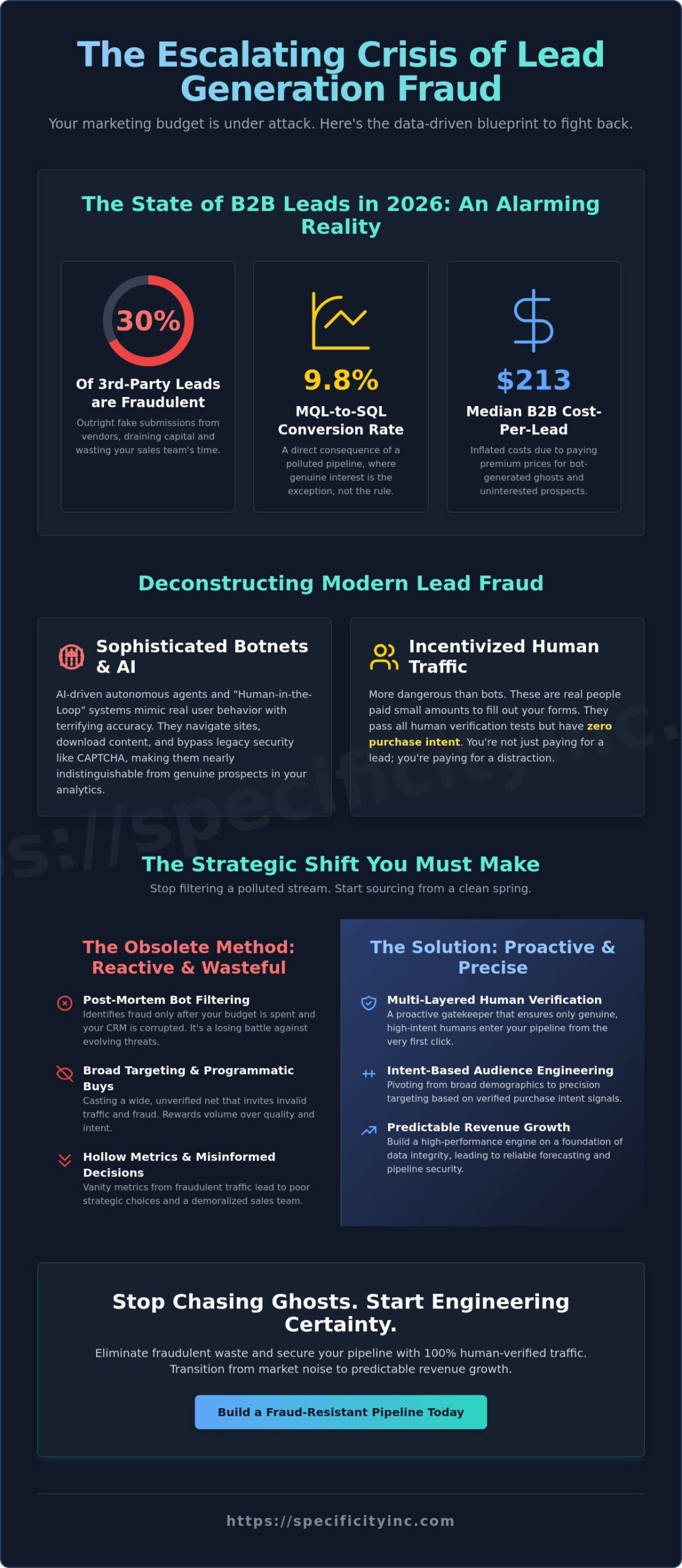
Thirty percent of leads acquired from third-party vendors in 2026 are outright fraudulent. This isn’t a minor margin of error; it’s a systematic drain on your capital and a direct assault on your sales efficiency. You’ve likely watched your median B2B cost-per-lead climb to $213 while your MQL-to-SQL conversion rates have dropped to a mere 9.8%. Reducing lead generation fraud is no longer about simple filtering. It requires a total shift toward proactive, human-verified audience engineering and intent-based precision.
We recognize the frustration of sales teams chasing bot-generated ghosts and the sting of programmatic exchanges where 20.6% of traffic is invalid. This guide provides the strategic blueprint to eliminate fraudulent waste and secure your pipeline with human-verified traffic. You’ll learn how to leverage intentional audience engineering to achieve predictable revenue growth and maintain dominance over competitors using generic tactics. We’ll explore the transition from reactive post-mortems to a methodology that prioritizes data-driven certainty over market noise.
Key Takeaways
- Identify the evolution of sophisticated “Human-in-the-Loop” fraud and its impact on 2026 national marketing budgets.
- Analyze the structural misalignment in legacy ad platforms that rewards traffic volume over lead quality and intent.
- Adopt a tactical framework for reducing lead generation fraud by pivoting from broad demographics to precision intent data.
- Implement multi-layered human verification protocols to purge bot-heavy traffic and secure your pipeline’s data integrity.
- Leverage fraud-resistant channels like Connected TV to build a high-performance, predictable lead generation engine.
The Escalating Crisis of Lead Generation Fraud in 2026
Lead generation fraud is the deliberate misrepresentation of intent through automated scripts, autonomous AI agents, or deceptive human activity. In the 2026 digital ecosystem, this isn’t a minor overhead cost; it’s a catastrophic drain on enterprise capital. Global ad fraud losses are projected to exceed $100 billion this year. When you realize that up to 22% of all digital ad spend vanishes into fraudulent channels, the urgency of reducing lead generation fraud becomes clear. Traditional lead capture forms remain the primary vulnerability. They act as static, unguarded entry points for sophisticated botnets designed to mimic human navigation and form-fill behaviors with alarming accuracy.
Broad targeting serves as the primary catalyst for this systemic failure. Many marketing leaders still prioritize reach over exactness, inadvertently creating a playground for bad actors. When you cast a wide net across unverified programmatic exchanges, you aren’t just reaching more people; you’re inviting garbage into your CRM. This lack of precision is the fuel that keeps fraud farms operational and profitable. Moving forward requires a rejection of these broad-stroke tactics in favor of data-driven certainty.
The Economic Toll on Performance Metrics
Fake leads do more than waste your media budget. They inflate your Cost-Per-Lead (CPL) while simultaneously decimating your downstream conversion rates. With the median B2B CPL climbing to $213 in early 2026, every fraudulent entry represents a significant financial loss that compounds over time. The damage extends beyond the balance sheet. There is a severe hidden cost: sales team burnout. When high-performing reps spend their hours chasing fake contact data and “ghost” prospects, morale collapses and productivity stalls. Research indicates that 30% of leads from third-party vendors are fraudulent. Much of this starts with click fraud, where automated systems trigger initial engagements that look legitimate on a dashboard but offer zero commercial value. This corruption of your analytics leads to misinformed business decisions based on hollow metrics.
Why Detection is No Longer Sufficient
Reactive bot filters are obsolete. They operate on a post-mortem basis, identifying fraud only after the budget has been spent and the data has been corrupted. AI-driven fraudulent actors now deploy autonomous agents that bypass legacy security with ease. You can’t just clean data after the fact; you must engineer intent from the start. This transition moves the focus from broad-stroke programmatic exchanges to human-verified traffic. It’s the difference between filtering a polluted stream and sourcing from a clean spring. By prioritizing precision over reach, you eliminate the noise and secure your pipeline with prospects who have been verified as real humans with genuine purchase intent. This is the only logical choice for businesses seeking predictable revenue growth.
Deconstructing the Mechanics of Modern Lead Fraud
The evolution of fraud has rendered basic security protocols obsolete. Sophisticated bad actors have moved beyond simple, repetitive scripts to Human-in-the-Loop (HITL) operations. These hybrid systems combine autonomous AI agents with manual human intervention to bypass standard CAPTCHA and IP filters. AI-generated personas now navigate sites with human-like variability, making them nearly indistinguishable from actual prospects. This technical sophistication is a primary hurdle in reducing lead generation fraud, as legacy systems struggle to differentiate between a high-intent buyer and a high-functioning bot.
Lead farms now target high-payout B2B conversion events with surgical precision. These operations are increasingly infiltrating B2B pipelines by mimicking the behavioral signatures of high-value executives. They don’t just click; they engage, download whitepapers, and trigger CRM workflows. This level of deception requires a move toward intent data targeting that validates behavior before a lead is ever counted. Without this layer of verification, your marketing automation simply accelerates the ingestion of garbage data.
Sophisticated Botnets vs. Incentivized Humans
Automated form-fillers are easy to spot; incentivized human traffic is far more dangerous. Reward-based human traffic consists of real people completing forms in exchange for digital currency, gaming rewards, or access to gated content. These individuals pass every basic “human” test because they are human. However, they possess zero intent to purchase your product. They are commercial ghosts. You aren’t just paying for a lead; you’re paying for a distraction that clogs your sales funnel. The strategic shift requires identifying genuine purchase intent rather than celebrating mere form completion. Success in 2026 depends on your ability to separate active buyers from professional form-fillers.
The Role of Data Breaches in Lead Injection
Fraudulent actors frequently use stolen Personally Identifiable Information (PII) from historical data breaches to populate lead forms. This stolen data allows them to inject “real” people into your system who have no idea they’ve “signed up” for your service. They often use compromised APIs to perform lead injection directly into CRM systems, bypassing front-end validation entirely. Lead injection is the unauthorized insertion of stolen data into marketing funnels. This process creates a massive liability for your compliance team and wastes your sales resources on people who will never convert. Securing your pipeline requires a methodology rooted in human verified traffic to ensure every data point is legitimate and legally compliant.
The Fallacy of Broad Targeting and Legacy Ad Platforms
Broad targeting is no longer a viable growth strategy; it’s a liability. Legacy ad platforms operate on a fundamental incentive misalignment that prioritizes their top-line revenue over your campaign integrity. These systems are designed to maximize clicks and impressions. Because platforms receive payment regardless of lead quality, their motivation for reducing lead generation fraud is secondary to maintaining high inventory liquidity. This dynamic transforms broad-stroke programmatic campaigns into an open invitation for fraudulent actors who exploit the “black box” nature of algorithmic optimization.
The failure of “Lookalike Audiences” illustrates this systemic weakness. If your initial conversion data is even slightly contaminated by the sophisticated AI personas discussed previously, the algorithm will seek more of the same. It identifies the behavioral signatures of high-functioning bots and scales your reach toward similar fraudulent segments. You aren’t just wasting budget; you’re actively training the platform to find more invalid traffic. Ad fraud remains the biggest threat to the industry precisely because the current infrastructure rewards volume over exactness.
Why Big Tech Profitability Hinders Fraud Prevention
There is a direct conflict of interest between platform profitability and advertiser ROI. Features like “audience expansion” are designed to keep CPMs low by serving ads to low-quality, bot-heavy sites that legitimate buyers never visit. These expanded networks are the primary breeding grounds for the lead farms mentioned in Section 2. When platforms provide “invalid traffic” reports, they’re essentially grading their own homework. Executives must question these self-reported metrics, as they often ignore sophisticated HITL fraud that legacy algorithms cannot detect. Relying on platform-native filters is a strategy built on misplaced trust.
The Failure of Reactive Bot Filters
Legacy security measures like IP blocking and user-agent filtering are relics of a simpler era. Modern fraudulent operations utilize rotating residential proxies and cloud-based autonomous agents to bypass these perimeter defenses with ease. Blacklisting fraudulent domains is a perpetual game of “whack-a-mole” that offers no long-term protection. This cycle of waste directly erodes your Digital Advertising ROI: The Definitive Guide to Strategic Dominance. Relying on reactive filters is a post-mortem strategy. True dominance requires a proactive shift toward human-verified traffic and precision intent data. You can’t filter your way to growth; you must engineer it from the start.
A Tactical Framework for Reducing Lead Generation Fraud
Reducing lead generation fraud requires more than a software patch; it demands a fundamental restructuring of your acquisition model. You must move from a defensive posture to an offensive strategy of audience engineering. This tactical framework replaces reactive filtering with proactive precision, ensuring that every dollar spent targets a verified human prospect. Broad-stroke tactics are the primary reason your ROI is flatlining. You need a surgical approach to secure your pipeline.
Execution of this framework follows five non-negotiable steps:
- Step 1: Shift from broad demographic targeting to high-intent data targeting. Stop guessing who your buyer is and start targeting individuals already displaying transactional behavior.
- Step 2: Implement multi-layered human verification protocols. Cross-reference lead data against independent, third-party human-verified databases to purge bot entries in real time.
- Step 3: Leverage Connected TV (CTV) to reach audiences in un-bottable environments. CTV operates within closed application ecosystems, making it significantly more resistant to the automated scripts that plague standard programmatic display.
- Step 4: Align payouts and KPIs with down-funnel, high-value conversion events. Move your success metrics from “form fills” to Sales Qualified Leads (SQLs) and closed-won revenue.
- Step 5: Audit traffic sources for “Human-Verified” certification. Demand transparency from every vendor. If they cannot provide a verified human audit trail, they are likely selling you recycled or bot-generated data.
Implementing Intent-Based Audience Engineering
Audience engineering is the proactive selection of users based on verified behavioral signals. This methodology integrates B2B Marketing intent data to bypass the noise of generic interest categories. By analyzing deep-funnel actions, you can identify prospects before they even reach your landing page. Intent-based engineering is the process of isolating high-probability buyers before the first ad is served. This ensures your budget is reserved exclusively for real people with actual commercial needs. Secure your pipeline by integrating human verified traffic into your 2026 growth strategy.
Moving the Conversion Goalpost
Paying for form fills is a legacy mistake that rewards fraud farms. When you incentivize volume, you invite deception. You must optimize your campaigns based on MQL-to-SQL progression rather than raw lead count. This shift naturally starves fraudulent actors of their incentives. Bots can fill out forms, but they cannot engage in a sales discovery call or demonstrate genuine purchase authority. By moving the goalpost further down the funnel, you force your marketing spend to focus on quality. This results in a cleaner data pipeline and a more efficient sales operation that no longer wastes time on commercial ghosts.
The Specificity Inc. Solution: Human-Verified Traffic and Precision
Specificity Inc. represents the definitive antidote to the systemic noise and waste that defines the broad-stroke marketing industry. We provide a surgical alternative to the “hope-based” tactics that have allowed global ad fraud to proliferate. Our methodology centers on a non-negotiable commitment to human-verified traffic and precision intent data. We don’t just “detect” fraud; we engineer it out of the customer journey entirely. By isolating high-probability buyers within verified environments, we ensure your budget targets real commercial intent rather than synthetic personas. Reducing lead generation fraud is not a technical goal for us; it’s a core operational philosophy that drives every campaign we execute.
Our approach rejects the industry standard of “acceptable waste.” We recognize that every fraudulent lead is a direct assault on your sales team’s productivity and your firm’s profitability. To combat this, we utilize a proprietary methodology that validates behavioral signals against independent, third-party data layers. This process purges bot activity and incentivized human traffic before it ever enters your CRM. We deliver the data certainty required for predictable revenue growth, allowing you to dominate your market while competitors remain trapped in a cycle of programmatic contamination.
Connected TV: The Fraud-Resistant Frontier
Connected TV environments offer a unique security profile because they lack the open-browser vulnerabilities exploited by human fraud farms. Unlike traditional display networks, Connected TV Advertising operates within authenticated, closed application ecosystems. This infrastructure makes it nearly impossible for autonomous botnets to mimic human viewing patterns. Lean-back audiences on CTV demonstrate higher cognitive engagement, which translates directly into superior lead quality. We leverage this high-intent environment to drive actions on secondary devices, ensuring the resulting conversion is rooted in genuine human interest. This strategy provides a secure, un-bottable foundation for your demand generation efforts.
Securing Your Competitive Advantage with Data Certainty
The shift from hope-based marketing to data-driven certainty is the only logical choice for executives seeking strategic dominance. While the broader market continues to subsidize fraudulent networks through broad targeting, our partners achieve expansion by prioritizing exactness. We measure success through quantitative outcomes: SQL volume, pipeline velocity, and hard ROI. This commitment to performance metrics ensures your budget is never a donation to bad actors. Demand certainty in your demand generation strategy. It’s time to stop paying for commercial ghosts and start investing in human verified traffic. Partner with Specificity Inc. to eliminate fraud and dominate your market.
Secure Your Pipeline with Intent-Based Certainty
Broad targeting and legacy ad platforms have created a marketplace where fraud is incentivized and quality is secondary. You’ve seen how sophisticated botnets and lead farms exploit high-payout conversion events, corrupting your CRM and exhausting your sales resources. Reducing lead generation fraud in 2026 demands a total rejection of these traditional, high-waste tactics. Success requires a shift toward high-intent audience engineering and environments like Connected TV that offer inherent resistance to automated scripts. You must prioritize the integrity of your data over the superficial volume of your reach.
You can’t afford to wait for platforms to grade their own homework. Strategic dominance belongs to those who prioritize human-verified traffic and data-driven certainty. By aligning your KPIs with down-funnel SQL progression, you secure your revenue and eliminate the noise of commercial ghosts. Our expertise in high-intent audience engineering and programmatic display ensures that every lead in your pipeline is a verified human prospect. It’s time to demand exactness in your acquisition model. Stop paying for fake leads and secure your revenue with Specificity Inc. We are ready to help you dominate your market through precision.
Frequently Asked Questions
What is the most common type of lead generation fraud in 2026?
Human-in-the-Loop (HITL) operations are the most prevalent threat in the current landscape. These involve real people employed at fraud farms to manually complete forms, which effectively bypasses most automated security layers. This activity creates leads that appear legitimate but possess zero intent to purchase. Because these actors exhibit human behavioral patterns, they remain invisible to legacy filters that only look for repetitive bot scripts.
Can bot detection software completely eliminate lead fraud?
Bot detection software cannot achieve total elimination because it is inherently reactive. These tools rely on known signatures and past behavior to identify threats. Sophisticated AI agents and rotating residential proxies evolve faster than detection algorithms can update. True security requires a shift to proactive audience engineering that verifies human intent before the lead event ever occurs in your CRM.
Why do major ad platforms struggle to stop fraudulent clicks?
Major ad platforms suffer from a fundamental conflict of interest where their profitability is tied directly to click volume. Their systems are designed to maximize liquidity and inventory usage, often pushing ads to low-quality sites via audience expansion features. This environment rewards reach over exactness, making the process of reducing lead generation fraud a secondary priority to maintaining platform revenue and liquidity.
How does intent-based targeting reduce the risk of fake leads?
Intent-based targeting mitigates fraud by isolating users who demonstrate specific, transactional behavioral signals before an ad is served. Instead of targeting broad interests, this methodology focuses on deep-funnel actions that bots and incentivized humans cannot easily replicate. By engineering your audience around verified intent data, you ensure your budget is reserved for high-probability buyers rather than synthetic personas or commercial ghosts.
Is human-verified traffic more expensive than standard programmatic traffic?
Human-verified traffic prioritizes net efficiency and downstream ROI over the superficial cost of raw impressions. While standard programmatic traffic often appears cheaper on a CPM basis, it carries a high hidden cost of invalid traffic and sales team burnout. Verified traffic eliminates the waste of commercial ghosts, resulting in a significantly lower cost-per-acquisition and a more predictable revenue pipeline for your organization.
How can I tell if my current lead generation campaign is suffering from fraud?
Look for a sharp divergence between your marketing qualified lead (MQL) volume and your sales qualified lead (SQL) conversion rate. If your lead volume remains high but your sales team reports non-existent prospects or disconnected phone numbers, you are likely suffering from fraud. High bounce rates on landing pages and unnatural spikes in traffic from specific geographic regions are also primary indicators of bot interference.
What role does Connected TV (CTV) play in reducing lead fraud?
Connected TV provides a highly secure environment because it operates within closed, authenticated application ecosystems. Unlike the open web, CTV lacks the browser-based vulnerabilities that allow scripts and botnets to thrive. Reaching audiences in a lean-back environment ensures higher cognitive engagement and virtually eliminates the risk of automated form-fillers, making it a cornerstone strategy for reducing lead generation fraud.
How should I adjust my KPIs to better account for lead quality over quantity?
Transition your success metrics from top-funnel volume to down-funnel velocity and closed-won revenue. Relying on cost-per-lead as a primary KPI encourages the ingestion of low-quality or fraudulent data. Instead, measure the progression from SQL to opportunity and final contract value. This alignment forces your marketing spend to focus on quality and starves fraudulent actors of the incentives they need to operate.