
High Bounce Rate But No Conversions? Your Precision Strategy is Failing
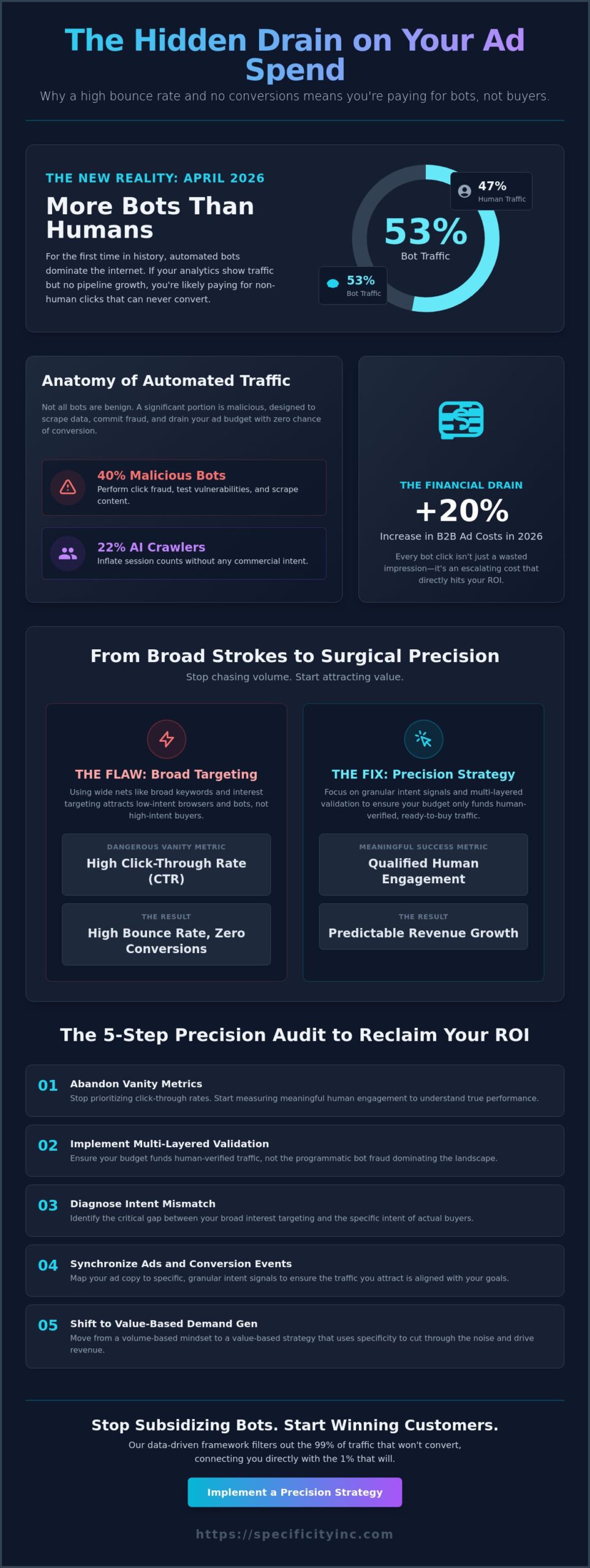
Did you know that as of April 2026, automated bots account for 53% of all online activity, officially surpassing human traffic for the first time in history? If you are struggling with a high bounce rate but no conversions, you aren’t just missing sales. You are likely subsidizing an army of AI crawlers and malicious scripts with an ad budget that saw a 20% increase in costs across B2B industries this year alone.
It’s frustrating to defend a mounting cost-per-acquisition to the C-suite when your analytics show plenty of sessions but zero pipeline growth. You’ve likely suspected that your broad-stroke targeting is attracting the wrong crowd, yet the internal pressure to scale remains relentless. We will dismantle the myth that volume equals value by identifying the systemic failures in your current intent targeting. This article provides a diagnostic framework to filter out the 40% of bot traffic classified as malicious and replaces it with human-verified precision. You will learn how to pinpoint high-intent buyers and ignite a predictable revenue stream through data-driven granularity.
Key Takeaways
- Stop prioritizing click-through rates and start measuring human engagement to eliminate dangerous vanity metrics from your marketing stack.
- Implement multi-layered validation to ensure your budget funds human-verified traffic instead of the programmatic bot fraud dominating the 2026 landscape.
- Diagnose why you have a high bounce rate but no conversions by identifying the critical mismatch between broad interest targeting and granular buyer intent.
- Execute a 5-step precision audit to map your ad copy to specific intent signals and synchronize your traffic sources with actual conversion events.
- Transition from broad, volume-based marketing to a value-based demand generation strategy that uses specificity to cut through general advertising noise.
Decoding the High Bounce Rate and Zero Conversion Paradox
High click-through rate (CTR) is the most dangerous vanity metric in your marketing stack. It provides a false sense of security while your budget evaporates. If your analytics show a high bounce rate but no conversions, you’ve fallen into a common trap: you’re paying for traffic that has zero intent to buy. Traditional agencies often ignore the bounce-to-conversion gap because high traffic volume makes their monthly reports look successful, even if that traffic never reaches your pipeline. They prioritize the “what” of clicks over the “who” of conversions.
The mathematical reality is cold. A high Bounce rate combined with low conversion indicates a fundamental failure in your targeting logic. You aren’t just missing sales; you’re actively funding “False Positive” traffic. This traffic often includes a significant portion of the 53% of internet activity now attributed to automated bots as of April 2026. When your targeting is broad, you aren’t just attracting wrong-fit humans; you are inviting AI crawlers that inflate your session count without any possibility of a conversion. In a market where B2B cost-per-click (CPC) has surged by 20% in early 2026, this level of inefficiency is a terminal threat to your ROI. Precision isn’t a luxury; it’s a survival requirement.
The Anatomy of a Bounce in 2026
In the current digital environment, you must distinguish between a satisfied exit and a targeting catastrophe. A 10-second threshold is your primary diagnostic tool. If users exit your site in under 10 seconds, your ad targeting failed to qualify the visitor before the click. GA4 metrics can mask this reality by reporting “engaged sessions” that meet bare minimum criteria but lack commercial intent. You don’t need more sessions. You need human-verified engagement that moves the needle. A high bounce rate but no conversions is the clearest signal that your data-driven methodology lacks the necessary granularity to filter out non-buyers.
The High Cost of Broad-Stroke Marketing
Broad-stroke tactics lead to high-volume, low-value site visits that bloat your data without increasing revenue. When you rely on broad keywords in search engine marketing (sem), you compete for the attention of browsers rather than buyers. In an environment where the average B2B conversion rate is a mere 2.9%, every non-intent click is a wasted resource. This creates a psychological mismatch. The user expects a specific solution based on your ad, but they find a generic landing page that fails to address their granular pain points. The Conversion Gap is the distance between ad promise and user intent.
The Hidden Culprit: Bot Traffic and Non-Human Clicks
You aren’t just losing customers; you are buying ghosts. As of April 2026, automated bots account for 53% of all web activity, officially outstripping human users for the first time in a decade. If you are staring at a high bounce rate but no conversions, the explanation is often found in the server logs rather than the landing page design. Malicious bot traffic, which comprised 40% of all automated activity in 2025, has a 100% bounce rate and 0% conversion potential. These scripts don’t have credit cards. They don’t have pain points. They exist to scrape data, test vulnerabilities, or fulfill fraudulent programmatic ad impressions that drain your budget with surgical efficiency.
The economic impact of this non-human engagement is devastating. With B2B cost-per-click rates rising by 20% in early 2026, every bot click represents a direct hit to your bottom line. Traditional agencies treat these clicks as “reach” or “engagement,” but we recognize them as systemic waste. Human-verified traffic is the only logical baseline for performance marketing; it is traffic filtered through multi-layered validation to ensure real human interaction before a single cent of your budget is spent. Without this filter, you are effectively subsidizing the growth of AI crawlers, which now represent 22% of all bot activity as of Q1 2026.
Identifying Bot Patterns in Your Analytics
Stop trusting high-level session counts in GA4. To diagnose a high bounce rate but no conversions, you must look for irregular spikes from non-target geographic regions and “ghost sessions” that bypass standard tracking parameters. These automated agents often mimic human behavior but fail to trigger specific conversion events, leaving you with a distorted view of your funnel. Identifying these patterns allows you to stop the bleeding and reallocate your budget toward human-verified traffic solutions that actually reach your intended audience.
The Antidote: Human-Verified Traffic Solutions
Specificity Inc. eliminates the noise of programmatic fraud by shifting the focus from buying raw impressions to buying validated intent. We utilize proprietary multi-layered validation to ensure your ads are served to human eyes, not server farms. This methodology secures your funnel against the drain of bot fraud and ensures that your traffic quality remains high enough to support predictable revenue growth. By pinpointing real human buyers through intent data targeting, we ignite conversions that broad-stroke marketing simply cannot reach. We don’t just increase traffic; we dominate the market by ensuring every click has the potential to become a client.
Intent Mismatch: Why Your Ads Attract Browsers, Not Buyers
Interest is not intent. While general agencies focus on broad interest-based targeting, they ignore the fundamental psychological drive behind a transaction. If you are experiencing a high bounce rate but no conversions, your strategy is likely targeting people who are curious about a topic rather than those ready to solve a specific problem. This Intent Mismatch occurs when your top-of-funnel reach is too wide, pulling in researchers and students instead of buyers. When you rely on broad match keywords in search engine marketing (sem), you are effectively bidding on the wrong audience. You pay for the click, but the user realizes within seconds that your offer doesn’t align with their immediate need. This creates a friction point that no amount of creative design can fix.
Clickbait creative strategies further exacerbate this problem. High-impact headlines that promise the world might drive a high CTR, but they lead to catastrophic bounce rates when the landing page fails to deliver on that specific promise. In an environment where B2B industries have seen a 15% to 20% increase in CPC throughout 2026 according to Blueprint Digital, you cannot afford to attract the curious. You need the committed. We utilize intent data to predict the probability of a conversion based on historical behavioral patterns before a single cent of your budget is spent. By the time a user sees your ad, they should already be statistically likely to convert.
The Granularity of High-Intent Data
We pinpoint users based on active search behavior and real-time purchasing signals rather than static demographics. Demographic data tells you who someone is; intent data tells you what they are going to do next. In b2b marketing, this granularity allows us to bypass the researchers and target actual decision-makers who are currently in a buying cycle. This shift from demographics to behavioral certainties is the only way to maintain a lead conversion rate that meets or exceeds the 2.9% B2B industry benchmark reported by Blueprint Digital in 2026.
Aligning Ad Creative with Landing Page Reality
Dominating the funnel requires a “Mirror Effect” where the ad creative and the landing page headline are perfectly synchronized. If there is even a slight deviation in messaging, high-intent users will bounce immediately, sensing a lack of relevance. We eliminate these friction points by ensuring every ad click leads to a hyper-specific landing page that answers the exact query that triggered the ad. This level of precision ensures that you aren’t just getting traffic; you’re getting pipeline. Intent data acts as a filter that prevents bounces before the click occurs.
The Precision Audit: 5 Steps to Synchronize Traffic and Conversion
Broad-stroke marketing is a budget killer. To solve the paradox of a high bounce rate but no conversions, you must execute a surgical diagnostic of your entire funnel. Traffic volume is a vanity metric; conversion is the only reality that matters for your bottom line. If your data shows thousands of hits but zero pipeline, your strategy isn’t just failing; it’s non-existent. You need a data-driven framework that prioritizes human intent over raw session counts.
- Step 1: Audit your traffic sources for human verification. Purge the 53% bot traffic identified in April 2026 reports from your active bidding. If you aren’t filtering for human-verified users, you are burning 50 cents of every dollar on scripts.
- Step 2: Map your ad copy to specific, granular intent signals. Stop using generic headlines. Your creative must be a mirror reflection of the user’s specific pain point.
- Step 3: Implement digital advertising roi tracking. Move beyond single-click attribution. You need a multi-touch model that accounts for the complex B2B buyer journey.
- Step 4: Synchronize CTV and Programmatic Display. Use top-of-funnel channels to prime high-intent audiences before they ever hit a search engine.
- Step 5: Optimize landing pages for Surgical Precision. Broad appeal is a weakness. Your landing page should speak to one specific persona with one specific solution.
Leveraging Multi-Channel Synergy
Precision requires a unified front. We use connected tv advertising to build intent and brand dominance long before a search click occurs. This multi-channel approach ensures that when a user finally searches for a solution, your brand is the only logical choice. Programmatic display maintains this dominance across the funnel, while SEM captures the high-intent demand generated by your video and social efforts. This synergy eliminates the noise and ensures your budget is concentrated on the 2.9% of B2B traffic that actually converts.
Technical Optimization for High-Stakes Conversions
Speed is a baseline requirement, but it isn’t a strategy. To fix a high bounce rate but no conversions, you must look at trust signals and human-centric creative. Executives on the go require mobile-first experiences that deliver value in seconds. We eliminate “Leaky Funnel” redirects and broken 404 paths that signal amateurism to high-value prospects. Every technical element must reinforce your authority and lead the user toward a conversion event. If your site feels like a maze, your prospects will leave; if it feels like a solution, they will stay. Secure your precision audit today to stop the waste and start the growth.
Beyond Vanity Metrics: Dominating the Funnel with Specificity
Volume is a trap that many B2B organizations fail to escape. In a landscape where cost-per-click (CPC) rates have surged by 20% across most B2B industries in early 2026, chasing raw traffic is financial suicide. If your analytics report a high bounce rate but no conversions, you are witnessing the wreckage of a broad-stroke campaign. Specificity is the only antidote to the chaos of general advertising. It’s the difference between shouting into a void and speaking directly to a buyer who is actively seeking your solution. We replace the noise of traditional “spray and pray” tactics with surgical intent, ensuring your budget is an investment in revenue rather than a donation to botnets.
The shift from volume-based marketing to value-based demand generation isn’t a trend; it’s a survival requirement. With automated bots now representing 53% of all online activity as of April 2026, every broad campaign is essentially subsidizing non-human engagement. Human-verified traffic and intent data transform your sales pipeline from a guessing game into a precision engine. By filtering out the 40% of traffic classified as malicious, you stop being just another option in a crowded market. You become the logical, data-backed choice for high-intent buyers who are ready to convert now.
The Specificity Inc. Methodology
Our methodology is built on the rejection of creative guesswork. Our surgical approach to social media advertising eschews the “lookalike” models that often pull in low-intent browsers and researchers. We ignite growth by eliminating the broad-stroke waste that inflates your bounce rate and drains your ROI. We pinpoint the exact behavioral signals that indicate a purchase is imminent, ensuring your brand appears at the precise moment of need. It’s time to stop guessing why your traffic isn’t translating to pipeline. You can request a strategy audit today to pinpoint your conversion leaks and reallocate your budget toward human-verified opportunities that scale.
The Future of High-Intent Performance
The 2026 digital landscape is defined by rapid shifts in data privacy laws across 20 states, including new regulations in Indiana and Oregon that restrict precise geolocation and sensitive data usage. Navigating these complexities requires more than just basic tracking; it requires granular data science. Dominating your industry means owning the high-intent segments of your market before your competitors even identify them. We use predictive analytics to ensure your brand maintains strategic dominance regardless of market volatility. Don’t let your budget evaporate into the void of “engagement” metrics that don’t pay the bills. Stop paying for bounces and start dominating your market with Specificity Inc.
Reclaiming Your Market Share Through Precision
The era of broad-stroke marketing is over. As of April 2026, the 20% surge in B2B ad costs makes every wasted click a liability you can’t afford. You now understand that a high bounce rate but no conversions isn’t a design flaw; it’s a targeting failure. By filtering out the 53% of traffic that is non-human and aligning your creative with granular intent signals, you transform your digital presence from a cost center into a revenue engine.
We deliver strategic dominance through human-verified traffic solutions and proprietary intent-based targeting data that traditional agencies simply can’t match. Whether you are scaling through CTV or dominating the funnel with programmatic display, the goal remains the same: predictable, scalable growth. It’s time to stop subsidizing the noise and start owning your industry’s highest-value segments. You have the data; now you need the methodology to execute with surgical certainty.
Stop the waste and ignite your ROI with a Precision Strategy Audit from Specificity Inc. Your path to surgical marketing precision starts here.
Frequently Asked Questions
Why is my bounce rate high even though my CTR is good?
A high click-through rate with a high bounce rate indicates a “Conversion Gap” where your ad creative attracts curiosity but your landing page fails to satisfy commercial intent. Good CTR means your ad is catchy; high bounce means the visitor realized within seconds that your offer doesn’t align with their immediate problem. You’re effectively paying for interest rather than intent, which is a common failure of broad-stroke targeting.
How can I tell if my website traffic is mostly bots?
Analyze your logs for sessions with zero engagement time and irregular traffic spikes from non-target geographic regions. As of April 2026, automated bots account for 53% of all online activity. If you see thousands of hits with zero cursor movement or no conversion events, you’re likely subsidizing malicious scripts, which made up 40% of all bot traffic in 2025.
What is a “good” bounce rate for a B2B landing page in 2026?
In the GA4 era, you should focus on engagement rate rather than just bounces. A healthy B2B landing page should maintain an engagement rate between 40% and 60%. If you have a high bounce rate but no conversions and your engagement rate falls below the 30% threshold, your targeting is fundamentally misaligned with your market’s needs.
Does a high bounce rate hurt my search engine rankings?
Search engines prioritize user satisfaction signals over raw traffic volume. While bounce rate itself isn’t a direct ranking factor, “pogo-sticking” back to search results signals to algorithms that your content lacks relevance for that specific query. This pattern of poor user experience eventually degrades your domain authority and lowers your visibility in high-intent search segments.
Can I fix a high bounce rate without redesigning my entire website?
You fix it at the source by refining the traffic entering your site. Redesigning a website won’t solve the problem if your targeting is pulling in non-human users or low-intent browsers. Implementing human-verified traffic filters and tightening your ad-to-page alignment solves the bounce issue by ensuring only qualified, high-intent humans reach your landing page.
How does intent-based targeting reduce bounce rates?
Intent-based targeting functions as a pre-click filter that eliminates the “curious” and focuses on the “committed.” By pinpointing users based on active purchasing signals and real-time behavioral data, you ensure every visitor has a high statistical probability of conversion. This precision removes the friction of mismatched expectations, which is the primary driver of site bounces.
What role does Connected TV play in reducing site bounces?
Connected TV (CTV) builds brand dominance and trust long before a search click occurs. It primes your prospect with your value proposition in a high-impact, non-skippable environment. When that user eventually interacts with your site, their existing familiarity with your brand reduces the skepticism and friction that typically cause immediate exits and high bounce rates.
Is human-verified traffic worth the extra cost?
It is the only logical choice for businesses seeking predictable revenue growth. With B2B cost-per-click rates rising by 20% in early 2026, you cannot afford to waste half your budget on the 53% of traffic that is automated. Human-verified traffic ensures your spend is concentrated on real people with the actual capacity to enter your sales pipeline.