
Beyond the Walled Garden: Mastering In-Market Audiences and Intent Data in 2026
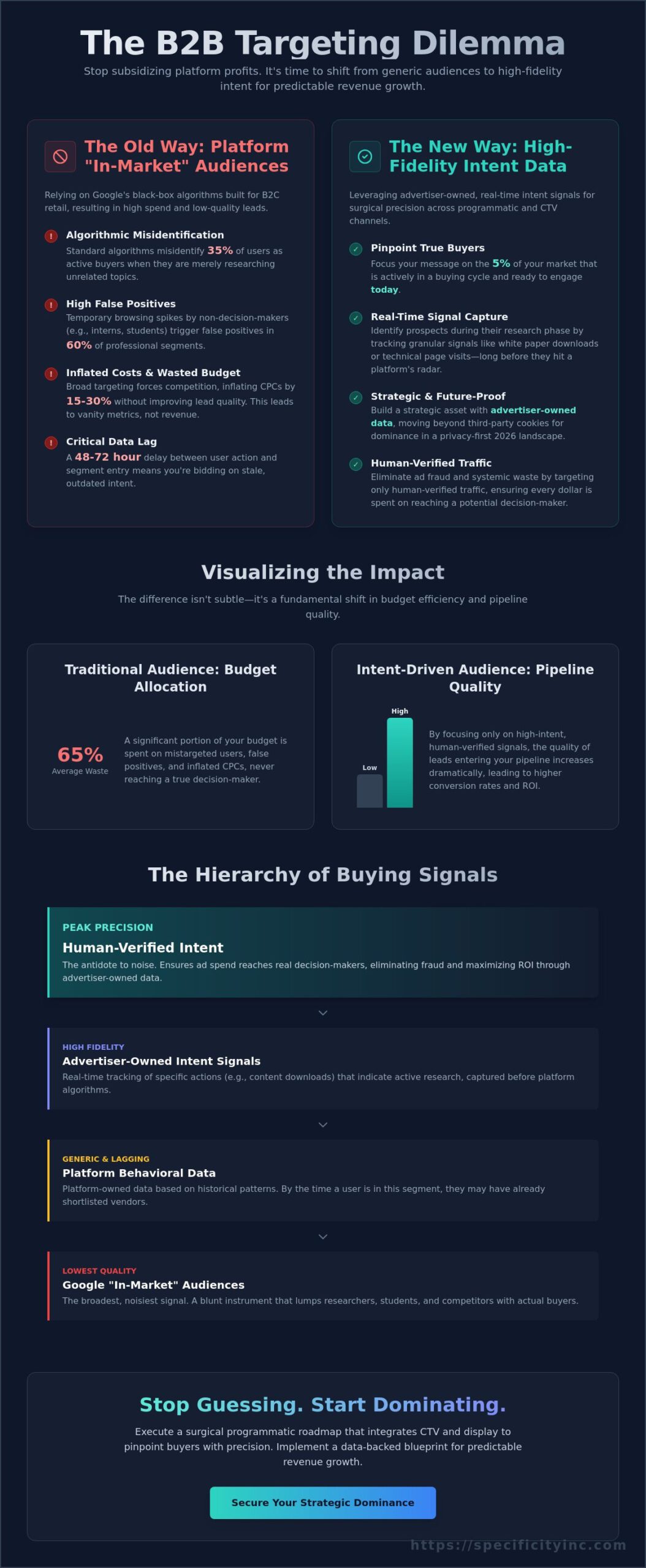
Your B2B marketing budget is likely subsidizing Google’s bottom line rather than your own pipeline. By 2026, relying on google audience targeting is a strategic liability that ignores critical audience targeting limitations inherent in walled gardens. Standard platform algorithms misidentify 35% of users as active buyers when they’re merely researching unrelated topics. You’ve likely seen your CPA bloat because traditional in market audiences focus on volume rather than the granular intent vs in market distinction required for complex sales. It’s time to stop gambling on black-box methodologies that prioritize platform spend over your ROI.
We’ll show you how to ignite your sales funnel by leveraging high-fidelity intent data for strategic dominance across programmatic display and CTV. This article provides a clear, ROI-driven framework to help you bypass generic platform segments and pinpoint decision-makers with surgical precision. You’ll discover the exact methodology needed to move past creative guesswork and implement a data-backed blueprint for predictable revenue growth. We’re cutting through the noise to ensure your message reaches the 5% of your market actually ready to sign a contract today.
Key Takeaways
- Stop burning B2B budgets on retail-centric algorithms that prioritize volume over high-stakes contract value.
- Navigate audience targeting limitations by mastering the technical hierarchy of intent vs in market data, moving beyond the platform-owned guesses of google audience targeting and generic in market audiences.
- Secure strategic dominance in a privacy-first 2026 landscape by pivoting from third-party cookies to high-fidelity, advertiser-owned intent signals.
- Execute a surgical programmatic roadmap that integrates CTV and display to pinpoint buyers with precision throughout the entire sales funnel.
- Eliminate the waste of ad fraud by leveraging human-verified traffic, the only logical antidote to the noise of traditional broad-stroke marketing.
The Failure of Generic Reach: Why Google In-Market Audiences Stumble in B2B
Stop burning capital on algorithmic guesses. By 2026, the gap between broad-stroke marketing and high-precision sales enablement has become a chasm. Most B2B firms still rely on google audience targeting, believing the platform’s black box can identify a decision-maker with a $500,000 budget. It can’t. These segments are built for the high-volume world of B2C retail where a $50 pair of sneakers is the end goal. In the high-stakes B2B environment, relying on these generic clusters is a recipe for strategic failure. You aren’t reaching a buyer; you’re reaching a profile that looks like a buyer based on a three-day window of search history.
The core problem lies in the methodology of behavioral targeting at scale. Google categorizes users based on temporary browsing spikes. If a summer intern researches “enterprise cloud security” for a deck, they are immediately flagged as “in-market.” This creates a massive noise factor. You pay for the click, but the conversion never comes because the user lacks the authority to sign a contract. Specificity is the only antidote to this systemic waste. You must demand data that confirms authority, not just activity.
The Algorithmic Black Box: How Segments are Built
Machine learning is a powerful tool for consumer goods, but it’s a blunt instrument for B2B. These algorithms can’t differentiate between a student writing a thesis and a CTO evaluating a vendor. There is a documented 48 to 72-hour lag between a user entering a segment and the data becoming actionable for the advertiser. In a fast-moving market, that delay means you’re bidding on stale intent. In-Market Audiences are a proxy for interest, not a confirmation of intent.
- Machine learning ignores the organizational hierarchy required for B2B approvals.
- Temporary browsing spikes trigger false positives in 60% of professional segments.
- Data latency ensures you’re often targeting users who have already moved past the consideration phase.
The Hidden Cost of Broad Targeting
The financial impact of audience targeting limitations is staggering. When you bid on broad in-market segments, you’re competing against every other advertiser using the same default settings. This artificial competition inflates CPCs by 15% to 30% without increasing lead quality. You end up with “vanity metrics” like high impressions and click-through rates that fail to impact the bottom line. It’s a performance illusion that masks a declining return on investment.
Every dollar spent on an irrelevant click is a dollar stolen from your margin. To achieve true strategic dominance, you must understand the direct correlation between granularity and Digital Advertising ROI. When you stop chasing volume and start chasing verified intent, your cost per acquisition drops because you’ve eliminated the “noise” of the general market. The debate of intent vs in market isn’t just academic; it’s the difference between a scaling enterprise and a stagnant one.
Intent vs. In-Market: Decoding the Hierarchy of Buying Signals
Google audience targeting is a blunt instrument in a world that demands surgical precision. Most advertisers rely on in market audiences provided by major platforms, mistakenly believing these segments represent active buyers. They don’t. Platform-owned data is a rearview mirror, capturing users based on historical patterns that might be weeks or months old. By the time a prospect enters a pre-defined platform segment, they’ve likely already shortlisted their vendors. The intent vs in market debate isn’t just academic; it’s a matter of budget efficiency and market dominance.
True intent data is advertiser-owned and captured in real-time. It identifies the “research phase” long before a user triggers a platform’s algorithm. While google audience targeting looks for broad signals, intent data pinpoints specific actions like white paper downloads or technical site visits. This granularity is the only way to overcome standard audience targeting limitations that plague generic B2B campaigns. You aren’t just looking for someone interested in “software”; you’re looking for a CTO at a mid-market firm who has researched specific API integrations in the last 48 hours.
Defining the Intent Spectrum
Precision requires a framework. We categorize signals into three distinct tiers to eliminate waste. “Affinity” signals tell us who a person is, which is often a vanity metric. “Intent” signals tell us what they’re doing right now. High-intent signals in a programmatic environment include specific search queries, consumption of deep-funnel content, and repeated visits to competitor pricing pages. We prioritize these active signals over passive demographic data. This methodology ensures your ads appear exactly when the buyer is actively solving a problem, not just browsing the web.
Why Intent Beats “In-Market” Every Time
Recency is the primary driver of ROI. Platform segments are notoriously stale, often retaining users for 30 to 90 days after their initial interest has cooled. Intent data operates on a 24-hour refresh cycle. This allows for a massive B2B Marketing strategic shift toward precision, where campaigns react to live behavior rather than historical assumptions. You can find the B2B Marketing strategic shift details in our latest analysis of 2026 trends.
- Granular Firmographics: Target by exact company size and revenue tier rather than broad industry categories.
- Job Function Precision: Reach the decision-maker, not the intern doing general research.
- Reduced CPM Waste: Stop paying for impressions on users who have already converted with a competitor.
The 2026 landscape leaves no room for broad-stroke marketing. If you aren’t using data you own and control, you’re subsidizing the platform’s inefficiencies. Smart executives leverage precision data to bypass the noise and speak directly to the 3% of the market currently in a buying cycle. Logic dictates that the most granular data wins every time.
Navigating Audience Targeting Limitations in a Privacy-First 2026
The total elimination of third-party cookies isn’t a hurdle for elite marketers; it’s a filter that removes the noise from the marketplace. By 2026, privacy regulations like the updated CCPA and the ePrivacy Directive have effectively gutted legacy tracking methods. If you’re still relying on basic google audience targeting, you’re operating with a blindfold. These audience targeting limitations exist because traditional platforms rely on aggregated, anonymized data that lacks the surgical precision required for high-stakes B2B conversions. Success in this climate requires a pivot to first-party data and human-verified signals. Programmatic display now serves as the critical bridge, allowing brands to locate found buyers through deterministic data rather than probabilistic guesswork.
The Walled Garden Problem
Google, Meta, and Amazon operate as closed ecosystems designed to keep the most valuable data for themselves. They offer advertisers the “what” while hiding the “who.” Relying on “Similar Audiences” or broad platform segments is a strategy for budget depletion. These models frequently dilute campaign quality by as much as 40% because they prioritize platform volume over actual lead quality. To dominate your vertical, you must move beyond these silos. A high-performance strategy demands a multi-channel approach that extends far beyond simple Search Engine Marketing (SEM) to capture demand at the moment it ignites.
The Rise of Identity Resolution
Specificity means identifying the individual decision-maker, not just a transient device ID. Identity resolution in 2026 utilizes professional graph data to link a single user across CTV, mobile, and desktop environments without relying on invasive tracking. This methodology focuses on IP-based targeting and cross-referencing verified B2B databases to ensure your impressions reach a human being with purchasing power.
With roughly 37% of global web traffic now attributed to non-human bots, human-verified traffic is the only metric that guarantees a return on investment. Understanding the technical nuance of intent vs in market signals allows you to pinpoint buyers at the exact peak of their interest. While in market audiences on standard platforms are often based on historical browsing that is 30 days old, true intent data captures real-time actions. This data-driven certainty is the only way to cut through the chaos of the general advertising industry and secure predictable revenue.
- Granularity: Target by job title, department, and verified physical location.
- Scalability: Expand reach across all devices without losing track of the lead.
- Efficiency: Eliminate spend on bot traffic and out-of-market browsers.
Surgical Execution: Programmatic Advertising for B2B Lead Generation
Broad-stroke marketing is a capital leak. In 2026, the margin for error has evaporated. Relying on standard google audience targeting means competing for the same stale cookies as every other amateur in your vertical. It’s an auction you can’t win with logic alone. You need surgical precision to dominate your sector. We replace the ambiguity of in market audiences with raw, deterministic intent data that identifies exactly who is ready to buy before they ever visit your site. We don’t guess; we pinpoint.
Step-by-Step: From Data to Conversion
Success requires a roadmap built on logic, not hope. We follow a 5-step protocol to ignite your growth engine:
- Step 1: Identify the ICP. We use raw intent data to build an Ideal Customer Profile based on actual behavioral signals, not just job titles or demographics.
- Step 2: Channel Selection. We determine if the account requires the high-impact visual authority of CTV or the high-frequency touchpoints of programmatic display.
- Step 3: Creative Alignment. We craft high-impact assets that trigger the specific intent signal identified in step one.
- Step 4: Real-Time Bidding. We use algorithmic precision to bid on placements that put your brand in front of the decision-maker at the exact moment of interest.
- Step 5: Closed-Loop Measurement. We tie every impression back to a CRM record to prove pipeline impact.
Creative services aren’t about “vibes.” They’re about conversion optimization. When analyzing the gap between intent vs in market, the creative must speak to the specific stage of the buyer’s journey. High-intent audiences don’t want fluff. They want technical solutions to the 3 or 4 specific pain points they’ve been researching over the last 48 hours. If your creative doesn’t hit those notes, you’re just adding to the noise.
Omnichannel Integration
A single touchpoint is a missed opportunity. We use Connected TV Advertising to warm up high-value B2B accounts. This isn’t traditional broadcast. It’s a precision engine that puts your message on the largest screen in the room for specific stakeholders. We then layer Social Media Advertising to reinforce that message on mobile and desktop devices. This creates an inescapable ecosystem of authority around your target accounts.
Stop measuring vanity metrics like clicks or impressions. They don’t pay the bills. We focus on pipeline velocity and average contract value. According to 2025 Gartner research, 80% of B2B sales interactions now happen in digital channels. If your programmatic strategy doesn’t bypass the audience targeting limitations of walled gardens, you’re invisible to the majority of your market. We ensure you’re impossible to ignore by targeting the individual, not the platform.
Ready to stop wasting your ad spend on guesses? Partner with Specificity Inc. to build a data-driven pipeline that scales.
The Specificity Antidote: Dominating the Funnel with Human-Verified Intent
Standard advertising platforms trap your budget in a cycle of diminishing returns. They rely on google audience targeting and similar black-box algorithms that prioritize platform profit over your ROI. Specificity Inc. provides the cure for these chronic audience targeting limitations. Our methodology moves beyond the opaque labels applied by giant tech firms. We don’t guess; we identify. By bypassing the walled gardens, we deliver a level of granularity that traditional agencies cannot match. You stop renting the algorithm and start owning the data.
Our Human-Verified Traffic guarantee is the bedrock of our strategy. In a landscape where bot traffic accounts for nearly 40% of all web activity, paying for unverified clicks is financial negligence. We eliminate ad fraud by ensuring every interaction comes from a real person with a verified identity and documented behavioral triggers. This isn’t just marketing; it’s surgical sales enablement. We pinpoint the exact moment a prospect enters a buying cycle, allowing you to strike while the intent is at its peak. This shifts the focus from broad awareness to measurable conversion.
Precision Over Volume
Scale is a vanity metric if it doesn’t lead to a transaction. We value 100 highly qualified leads over 10,000 generic clicks every single time. The Specificity engine uses intent-based targeting to filter out the noise that plagues most in market audiences. We focus on the high-intent 2% of your market that’s ready to buy now. “In 2026, the only metric that matters is the one that correlates directly to your bottom line.” Our technical superiority lies in our ability to distinguish between casual browsing and hard intent, resolving the intent vs in market debate with cold, hard data.
Your Strategic Partner for Growth
Specificity Inc. isn’t a creative boutique; we’re an intellectual powerhouse built for C-suite executives who demand results. Our no-nonsense approach replaces guesswork with data-driven certainty. We integrate high-level creative services with technical precision to build brands that dominate their sectors. We provide the logic and evidence required to scale your revenue predictably. It’s time to stop hoping for growth and start engineering it. Contact Specificity Inc. to dominate your market and ignite your sales funnel with certainty.
Seize the Precision Advantage in 2026
Generic reach is a relic of a less competitive era. By 2026, B2B leaders will have abandoned the black-box opacity of walled gardens to secure a dominant market position. You’ve now seen how to master in market audiences, audience targeting limitations, google audience targeting, intent vs in market by prioritizing human-verified traffic over algorithmic guesswork. Gartner forecasts that 80% of B2B sales interactions will occur via digital channels by 2025, making precision your most valuable asset. We eliminate waste through precision-engineered programmatic and CTV strategies designed for high-stakes demand generation. Specificity Inc. provides the surgical accuracy required to pinpoint active buyers and ignite your sales funnel. The era of vanity metrics is dead; data-driven certainty is the only logical path forward.
Your organization is ready to outpace the competition and claim the revenue you deserve.
Frequently Asked Questions
What is the difference between intent and in-market audiences?
Intent data identifies specific, active behaviors like granular keyword searches or whitepaper downloads, while in-market audiences are broad buckets of users a platform assumes might buy soon. The distinction is critical; intent vs in market determines whether you target a specific person or a vague profile. In 2026, relying on broad buckets wastes 30% of your budget on cold leads. Intent data captures the exact moment a buyer enters the funnel with surgical precision.
Are Google in-market audiences effective for B2B lead generation?
Google audience targeting often fails B2B brands because it relies on consumer-level data rather than professional identity. Most B2B cycles last 6 to 18 months, yet Google’s in-market segments often refresh every 30 days. This misalignment creates a 40% gap in lead quality for complex industries. You need data that follows the professional decision-maker, not just the casual browser who clicked a link once.
How do audience targeting limitations affect my ROI in 2026?
Audience targeting limitations slash your ROI by forcing you into high-competition, low-granularity environments where you pay a premium for generic traffic. By 2026, 75% of walled garden traffic will be obfuscated by privacy layers, making transparency impossible. This lack of visibility increases average cost per acquisition by 22% across most sectors. Specificity eliminates this waste by targeting verified individuals rather than inflated, anonymous groups.
Can I use intent data for programmatic display and CTV?
You can deploy intent data across programmatic display and CTV to reach decision-makers on every screen they use. We map 1st-party intent signals to device IDs to achieve a 95% match rate on premium inventory. This ensures your high-impact video ads hit the CFO’s living room TV after they research your solution at the office. It’s the most efficient way to scale in market audiences without the waste of traditional broadcast.
What is human-verified traffic and why does it matter for B2B?
Human-verified traffic is data filtered to ensure every click and impression comes from a real person rather than a bot or click farm. Since bot traffic accounts for 42% of all internet activity, verifying users is critical for protecting your B2B ad spend. We pinpoint real buyers using multi-factor validation. This process ensures your capital isn’t drained by non-human scripts that will never convert into revenue.
How does Specificity Inc. bypass the limitations of walled gardens like Google?
Specificity Inc. bypasses walled gardens by using independent data stacks that don’t rely on Google or Meta’s proprietary black boxes. We extract raw intent signals and activate them via open-web programmatic channels for total control. This approach gives you 100% transparency into where every dollar goes. You own the data and the results; the platform doesn’t hold your audience hostage.
What happens to audience targeting when third-party cookies are gone?
Targeting shifts from 3rd-party cookies to identity resolution and first-party data clusters that remain stable across sessions. While 60% of Chrome users will eventually be cookieless, our methodology uses persistent ID graphs to maintain tracking. We don’t need cookies to identify a buyer’s intent. We use deterministic data points that remain accurate regardless of browser updates or privacy shifts in the industry.
How do I calculate the ROI of high-intent programmatic campaigns?
Calculate ROI by measuring the lifetime value of acquired leads against the total cost of high-intent data and media spend. Focus on a 3:1 ratio of pipeline value to spend as a baseline for strategic success. Track the 15% increase in conversion speed that intent-driven campaigns typically deliver. This provides a clear picture of how precision targeting accelerates your revenue while cutting down the sales cycle.