CTV Advertising in 2026: The Precision Engine for Strategic Growth
Traditional television advertising is a relic of the shotgun era. If you’re still targeting “adults 18 to 49” through ctv advertising, you’re effectively burning 70% of your budget on ghost impressions. By 2026, broad demographics will be a liability for any C-suite executive demanding predictable revenue. You already understand that the living room is the most influential real estate for brand dominance, but the lack of granular attribution has historically made it a black hole for ROI. It’s time to stop guessing and start executing.
You need a system that converts. This article will teach you how to leverage high-intent data to pinpoint your exact buyer with surgical precision. We’ll strip away the confusion between OTT and linear TV to install a framework for measurable growth. We’re moving beyond vanity metrics to provide a technical breakdown of intent-based targeting and the specific attribution models required to dominate your market over the next 24 months.
Key Takeaways
- Weaponize programmatic infrastructure to transform the living room screen into a high-precision engine for strategic growth.
- Replace the legacy failures of linear television with the unskippable impact and data-rich environment of ctv advertising.
- Build a high-performance funnel by mapping granular data sets to the specific stages of the modern buyer’s journey.
- Eliminate bot waste and maximize ROI through human-verified traffic protocols that ensure your budget hits real prospects.
- Master the mechanics of intent-based targeting to dominate the channel with surgical precision and data-driven certainty.
Beyond the Big Screen: What is CTV Advertising in 2026?
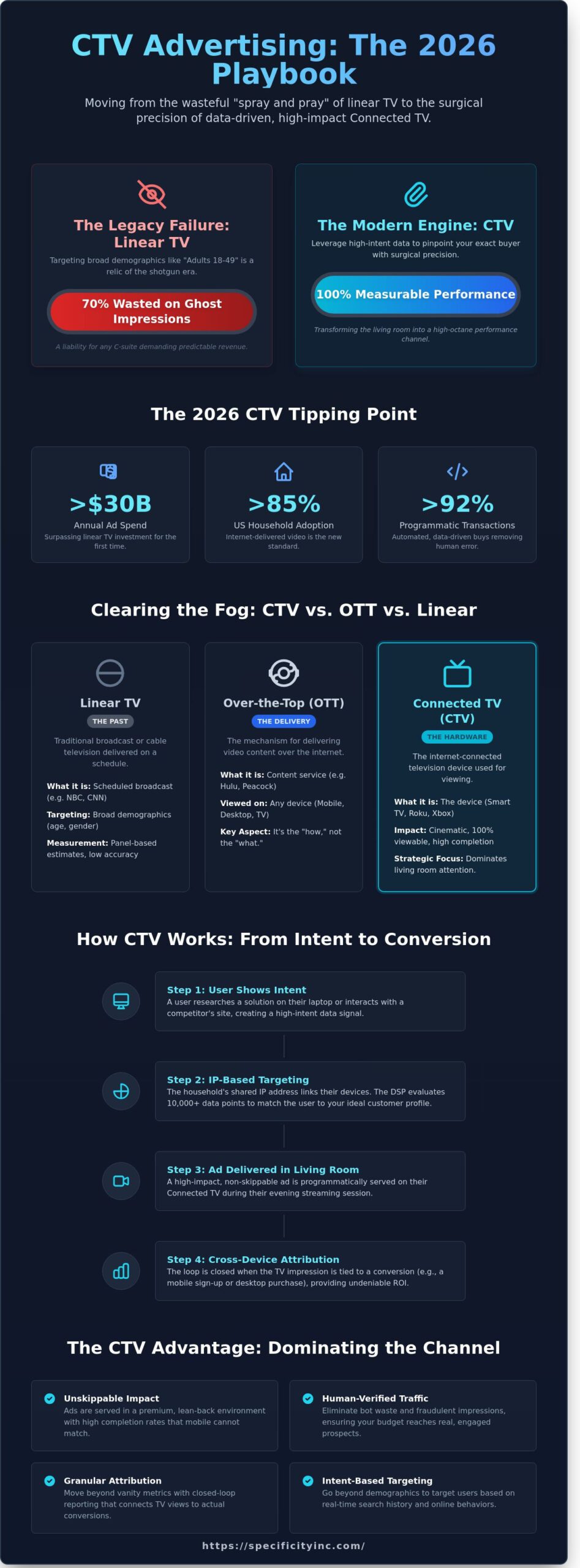
CTV advertising is the definitive fusion of digital granularity and cinematic impact. It represents any television set connected to the internet, whether through native hardware or peripheral devices like gaming consoles and streaming sticks. By 2026, the industry has reached a permanent tipping point where streaming ad spend has officially surpassed linear TV, exceeding $30 billion in annual investment. This isn’t a mere shift in platform; it’s a total rejection of the “spray and pray” methodology that defined legacy broadcast for decades.
Traditional television relied on broad, wasteful approximations. We’ve replaced that inefficiency with surgical precision. CTV advertising allows brands to deliver high-definition, non-skippable creative content directly to engaged audiences with the same tracking and optimization capabilities found in search or social. It’s the antidote to marketing waste, ensuring every dollar spent is tied to a specific, identifiable viewer rather than a vague demographic estimate.
The 2026 CTV Landscape
The legacy cable model is a carcass. In 2026, over 85% of US households have fully embraced internet-delivered video, fueled by the aggressive expansion of ad-supported streaming tiers from every major provider. We’ve moved beyond basic demographics into the era of identity-based targeting. This evolution has transformed connected tv advertising into a high-octane performance channel where conversion optimization is the only metric that matters. Brands no longer buy “shows”; they buy intent-driven audiences across a fragmented but highly measurable ecosystem.
Connected TV vs. OTT: Clearing the Fog
Precision requires clarity, yet many marketers still conflate OTT and CTV. Over-the-Top (OTT) is the delivery mechanism—the content itself moving over the internet. Connected TV (CTV) is the hardware. Understanding What is a Smart TV provides the technical foundation for this distinction, as these devices are the primary vehicles for high-impact engagement. This difference is critical for creative execution. While OTT content can be viewed on a mobile device with a 9:16 aspect ratio, CTV demands 16:9 cinematic excellence. We focus on the big screen because that’s where viewer attention is highest and where brand dominance is established. Whether it’s a smart TV, a PlayStation, or a streaming stick, the device dictates the engagement level.
- CTV: The physical device (Smart TV, Roku, Xbox).
- OTT: The service providing the content (Hulu, Peacock, Max).
- Strategic Impact: 100% viewability and high completion rates that mobile cannot match.
The Mechanics of Intent: How Connected TV Advertising Actually Works
The era of spray-and-pray broadcasting is dead. Modern ctv advertising operates on a programmatic backbone that executes media buys with millisecond latency. This isn’t about buying a time slot; it’s about buying a specific audience profile at the exact moment they engage with content. The Demand Side Platform (DSP) acts as the central intelligence unit, evaluating over 10,000 data variables to decide if a viewer fits your ideal customer profile before the ad even loads. By 2026, automated programmatic channels will handle more than 92% of all CTV transactions, removing human error and maximizing every cent of your budget.
Traditional tracking relied on fragile, third-party cookies that are now obsolete. CTV thrives on IP-based targeting. Every connected device in a home shares a unique IP address, creating a persistent digital footprint that doesn’t disappear when a browser closes. This allows for surgical precision, mapping a household’s behavior across smartphones, tablets, and the big screen. When a user researches a solution on their laptop, the IP link ensures your high-impact ad appears on their living room TV later that evening. This cross-device attribution closes the loop, providing undeniable proof that a TV impression drove a mobile conversion or a desktop sign-up.
Leveraging High-Intent Data
Success in this space requires mapping search history and purchase intent directly to the household. We don’t guess who is watching. We utilize data layers to identify users who have searched for specific industry solutions or interacted with competitor sites within the last 24 hours. Integrating your first-party CRM data allows for aggressive retargeting of existing prospects who have stalled in your sales funnel. Intent data is the catalyst that transforms a passive viewer into a qualified lead.
Precision Targeting for B2B
B2B marketers must bypass the noise to reach decision-makers where they are most receptive. We use firmographic data to isolate job titles like Chief Information Officer or VP of Supply Chain. By mapping these professionals to their home IP addresses, we deliver high-impact messaging that traditional social media ads simply cannot match. This represents a fundamental evolution in b2b marketing, shifting from broad-stroke awareness to intent-based precision. To dominate your sector in 2026, you need a strategic partner who prioritizes data over creative guesswork.
CTV vs. Linear vs. OTT: Why Broad Reach is a Legacy Failure
Linear television relies on the Nielsen rating system; a methodology that belongs in a museum. It estimates viewership based on a minuscule sample size of roughly 42,000 households to represent a nation of over 330 million people. This isn’t data. It’s a guess. Legacy broadcast buys are built on these extrapolations, forcing brands to pay for millions of irrelevant eyeballs just to reach a few thousand prospects. In contrast, ctv advertising offers 1:1 deterministic tracking. You aren’t buying “potential” reach; you’re buying confirmed impressions delivered to specific, verified households with surgical precision.
Broad-market broadcast buys are a dereliction of fiscal duty. When you buy a local news spot, you’re paying to reach everyone from retirees to teenagers, regardless of whether they fit your buyer persona. This creates a “wasted impression” epidemic that guts your margins. CTV eliminates this noise. It allows for a “quality over quantity” approach where frequency is capped to prevent ad fatigue, and every impression is served to a viewer who has already demonstrated intent. We don’t settle for “maybe” when data allows for “certainty.”
The Death of the Broad-Stroke Tactic
The era of spray-and-pray marketing is over. Granularity is the only path to sustainable growth in 2026. We build campaign architectures that ignore the masses to pinpoint the few. This shift moves the needle from vanity metrics like “Gross Rating Points” to the only metric that matters: digital advertising roi. If an impression doesn’t have a direct, data-backed path to a conversion, it’s a liability, not an asset. Scalability requires this level of ruthlessness in your media spend.
Unskippable Impact and Completion Rates
CTV dominates the attention economy through sheer format superiority. While social media video completion rates often hover in the single digits because of the “infinite scroll,” ctv advertising consistently delivers Video Completion Rates (VCR) exceeding 95%. These ads are unskippable and viewed on the largest screen in the house in a lean-back environment. This isn’t a distracted mobile experience. It’s a high-impact brand interaction. Viewers are 10% more likely to recall brands seen on CTV compared to those seen on small-screen devices, providing an immediate psychological advantage that helps you dominate your vertical.
Building the Funnel: Strategic Best Practices for CTV Campaigns
Execution in 2026 demands more than just presence; it requires a surgical approach to the sales funnel. Traditional TV relied on hope. Modern ctv advertising relies on hard data and aggressive optimization. If you aren’t deploying a multi-layered strategy, you’re subsidizing your competitor’s market share.
- Step 1: Define high-intent audiences. Forget age and gender. Utilize granular data sets including past purchase behavior, real-time location data, and specific B2B intent signals to pinpoint your ideal buyer.
- Step 2: Map creative to the journey. A prospect in the awareness phase needs a different stimulus than one in the consideration phase. Align your messaging with the viewer’s current psychological state.
- Step 3: Deploy cross-device retargeting. Use household IP matching to bridge the gap between the living room screen and the mobile device in the viewer’s hand. Immediate follow-up on secondary screens drives the action the TV spot initiated.
- Step 4: Establish unified measurement. Track every touchpoint. Your framework must account for online conversions and offline foot traffic to prove 100% attribution.
- Step 5: Optimize with human-verified data. Ad fraud is a drain on ROI. Continuously refine campaigns based on traffic verified by actual human engagement, not bot-driven vanity metrics.
Creative Services for Performance
High-production value is the entry fee for the big screen, but aesthetic beauty won’t pay the bills. Your CTV creative must be direct-response oriented. We integrate high-contrast QR codes and unique vanity URLs to transform a lean-back experience into a lean-forward transaction. Creative without a data-driven strategy is merely expensive art. Every frame must serve the conversion goal, utilizing clear calls-to-action that command immediate response. In 2026, 74% of consumers report scanning QR codes on their TV screens to access exclusive offers or product details.
Full-Funnel Integration
CTV acts as the ultimate catalyst for the entire digital ecosystem. It sits at the top of the funnel while simultaneously driving massive search engine marketing (sem) volume. When a high-impact CTV spot runs, branded search queries typically spike by 22% within the first 48 hours. This synergy extends to social media, where retargeting viewers who have seen a CTV ad results in a 3.5x higher conversion rate compared to cold social traffic. Success requires sequential messaging; the story you start on the 65-inch screen must be finished with precision on the smartphone. This creates a relentless environment where your brand dominates the prospect’s digital reality.
Stop settling for fragmented marketing efforts and start building a dominant presence with an aggressive growth strategy that delivers measurable results.
Dominating the Channel: The Specificity Approach to CTV
Specificity Inc. stands as the elite specialist in high-intent audience targeting. We don’t participate in the industry’s obsession with broad, wasteful reach. Most agencies operate on creative guesswork; we operate on surgical precision. Our methodology is built for the B2B leader who demands strategic dominance and measurable outcomes. We’ve replaced the soft language of traditional marketing with a high-stakes, data-driven framework designed to fuel predictable revenue. This is not about being seen. It’s about being seen by the exact individuals ready to enter your sales funnel.
Human-Verified Traffic: The ROI Safeguard
Ad fraud is a systemic plague in the programmatic landscape. A 2023 study by Juniper Research revealed that ad fraud costs advertisers approximately $84 billion every year. Specificity Inc. mitigates this risk through our Human Verified Traffic differentiator. We’ve eliminated the bot waste that inflates the metrics of lesser agencies. Our process ensures that every impression in your ctv advertising campaign is served to a real person in a verified household. We focus on the following pillars to protect your investment:
- Bot Elimination: We use advanced filtering to strip away non-human traffic before a single cent is spent.
- Household Verification: Our data sets confirm the physical presence of your high-intent audience.
- Granular Transparency: We provide reports that highlight actual engagement rather than inflated “potential” views.
This verification protocol leads directly to scalability. When you know your traffic is human, your conversion data becomes a reliable compass for growth. We reject vanity metrics like “brand lift” in favor of hard ROI. If a tactic doesn’t contribute to demand generation, it has no place in our strategy. We provide the intellectual powerhouse your business needs to turn ctv advertising into a high-performance engine.
Ignite Your Growth with Precision
The marketing environment in 2026 doesn’t reward the hesitant or the broad. It rewards those who use data as a weapon. Specificity Inc. is the partner for businesses ready to stop wasting budget on “awareness” and start dominating through intent. We pinpoint your audience with a level of granularity that makes traditional methods look like relics. Our team values logic, evidence, and the relentless pursuit of conversion optimization.
Your growth shouldn’t be a gamble. It should be a calculated result of elite targeting and human-verified engagement. We invite you to move past the chaos of the general advertising industry. It’s time to embrace the certainty of data. Contact Specificity Inc. today for a consultation to pinpoint your high-intent audience and ignite your sales funnel with surgical precision. To explore more about the evolving digital landscape, visit the site for further industry insights.
Own the Living Room with Surgical Precision
The era of broad-stroke broadcasting is dead. By 2026, the distinction between digital precision and television reach has vanished, leaving legacy linear tactics in the rearview. You can’t win market share with 20th-century guesswork. Success requires a transition to ctv advertising strategies built on granular intent and human-verified traffic. We’ve moved past the “spray and pray” model. Today, 82% of U.S. households own at least one connected TV device, making it the primary battleground for high-intent audience engagement.
Specificity Inc. eliminates the noise of traditional media buying. We deploy proprietary B2B and B2C demand generation frameworks that prioritize ROI over vanity metrics. As high-intent audience data specialists, we ensure your message reaches actual decision-makers, not bots or disinterested viewers. We pinpoint your ideal customer with surgical accuracy, turning the living room into a high-conversion sales engine. Don’t settle for the chaos of the general advertising industry. It’s time to leverage data-driven certainty to scale your revenue. The path to market dominance is clear, and we’re ready to help you take it.
Stop wasting ad spend and start dominating your market with Specificity Inc.
Frequently Asked Questions
Is CTV advertising the same as OTT?
No; CTV and OTT represent distinct layers of the streaming ecosystem. CTV refers specifically to the hardware, such as a smart TV or Xbox, whereas OTT is the content delivery mechanism. Think of OTT as the signal and CTV as the physical screen. The IAB reports that 82% of US households owned a connected TV device in 2023, making it the primary vehicle for premium OTT content.
How much does CTV advertising cost for a national campaign?
National campaigns typically operate on a CPM model with rates ranging from $20 to $50 according to Statista. High-demand inventory or specific audience segments can push these figures higher. Unlike linear buys, you don’t pay for waste. You invest in impressions served to verified households. This efficiency ensures your capital targets specific buyers rather than a broad, unquantified demographic that will never convert.
How do you measure the ROI of a CTV advertising campaign?
You measure ROI by linking ad exposure to specific conversions through IP matching and household-level attribution. We track the entire journey from the first impression to the final click or physical store visit. By deploying a tracking pixel on your site, we attribute revenue to ctv advertising with surgical precision. This methodology eliminates guesswork and identifies exactly which creative assets ignite your sales funnel and drive growth.
Can B2B companies benefit from Connected TV advertising?
B2B companies benefit by leveraging account-based marketing to reach decision-makers in their living rooms. We pinpoint specific professional roles or companies using IP targeting and third-party data. This isn’t broad-stroke marketing; it’s a strategic strike. LinkedIn’s 2024 B2B Marketing Benchmark report shows 72% of marketers are increasing video spend to reach these audiences. You can reach a C-suite executive with a targeted message, ensuring your brand dominates their screen.
What is the difference between CTV and Linear TV?
Linear TV relies on scheduled broadcasts and broad demographics, while CTV utilizes internet connectivity to deliver targeted ads to specific viewers. Nielsen reported that streaming viewership surpassed cable for the first time in July 2022. CTV offers the granularity of digital marketing with the prestige of the big screen. You stop buying spots and start buying audiences, which optimizes your budget and eliminates the wasted impressions common in traditional broadcasting.
How does intent-based targeting work on a television?
Intent-based targeting works by aggregating cross-device data to identify active buyers. If a user searches for your product on a laptop, we pinpoint that intent and serve a ctv advertising spot to their television. This 1-to-1 mapping ensures your message reaches individuals who have already signaled a readiness to buy. We focus on high-intent signals to drive predictable revenue growth rather than hoping for passive engagement.
What is human-verified traffic in the context of CTV?
Human-verified traffic ensures your ads are viewed by actual people rather than automated botnets. We use third-party validation from firms like DoubleVerify to confirm every impression is legitimate. In a landscape where ad fraud cost the industry $84 billion in 2023 according to Statista, this verification is non-negotiable. We prioritize transparency and demand that every dollar spent reaches a human eye, protecting your ROI from digital waste and fraudulent activity.
Do I need a massive budget to start advertising on CTV?
You don’t need a million-dollar budget to dominate your market. Because CTV allows for extreme granularity, you can run a hyper-local or niche campaign for a fraction of the cost of traditional TV. We focus on scalability; you start with a data-backed pilot and expand as the ROI proves itself. This approach allows smaller, aggressive brands to outmaneuver larger competitors through strategic precision and efficient capital allocation.