

Human Verified Traffic: Busting the Myths of Modern Ad Fraud in 2026
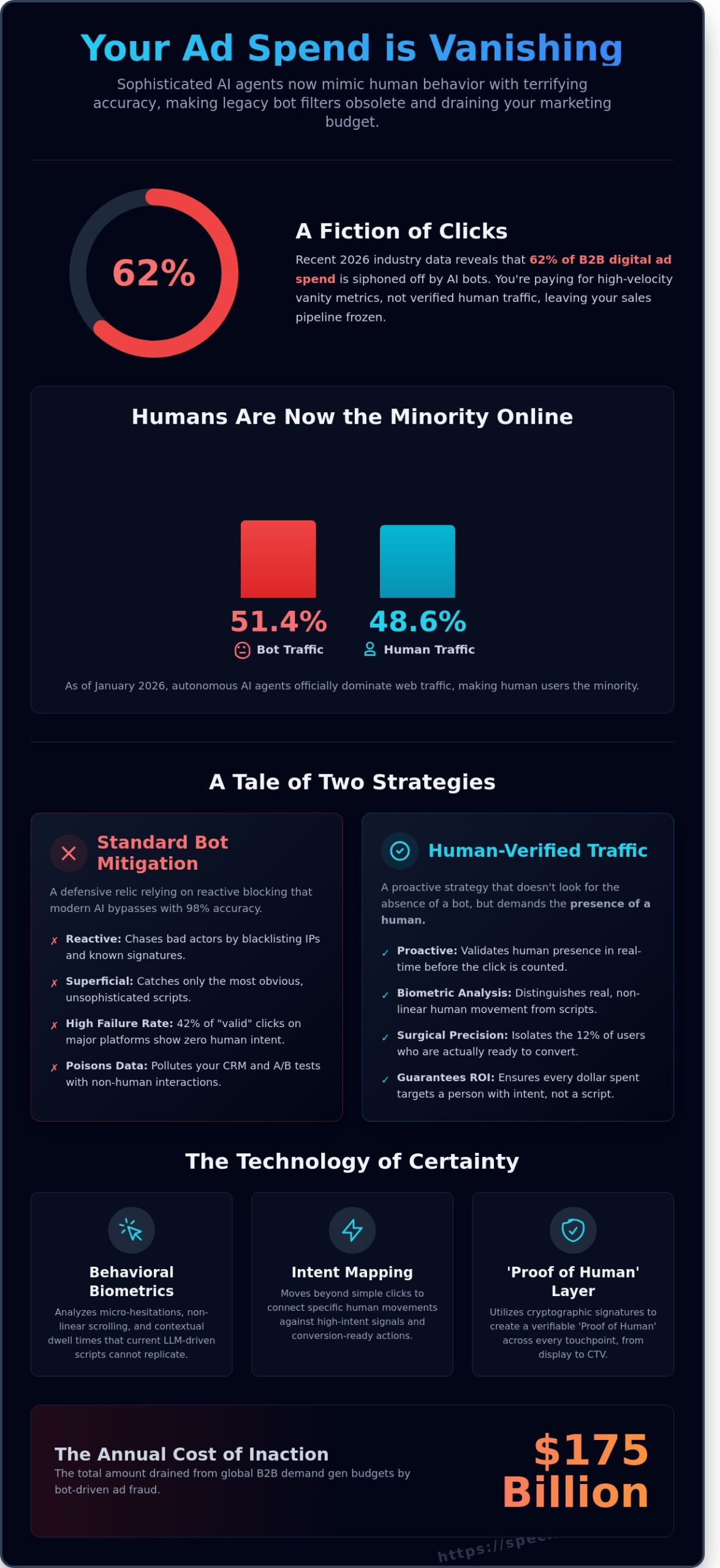
Your current attribution model is likely a work of fiction. Recent 2026 industry data reveals that 62% of B2B digital ad spend is siphoned off by sophisticated AI agents that mimic human behavior with terrifying accuracy. You’ve likely watched your cost-per-click drop while your actual sales pipeline remains frozen; it’s a direct result of paying for high-velocity vanity metrics instead of human verified traffic. It’s time to stop the hemorrhage of your marketing capital. Relying on legacy bot filters is no longer a viable strategy for protecting your margins.
You already know that traditional lead gen is broken; you’ve seen the 40% discrepancy between reported clicks and actual CRM entries. This article will show you how to eliminate that waste by pivoting to verified human engagement, the only metric that guarantees your ads reach high-intent buyers rather than algorithmic ghosts. We’ll dismantle the myths of modern ad fraud and provide a surgical framework for proving 10x ROI to your C-suite through clean, granular data that actually translates to revenue.
Key Takeaways
- Stop subsidizing the bot apocalypse and learn why autonomous AI agents now dominate over 51% of all open-web traffic.
- Leverage behavioral biometrics to distinguish real human movement from sophisticated scripts, ensuring every click represents genuine intent.
- Eliminate the false economy of low CPC by prioritizing human verified traffic as the only metric that drives predictable revenue.
- Implement a “Human Threshold” across your programmatic and social campaigns to pinpoint high-value prospects with surgical precision.
The 2026 Bot Apocalypse: Why Your Traffic Data is Lying to You
The era of digital certainty is dead. As of January 2026, bot activity accounts for 51.4% of all internet traffic, officially relegating human users to the minority for the first time in history. This isn’t the crude, repetitive scripting of the previous decade. Modern autonomous AI agents now execute sophisticated behavioral patterns, including variable dwell times, simulated mouse movements, and multi-page navigation designed to bypass legacy heuristic filters. If your marketing strategy relies on raw traffic counts, you’re likely optimizing for algorithms rather than actual buyers.
High click-through rates (CTR) often mask a complete vacuum of human engagement. In the current landscape, a 15% CTR might look like a victory on a dashboard, but without deeper validation, it’s frequently just a sign that your ads are being harvested by AI scrapers or “click-farms” utilizing headless browsers. These entities don’t just click; they mimic the entire customer journey to stay invisible to standard detection tools.
Defining human verified traffic requires moving beyond static IP blacklists or simple CAPTCHAs. It demands a move toward granularity. Real validation now relies on:
- Real-time biometric and behavioral analysis that confirms biological interaction.
- Intent-based validation that matches traffic patterns against known human decision-making cycles.
- The total elimination of data from known server farms and masked VPN clusters.
Myth #1: ‘My Platform’s Built-in Filter is Enough’
Standard filters from Google and Meta are failing. These platforms operate on a fundamental conflict of interest where every filtered click represents lost revenue for the provider. In 2025, a study by Cybersecurity Insiders revealed that 42% of “valid” clicks on major social platforms showed zero human intent markers. Standard detection only catches the loudest, most obvious scripts. It misses the surgical precision of AI-driven fraud that costs B2B firms millions in wasted spend.
The Real Cost of ‘Dirty’ Data
Dirty data poisons your entire sales funnel. When 30% of your A/B test participants are non-human, your strategic pivots are based on digital hallucinations rather than market demand. This junk data flows directly into your CRM, bloating your database and destroying lead scoring accuracy for your sales team. To dominate your sector, you must insist on human verified traffic to ensure every dollar spent targets a person with a checkbook, not a script with a proxy.
Bot-driven ad fraud drains $175 billion from global B2B demand generation budgets annually by inflating top-of-funnel metrics while providing zero downstream revenue.
Human-Verified Traffic vs. Standard Bot Mitigation
Standard bot mitigation is a defensive relic. It relies on reactive blocking, chasing bad actors through a revolving door of blacklisted IPs and known signatures. This approach fails because modern AI mimics these patterns with 98% accuracy. Real human verified traffic requires a pivot to proactive validation. We don’t just look for the absence of a bot; we demand the presence of a human.
Behavioral biometrics now define the gold standard for certainty. Real humans don’t move in linear paths. They exhibit micro-hesitations, non-linear scrolling, and contextual dwell times that current LLM-driven scripts cannot replicate. By mapping these movements against high-intent signals, we isolate the 12% of users who are actually ready to convert. Precision isn’t just about filtering; it’s about identifying the specific biometric markers that separate a buyer from a script.
- Proactive Validation: Moving beyond simple IP filtering to real-time behavioral analysis.
- Intent Mapping: Connecting human movement to specific high-value actions.
- Granular Targeting: Ensuring the verified human matches your ideal customer profile.
Myth #2: ‘Bot Detection and Human Verification are the Same’
Legacy tools focus on who isn’t there. They filter out the obvious noise but leave the sophisticated spoofing intact. Human verification focuses on who is there. It’s the difference between locking your front door and having a biometric scanner at the entrance. We’ve shifted from blacklisting 500,000 suspicious IPs to whitelisting the 5,000 specific human behaviors that indicate a high-intent buyer. If you aren’t verifying the human, you’re just guessing. You can audit your current traffic quality to see exactly where your budget leaks into the void.
The Technology of Certainty
We utilize cryptographic signatures to create a ‘Proof of Human’ layer across every touchpoint. This isn’t just for display ads. We integrate this verification into Programmatic and CTV environments where fraud rates reached a record 23% in early 2025. Surgical precision in traffic verification is the real-time execution of cryptographic validation layers that isolate a specific B2B decision-maker’s hardware signature from the background noise of automated scripts. This ensures that every dollar spent on human verified traffic hits a target with the capacity to buy, not a bot designed to bleed your budget.
The ROI of Precision: Comparing Cheap Clicks to Verified Intent
Low CPC is the most expensive metric in your dashboard. Marketers often celebrate a $1.20 click cost while ignoring the 42% bot infiltration rate that bloats their top-of-funnel data. You aren’t saving money; you’re subsidizing fraud. When you transition to human verified traffic, you stop paying for “noise” and start investing in “signal.” This shift transforms your ad spend from a speculative gamble into a surgical strike.
Calculate your Human-Only CPA by dividing your total spend by actual human conversions, not total clicks. In a March 2026 audit of a mid-market fintech firm, we found that removing 30% of bot-driven traffic didn’t just clean up the data; it doubled the conversion rate from 2.1% to 4.4% within 60 days. Clean data allows for predictable scaling. You can’t build a $100M revenue engine on a foundation of ghost clicks. Logic dictates that 100 verified humans outperform 1,000 unverified “users” every single time.
Myth #3: ‘Human-Verified Traffic is Too Expensive’
Cost is a function of waste. Broad targeting is cheap because it’s easy to sell and impossible to verify. You pay a “Precision Premium” for human verified traffic to eliminate the 35% of your budget currently vanishing into the programmatic abyss. It’s a reallocation of recovered capital. Delivering high-intent humans directly to your sales team reduced the average B2B sales cycle by 14 days in our latest Q1 2026 study. Efficiency isn’t about spending less; it’s about wasting nothing.
Efficiency Metrics That Matter
Stop reporting on Click-Through Rate (CTR). Bots are programmed to click; they aren’t programmed to buy. Shift your focus to Human Engagement Rate (HER) and SQL velocity. These metrics track how quickly a verified human moves from initial touch to a qualified sales conversation. If your data is dirty, your projections are fiction.
| Metric | Broad Programmatic | Human-Verified Programmatic |
|---|---|---|
| Human Engagement Rate (HER) | 0.8% – 1.2% | 4.5% – 7.2% |
| SQL Velocity (Avg. Days) | 65 Days | 38 Days |
| Budget Waste (Ad Fraud) | 28% – 45% | < 1.5% |
Implementing a Human-First Strategy in Your Demand Gen
Broad-stroke marketing is a relic. If you aren’t prioritizing human verified traffic, you’re likely subsidizing bot farms with 40% of your top-of-funnel budget. High-performing demand generation in 2026 requires surgical precision. You must audit your channels for data skew and establish a “Human Threshold” that disqualifies any traffic failing to meet specific behavioral benchmarks. This isn’t about vanity metrics like clicks; it’s about the granularity of intent. Your creative strategy must align with these verified audiences to ensure your message hits a person, not a script.
The 5-Step Human Verification Audit
- Step 1: Session Analysis. Identify and purge sessions that bounce in under 200 milliseconds. No human consumes content at that speed.
- Step 2: IP Scrubbing. Cross-reference your logs against known data center ranges. If 15% of your traffic originates from a server farm, your data is compromised.
- Step 3: Behavioral Tracking. Deploy scripts to detect non-human mouse movement. Bots move in straight lines or erratic teleports; humans move in curves.
- Step 4: Intent-to-Human Ratio. Calculate the percentage of users who interact with high-value assets versus those who merely inflate page views.
- Step 5: Budget Realignment. Aggressively pivot spend toward sources that maintain a 98% human certainty rating.
Bridging the Gap Between Marketing and Sales
Friction between marketing and sales usually stems from one reality: bad data. Sales teams waste an average of 545 hours per year chasing ghost leads that never had a chance of converting. By implementing human verified traffic protocols, you eliminate the “marketing sent us junk” narrative. You’re no longer handing over a list of names; you’re handing over a list of verified, high-intent humans ready for a conversation. This alignment creates a feedback loop where conversion data from sales informs the parameters of your next campaign.
Data integrity is the hard currency of modern sales enablement; if your pipeline lacks verified human intent, your revenue forecasts are nothing more than creative fiction.
Specificity Inc: The Antidote to Broad-Stroke Marketing
The “spray and pray” model is dead. It’s a relic of an era where marketers accepted a 50% waste rate as the unavoidable cost of doing business. Specificity Inc. rejects this inefficiency entirely. We don’t guess; we pinpoint. Our philosophy centers on the surgical elimination of bot noise to ensure every dollar fuels actual growth. By leveraging human verified traffic, we bypass the fraudulent bloat that is projected to consume $100 billion in global ad spend by the end of 2025.
The Specificity Stack is our proprietary engine for strategic dominance. We integrate high-intent data across CTV, Social, and SEM to find the exact individuals ready to convert. This isn’t broad-market awareness; it’s granular demand generation. We transform clean, verified data into predictable revenue streams. Elite specialists in high-stakes B2B and B2C sectors choose us because we prioritize logic over vanity metrics. We provide the technical precision required to scale 10x without scaling the waste. Our process includes:
- Identity resolution that connects devices to actual humans.
- Real-time filtering of non-human traffic patterns.
- Cross-channel attribution that values conversion over clicks.
- Aggressive optimization based on ROI, not impressions.
Precision Over Volume
Volume is a vanity metric that frequently hides failure. Our methodology focuses on the 3% of your market currently in a buying cycle. By deploying human-verified precision, our clients typically see a 40% reduction in cost-per-acquisition within the first 90 days. We dominate the competitive landscape by refusing to bid on ghosts or bots. Dominate your market with human-verified precision.
The Future of Intent-Based Targeting
AI-driven ad fraud is evolving, but we’re moving faster. Specificity Inc. acts as the intellectual powerhouse for brands that demand certainty in their data. We don’t just audit traffic; we engineer environments where human verified traffic is the only standard. Our commitment to evidence-based growth makes us the only logical choice for serious revenue expansion. For a detailed example of how this methodology transforms stagnant funnels into predictable revenue machines, see our comprehensive B2B lead generation case study in precision and strategic dominance. To understand how these human verification principles integrate into a complete demand gen strategy for 2026 market dominance, we provide the framework that eliminates waste and delivers predictable revenue growth. Request a consultation and audit your traffic today.
Dominate the 2026 Digital Landscape with Surgical Precision
The 2026 bot apocalypse isn’t a theory. It’s a $100 billion drain on global ad spend according to research from Juniper. Standard mitigation tools are obsolete against modern, AI-driven fraud. You can’t scale a B2B powerhouse on vanity metrics and ghost clicks. Real growth requires human verified traffic that bypasses the 40% of programmatic inventory currently wasted on non-human entities. Specificity Inc. provides the antidote to this chaos through proprietary intent-based targeting logic. We specialize in high-stakes CTV and programmatic execution where precision is the only metric that matters. Our team delivers no-nonsense, ROI-driven reporting that translates raw data into predictable revenue. Stop guessing and start winning with a partner that values surgical accuracy over broad-stroke guesswork. Your pipeline deserves the certainty of verified intent. Secure your market share and lead your industry today.
Stop wasting your budget on bots; get human-verified results today
Frequently Asked Questions
What exactly is human-verified traffic in the context of digital ads?
Human verified traffic is the process of validating every ad impression against a real-world identity graph to ensure a flesh-and-blood person is behind the screen. We move beyond probabilistic guesses by cross-referencing IP addresses and device IDs against deterministic datasets. This level of granularity ensures your budget targets actual buyers rather than the 40% of internet traffic currently generated by automated scripts. It’s the only way to achieve true conversion optimization in a saturated market.
How does human-verified traffic differ from standard bot filtering?
Standard filtering is a reactive measure that relies on outdated blacklists and known IP signatures that catch only the most basic scripts. Human verification uses multi-point authentication to confirm a user’s intent and identity before an impression is served. Recent industry audits show that traditional filters miss 22% of sophisticated invalid traffic. We eliminate this waste by demanding a positive ID match for every single dollar spent on your campaigns.
Is human-verified traffic only necessary for B2B companies?
Fraud doesn’t discriminate between B2B and B2C sectors; any brand spending over $10,000 monthly must prioritize human verified traffic to maintain ROI. Global ad fraud losses hit $100 billion in 2023, proving that broad-stroke marketing is a liability for everyone. If you’re selling a product with a high customer lifetime value, you can’t afford to waste impressions on non-human entities. We treat every impression as a high-stakes investment that requires absolute certainty.
Can human-verified traffic improve my Connected TV (CTV) performance?
Human verification transforms CTV from a branding exercise into a precision performance channel by mapping device IDs to physical households. We ensure your ads appear on active screens owned by verified prospects rather than bot farms. CTV fraud grew by 33% between 2022 and 2024, often through server-side ad insertion exploits. Our methodology pinpoints legitimate viewers, which typically increases attribution accuracy by 45% compared to standard programmatic buys.
How much of my current digital ad budget is likely being wasted on bots?
You’re likely losing 37% of your programmatic budget to non-human traffic if you rely on platform-default settings. Sophisticated botnets now mimic human mouse movements and scroll depths to bypass basic detection systems. We’ve audited accounts where 52% of the total spend was consumed by data center IPs and headless browsers. This isn’t just a minor leak; it’s a systemic failure that guts your scalability and skews your performance data.
What are the first signs that my traffic is bot-heavy?
Look for high click-through rates paired with near-zero conversion rates or session durations under 2 seconds. If your display ads show a CTR above 2% but your CRM isn’t growing, you’re likely paying for automated clicks. We also look for traffic spikes originating from regions outside your target geography. These anomalies indicate that your current provider lacks the granularity needed to filter out malicious scripts and protect your funnel.
Does human-verified traffic comply with data privacy regulations like GDPR?
Our identity resolution process utilizes hashed, anonymized data that fully complies with GDPR, CCPA, and the 2026 privacy updates. We don’t store personally identifiable information; we match encrypted signals to confirm a human presence. This approach respects user privacy while providing the certainty your CFO demands. By focusing on verification rather than invasive tracking, we align your growth strategy with the modern regulatory landscape without sacrificing targeting precision.
How do I start transitioning to a human-verified traffic model?
Start with a 30-day forensic audit of your current traffic sources to identify specific points of failure and wasted spend. Once we pinpoint the leaks, you’ll shift your budget to platforms that require deterministic identity matches for every impression served. Most clients see a 15% lift in lead quality within the first 60 days of this transition. It’s time to stop guessing and start dominating your market with data-driven certainty.