
Stopping Ad Fraud in 2026: The Strategic Move from Detection to Prevention
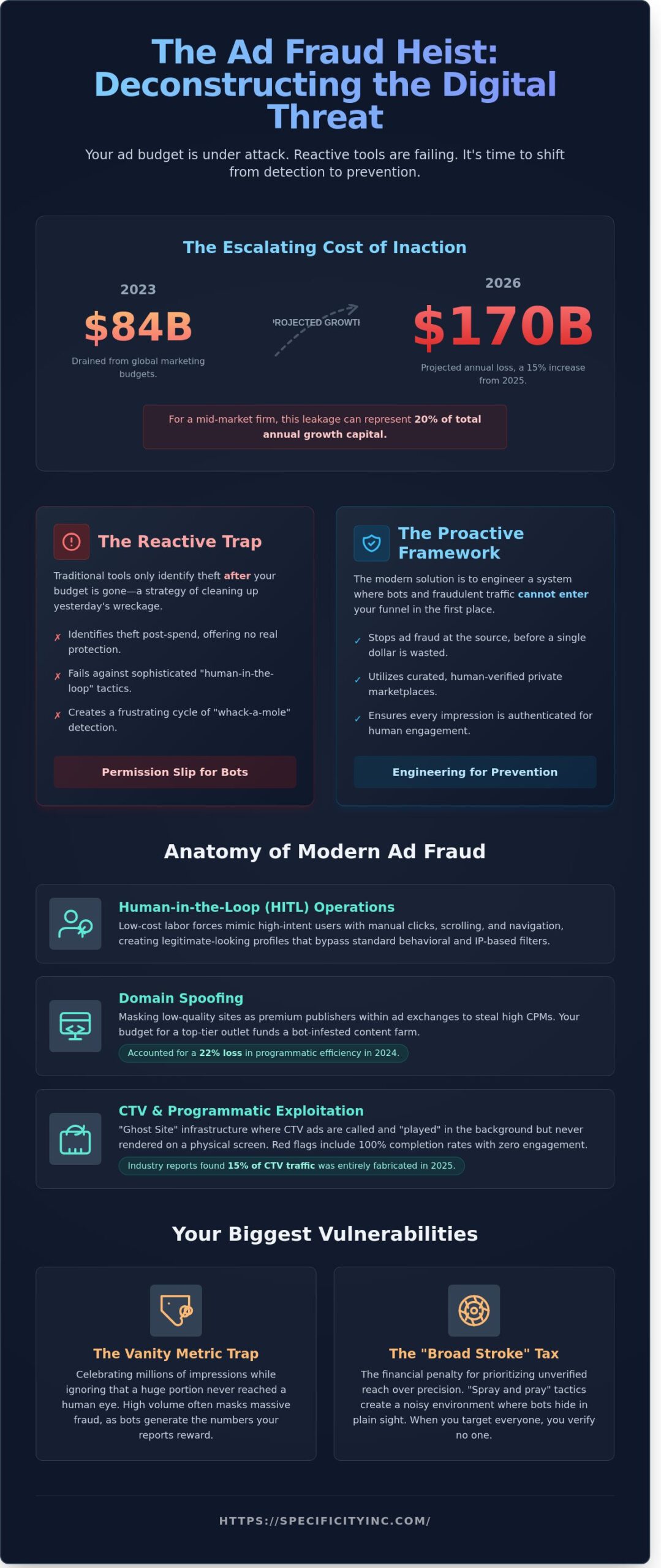
Your current fraud detection software is a permission slip for bots to steal your budget. In 2023, global ad fraud drained $84 billion from marketing departments, yet most C-suite executives continue to rely on reactive tools that only identify theft after the money is gone. Stopping ad fraud isn’t about looking at yesterday’s wreckage; it’s about engineering a system where bots can’t enter the funnel in the first place. You know your campaign data is skewed, and you’re right to be frustrated with the lack of accountability in modern programmatic networks.
This guide provides the blueprint to eliminate wasted spend and protect your ROI by shifting to proactive, human-verified traffic strategies. We’ll dismantle the “black box” mentality and show you how to achieve full transparency in your digital ecosystem. You’ll learn the precise methodology to ignite lead quality and secure market dominance through 100% human-verified engagement. We’re moving beyond detection into a new era of strategic prevention that ensures every dollar works for your growth.
Key Takeaways
- Stop burning budget on vanity metrics that mask systematic theft and learn to identify the sophisticated fraud schemes draining US marketing budgets.
- Shift your strategy from reactive “whack-a-mole” detection to a proactive framework focused on stopping ad fraud at the source.
- Understand why standard DSP-level filters fail against modern “human-in-the-loop” tactics and how to bypass these technical limitations.
- Secure your ROI by migrating from the chaos of open exchanges to curated, human-verified private marketplaces that prioritize intent.
- Discover how to implement rigorous traffic protocols that eliminate industry noise and pinpoint high-value leads with surgical precision.
The Silent Budget Killer: Why Ad Fraud Still Wins in 2026
Ad fraud isn’t a technical glitch or a rounding error. It’s a calculated heist. We define ad fraud as the deliberate manipulation of digital systems to siphon off marketing budgets into the pockets of malicious actors. In 2026, stopping ad fraud requires a fundamental shift in how C-suite executives view their digital supply chain. Success starts with understanding ad fraud as a professionalized criminal industry that thrives on your desire for scale over substance.
Most marketing departments remain stuck in the “Vanity Metric Trap.” They celebrate 2,000,000 impressions while ignoring the reality that a significant portion of that traffic never reached a human eye. High impressions often mask massive fraud because bots are programmed to generate the very numbers your reports reward. If you prioritize volume without verifying the source, you’re subsidizing a botnet. In 2026, reach is a liability if it isn’t authenticated.
The economic impact is no longer a peripheral concern. Global losses to ad fraud are projected to exceed $170 billion by the end of 2026, representing a 15% increase from 2025. This isn’t just “waste.” It’s a direct hit to your bottom line and a drain on your EBITDA. Much like how Strictly helps organizations identify and recover lost margins in their payment operations, stopping ad fraud allows you to reclaim every dollar that would otherwise fail to reach a high-intent B2B buyer. For a mid-market firm, this leakage can represent 20% of their total annual growth capital.
The Evolution of Fraudulent Traffic
Simple click bots are relics of the past. The 2026 landscape is dominated by sophisticated, human-mimicking AI agents. These scripts replicate mouse movements, erratic scroll patterns, and realistic dwell times with surgical precision. As automated ad-buying platforms have become more complex, they’ve inadvertently provided a larger playground for these high-tech thieves. The psychological cost is equally high; when 25% of your lead data is polluted, you lose trust in your own marketing engine.
Why Broad Targeting is Your Biggest Vulnerability
Traditional “spray and pray” tactics are an open invitation for disaster. Broad-stroke targeting creates a noisy, massive environment where bots hide in plain sight. When you target “everyone,” you verify no one. There’s a direct correlation between audience granularity and fraud reduction. By narrowing your focus to verified, intent-based segments, you eliminate the shadows where malicious actors operate. Precision isn’t just about conversion; it’s your primary defensive perimeter.
The Broad Stroke Tax is the quantifiable financial penalty businesses pay when they prioritize unverified reach over data-driven precision.
The Anatomy of Modern Ad Fraud: Beyond Simple Bot Clicks
Ad fraud in 2026 has evolved into a sophisticated engineering challenge that drains over $100 billion from global marketing budgets annually. Simple bot clicks are yesterday’s problem. Today, we face “human-in-the-loop” (HITL) operations. These schemes involve low-cost labor forces hired to perform manual actions that mimic high-intent users. These individuals click, scroll, and navigate through sites to establish a profile of legitimacy that bypasses standard IP-based filters. Stopping ad fraud requires a surgical understanding of these technical exploits before they compromise your data integrity.
Domain spoofing remains a primary weapon for stealing programmatic display spend. It works by masking a low-quality site as a premium publisher within the ad exchange. Your budget intended for a top-tier financial news outlet actually funds a 10-page content farm. This practice accounted for a 22% loss in programmatic efficiency across US B2B campaigns in 2024. To combat these layered attacks, executives need a practical guide to spot and stop these drainages before they scale into unrecoverable losses.
- Human-in-the-loop: Manual interactions that defeat behavioral analysis.
- Domain Spoofing: Falsifying publisher identity to capture premium CPMs.
- Data Pollution: Injecting false signals into your attribution models.
CTV and Programmatic Display Exploitation
Fraudsters now spoof Connected TV (CTV) device IDs at scale. They create a “Ghost Site” infrastructure where ads are called and “played” but never rendered on a physical screen. In 2025, industry reports identified that 15% of CTV traffic was entirely fabricated. Red flags include 100% completion rates paired with zero post-view engagement. If your premium inventory shows no regional variance in performance, you’re paying for ghosts. Effective strategies for stopping ad fraud must pinpoint these anomalies at the device ID level.
The Rise of Fake Lead Generation
B2B marketers are the new primary targets for automated deception. Advanced bots now use Large Language Models (LLMs) to fill out complex whitepaper forms with 98% accuracy against field requirements. These fake leads trigger payout events and pollute your CRM with garbage data. This isn’t a victimless crime; it destroys sales team morale and skews your ROI projections. When 30% of your MQLs are verified fakes, “conversion” becomes a vanity metric. You must prioritize intent-based targeting to isolate real human demand from automated noise and reclaim your funnel’s health.
Detection vs. Prevention: Why Most ‘Anti-Fraud’ Tools Fail
Most companies treat ad fraud as a post-mortem exercise. They review a report on Friday to see how much money they lost on Tuesday. That isn’t a strategy; it’s an autopsy. Reactive detection is a failed model because botnets evolve faster than the algorithms designed to catch them. By the time a standard filter identifies a fraudulent IP, the botnet has already rotated through 1,000 new ones. Stopping ad fraud requires a move away from this “whack-a-mole” cycle and toward a framework of total prevention.
The Flaws in Reactive Monitoring
Accepting fraud as an inevitable cost of doing business is a strategic failure. Standard DSP-level filters are often toothless because the platforms themselves face a glaring conflict of interest. DSPs profit from high impression volumes. Cutting out 30% of their traffic, even if it’s demonstrably fake, directly hits their bottom line. This creates a culture of “good enough” detection that leaves your budget exposed.
The technical limitations are equally severe. Automated blocking tools frequently trigger false positive rates between 15% and 20%, meaning you’re paying to block your own legitimate prospects. Meanwhile, sophisticated bots now mimic human cursor movements and scroll depths with 98% accuracy. These bots don’t just click; they simulate engagement to bypass basic security layers. If your tool is looking for “bot-like behavior” after the bid is won, you’ve already lost the capital.
- Lag Time: Detection tools often take 24 to 48 hours to flag suspicious clusters, during which your budget is drained.
- Volume Bias: Platforms are incentivized to maintain high reach metrics over lead quality.
- Algorithm Mimicry: Modern scripts use AI to adapt to detection patterns in real-time, staying one step ahead of static blacklists.
The Power of Intent-Based Immunity
Precision is the only effective antidote to digital waste. Instead of wasting resources watching for bots, elite marketers focus on targeting verified humans. Intent data creates a natural immunity to fraud. Bots don’t research complex B2B solutions, download whitepapers, or demonstrate multi-stage buying signals across niche professional platforms. They’re programmed for volume, not nuance.
By shifting your focus to B2B marketing in 2026, you pivot from guessing to knowing. Intent-based precision ensures your ads only appear in front of users who have already signaled a professional need through their historical data and behavioral patterns. You don’t need to block bots if you only bid on high-intent human signals. This methodology replaces the chaos of broad-stroke tactics with surgical certainty, ensuring every dollar spent is an investment in a real person with a real budget.
Stopping ad fraud isn’t about building a better wall; it’s about changing the destination. When you target based on verified intent, the bots are naturally excluded from the funnel. This is the difference between defensive monitoring and offensive dominance.
The Proactive Framework for Stopping Ad Fraud at the Source
Stopping ad fraud requires a complete abandonment of the “spray and pray” programmatic mindset. If your strategy relies on open-exchange bidding, you’re essentially handing 15% to 30% of your budget to sophisticated botnets. Strategic dominance in 2026 demands a shift from passive detection to active prevention through these five critical steps:
- Step 1: Curated Environments. Exit the open exchange immediately. Move your spend to high-intent private marketplaces (PMPs) where inventory is manually vetted and verified.
- Step 2: Human-Verified Protocols. Implement multi-factor verification for all lead generation. If a lead doesn’t have a verified human signature, it never enters your CRM.
- Step 3: Intent-Based Targeting. Leverage granular intent data to identify real buyers before an ad is ever served. Bots don’t buy products; humans with specific pain points do.
- Step 4: Attribution Auditing. Stop rewarding volume. Audit your model to prioritize conversion quality over inflated click-through rates.
- Step 5: Elite Partnerships. Work with an agency that stakes its reputation on ROI, not vanity metrics like impressions or reach.
Targeting Real Humans with Precision
Bots mimic clicks, but they struggle to mimic human nuance. We use deep behavioral signals, such as dwell time on technical whitepapers and non-linear cursor movements, to confirm a human presence behind the screen. This surgical precision ensures your budget targets legitimate decision-makers. For a detailed breakdown of how to measure these high-stakes interactions, consult our Digital Advertising ROI Guide. We don’t guess; we verify.
Securing the CTV and Social Funnels
Connected TV is the new frontier for fraudulent traffic, with some reports indicating that 18% of CTV traffic is invalid. We combat this by applying the same rigorous standards found in Connected TV Advertising to ensure every impression reaches a living room, not a server farm. In the social sphere, we use platform data more aggressively to filter botnets that inflate engagement metrics. High-quality creative services play a defensive role here; complex, interactive ads engage real humans while providing zero value to automated scripts. This approach turns your creative assets into a filter for quality, ensuring that stopping ad fraud becomes a byproduct of your superior targeting strategy.
Strategic Dominance: How Specificity Inc. Verifies Every Impression
General advertising is a graveyard of wasted capital. Most agencies prioritize volume over validity, leaving your budget vulnerable to the $100 billion annual drain of invalid traffic. Specificity Inc. operates as the antidote to this systemic failure. We don’t just participate in the market; we dominate it through surgical precision. Stopping ad fraud requires more than a software patch. It demands a fundamental shift in how impressions are sourced and validated.
We treat your marketing spend like our own capital. This mindset forces a rejection of the “spray and pray” tactics that define 85% of the digital landscape. Our methodology replaces broad targeting with granular, data-backed intent. We pinpoint high-value targets before a single cent is deployed, ensuring your message reaches actual decision-makers rather than bot farms or disinterested observers. This isn’t just marketing; it’s strategic asset management.
Our Human-Verified Traffic Standard
We’ve established a rigorous protocol to ensure every click represents a legitimate potential buyer. This process eliminates the “Broad Stroke Tax,” a 25% to 30% inefficiency common in traditional programmatic buying. By verifying traffic at the individual level, we remove the noise that clogs your sales funnel. Your team stops chasing ghosts and starts closing deals. This level of granularity results in a documented 40% increase in lead quality for our B2B partners, providing the predictable revenue streams necessary for aggressive scaling in 2026.
Ignite Your Growth with Data-Driven Certainty
Serious growth isn’t a product of luck. It’s the result of technical superiority. You can continue paying for bot-inflated metrics, or you can transition to a fraud-immune framework that prioritizes ROI above all else. We help you move past the chaos of the open exchange into a controlled environment where data dictates every move. To capture high-intent demand with total transparency, explore our Search Engine Marketing (SEM) solutions.
Stopping ad fraud is the first step toward total market dominance. The next step is choosing a partner that values precision as much as you value profit. Stop settling for vanity metrics that don’t convert. Contact Specificity Inc. today to audit your current strategy and ignite a trajectory of certain growth. We provide the logic, the evidence, and the results that your C-suite demands.
Dominate Your Market by Eliminating the Fraud Tax
The era of passive detection is dead. By 2026, reactive tools that merely flag fraud after your budget has vanished are a liability, not a solution. Stopping ad fraud requires a proactive shift toward human-verified impressions and surgical precision at the source. Modern bot networks have evolved beyond simple click scripts. This makes traditional filters obsolete for any firm serious about scalability. Specificity Inc. eliminates the noise by verifying every single impression before it hits your ledger. As pioneers in human-verified traffic, we use an ROI-focused methodology that pinpoints high-intent audience granularity with surgical accuracy. You shouldn’t settle for the industry standard of “acceptable loss.” Demand absolute certainty in your data and your results to ensure your capital fuels growth, not bot farm cycles. It’s time to stop funding the global fraud industry and start owning your outcomes.
Stop wasting your budget on bots; get human-verified traffic with Specificity Inc. today.
Your path to predictable revenue starts with precision.
Frequently Asked Questions
What is the most effective way to stop ad fraud in 2026?
The most effective way of stopping ad fraud in 2026 is moving from reactive detection to intent-based audience prevention. Detection tools only tell you how much money you’ve already lost. By the time you see the report, your budget is gone. We eliminate the problem by targeting human-verified data sets before the bid happens. This proactive stance ensures your capital funds growth rather than bot farms.
Can ad fraud detection tools really protect my entire budget?
Detection tools cannot protect your entire budget because they function as post-mortem audits. Juniper Research estimates that global ad fraud losses will hit $100 billion by 2025. These tools identify the theft after the impression is served. You don’t need a report on how you were robbed; you need a locked door. True protection requires a strategy built on deterministic data and closed-loop ecosystems.
How does Connected TV (CTV) ad fraud work?
Connected TV (CTV) fraud operates through sophisticated device spoofing and SSAI manipulation. Bots mimic the signals of high-value household devices to siphon premium ad spend. In 2023, the “Dictum” botnet spoofed over 10 million devices per day. This isn’t just a glitch; it’s a coordinated attack. We bypass these vulnerabilities by focusing on verified residential IP addresses and hardware-level identification to ensure real viewership.
Why is broad-stroke targeting more susceptible to ad fraud?
Broad-stroke targeting is a magnet for fraud because it lacks the granular filters necessary to distinguish humans from scripts. When you target “Business Professionals” across the open web, you’re buying into a 40 percent invalid traffic rate. Bots thrive in the ambiguity of large, probabilistic pools. Precision is the only antidote. We use specific, intent-based parameters to shrink the attack surface and maximize your ROI.
What is human-verified traffic and why does it matter for B2B?
Human-verified traffic consists of users whose identity is confirmed through deterministic data points like professional licenses or verified employment history. In B2B, this is the difference between a lead and a ghost. According to 2024 industry benchmarks, 35 percent of B2B marketing data is inaccurate. We use human verification to ensure every dollar targets a real decision-maker with a pulse and a budget.
Does ad fraud affect search engine marketing (SEM) as much as display?
SEM is heavily impacted by fraud, with click bots and malicious competitors draining up to 25 percent of budgets in high-cost sectors like legal or SaaS. Stopping ad fraud in search requires more than just Google’s basic filters. You need real-time IP blocking and behavioral analysis to spot non-human patterns. Without these aggressive measures, you’re subsidizing your competitors’ bot scripts and wasting your acquisition budget.
Is it possible to eliminate 100% of ad fraud from my campaigns?
Eliminating 100 percent of fraud is statistically impossible, but reducing it to less than 1 percent is our standard. The industry often accepts a 10 percent “tax” for invalid traffic as the cost of doing business. We reject that mediocrity. By utilizing closed-loop environments and verified data, we push fraud levels to the absolute floor. This level of precision is what separates elite performers from the rest of the market.
What are the red flags that indicate my campaign is suffering from ad fraud?
Immediate red flags include a 0.01 percent conversion rate despite a high click-through rate or 100 percent bounce rates on specific landing pages. If your traffic shows no mouse movement or scrolls, it’s non-human. Data from 2024 shows that bot traffic often originates from data centers rather than residential ISPs. If you see a surge in traffic from unexpected geographic regions, your campaign is under attack.