
Human Traffic Verification Services: Eliminating Ad Fraud in 2026
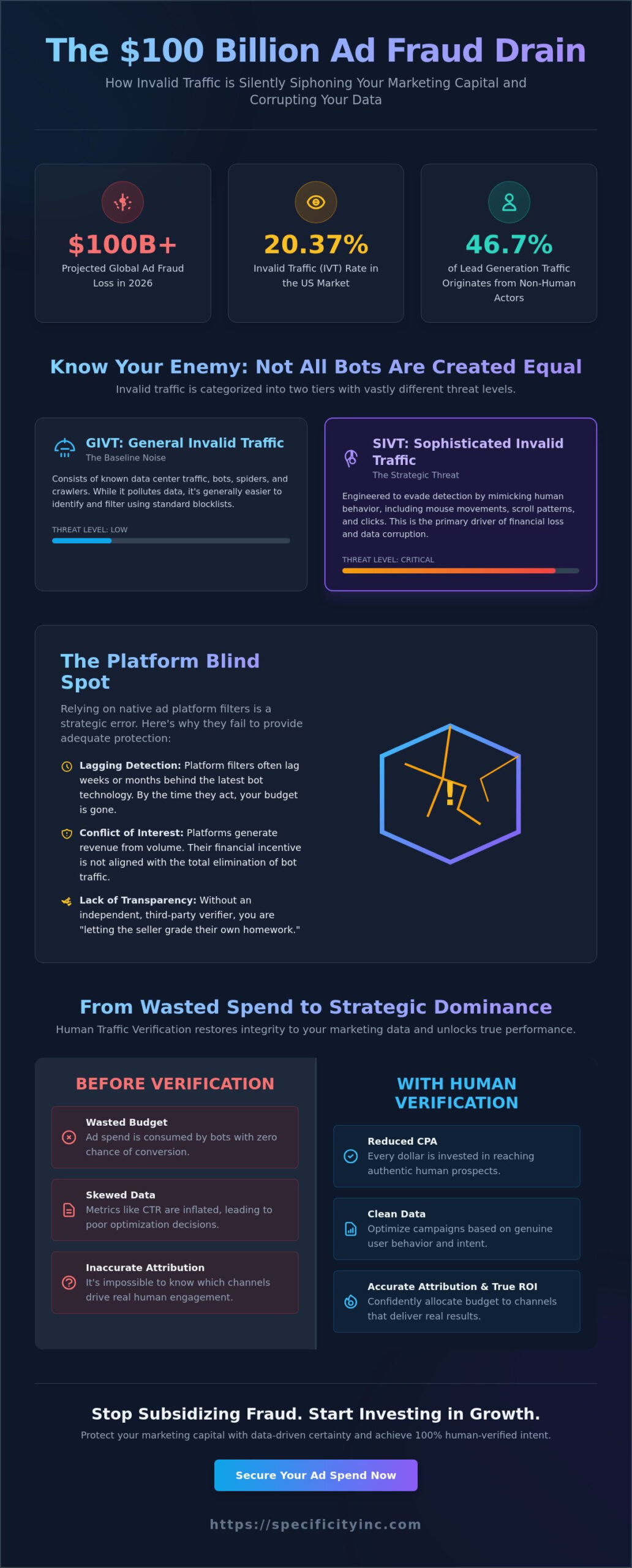
Analysts project that digital advertising fraud will drain over $100 billion from global marketing budgets in 2026. This isn’t just a rounding error; it’s a systemic failure of the programmatic supply chain. With US invalid traffic rates hitting 20.37% in early 2026, your marketing spend likely leaks into bot-driven noise. Implementing robust human traffic verification services is no longer optional for brands that prioritize quantitative outcomes and performance metrics. You’ve seen the skewed data and the lack of transparency in your attribution models. It’s time to stop subsidizing the 46.7% of lead generation traffic that originates from non-human actors.
This guide explains how to protect your marketing capital by distinguishing between synthetic performers and authentic human engagement. You’ll learn how to purge invalid traffic from your funnel to achieve clean data for accurate attribution. We’ll examine the shift in fraud across devices and the critical regulatory updates, including New York’s Synthetic Performer Disclosure Law, to ensure your growth strategy rests on a foundation of 100% human-verified intent. By cutting through the complexity of modern ad fraud with data-driven certainty, you’ll secure a significant reduction in cost-per-acquisition and reclaim your strategic dominance in the market.
Key Takeaways
- Quantify the immediate risk by identifying how the $100 billion ad fraud landscape in 2026 erodes marketing capital and invalidates performance metrics.
- Deploy advanced human traffic verification services to distinguish between baseline bot activity and the sophisticated invalid traffic that mimics human behavior.
- Evaluate potential verification partners based on MRC certification and their technical capacity to provide transparency across programmatic, social, and CTV channels.
- Leverage behavioral biometrics like dwell time and scroll depth to ensure every dollar spent targets authentic human intent rather than synthetic engagement.
- Restore the integrity of your attribution models by purging the 46.7% of lead generation traffic that typically originates from non-human actors.
What are Human Traffic Verification Services in Digital Marketing?
Growth requires precision. In the current digital landscape, human traffic verification services act as the primary technical filter to separate authentic audience engagement from automated scripts. This is the only way to secure the integrity of your marketing funnel. It involves the real-time isolation of legitimate human users from the vast sea of non-human traffic that currently accounts for nearly 20% of global ad impressions. This isn’t a passive security measure; it’s an active strategy to ensure every dollar of your marketing capital targets a person with the capacity to convert.
We categorize invalid traffic into two distinct tiers: General Invalid Traffic (GIVT) and Sophisticated Invalid Traffic (SIVT). GIVT is the baseline noise of the internet, consisting of known spiders, crawlers, and data center bots that are relatively easy to identify. SIVT represents the real threat to your ROI. These bots are engineered to bypass standard security layers by mimicking human navigation patterns, making them invisible to legacy detection tools. High-performance campaigns treat human traffic verification services as a foundational requirement rather than an optional add-on.
The Distinction Between Human Users and Sophisticated Bots
Fraudsters in 2026 utilize “headless browsers” to execute high-stakes ad fraud. These tools allow bots to render JavaScript and navigate websites exactly like a human user, effectively spoofing mouse movements and scroll depth. Because of this, simple click-through rates (CTR) have become a dangerous vanity metric. If you optimize for CTR without verification, you’re likely training your algorithms to find more bots. Success in this environment requires understanding click fraud at a granular level. We don’t just look for impressions; we verify the intent behind the interaction to ensure it originates from a biological user.
Why Traditional Ad Platforms Fail to Filter Fraud
Traditional ad platforms operate under a fundamental conflict of interest. They generate revenue from high volume, and their incentives rarely align with the total elimination of bot traffic. While they may offer basic filtering, their detection often lags behind the latest bot technology by weeks or months. Waiting for a platform to issue a credit refund for fraudulent impressions is a losing game that destroys your momentum. Independent, third-party verification is the only logical safeguard. It provides an objective layer of accountability that the platforms themselves cannot offer. By the time a platform identifies a bot, your budget is already gone. You need a methodology that prevents the spend before it occurs.
Relying on platform-native filters is a strategic error that leads to skewed data and wasted spend. Without an external verification partner, you’re effectively letting the seller grade their own homework. This lack of transparency in the programmatic supply chain makes strategic decisions impossible. To achieve predictable revenue, you must cut through the noise with data-driven certainty and verify every single engagement.
The Financial Impact of Ad Fraud: Why Verification is Non-Negotiable
Ad fraud is a $100 billion drain on global marketing capital in 2026. This theft isn’t just a line item; it’s a direct assault on your strategic dominance. When sophisticated bots intercept 15.43% of programmatic impressions, they don’t just steal your budget. They poison your entire data ecosystem. Relying on unverified traffic makes it impossible to distinguish between a high-intent prospect and a script designed to mimic one. Effective digital advertising ROI depends entirely on your ability to purge these non-human actors from your funnel.
The opportunity cost of unverified spend is staggering. Every dollar wasted on a bot is a dollar not spent on a converting human. This creates a feedback loop of inefficiency where your algorithms optimize for engagement that never leads to revenue. A comprehensive survey of ad fraud techniques reveals that modern fraudsters use AI to generate fake lead data, which compromises your attribution models. Without human traffic verification services, you’re building your growth strategy on a foundation of digital fiction.
Eroding the Bottom Line: The Cost of Invalid Impressions
Bot traffic creates artificial demand that inflates CPMs across the board. You’re paying premium prices for zero-value interactions. This distortion hides true campaign performance, leading executives to scale failing initiatives or cut high-performing ones based on fraudulent signals. The ripple effect of this bad data can persist for years, skewing historical benchmarks and future budget allocations. For every dollar spent on unverified programmatic advertising, approximately 15.43 cents is lost directly to sophisticated invalid traffic.
The Data Integrity Crisis
High-intent targeting is only as good as the data feeding it. If your remarketing lists are polluted with bots, you’re paying to stalk scripts that will never buy. This is particularly critical for search engine marketing (SEM), where high costs-per-click make fraud even more damaging. Clean, human-only data sets are the only way to ensure your sales team isn’t chasing ghost leads. To secure your market position, you must implement a data-driven verification strategy that guarantees every interaction is biological.
The Mechanics of Modern Human Traffic Verification
Post-campaign reporting is a post-mortem on wasted capital. In 2026, waiting for a monthly reconciliation report to identify fraud is a strategic failure. Dominant marketing operations have shifted from retrospective analysis to real-time blocking. Elite human traffic verification services now sit at the edge of the bid request, intercepting and neutralizing invalid traffic before a single cent is committed. This methodology replaces guesswork with algorithmic certainty, ensuring your budget only funds authentic human engagement.
Modern verification relies on behavioral biometrics rather than simple IP blacklists. We analyze the biological signature of every interaction, measuring micro-movements of the cursor, scroll velocity, and dwell time. Humans are inherently non-linear and unpredictable. Bots, even those utilizing sophisticated AI, eventually revert to programmed patterns. For those seeking a foundational taxonomy of these threats, IAB Europe’s Guide to Ad Fraud provides the industry standard for identifying both general and sophisticated invalid traffic categories.
We augment these behavioral signals with infrastructure analysis. This includes real-time reputation scoring for IP addresses and the immediate blacklisting of known data center ranges. AI-driven pattern recognition identifies the tell-tale signatures of bot farms, such as synchronized surges in traffic from disparate locations that share identical browser fingerprints. This multi-layered approach ensures that your campaign data remains pure and actionable.
Behavioral Fingerprinting: Identifying the Human Signature
Sophisticated invalid traffic (SIVT) often bypasses standard filters by spoofing device headers. We counter this by deploying “honeypots” and invisible obstacles within the site architecture. These elements are undetectable to a human user but act as a tripwire for automated scripts. When a bot interacts with a hidden element, it’s immediately flagged and purged from the data set. We verify humanity through multi-touch interaction points, confirming that the user path reflects genuine intent rather than a pre-scripted sequence.
Real-Time Programmatic Filtering
The programmatic auction moves at millisecond speeds, and your verification must keep pace. Pre-bid filtering allows us to evaluate the quality of a supply path before the auction even concludes. Strategic buyers utilize these filters to clean their programmatic display supply paths, ensuring ads only render when a human is present. This level of exactness is the only way to protect marketing capital in a high-volume environment. By integrating human traffic verification services directly into the bid stream, we eliminate the lag between detection and action, securing your ROI in real time.
Selection Criteria for Human Verification Partners
Choosing a partner to secure your marketing capital is a high-stakes decision. A weak link in your verification chain is a strategic liability that allows fraud to persist. You must look beyond basic bot-blocking and demand a partner capable of providing granular visibility into every impression. Elite human traffic verification services should act as an integrated component of your growth engine, not a detached third-party observer. If a provider cannot demonstrate a clear methodology for distinguishing between biological intent and AI-generated mimicry, they don’t belong in your tech stack.
The vetting process must prioritize technical depth and cross-channel versatility. Your audience doesn’t live in a single silo, and your verification shouldn’t either. You need a partner that can maintain data integrity across programmatic, social, and emerging high-stakes channels. This level of exactness is the only way to ensure your strategic decisions are based on reality rather than bot-polluted noise.
Technical Standards and Certifications
Certification by the Media Rating Council (MRC) is the foundational floor for any legitimate provider. However, in 2026, baseline certification is merely the price of entry. You must evaluate the proprietary algorithms that power their detection engine. Specifically, look for the ability to verify humanity within connected tv advertising, where high CPMs attract sophisticated fraud schemes. A partner must prove they can detect SIVT in server-side ad insertion (SSAI) environments to protect your most expensive media buys.
Reporting and Transparency Requirements
Binary “Pass/Fail” metrics are insufficient for modern performance marketing. Demand nuanced risk scoring that provides a probability of human engagement for every impression. This allows you to set custom thresholds based on the specific goals of each campaign. Real-time dashboards must replace static monthly PDFs. If you can’t see the fraud as it happens, you can’t stop the waste. You should also have the right to audit the service for its own accuracy through independent data logs. Transparency is the antidote to the opacity of the programmatic supply chain.
Integration capabilities are equally critical. Your verification data must flow seamlessly into your CRM and existing tech stacks to inform long-term attribution. We focus on high-intent data rather than broad-stroke filtering. This ensures that you aren’t just blocking bad traffic, but actively optimizing for the highest quality human interactions. To secure your position as a market leader, you must partner with experts who prioritize quantitative outcomes over superficial metrics. Every interaction must be verified; every dollar must be accounted for.
Strategic Dominance: The Specificity Inc. Approach to Human-Verified Traffic
Specificity Inc. operates on a single, non-negotiable premise: we don’t buy traffic; we buy human intent. In a market where 20.37% of US traffic is invalid, “buying traffic” is an invitation to waste capital. Our methodology treats human traffic verification services as the engine of our growth strategies, not just a security layer. This approach ensures that your message reaches biological decision-makers, providing the exactness required for strategic dominance. We don’t settle for platform-native filters that allow 15.43% of programmatic spend to vanish into the pockets of fraudsters.
We integrate this verified intent directly into our social media advertising frameworks. By purging the 10.61% fraud rate common in social channels, we create a high-performance environment where every click has the potential for conversion. This isn’t broad-stroke marketing. It’s a surgical application of capital that targets high-intent demand with data-driven certainty. Our positioning as elite specialists ensures that your marketing infrastructure remains resilient against the evolving threats of the 2026 landscape.
Precision Targeting Through Verified Intent
Clean data is the ultimate competitive advantage. While competitors struggle with skewed attribution and bot-polluted remarketing lists, we leverage human traffic verification services to sharpen audience segments to a razor edge. This allows for the seamless marriage of creative services with high-intent delivery. We eliminate the noise of synthetic engagement, clearing the path for predictable revenue growth in both B2B and B2C demand generation. When you remove the 46.7% of lead-gen traffic that originates from bots, your sales team can focus exclusively on biological prospects with genuine buying power.
Execution and Results: The Specificity Framework
Our commitment to quantitative outcomes is absolute. We reject the superficial metrics of the broader market in favor of hard numbers and verified engagement. The Specificity Framework cuts through the complexity of the digital landscape by prioritizing performance metrics above all else. This isn’t creative guesswork; it’s an elite specialization designed for businesses that refuse to subsidize the ad fraud economy. We provide the transparency and data depth needed to make high-stakes strategic decisions with total confidence.
Securing your marketing infrastructure starts with a rejection of the status quo. Executives ready to dominate their space must move beyond passive filters and embrace a strategy rooted in exactness. It’s time to stop paying for impressions and start investing in human verified traffic. Contact our team to implement a data-driven methodology that secures your ROI and drives substantial growth through verified human engagement.
Secure Your Strategic Dominance in a Bot-Driven Market
Ad fraud isn’t a minor inefficiency. It’s a systemic drain that compromises your entire growth trajectory. By implementing human traffic verification services, you shift from defensive filtering to offensive market dominance. You’ve seen how sophisticated invalid traffic pollutes attribution and inflates acquisition costs. Now’s the time to purge the noise and base your strategic decisions on 100% human-verified data. This transition is the only logical choice for leaders who prioritize exactness over superficial metrics.
Founded in 2018, Specificity Inc. remains an elite specialist in high-intent audience targeting. We provide comprehensive human-verified traffic solutions that ensure your capital targets biological decision-makers rather than automated scripts. Our methodology replaces creative guesswork with quantitative certainty, allowing you to scale your operations with total confidence. Secure Your Ad Spend with Human-Verified Traffic Solutions from Specificity Inc. and reclaim your marketing ROI today. You possess the intelligence to eliminate the waste. Use it to fuel your strategic expansion and dominate your market.
Frequently Asked Questions
What is the difference between human traffic verification and standard ad-fraud protection?
Standard ad-fraud protection relies on retrospective blacklists and known data center ranges. Human traffic verification services utilize behavioral biometrics to analyze the biological signature of every interaction in real time. This methodology identifies non-linear human behavior rather than just matching IP addresses against a static list. It’s the difference between checking a database and verifying a pulse.
How does human verification improve my overall digital advertising ROI?
Verification forces your budget into authentic engagement; it immediately reclaims the 15.43% of programmatic spend typically lost to fraud. Beyond direct savings, it preserves the integrity of your attribution models. Clean data allows your algorithms to optimize for actual human intent rather than synthetic engagement patterns. This shift results in a significantly lower cost-per-acquisition and predictable revenue growth.
Can bot traffic affect my Connected TV (CTV) campaigns?
High CPMs make CTV a primary target for sophisticated fraud schemes in 2026. Fraudsters use server-side ad insertion spoofing to fake millions of impressions on premium devices that never actually occur. Without specialized verification, your CTV budget funds bot-driven playback loops rather than reaching household decision-makers. Protecting these high-stakes buys requires real-time infrastructure analysis to ensure a human is present.
What are the main indicators that my current traffic is not human?
Look for perfect click-through rates that fail to generate any downstream conversion activity. Synchronized traffic surges from disparate geographies sharing identical browser fingerprints are another red flag. If your analytics show zero scroll depth or dwell times that match programmed intervals, you’re likely paying for bot-driven noise. These indicators signal a fundamental failure in your current platform-native filtering layers.
How much ad spend is typically lost to bot fraud without verification services?
Industry data for 2026 projects global losses to exceed $100 billion. In the US, invalid traffic rates hit 20.37% in the first quarter of the year. This means nearly one out of every five dollars spent on unverified media is stolen by automated scripts. Businesses that refuse to implement verification are effectively subsidizing the ad fraud economy at the expense of their own strategic growth.
Is human traffic verification necessary for B2B marketing on LinkedIn?
High-value B2B leads attract aggressive bot activity designed to deplete competitor budgets. While LinkedIn has native filters, a 2025 report found that 46.7% of traffic to lead-generation forms originated from bots. Given the premium cost-per-click in B2B marketing, even low fraud rates cause significant financial erosion. Verification ensures your sales team spends their time on biological prospects with the capacity to buy.
How does real-time verification impact campaign latency?
Elite verification services operate at the edge of the bid request; they complete analysis in milliseconds. This process occurs during the programmatic auction, ensuring no perceptible latency for the end user. You gain the security of real-time blocking without sacrificing the speed of your digital delivery. Speed and security are no longer mutually exclusive in a high-performance tech stack focused on quantitative outcomes.
What is SIVT and why is it more dangerous than standard bot traffic?
Sophisticated Invalid Traffic (SIVT) is engineered to mimic human navigation, including mouse movements and rendering JavaScript. Unlike General Invalid Traffic (GIVT), SIVT bypasses standard platform filters and legacy security tools. It’s dangerous because it pollutes your remarketing lists and attribution data with “perfect” bot profiles. This leads to massive strategic errors based on fraudulent signals that appear to be high-performing human engagement.