
How to Stop Paying for Fake Clicks: The Precision Guide to Purging Ad Fraud
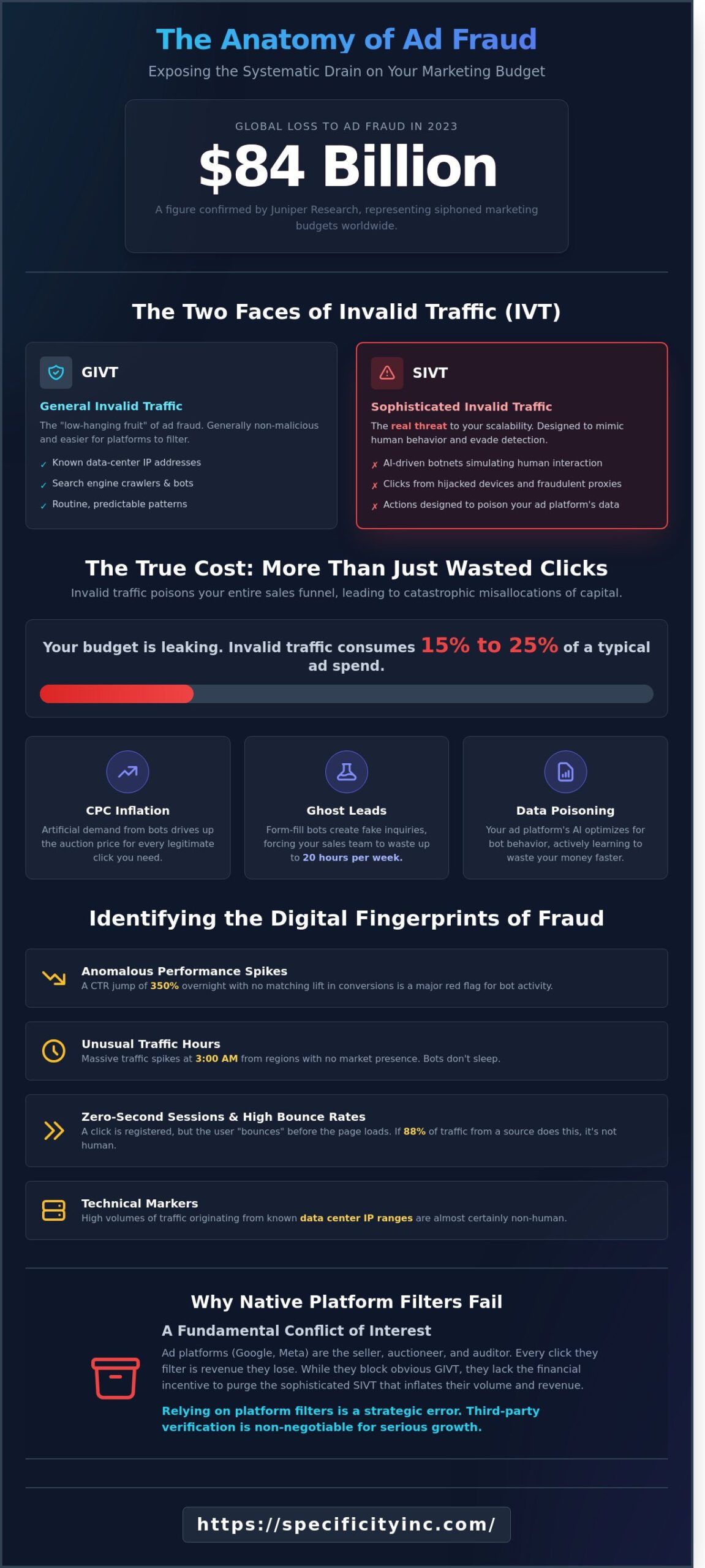
Juniper Research confirms that ad fraud siphoned $84 billion from global marketing budgets in 2023. This isn’t just a technical glitch; it’s a systematic drain on your scalability. You’ve likely witnessed your analytics become a graveyard of non-converting sessions while competitors use click farms to deplete your daily caps. Learning how to stop paying for fake clicks is the only way to protect your margins and restore integrity to your sales funnel.
We recognize that you’re tired of guessing which portion of your traffic is legitimate. When data is corrupted by bots, your ability to make dominant, logic-based decisions vanishes. This guide delivers the surgical precision required to purge invalid traffic and pivot your budget toward human-verified, high-intent audiences. We’ll outline the exact methodology to pinpoint fraud at the source, lower your CPA, and ensure your capital targets only the individuals ready to convert.
Key Takeaways
- Identify the technical markers of Sophisticated Invalid Traffic (SIVT) to pinpoint and neutralize the automated threats sabotaging your advertising ROI.
- Implement a surgical 5-step protocol to audit your traffic sources and learn how to stop paying for fake clicks by tightening targeting parameters.
- Move beyond the “whack-a-mole” cycle of reactive IP blacklisting and understand why software-only solutions fail against sophisticated botnets.
- Secure strategic dominance by pivoting from broad placements to human-verified, intent-based audiences that guarantee genuine B2B engagement.
What is Click Fraud and Why Is It Sabotaging Your ROI?
Click fraud is the deliberate, automated, or malicious clicking of your digital ads with zero intent to purchase. It represents a systemic extraction of your marketing capital. To understand the depth of this issue, one must first ask What is Click Fraud? and recognize it as a coordinated attack on your bottom line. This isn’t a technical glitch or a minor rounding error. It’s a predatory practice designed to drain budgets, often orchestrated by competitors or sophisticated botnet operators seeking to inflate publisher revenue. If you want to know how to stop paying for fake clicks, you must first accept that your current traffic is likely compromised by bad actors.
Ad traffic bifurcates into two distinct categories of waste. General Invalid Traffic (GIVT) includes routine crawlers and known data-center IPs that are relatively easy to filter. Sophisticated Invalid Traffic (SIVT) is the real threat to your scalability. By 2026, AI-driven botnets have evolved to mimic human behavior with terrifying accuracy. These bots scroll, pause, and interact with page elements to bypass legacy detection systems. They don’t just click; they simulate engagement to stay invisible while you pay the bill for their activity.
The Economic Impact of Invalid Traffic (IVT)
Fake clicks do more than just inflate your Cost Per Click (CPC). They destroy your conversion rates and compromise your entire scaling strategy. When 15% to 25% of your budget disappears into botnets, your cost-of-acquisition metrics become fiction. The most dangerous byproduct is “Data Poisoning.” Your ad platform’s machine learning sees a bot “convert” on a low-value action and optimizes to find more bots just like it. You’re effectively paying to train an algorithm to waste your money faster.
- CPC Inflation: Artificial demand drives up the price of every legitimate click in the auction.
- Ghost Leads: Form-fill bots generate fake inquiries, forcing your sales team to waste up to 20 hours a week chasing non-existent prospects.
- Resource Drain: Marketing teams make strategic pivots based on skewed data, leading to catastrophic misallocations of capital.
Why Native Platform Filters Fail
Relying on platform-native filters is a strategic error. Google and Meta operate under a fundamental conflict of interest. They are the seller, the auctioneer, and the auditor. Every click they “filter” is revenue they lose. While they catch the obvious GIVT, they lack the incentive to purge the SIVT that keeps their quarterly volume high. Learning how to stop paying for fake clicks requires moving beyond these basic, internal black boxes. Surgical, third-party verification is the only logical choice for any organization prioritizing serious growth over vanity metrics.
Identifying the Digital Fingerprints of Fake Clicks
Ad fraud leaves a trail. It isn’t invisible; it’s just ignored by agencies that prioritize volume over value. If you want to learn how to stop paying for fake clicks, you must first recognize the technical signatures of non-human traffic. Sophisticated scripts and click farms now account for an estimated 22% of all programmatic ad spend according to industry audits. These entities thrive on broad targeting. When you cast a wide net, you invite botnets to feast on your budget. Precision is your only defense.
Vanity metrics often mask the decay. A high click-through rate (CTR) usually signals success, but in the context of ad fraud, it’s a warning light. Automated scripts are programmed to click ads to mimic engagement and drain competitor budgets. If your CTR jumps by 350% overnight without a corresponding lift in conversions, you aren’t winning. You’re being targeted. Understanding the mechanics of preventing click fraud requires a shift from superficial monitoring to granular data interrogation.
Anomalous Patterns in Performance Data
Bots don’t sleep, but your customers do. Look for massive traffic spikes at 3:00 AM in regions where you have zero market presence. These are clear indicators of botnet activity. Monitor for “0-second sessions.” This occurs when a click is registered, but the user bounces before the tracking pixel even renders. Real humans have latency; bots are instantaneous. If 88% of your mobile traffic from a specific site results in immediate bounces, blacklisting that placement is the only logical move. You need a partner who understands how to pinpoint these inefficiencies before they erode your ROI.
Technical Red Flags: IPs and User Agents
Data centers are for hosting, not for shopping. High volumes of traffic originating from known data center IP ranges are almost certainly non-human. You should also scrutinize user agents. Modern users operate on updated browsers. If your logs show a cluster of clicks from Internet Explorer 11 or outdated versions of Chrome from 2019, you’ve identified a bot farm. Use session recording tools to analyze mouse movements. Humans move in erratic, curved paths. Automated scripts move in straight lines or execute instantaneous clicks on specific coordinates. Identifying these fingerprints allows you to purge the waste and focus your spend on high-intent, human prospects.
Why Standard Click-Blocking Software Isn’t the Final Solution
Most marketers treat ad fraud like a pest control problem. They buy a software subscription, toggle a few settings, and assume the “blocking” feature handles the rest. This mindset is a fundamental strategic failure. Software-only solutions are reactive by design. They play an endless, losing game of whack-a-mole against an adversary that evolves faster than their code updates. If you want to learn how to stop paying for fake clicks, you must stop viewing the click as the problem. The click is merely a symptom; the source of the traffic is the disease.
Relying solely on automated blocking creates a false sense of security. These tools often brag about the number of bots they’ve “stopped,” yet your conversion rates remain stagnant. This happens because the software is looking backward at historical data while fraud operations are moving forward with AI-driven agility. True strategic dominance requires moving beyond defensive filters and addressing the fundamental mechanics of how your ads are served.
The Limitations of IP Blacklisting
Static blacklists are a relic of a simpler era. Modern botnets don’t operate from centralized server farms with easily identifiable IP ranges. They leverage rotating residential IPs. In 2023, data showed that nearly 50 percent of all internet traffic originated from bots, with a massive portion masked by hijacked home routers and mobile devices. These bots cycle through thousands of unique, legitimate-looking IPs every hour. By the time a software tool identifies and blacklists an IP, the botnet has already moved on to the next ten thousand.
There is also the persistent threat of false positives. Aggressive blacklisting often catches legitimate potential customers who happen to share a service provider or a public network with a malicious script. Industry benchmarks suggest that over-reliance on automated blocking can result in a 15 percent false-positive rate. You aren’t just blocking bots; you’re accidentally locking out the high-value human traffic your business needs to scale. Static lists can’t keep up with a dynamic, AI-driven environment where the line between bot behavior and human browsing becomes thinner every day.
The Shift from Defense to Offense
Defensive “Click Blocking” is a loser’s game because it lets the fraudster dictate the battlefield. You need to shift to an offensive posture built on Intent-Based Targeting. This methodology doesn’t wait for a bot to click and then try to block it; it ensures the ad is only ever visible to verified, high-intent human audiences in the first place. High-intent data acts as a natural filter for invalid traffic. Bots can mimic a click, but they struggle to replicate the complex, multi-layered behavioral history of a genuine B2B buyer. Precision in targeting is the ultimate antidote to ad waste.
Your primary focus must shift toward Digital Advertising ROI as your North Star metric. Vanity numbers like “blocked clicks” mean nothing if your cost per acquisition isn’t dropping. When you master how to stop paying for fake clicks through precision targeting, you stop worrying about the bots that might see your ad. You’ve already ensured they aren’t in the room. Strategic dominance isn’t about building a better wall; it’s about choosing a better neighborhood for your ad spend.
The 5-Step Protocol to Eliminate Invalid Traffic Waste
Stop wasting capital on digital ghosts. If you want to know how to stop paying for fake clicks, you must stop treating all traffic as equal. The digital landscape is saturated with sophisticated bots designed to mimic human behavior, but they cannot withstand a rigorous, data-driven audit. Follow this five-step protocol to reclaim your ad spend.
- Step 1: Audit Traffic Sources. Analyze your current channels with surgical precision. If a specific source delivers a 95% bounce rate or 0.5-second session durations, it’s a fraud mill. Kill it immediately.
- Step 2: Tighten Targeting. Narrow your geographic and behavioral parameters. If your market is North America, seeing 15% of your traffic from data center IP ranges in Eastern Europe is a red flag.
- Step 3: Implement Frequency Caps. Bots refresh pages to drain budgets. Set a cap of 3 impressions per user per 24 hours. This limits the damage any single bot can do to your daily spend.
- Step 4: Shift Budget to High-Intent. Move your capital toward Search Engine Marketing (SEM) and CTV. These environments demand active human input or verified hardware, making them significantly harder to spoof than standard display banners.
- Step 5: Use Human-Verified Sources. Prioritize deterministic data sets. Every click must represent a real person with a verifiable intent profile, not a probabilistic guess by an algorithm.
Refining Your Targeting Perimeter
Precision requires total exclusion of “Known Fraud” categories within your programmatic display settings. In 2023, the Association of National Advertisers found that 15% of ad spend goes to “Made for Advertising” (MFA) websites. These sites exist only to harvest clicks. Use aggressive negative keyword lists to prevent your ads from appearing on these low-quality domains. Use day-parting to align ad delivery with actual human business hours. Real B2B buyers don’t click enterprise software ads at 3:15 AM on a Tuesday; bots do.
Tracking Deep Engagement Metrics
The click is a vanity metric. To understand how to stop paying for fake clicks, you must track what happens after the landing page loads. Monitor scroll depth, time on site, and multi-page visits. Set up custom conversion events that bots cannot easily trigger, such as hovering over specific elements or interacting with a calculator. Most importantly, align your sales feedback with your marketing data. If a lead source produces high volume but 90% of the phone numbers are disconnected, that channel is a fraud vector that requires immediate termination.
Don’t let bot farms dictate your ROI. It’s time to audit your traffic and dominate your market with data-backed precision.
Strategic Dominance: Pivoting to Human-Verified Traffic
Ad fraud thrives on anonymity. If you’re buying “placements” on open exchanges, you’re buying a zip code without an address. Specificity Inc. flips this broken model. We don’t buy ad space; we buy audiences. This shift is the definitive answer to how to stop paying for fake clicks. By focusing on human-verified data, we effectively purge the non-human entities that account for nearly 40% of all web traffic. We don’t guess where your customers are. We know who they are.
Our methodology treats every dollar as a strategic investment in a specific human being. This level of granularity is the only way to achieve predictable revenue in a market saturated with bot-driven noise. We eliminate the guesswork and replace it with data-driven certainty.
The Antidote to Broad-Stroke Waste
General advertising is a gamble. It relies on “hope-based” marketing where you throw budget at a wall and wait for a signal. Precision changes that dynamic. We leverage intent-based audience data to pinpoint high-intent buyers before they ever touch a search bar. This is the cornerstone of modern B2B Marketing. Instead of screaming into a digital void, you’re engaging a curated list of high-value targets who have already demonstrated a need for your solution.
You aren’t just reducing waste; you’re engineering scalability. We focus your resources on the 3% of your market currently in an active buying cycle. By ignoring the noise of the other 97%, we ensure your sales team spends their time on conversions, not chasing ghosts. This isn’t just marketing; it’s sales enablement at its most surgical level.
Connected TV: The High-Ground of Verified Traffic
Click fraud requires a click to exist. Connected TV Advertising removes that vulnerability from the equation. It’s a non-clickable, high-impact medium that commands attention in the living room. Bots don’t sit on couches. This environment is inherently resistant to traditional fraud because it bypasses the browser-based vulnerabilities that drain your budget. It’s a walled garden of verified human engagement.
For B2B and B2C demand generation, CTV provides a cinematic stage to tell your story to decision-makers. It combines the prestige of traditional television with the precision of digital targeting. It’s the most effective way to learn how to stop paying for fake clicks while simultaneously building massive brand equity. Stop funding the botnets. Ignite your growth by eliminating waste and dominating your vertical with precision. The era of broad-stroke waste is over; the era of human-verified dominance has begun.
Command Your Funnel with Surgical Precision
Ad fraud isn’t a minor nuisance; it’s a systemic drain on your ROI. Industry data from Juniper Research indicates that ad fraud losses will hit $100 billion by the end of 2024. You can’t solve a problem of this magnitude with basic, automated blockers that modern bots easily bypass. True market dominance requires a shift from passive defense to an aggressive, data-driven offense that prioritizes high-intent audience data over vanity metrics.
This guide detailed how to stop paying for fake clicks by identifying digital fingerprints and implementing a rigorous 5-step protocol. Moving to human-verified traffic is the only logical choice for C-suite leaders who demand predictable revenue and absolute granularity in their targeting. Our elite specialist team focuses on ROI, ensuring your budget fuels real growth rather than bot activity. Stop settling for the noise of the general advertising industry and start scaling with certainty.
Your path to predictable revenue starts with precision.
Frequently Asked Questions
Is click fraud actually illegal in the United States?
Click fraud is illegal in the United States under the Computer Fraud and Abuse Act (CFAA) and federal wire fraud statutes. The Department of Justice actively prosecutes these cases; the 2018 3ve botnet operation saw 13 defendants face charges for defrauding advertisers of 29 million dollars. Violators face up to 20 years in prison for these crimes. You shouldn’t wait for federal intervention to protect your budget from this criminal drain on your ROI.
How can I tell if my competitors are clicking on my ads?
You pinpoint competitor interference by auditing server logs for repeated IP addresses that originate from a competitor’s known headquarters or geographic region. High-frequency clicks with a 100% bounce rate and session durations under 0.5 seconds signal malicious intent. This data provides the evidence needed to blacklist specific IP ranges. Learning how to stop paying for fake clicks requires this level of forensic granularity to ensure your ad spend reaches actual prospects.
Does Google Ads refund money for invalid clicks automatically?
Google Ads automatically filters some invalid traffic, but their internal systems often miss sophisticated botnets. Their 2023 Ad Safety Report highlights the removal of 5.5 billion ads, yet independent data shows that 11.3% of search traffic remains fraudulent. You can’t rely on a platform’s self-policing to protect your margins. Proactive monitoring is the only way to recover the 10% to 20% of your budget typically lost to undetected invalid clicks.
What is the difference between click fraud and ad fraud?
Click fraud is a specific tactic where bots or humans mimic user engagement, while ad fraud is an umbrella term covering various deceptive practices. Ad fraud includes complex schemes like domain spoofing, where 30% of video ad inventory can be misrepresented; it also includes pixel stuffing. Click fraud focuses strictly on inflating click counts. We target both with surgical precision to ensure every dollar fuels genuine market penetration rather than subsidizing criminal infrastructure.
Can bot clicks affect my organic search rankings?
Bot clicks don’t directly lower your organic search position, but they destroy the data integrity you need for optimization. When bots inflate your bounce rates by 40% or more, your analytics become useless for making strategic decisions. This noise masks true user intent and forces you into suboptimal SEO choices. You must purge this junk traffic to reveal the actual performance of your content and regain control over your strategy.
What industries are most targeted by click fraud botnets?
Industries with high Cost-Per-Click (CPC) values, such as Law, Finance, and Insurance, are the primary targets for botnets. In the legal sector, where a single click can exceed 100 dollars, the incentive for fraud is massive. Reports indicate that the finance sector experiences invalid traffic rates of 17.5% on average. Understanding how to stop paying for fake clicks is a survival requirement for firms operating in these high-stakes, high-cost digital environments.
Is it possible to achieve 0% invalid traffic in a digital campaign?
Achieving 0% invalid traffic is impossible because bot technology evolves as fast as detection software. However, you can reduce fraud to a negligible level of under 2% through aggressive IP filtering and real-time verification. Passive management usually results in a 14% waste of total ad spend. We replace that waste with data-driven certainty, ensuring your budget scales through actual conversions rather than disappearing into a black hole of bot activity.