Search Engine Marketing (SEM) in 2026: Dominating High-Intent Demand
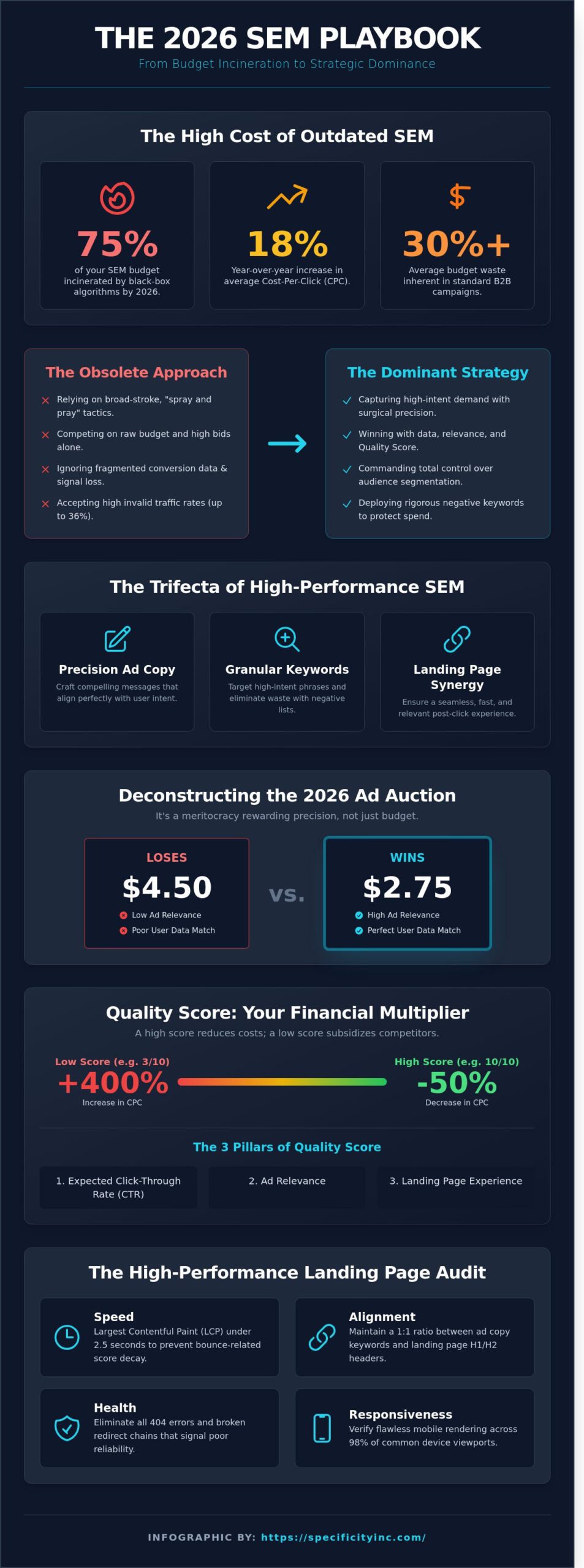
By 2026, 75% of your current search engine marketing (sem) budget will likely be incinerated by black-box algorithms that prioritize platform profit over your bottom line. Traditional broad-stroke tactics are dead. If you’re still relying on basic keyword matching in an era of signal loss and AI-driven auctions, you’re essentially subsidizing your competitors’ growth. You know the frustration of watching CPCs climb by 18% year-over-year while your conversion data grows increasingly fragmented and unreliable.
It’s time to stop guessing and start dominating. We’ll show you how to master the mechanics of high-intent demand to ignite predictable revenue growth through data-driven precision. By implementing granular control over your marketing spend, you can eliminate the 30% of waste inherent in standard B2B campaigns. This article reveals the exact frameworks required to pinpoint lucrative audiences and secure strategic dominance in the most competitive search results of the decade.
Key Takeaways
- Capture high-intent demand with surgical precision through search engine marketing (sem), moving beyond the waste and inefficiency of broad-stroke digital advertising.
- Master the 2026 auction environment where granularity and Quality Score in search engine marketing (sem) outperform raw budget to slash your acquisition costs.
- Leverage search engine marketing (sem) to command total control over audience segmentation and messaging for immediate, predictable revenue growth.
- Eliminate budget leakage by identifying high-intent purchase signals within your search engine marketing (sem) and deploying rigorous negative keyword lists to protect your bottom line.
- Integrate search into a full-funnel ecosystem, synchronizing your search engine marketing (sem) strategy with high-authority channels like Connected TV to dominate the market.
What is Search Engine Marketing (SEM)? Defining Strategic Visibility
Search engine marketing (sem) isn’t a digital billboard; it’s a surgical strike. While traditional display advertising casts a wide, often wasteful net, SEM targets active intent. You’re not hoping someone notices your brand. You’re appearing exactly when a prospect asks for a solution. This discipline has transformed since its early days of simple keyword matching. In 2024, it functions as a high-velocity intent-prediction engine that analyzes user behavior patterns to deliver extreme relevance. The objective is clear: achieve strategic dominance on the Search Engine Results Page (SERP) to capture the 3.5 billion searches performed daily on Google.
The Core Components of a High-Performance SEM Campaign
Winning a high-performance search engine marketing (sem) campaign requires more than a high bid. You need a trifecta of precision ad copy, granular keyword selection, and landing page synergy. If these three elements don’t align, your Quality Score drops, and your cost-per-click (CPC) skyrockets. Smart players use ad extensions to seize more SERP real estate. These extensions can increase click-through rates (CTR) by 15 to 20 percent according to Google’s internal data. Most importantly, you must prioritize human-verified traffic. With invalid traffic rates reaching 36 percent in some industries according to 2023 cybersecurity reports, paying for bot clicks is a fast way to burn capital. We demand data that proves a human is behind the click before a single cent is spent.
Why SEM is the Antidote to Market Stagnation
Speed is a competitive advantage. SEM offers the fastest route to market for any product launch or strategic pivot. While organic SEO is a necessary long-term play, it often takes 180 days or more to see measurable traction. SEM scales instantly. You can go from zero visibility to the top of the SERP in under 48 hours. The mindset of a search user is fundamentally different from a social media browser. A LinkedIn user is there to network; a search user is there to solve a problem. This commercial intent is why search traffic consistently out-converts social traffic by 2 to 1 in B2B sectors. You aren’t just buying traffic; you’re buying immediate market share based on logic and evidence. It’s the only logical choice for businesses seeking predictable revenue.
The Mechanics of Precision: How SEM Operates in 2026
Raw spending is a legacy metric. In 2026, search engine marketing (sem) requires a level of granularity that renders “spray and pray” budgets obsolete. High-performance campaigns now prioritize surgical intent over raw impressions. Your budget doesn’t dictate your dominance; your data does. Success in this environment requires a shift from manual bidding to high-level strategic oversight, where machine learning handles the execution while you define the parameters of profitability.
The Auction: Where Data Meets Strategy
The modern auction is no longer a simple contest of the deepest pockets. Search engines now weigh three distinct variables: your bid amount, real-time ad relevance, and the specific user’s historical interaction data. A $4.50 bid from a competitor often loses to a $2.75 bid that aligns perfectly with the user’s immediate intent. This happens because the platform prioritizes the user experience to maintain its own market share. The Ad Auction is a meritocratic system that rewards precision over volume. Machine learning models now process 50 million data points per second to determine ad placement. This makes identifying high-intent traffic the only way to maintain a competitive edge without overpaying for every lead.
Quality Score: The Invisible ROI Multiplier
Quality Score is the ultimate financial lever in your search engine marketing (sem) strategy. It acts as a direct multiplier or a tax on your campaign performance. A score of 10/10 can reduce your CPC by 50%, while a score of 3/10 can increase your costs by 400% for the exact same placement. This score rests on three pillars: expected click-through rate (CTR), ad relevance, and landing page experience. If your landing page doesn’t deliver on the promise of the ad, you’re essentially subsidizing your competitors’ clicks.
To protect your Ad Rank and keep your CPCs low, you must maintain technical landing page performance. Use this checklist to audit your assets:
- Speed: Ensure the Largest Contentful Paint (LCP) is under 2.5 seconds to prevent bounce-related score decay.
- Alignment: Maintain a 1:1 ratio between high-intent ad copy keywords and landing page headers.
- Health: Eliminate all 404 errors and broken redirect chains that signal poor reliability to the crawler.
- Responsiveness: Verify flawless mobile rendering across 98% of common device viewports.
By 2026, 85% of bidding tasks are automated by AI. This shift means your primary job isn’t adjusting bids by five cents; it’s ensuring the algorithm only pursues human-verified, high-value targets. When you feed the machine clean data, you ignite a cycle of efficiency that your competitors can’t match with raw capital alone.
SEM vs. SEO: Strategic Dominance Through Speed and Control
Stop viewing SEO and SEM as a binary choice. This isn’t a playground debate; it’s a high-stakes resource allocation strategy. While organic growth represents a long-term asset, search engine marketing (sem) is your tactical weapon for immediate market capture. The common misconception that SEO is ‘free’ traffic ignores the massive capital investment required for content engineering, technical optimization, and authority building. A 2024 analysis shows that mid-market firms often spend over $10,000 monthly on SEO talent and software before seeing a single conversion. SEM removes this ambiguity by placing a clear price tag on every lead. It provides a level of predictability that organic strategies simply cannot match.
The ‘free’ myth persists because businesses fail to account for the opportunity cost of lost time. Every month you spend waiting for an organic ranking is a month your competitors are closing deals. By the time your content ranks, the market may have shifted. SEM also creates a strategic halo effect. When users see your brand in both paid and organic positions, trust increases. A Google study confirmed that even with a #1 organic ranking, search ads still drive 50% of incremental clicks that organic results miss. You aren’t just buying traffic; you’re buying market share and psychological dominance.
The Speed to Lead Advantage
SEO is a marathon; SEM is a 100-meter sprint. Most organic campaigns require 180 to 270 days to achieve top-three rankings for high-value keywords. You don’t have six months to wait for revenue. Use search engine marketing (sem) to ignite your sales funnel instantly. This speed allows for rapid-fire A/B testing. You can validate a new value proposition in 48 hours rather than waiting months for organic data to trickle in. SEM bridges the revenue gap while your long-term organic authority matures. It’s the difference between hoping for a lead and securing one with mathematical certainty.
Granular Control and Audience Segmentation
Organic search is a broad-stroke tool that often attracts top-of-funnel browsers. Paid search is a surgical instrument. You can pinpoint specific personas based on geography, device, and precise intent markers that organic algorithms often ignore. If your production capacity hits 100%, you can pause your SEM spend in seconds. You can’t ‘turn off’ organic traffic. This granularity ensures you only pay for traffic that aligns with your current inventory and operational scale. You control the narrative, the timing, and the destination of every dollar spent. It’s about precision, not just volume.
Architecting a High-Performance SEM Strategy
Stop treating search engine marketing (sem) as a broad-reach experiment. It’s a precision strike. Most agencies waste 27% of their client’s budget on bots and low-intent queries because they prioritize visibility over velocity. At Specificity Inc., we reject the “more is better” fallacy. High-performance SEM requires a ruthless commitment to data integrity and a refusal to pay for clicks that don’t convert into revenue.
To dominate the auction, you must implement a multi-layered tracking architecture. This goes beyond basic pixel tracking. You need server-side tagging and human-verification protocols to ensure every dollar of spend is accounted for. If you can’t trace a conversion back to a specific, human-driven click, your data is compromised. We use 100% granular tracking to eliminate the fog of war in digital spend.
Keyword Selection: Beyond Search Volume
High search volume is often a siren song for wasted capital. We reject high-volume vanity keywords that signal research rather than readiness. A query like “what is cloud security” is a budget sinkhole. Conversely, “enterprise cloud security compliance auditing” signals transactional intent. You must prioritize long-tail queries that contain commercial markers such as “pricing,” “vendor,” or “implementation.”
This precision allows you to capture high-intent demand at the exact moment of need. Once you’ve captured these leads, you can leverage precision email marketing to nurture them through the final stages of the sales funnel. Focus on the 4% of users ready to buy today, not the 96% just browsing.
Waste Mitigation and Conversion Optimization
Your negative keyword list should be more robust than your targeted list. We implement rigorous exclusions to protect your budget from “looky-loos,” job seekers, and students. If you aren’t excluding terms like “free,” “salary,” or “template,” you’re burning cash. We’ve seen companies recover up to $15,000 in monthly spend simply by cleaning up irrelevant query triggers.
Landing pages must serve as the logical, inevitable conclusion to the searcher’s question. If the ad promises a solution, the page must deliver the proof immediately. Continuous A/B testing of ad copy and CTA placement isn’t a luxury; it’s a requirement for survival. Conversion rate optimization is the only way to lower your customer acquisition cost in a competitive auction.
- Intent-Based Targeting: Focus on keywords with 3.5x higher conversion potential.
- Negative Keyword Scrubbing: Eliminate the 18% of traffic that typically bounces instantly.
- Logical Continuity: Ensure ad-to-page alignment to maintain a quality score of 9 or 10.
Don’t let bot traffic and poor strategy erode your margins. Audit your current SEM performance with Specificity Inc. and start capturing real human intent.
The Specificity Edge: Integrating SEM into a Full-Funnel Engine
Treating search engine marketing (sem) as an isolated tactic is a high-stakes tactical error that leads to budget exhaustion. When you bid on keywords in a vacuum, you’re competing solely on price in a crowded auction. Specificity Inc. rejects this fragmented approach. We integrate SEM into a rigorous full funnel marketing ecosystem that captures interest long before a user reaches the search bar. By the time a prospect types a query, our ecosystem has already established your brand as the dominant authority.
Our methodology leverages intent data to pinpoint “in-market” buyers with surgical precision. We don’t wait for the search; we anticipate it. Data from 2024 indicates that 82% of B2B buyers conduct significant research before ever engaging a sales team. We use this lead time to ignite interest through high-impact touchpoints, ensuring that when the search finally happens, your brand isn’t just an option, it’s the expected solution. Once these high-intent prospects enter your ecosystem, you can deploy precision email marketing strategies to maintain engagement and drive them toward conversion with surgical accuracy. Specificity Inc. moves your brand beyond basic PPC management and into the realm of strategic demand generation.
Cross-Channel Synergy: SEM, CTV, and Programmatic
Connected TV (CTV) is the ultimate primer for search performance. With 88% of US households reachable via CTV in 2024, the synergy is undeniable. A prospect sees your high-definition ad on their main screen, which drives a 14% lift in branded search queries on their mobile devices. We then follow these high-intent searchers across programmatic display networks with aggressive retargeting. This multi-channel approach works in perfect harmony with strategic social media advertising to create a comprehensive ecosystem that captures prospects at every stage of their decision-making process. This is vital for B2B marketing where sales cycles often stretch over 6 to 12 months. We maintain a constant, data-backed presence that wears down the competition through sheer strategic persistence.
The Future of Search: AEO and Intent-Based Precision
The landscape is shifting toward Answer Engine Optimization (AEO). As AI-driven search engines provide direct answers, your search engine marketing (sem) strategy must evolve to capture these zero-click opportunities. However, the rise of AI also brings a surge in sophisticated bot-driven ad fraud, which currently accounts for roughly 40% of all digital ad traffic. Human-verified traffic is your only defense against this drain on your ROI. We eliminate the noise and the fraud, ensuring every dollar spent targets a breathing, motivated human buyer. Stop paying for empty clicks and start investing in predictable outcomes. The era of guesswork is over; the era of precision has arrived.
Own the High-Intent Landscape
Success in 2026 requires a departure from the wasteful, broad-stroke tactics of the past decade. You’ve seen how search engine marketing (sem) has evolved into a high-stakes battleground where only the most granular, data-backed strategies survive. With bot traffic now exceeding 42% of total web activity according to recent security audits, the margin for error has vanished. You need a system that prioritizes human-verified traffic and leverages proprietary intent-data to pinpoint buyers at the exact moment of decision. This isn’t about mere visibility; it’s about engineering a high-performance engine that converts high-intent B2B and B2C demand into predictable revenue.
Specificity Inc. eliminates the guesswork that plagues traditional agencies. We deploy a methodology rooted in logic and hard numbers to ensure your capital produces maximum ROI. Our specialists focus on the 3% of your market ready to buy today, ensuring your brand dominates the search results that actually matter. Stop settling for vanity metrics and start scaling with surgical precision. Ignite your growth with a precision-engineered SEM strategy from Specificity Inc. Your dominance in the market is within reach if you’re ready to lead.
Frequently Asked Questions
What is the primary difference between SEM and PPC?
SEM is the strategic framework for search engine marketing (sem) dominance, while PPC is the specific tactical billing model. SEM encompasses every methodology used to gain visibility on search results pages. PPC refers strictly to the auction-based pay-per-click mechanism. We treat search as a holistic growth engine to ensure your brand captures the 65% of high-intent clicks that occur at the top of the page.
How much should a B2B company expect to spend on SEM in 2026?
By 2026, B2B firms in competitive verticals should budget between $18,400 and $52,000 per month for paid search. This figure accounts for the projected 9% year-over-year increase in platform costs across Google and Bing. We recommend a budget that represents 10% of your target revenue goal to ensure your brand maintains a dominant 25% share of voice in your primary category.
How long does it take to see measurable results from an SEM campaign?
Measurable data surfaces within the first 14 days, but true optimization takes 90 days. We require this three month window to gather enough statistical significance to move the needle on your bottom line. During the initial 30 days, we focus on aggressive waste elimination, typically cutting irrelevant traffic by 25% to stabilize your cost per lead and improve lead quality.
Is SEM effective for companies with a long sales cycle?
SEM is vital for nurturing prospects through a 6 to 12 month decision process. It allows you to pinpoint buyers during the initial 70% of their journey when they’re researching solutions anonymously. By capturing this intent early, we’ve helped firms increase their pipeline velocity by 18% through strategic retargeting and high-value content offers that keep your brand visible throughout the evaluation phase.
How do I know if my SEM agency is delivering real ROI or just vanity metrics?
Real ROI is measured in bank deposits, not impressions. If your current partner can’t show a direct line from a click to a $50,000 contract in your CRM, they’re failing. We ignore the 2% click-through rate fluff and focus on the 12% increase in qualified sales opportunities that actually drive enterprise value. Demand a report that connects ad spend to Closed-Won revenue.
What happens to my search visibility if I stop paying for SEM ads?
Your search visibility will crater by roughly 60% the moment you pause your campaigns. Organic results are often buried beneath four paid slots and various SERP features, meaning you’ll lose immediate access to the 41% of users who click the top three ads. Stopping your search engine marketing (sem) efforts hands that market share directly to your competitors who are willing to pay for that real estate.
Can SEM help improve my organic search engine optimization (SEO) rankings?
SEM provides the intelligence report for your organic strategy. While Google’s algorithm doesn’t reward paid spend with higher organic rankings, the 20% conversion data we pull from ads tells us exactly which keywords deserve SEO investment. This prevents you from wasting six months of content production on terms that don’t actually generate revenue. It’s about using paid data to fuel organic precision.
What are negative keywords and why are they vital for budget protection?
Negative keywords are filters that prevent your ads from appearing for irrelevant queries. Implementing a robust negative list can reduce wasted spend by 30% in the first quarter alone. We use these to block “free,” “cheap,” or “entry level” searches, ensuring your budget only ignites for prospects ready to sign a professional services agreement. This surgical approach protects your margins from low-intent noise.