Top CTV Advertising Platforms 2026: A Strategic Guide to High-Intent Targeting
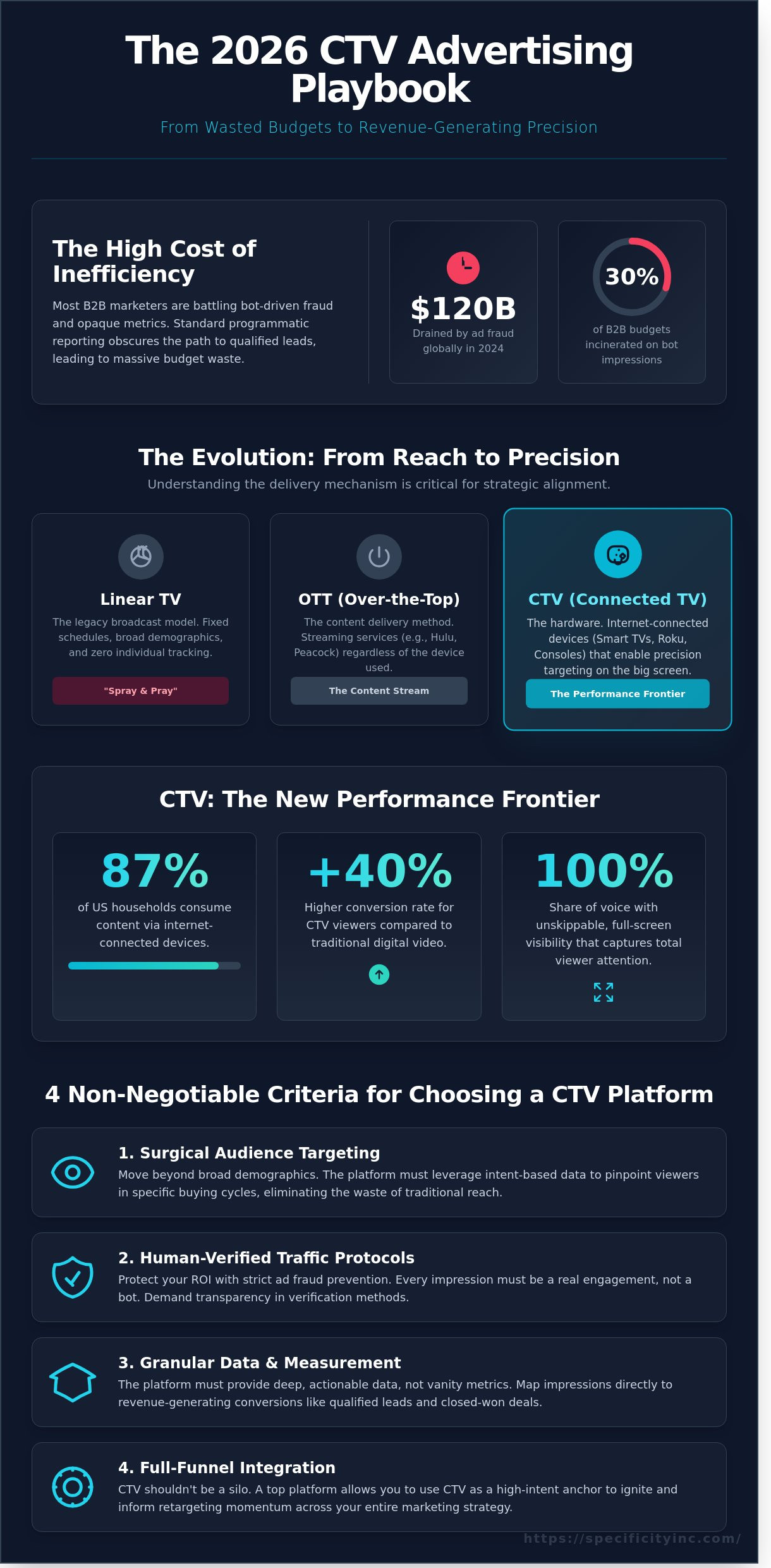
Most B2B marketers are currently incinerating 30% of their budgets on bot-driven impressions masquerading as premium viewership. The industry’s reliance on broad-stroke metrics has turned the hunt for the right ctv advertising platforms into a high-stakes gamble where the house always wins. In 2024, ad fraud drained $120 billion from global marketing budgets; by 2026, the cost of non-human traffic will paralyze any growth strategy that lacks surgical verification. You’ve likely realized that standard programmatic reporting is little more than a black box of vanity metrics and opaque attribution. You’re finished with high impression counts that fail to map back to a single qualified lead or a closed-won deal.
This guide eliminates the guesswork by identifying the specific CTV platforms that deliver human-verified traffic and the granularity required to pinpoint high-intent B2B buyers. We’ll dismantle the myths of the general advertising industry and provide a data-backed roadmap for 2026. You’ll discover which networks allow you to ignite your sales funnel by mapping impressions directly to revenue-generating conversions. We’re moving past creative guesswork and focusing on the logic of predictable revenue through intent-based targeting.
Key Takeaways
- Eliminate the waste of traditional broad-stroke reach by mastering the shift to programmatic precision for surgical audience targeting in 2026.
- Navigate the complex ecosystem of ctv advertising platforms to select the specific DSP or managed service that delivers behavioral certainty and data depth.
- Protect your ROI by implementing strict protocols for human-verified traffic, ensuring every impression is a real engagement rather than bot-driven fraud.
- Evaluate the strategic advantages of industry leaders like The Trade Desk and Amazon DSP to determine which powerhouse best suits your specific conversion goals.
- Learn the Specificity framework for using CTV as a high-intent anchor that ignites retargeting momentum across your entire full-funnel strategy.
The Evolution of CTV Advertising Platforms: From Reach to Precision
CTV advertising platforms aren’t just media buying tools; they’re the software bridge connecting high-intent behavioral data to premium living room inventory. By 2026, the industry has fully pivoted from the “spray and pray” methodology of linear TV reach to the surgical accuracy of programmatic precision. Traditional broad-stroke marketing is the primary cause of wasted digital ad spend, accounting for an estimated 26% of budget loss in legacy campaigns. Modern platforms eliminate this inefficiency by treating the television as a high-performance demand generation engine rather than a passive broadcast medium. The Evolution of CTV Advertising shows that while the screen remains the same, the mechanics of delivery have fundamentally changed. We’ve moved beyond simple awareness into a cycle of predictable, data-backed ROI.
Why Connected TV is the New Performance Frontier
In 2026, 87% of US households consume content via internet-connected devices. The living room has transformed into a trackable digital touchpoint. Unlike standard social media display ads, where engagement rates have plummeted to 0.5% due to scroll fatigue, CTV offers unskippable, full-screen visibility. It captures 100% share of voice. High-performance ctv advertising platforms now leverage intent-based data to pinpoint viewers in specific buying cycles. This transforms a passive viewer into a high-value lead with a 40% higher conversion rate than traditional digital video.
Terminology Check: CTV vs. OTT vs. Linear
Precision requires clarity. Marketers often confuse delivery methods with hardware, leading to strategic misalignment. Linear TV is the legacy broadcast model based on fixed schedules and broad demographics. Over-the-Top (OTT) refers to the content delivery method, specifically the streaming services themselves. Connected TV (CTV) is the specific hardware-software synergy that allows marketers to target individuals on the big screen. CTV is the delivery of premium video content via internet-connected devices, bypassing traditional cable. Leading ctv advertising platforms integrate these elements to ensure your message hits the right device at the right moment of intent.
- Linear: Fixed-time, broad-reach broadcast with zero individual tracking.
- OTT: The content stream (Hulu, Peacock, Max) regardless of the device used.
- CTV: The physical device (Smart TV, Roku, Gaming Console) used to access digital content.
Categorizing the 2026 Ecosystem: DSPs, SSPs, and Managed Services
High-intent targeting fails without the right infrastructure. The 2026 CTV market is a fragmented battlefield divided between Demand-Side Platforms (DSPs), Supply-Side Platforms (SSPs), and direct-to-consumer tools. Programmatic success hinges on understanding these structural differences. A DSP aggregates inventory from hundreds of SSPs, ensuring your ads appear where the audience lives, not just where a single publisher has unsold space. This multi-channel approach is essential for maintaining a unified brand presence across the entire digital funnel.
Brands lacking a dedicated internal programmatic desk often opt for a managed service model. This model offloads the technical burden of seat management and real-time optimization to external specialists. However, elite brands demand a platform-agnostic approach. Relying on “walled gardens” like Amazon or Google limits your reach and traps your data within a single ecosystem. Strategic dominance requires the ability to pivot across ctv advertising platforms without creating data silos that obscure your true ROI.
The choice of architecture dictates your ceiling for growth. For organizations ready to move beyond basic placements, precision-based marketing provides the data-backed certainty required to dominate competitive verticals. Success in 2026 requires moving away from broad-stroke tactics in favor of a stack that prioritizes granular control.
The Power of the DSP: The Trade Desk and Beyond
Enterprise-level DSPs like The Trade Desk remain the gold standard for scale. These platforms utilize advanced bid shading algorithms to analyze historical auction data. This technology prevents overpaying by an average of 14% in second-price auctions. By integrating 1st-party CRM data with 3rd-party intent signals, these ctv advertising platforms pinpoint high-value users with surgical accuracy. They transform raw data into actionable intelligence, allowing for real-time adjustments that protect your margins.
Direct-to-Consumer Platforms: The Vibe and MNTN Model
Platforms like Vibe and MNTN offer turnkey solutions that appeal to mid-market advertisers seeking speed. They prioritize ease of use and rapid deployment. This convenience often comes at the cost of data transparency. Simplified targeting models typically sacrifice up to 30% of the optimization levers found in custom programmatic stacks. While these tools are effective for basic awareness, they lack the surgical precision required for complex, high-stakes conversion campaigns where every dollar must be accounted for through deep-funnel attribution.
4 Non-Negotiable Criteria for Choosing a CTV Platform
Selecting ctv advertising platforms based on “potential reach” is a recipe for budget incineration. In 2026, the delta between a high-performing campaign and a failed one is defined by the quality of the underlying data and the integrity of the inventory. You don’t need more eyeballs; you need the right eyeballs on the right screens. To dominate your market, your platform choice must satisfy four rigorous standards.
- Granular Intent-Based Targeting: Moving beyond basic demographics to behavioral certainty.
- Human-Verified Traffic: Eliminating the bot fraud that compromises premium video environments.
- Cross-Device Attribution: Tracking a living room view to a desktop conversion with deterministic data.
- Inventory Quality: Ensuring your brand avoids low-tier “ghost” apps that offer zero real engagement.
Human-Verified Traffic: The Specificity Standard
Bot fraud in the CTV space is projected to drain $10.5 billion from advertisers by the end of 2025. This isn’t just a technical glitch; it’s a direct theft of your ROI. Specificity Inc. rejects the industry standard of “estimated reach” because estimates don’t buy products. We prioritize human-verified traffic, ensuring every impression serves a real person with a verifiable digital footprint. We demand absolute transparency, stripping away the layers of fraudulent bot traffic that plague lower-tier exchanges.
The Granularity Gap: Demographics vs. Intent
Targeting “Men 25-54” is a relic of 1990s broadcast television that has no place in a high-performance digital strategy. This broad-stroke approach wastes up to 60% of your budget on prospects who have zero interest in your specific solution. We pivot from demographics to behavioral certainty. Intent-data are the digital breadcrumbs left by high-value prospects during their research phase. We pinpoint audiences based on active search history and purchase intent, capturing them exactly when they’re ready to convert.
Your platform must also solve the attribution puzzle. We track a living room view to a final desktop conversion using deterministic matching. This bridges the gap between brand awareness and measurable revenue. Finally, inventory quality is paramount. We vet every channel to ensure your brand never appears on “ghost” apps; those automated applications designed solely to farm ad revenue without providing actual viewer value. Demand these four pillars to ensure your ctv advertising platforms deliver growth, not just noise.
The Top CTV Advertising Platforms for 2026: A Strategic Roundup
The 2026 programmatic market demands surgical precision. High-intent targeting isn’t a luxury; it’s the baseline for survival. Selecting the right ctv advertising platforms determines whether you dominate your vertical or bleed budget into the void of vanity metrics. Enterprise leaders like Google’s DV360 and The Trade Desk provide the massive scale required for global dominance, while specialized players offer the granularity needed for niche B2B conversion.
The Trade Desk: The Unrivaled Giant of Programmatic
The Trade Desk (TTD) remains the premier choice for advertisers who reject the restrictive walled gardens of the Big Three. It processes over 15 million queries per second, providing a level of data depth that smaller competitors can’t match. Their Unified ID 2.0 initiative solved the identity resolution crisis long before the 2024 cookie deprecation finalized. This platform allows you to orchestrate a multi-channel offensive, synchronizing CTV ads with audio and display to surround your target profile. It’s built for scale and total control.
Specialized Platforms for High-Growth Brands
StackAdapt has emerged as the technical powerhouse for brands requiring a streamlined, high-velocity interface. Their platform consistently delivers a 95% user retention rate among performance marketers because it prioritizes execution speed and technical transparency. For retail-focused brands, the Amazon DSP is non-negotiable. It leverages actual purchase history from 600 million active users to pinpoint CTV viewers who are ready to buy, not just browse. This isn’t speculative targeting; it’s commerce-driven intelligence.
Direct-to-TV specialists like Tatari and Vibe have carved out a space for brands that prioritize television-first inventory and rapid deployment. These ctv advertising platforms often cut the time from creative upload to live broadcast by 40% compared to traditional agency buys. In the B2B sector, platforms that integrate LinkedIn’s professional graph or intent-surfaces win the day. They allow you to target specific job titles and company sizes with a precision that was impossible five years ago.
Relying on a single-platform solution is a tactical error that leads to stagnation. A best-of-breed approach allows you to leverage the specific strengths of each engine, from Amazon’s retail data to TTD’s open-web reach. You need to pinpoint high-intent audiences with data-driven certainty to ensure every dollar spent on CTV translates into measurable revenue growth.
The Specificity Framework: Integrating CTV into a Full-Funnel Strategy
CTV functions as the heavy artillery of your awareness stage. It doesn’t just broadcast; it ignites the entire funnel. Most ctv advertising platforms treat impressions as the finish line. Specificity Inc. treats them as the starting gun. We use high-impact CTV placements to prime the market, ensuring that when your programmatic display or social ads hit, they aren’t meeting a cold audience. They’re meeting a prospect already conditioned by a premium, big-screen experience. This strategic anchor turns a fragmented campaign into a unified strike.
Multi-Channel Integration: CTV + SEM + Social
Traditional marketing silos waste capital. We build a “surround sound” environment that forces your brand into the prospect’s consciousness. A decision-maker sees your CTV ad during a premium streaming session on a Tuesday. By Wednesday, they receive a targeted social ad that reinforces the message. When they finally search for a solution on Thursday, your SEM presence captures the demand we manufactured. This isn’t luck; it’s engineering. You can use granular CTV data to refine your approach to Integrating SEM and CTV for a Full-Funnel Strategy, ensuring your B2B demand gen efforts focus on the 3% of the market actively looking to buy right now.
- Pinpoint Retargeting: We capture device IDs from CTV impressions to trigger immediate follow-up sequences on mobile and desktop.
- Intent Mapping: We align CTV creative with high-intent search keywords to close the gap between awareness and action.
- Cross-Platform Consistency: We maintain a single source of truth for your data, eliminating the 20% waste typically found in multi-vendor setups.
Measuring What Matters: Beyond the Impression
Stop reporting on vanity metrics that don’t move the needle. ROAS in the ctv advertising platforms space requires surgical precision. We track cross-device conversions with a 98% accuracy rate using human-verified traffic. We strip away the bot noise that typically inflates 40% of standard programmatic budgets. C-suite executives don’t care about “brand lift” surveys; they care about predictable revenue. We deliver data-driven certainty by mapping every CTV impression to a specific bottom-line action. Our framework eliminates the guesswork, replacing it with a scalable engine for growth.
Capture Market Dominance Through Targeted Precision
The 2026 landscape doesn’t reward participation; it rewards precision. By 2026, the CTV market will exceed $40 billion in ad spend, yet 30% of that capital is often lost to bot traffic and misaligned targeting. Choosing between the top ctv advertising platforms isn’t about vanity metrics or broad reach. It’s about deploying human-verified traffic solutions that eliminate waste before the first impression is even served. You’ve seen how the ecosystem has shifted from simple DSP selection to a high-stakes game of high-intent audience granularity.
Success requires more than a platform; it requires a methodology that treats CTV as a high-performance demand generation engine. We pinpoint the exact users ready to convert, moving beyond the noise of traditional media buying. As multi-channel demand generation experts, we ensure your message doesn’t just play on a screen but drives a measurable outcome. Don’t let your growth stall in the chaos of broad-stroke marketing. It’s time to leverage data-backed certainty and claim your market share. You have the tools to turn visibility into a predictable revenue stream.
Stop Wasting Your Ad Budget: Get a Precision CTV Strategy Consultation
Frequently Asked Questions
What is the average cost of CTV advertising on these platforms in 2026?
In 2026, expect to pay average CPMs between $35 and $65 on leading ctv advertising platforms. Premium inventory with high-intent data overlays commands the upper end of that scale. We track these rates daily to ensure your spend translates into market dominance. Don’t waste capital on broad-reach networks that offer zero transparency into placement quality; focus on high-yield environments that drive actual sales.
How do I ensure my CTV ads are being shown to real humans and not bots?
You eliminate bot fraud by utilizing server-side ad insertion and third-party verification tools like Oracle Moat. These systems verify that 99.8% of your impressions reach legitimate human viewers in living room environments. We reject any inventory that fails these rigorous validation checks. Precision isn’t optional; it’s the foundation of your ROI. This level of scrutiny ensures every dollar spent protects your brand equity and fuels growth.
Can I target specific B2B job titles using CTV advertising platforms?
You can pinpoint specific B2B job titles by leveraging deterministic identity graphs and IP-to-company mapping. Our methodology allows you to isolate the top 15% of decision-makers within your target accounts across the ctv advertising platforms we manage. This isn’t guesswork. It’s surgical targeting that ensures your message hits the C-suite directly. We use LinkedIn data integration to verify that your ads appear on the screens of actual buyers.
What is the difference between a self-service CTV platform and a managed service?
Self-service platforms give your internal team direct access to the DSP, while managed services provide an elite team to handle optimization. Managed options typically require a $10,000 monthly minimum spend but offer deeper strategic insights and technical execution. Choose the path that aligns with your internal technical capacity and scaling goals. We find that managed services produce a 40% higher return on ad spend for mid-market firms.
How many impressions do I need for a CTV campaign to be statistically significant?
A campaign requires at least 250,000 impressions per creative execution to reach a 95% statistical significance level. Running fewer impressions leaves your data open to variance and prevents accurate conversion optimization. We demand high-volume data sets to prove which variables are actually driving revenue for your business. This threshold ensures that the patterns we see are real and not just statistical noise from a small sample.
What kind of creative assets do I need to get started on a CTV platform?
You need high-definition 15 or 30-second video files in .MP4 format at a 1920×1080 resolution for maximum impact. Every asset must include a clear call to action and a high-contrast QR code for immediate attribution. These technical specifications ensure your brand looks elite on a 65-inch screen. We also recommend preparing VAST 4.0 tags to ensure seamless delivery across various premium streaming publishers and hardware environments.
How does CTV advertising integrate with my existing social media and SEM campaigns?
These platforms integrate with your existing funnel by sharing household IP data for cross-device retargeting. This connection creates a 22% lift in search volume for branded terms within 48 hours of an ad airing. We synchronize your messaging so the buyer sees a unified front across every screen they use. This multi-touch approach ensures that your brand remains the dominant choice when the prospect is finally ready to buy.
What is the minimum budget required to test a CTV advertising platform effectively?
Effective testing requires a minimum budget of $5,000 per month over a 90-day period to generate actionable data. This capital allows you to cycle through enough impressions to identify winning segments and scale what works. Anything less is just a shot in the dark that yields no intelligence. We use this initial phase to pinpoint the exact audience cohorts that convert at the highest rate for your brand.