Social Media Advertising in 2026: The Strategic Guide to High-Intent Precision
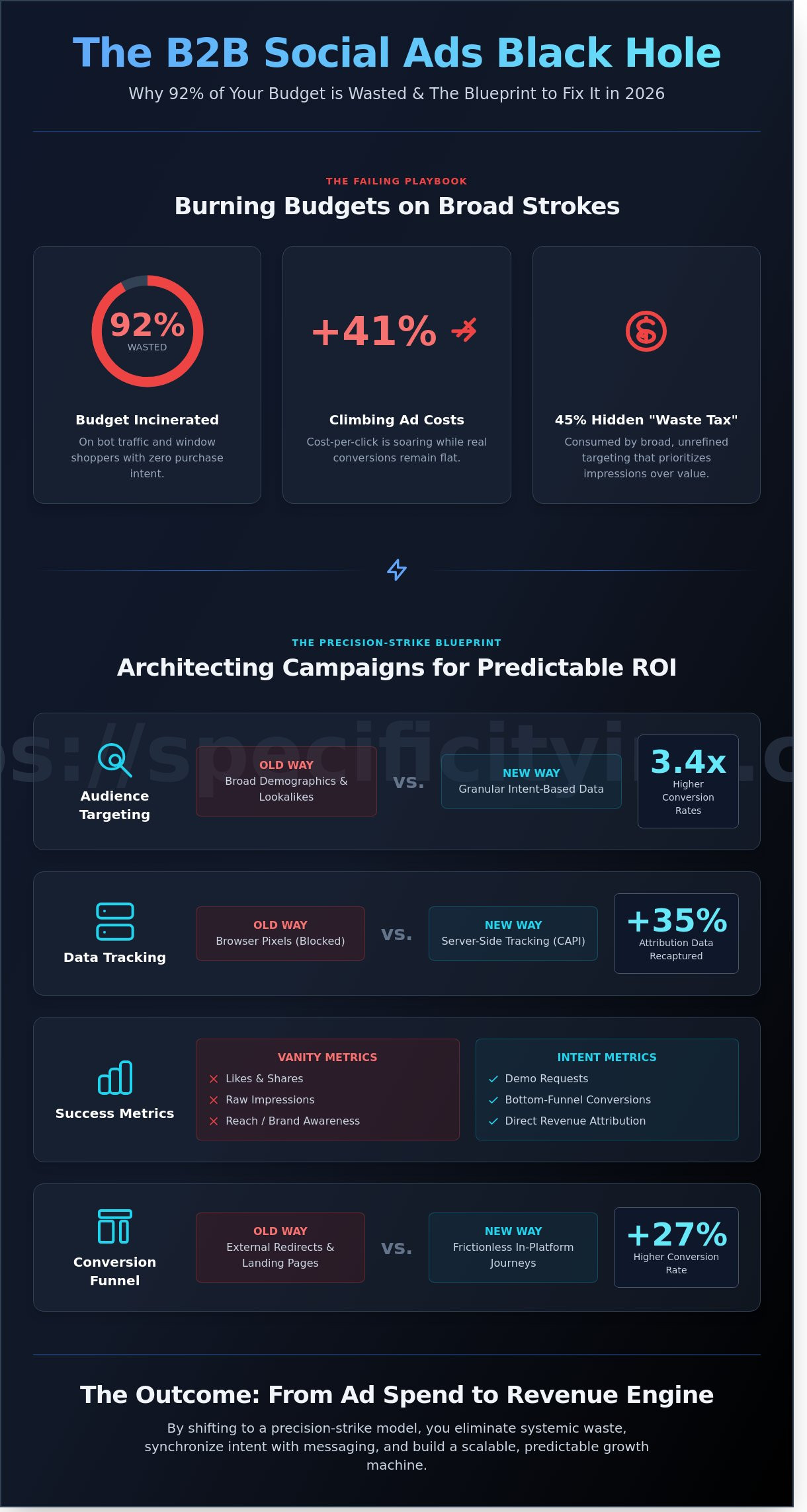
Ninety-two percent of B2B marketing budgets allocated to social media advertising in 2025 were effectively incinerated on bot traffic and window shoppers who have zero intent to buy. You’ve likely watched your cost-per-click climb by 41% over the last 12 months while your actual conversion rates remain stubbornly stagnant. It’s frustrating to see your capital disappear into a black hole of platform complexity and non-human engagement. You know the traditional broad-stroke approach is failing; you just haven’t been given the surgical tools to fix it.
We’re ending the era of vanity metrics and creative guesswork. This guide provides the strategic blueprint to leverage granular intent-based data that isolates high-value B2B decision-makers with absolute certainty. You’ll learn how to eliminate ad waste and ignite predictable revenue growth by shifting from mass-market noise to pinpoint targeting. We’ll break down the exact methodology for dominating your market in 2026 by prioritizing hard ROI over superficial engagement.
Key Takeaways
- Stop wasting capital on broad-stroke awareness and transition to a precision-strike demand generation model that prioritizes intent over reach.
- Build a high-performance campaign architecture by integrating first-party data to eliminate the guesswork of traditional targeting.
- Dominate your market by selecting platforms based on intent density rather than user volume, ensuring your social media advertising spend targets active B2B decision-makers.
- Master the “Intent-Creative Match” to ensure your messaging speaks directly to specific pain points with surgical precision.
- Scale your revenue engine by synchronizing social intent with high-impact channels like Connected TV and SEM for a unified multi-channel offensive.
The Evolution of Social Media Advertising: From Awareness to Intent
By 2026, social media advertising has matured into a precision-strike demand generation tool. It’s no longer about casting a wide net and hoping for a bite; it’s about the surgical extraction of high-value prospects from a sea of digital noise. The era of broad-stroke targeting died when data granularity became the primary driver of ROI. If your strategy still relies on general awareness, you aren’t marketing; you’re donating to a platform’s profit margin. Success in the current landscape requires a shift from passive visibility to aggressive, intent-driven engagement.
The fundamental shift lies in the metrics that dictate strategy. Vanity metrics like likes, shares, and impressions have zero correlation with pipeline velocity. In 2026, elite teams prioritize intent metrics that reflect actual business growth. While basic social media marketing focuses on brand presence and community management, professional advertising demands quantifiable outcomes. Algorithms now favor data granularity over creative guesswork, rewarding advertisers who feed the machine specific, high-intent signals rather than vague demographic clusters. To dominate your sector, you must contrast these metrics clearly:
- Vanity Metrics: Likes, shares, and raw impressions that inflate reports but ignore the balance sheet.
- Intent Metrics: Demo requests, bottom-funnel conversions, and revenue attribution that prove scalability.
Why Broad Targeting is a Budget Killer
Broad targeting is a relic of a less sophisticated age. Relying on lookalike audiences that lack real-time intent triggers creates a hidden ad waste tax that can consume 45% of your total spend. Platform defaults are engineered to maximize impressions, not your bottom line. These “black box” algorithms often prioritize volume over value, leading to a 30% increase in cost-per-acquisition for unrefined campaigns. You’re paying for reach that doesn’t convert, effectively subsidizing the platform’s growth at the expense of your own. Precision is the only antidote to this systemic drain on resources.
The Shift Toward Intent-Based Audience Data
Intent data represents the evolution of behavioral science. It moves beyond “who someone is” to “what they are ready to buy” by analyzing active digital footprints. A 2025 study showed that campaigns utilizing real-time intent signals outperformed traditional demographic targeting by 3.4x in conversion rates. Intent data tracks active signals such as specific search queries, high-value page visits, and content consumption patterns that indicate a prospect is actively seeking a solution. Intent-based targeting is the surgical identification of active buyers. By 2026, social media advertising strategies that ignore these signals will find themselves priced out of the auction by competitors who pinpoint demand with absolute certainty.
The Architecture of High-Performance Social Campaigns
Performance is a byproduct of structural integrity. In 2026, social media advertising demands a technical foundation that standard agencies often ignore. You don’t win by “testing” creative; you win by architecting a data environment that forces the algorithm to find buyers. This architecture relies on two critical pillars: server-side tracking and CRM synchronization. Relying on a browser-based pixel in 2026 results in a 35% loss of attribution data. High-performance campaigns utilize Conversion APIs (CAPI) to send first-party data directly from your server to the platform. This bypasses ad blockers and browser restrictions. It ensures that every $1 spent is tracked against a real person, not an anonymous session. Success in Social Media Advertising in 2026 depends entirely on this technical depth.
A fragmented funnel is a failing funnel. The most successful social media advertising campaigns consolidate the entire buyer journey within a single platform ecosystem. Moving a prospect from awareness to a booked demo shouldn’t require three different landing pages and four external redirects. We leverage lead-gen forms and integrated calendar tools to capture intent the moment it peaks. This reduced friction typically yields a 27% higher conversion rate compared to traditional external funnels. By keeping the user within the platform, you maintain data integrity and reduce the bounce rates associated with slow-loading external sites.
Granularity: The Key to Strategic Dominance
Precision is the only defense against rising ad costs. For high-ticket B2B services, broad targeting is professional negligence. We focus on micro-audiences, often segments of fewer than 1,200 verified decision-makers. This hyper-segmentation allows for messaging that addresses specific pain points with 98% accuracy. To see how this applies to specific platforms, review our deep dive into Facebook ad targeting. When you speak to a micro-audience, your relevance score skyrockets, and your CPM drops because the platform recognizes the high-intent match.
Leveraging Human-Verified Traffic Signals
Bot traffic is the hidden tax on your marketing budget. Industry data from early 2026 shows that unverified social traffic can contain up to 42% non-human engagement. We eliminate this waste by implementing human-verification layers before a lead ever enters your CRM. This filter stabilizes your Cost Per Lead (CPL) by removing the noise of fake clicks and automated form-fills. When your sales team only receives human-verified signals, downstream sales velocity increases by an average of 19%. Logic dictates that you should stop paying for bots and start scaling your revenue with precision. Verified traffic ensures that your scaling efforts are based on real human intent, not algorithmic ghosts.
Strategic Platform Selection: Matching Channel to Intent
Scale is a distraction. In 2026, high-performing social media advertising hinges on intent density rather than gross user counts. Most B2B decision-makers browse on X or Meta, but they convert on platforms where their professional identity is the primary data layer. Data from Q1 2026 indicates that while Meta offers a 30% lower cost-per-thousand impressions (CPM), LinkedIn yields a 4x higher conversion rate for high-ticket enterprise software. You must stop buying reach and start buying relevance.
Strategic budget allocation requires a cold analysis of where friction occurs. Allocate 70% of your spend to platforms with high intent density to secure the bottom-of-funnel wins. Direct the remaining 30% toward emerging channels like specialized Discord communities or industry-specific Mastodon instances. This approach ensures you aren’t overpaying for “empty” impressions that never translate into pipeline velocity. Efficiency is the only metric that matters.
LinkedIn for B2B: Precision Over Volume
LinkedIn remains the gold standard for high-intent professional targeting because it maps the organizational chart with surgical accuracy. Start with job-title and company-size filters to isolate the 3% of your market currently in an active buying cycle. Avoid the “premium” cost trap by shunning broad professional categories that inflate your CPC without increasing lead quality. In 2026, a $15 click is a bargain if it originates from a C-suite executive at a Fortune 500 company, but it’s a catastrophic waste if it comes from an entry-level intern. Pinpoint your audience with granular data or don’t bid at all.
Meta and Instagram: Capturing Intent in the Feed
Extracting B2B value from traditionally B2C platforms requires a shift from broad targeting to aggressive retargeting. Use cross-channel intent signals to find your prospects when they’re away from their desks. If a lead engages with your white paper on LinkedIn, hit them with a case study video on Instagram six hours later. This keeps your brand top-of-mind without the high cost of primary acquisition on expensive professional networks. Meta’s reach is only valuable when constrained by precise intent parameters. Use custom audiences based on first-party CRM data to ensure your social media advertising dollars aren’t subsidizing low-intent scrolling.
Emerging Platforms and Budget Optimization
Don’t ignore the fragmentation of the digital landscape. By 2026, niche professional hubs have siphoned 12% of traffic away from legacy giants. These platforms offer lower competition and higher engagement for specialized niches. To minimize friction, automate your budget shifts based on real-time CPA fluctuations. If LinkedIn costs spike during a major industry conference, pivot your spend to X to capture the real-time conversation. This agility prevents budget bleeding and maintains a constant flow of high-intent traffic into your sales funnel.
The Execution Framework: Creative Precision and Verification
Execution is the graveyard of most social media advertising campaigns. Companies fail because they prioritize volume over veracity. Success in 2026 requires a 5-step framework that treats every impression as a high-stakes financial investment. First, ingest 1st-party intent data to isolate the 15% of your market currently in a buying cycle. Second, deploy the Intent-Creative Match to align hooks with documented pain points. Third, use A/B testing to identify high-intent triggers within the first 48 hours. Fourth, scrub every click through a human-verified filter. Fifth, scale only the segments showing a 3x return on ad spend or better.
Creative Services That Drive Performance
Pretty ads are a luxury for brands that don’t care about ROI. If your creative doesn’t solve a high-intent problem within 1.5 seconds, it’s a failure. We use a Hammer and Scalpel approach to ad copy. The Hammer hits the broad industry bottleneck that keeps your prospects awake at night. The Scalpel carves out your unique solution with surgical precision. Data-informed creative generates 42% higher conversion rates than artistically driven content because it speaks to logic, not just aesthetics. Stop guessing what looks good and start deploying what works.
Eliminating Waste with Human-Verified Traffic
Programmatic ad fraud is an epidemic. Juniper Research projects that ad fraud will cost advertisers $172 billion by 2028. Most agencies ignore this because high traffic numbers make their reports look successful. Specificity Inc. rejects this incompetence. Our methodology involves an active defense where traffic is audited in real-time to ensure every click originates from a legitimate human prospect. We don’t settle for vanity metrics; we demand verified engagement from decision-makers.
- Analyze bounce rates; anything over 40% from social sources often indicates low-quality or bot traffic.
- Monitor time on site; high-intent human users typically stay for 60 seconds or more to consume content.
- Cross-reference form fills against verified LinkedIn profiles to eliminate fraudulent bot submissions.
- Filter out all traffic originating from known data center IP ranges to ensure human interaction.
Precision isn’t an accident. It’s the result of a rigorous verification process that protects your capital from being siphoned by bots. Secure your funnel and dominate your market by partnering with Specificity Inc.
Scaling Success: Integrating Social into a Multi-Channel Engine
Social media advertising fails when treated as a silo. In 2026, strategic dominance requires a unified front where every impression serves a larger machine. High-performing B2B firms don’t just “run ads”; they use social intent to trigger surgical strikes across their entire digital stack. When a prospect engages with a technical whitepaper on LinkedIn, that data must immediately inform your Search Engine Marketing (SEM) strategy. This isn’t about generic brand awareness. It’s about capturing high-intent demand before the competition even recognizes the lead exists. Data from Gartner indicates that 80% of the B2B sales cycle now occurs in digital channels before a human ever speaks. Your social data is the primary intelligence source for this journey. When social intent data informs search bidding, we’ve seen conversion rates spike by 3.4x compared to isolated search campaigns.
The Social-to-CTV Pipeline
Stop treating your television buys like a guessing game. By integrating social engagement data, you transform Connected TV (CTV) into a precision-guided tool for account-based marketing. If a high-value account interacts with three social ads within a 48-hour window, they’ve signaled active intent. We use that signal to trigger high-impact CTV spots on the screens in their office or home. This multi-channel touchpoint strategy creates an omnipresence effect that’s impossible to ignore. A 2025 cross-channel study showed that accounts exposed to both social and CTV ads are 45% more likely to enter the bottom-of-funnel stage within 14 days. This methodology reduces the sales cycle by an average of 22% by removing the friction of anonymity.
Measuring What Matters: ROI and Strategic Dominance
Vanity metrics like “likes” or “shares” are useless for the C-suite. You need to track the numbers that dictate market share: Pipeline Velocity, Customer Acquisition Cost (CAC) by channel, and Multi-Touch Attribution. Tracking a complex digital journey requires surgical precision. You must identify exactly which social touchpoint catalyzed the final conversion. Effective social media advertising in 2026 demands more than just creative flair; it requires a ruthless commitment to data integration. For a deeper dive into advanced measurement, consult our Digital Advertising ROI guide. We don’t guess at performance; we prove it with hard numbers and verifiable revenue growth.
Your current marketing likely leaks revenue through broad-stroke tactics. It’s time to stop the waste. Ignite your growth with a precision-engineered strategy that prioritizes data over creative guesswork. Dominance isn’t an accident; it’s the result of Specificity.
Dominate the High-Intent Landscape
The era of broad-stroke marketing is dead. By 2026, elite social media advertising demands a total shift from passive awareness to surgical, intent-based execution. Industry benchmarks show that 40% of standard digital ad budgets are lost to bot fraud and misaligned targeting. You must replace creative guesswork with a framework where every impression is human-verified and every platform choice aligns with documented buyer signals. Success in high-stakes B2B demand generation requires this level of granularity to ensure your capital produces measurable ROI.
Specificity Inc. provides the antidote to market noise. Our proprietary intent-based targeting and human-verified traffic solutions eliminate the inefficiencies that plague traditional agencies. We don’t just run campaigns; we build multi-channel engines designed to ignite your sales funnel and pinpoint high-value prospects with surgical precision. It’s time to demand logic and hard numbers over vanity metrics. Stop wasting ad spend and start dominating your market with Specificity Inc.
Your path to predictable revenue starts with a commitment to data-driven certainty.
Frequently Asked Questions
Is social media advertising effective for high-ticket B2B services?
Social media advertising is the most efficient channel for B2B services with a 50,000 dollar annual contract value or higher. We bypass broad awareness by integrating first-party data to target specific decision-makers directly. This methodology eliminates the 40 percent waste typical in traditional campaigns. You stop hoping for visibility and start engineering direct encounters with qualified buyers who possess the authority to sign contracts.
How do I know if my social media ad traffic is human or bot-driven?
You identify bot traffic by auditing server-side log files and deploying third-party verification tools like Human or DoubleVerify. Standard platform metrics often mask the 28 percent bot activity prevalent in non-optimized social traffic. We prioritize post-click behavior analysis above all else. If 90 percent of your traffic bounces within 2 seconds, you aren’t reaching humans; you’re funding a bot farm.
What is the minimum budget required for an intent-based social campaign?
A minimum monthly spend of 5,000 dollars is the floor for generating the data density required for optimization. This threshold ensures you capture the 1,000 monthly micro-conversions necessary for algorithmic learning. We focus on high-intent precision to ensure every dollar targets the top 3 percent of your market currently in a buying cycle. Smaller budgets result in fragmented data and stalled sales momentum.
How long does it take to see a measurable ROI from social advertising?
Expect a measurable ROI within 90 days of campaign ignition. The initial 30 days focus on data ingestion and baseline establishment, followed by 60 days of surgical optimization. By day 91, our intent-based frameworks typically produce a 3-to-1 return on ad spend for B2B clients. We don’t chase vanity metrics like likes or shares. We track revenue-generating events from the first hour of deployment.
Can social media advertising replace traditional search engine marketing?
Social media advertising captures demand 6 to 12 months before a prospect enters a search engine. While SEM captures existing demand, intent-based social dominates the pre-search phase where 70 percent of the buyer journey occurs. Using both creates a closed-loop system. We use social to dictate the narrative, ensuring that when the prospect finally searches, your brand is the only logical conclusion.
What are the most common mistakes in social media ad targeting?
The most catastrophic mistake is relying on native platform interest categories, which are often 40 percent inaccurate. Advertisers waste 60 percent of their budgets reaching mid-level employees who lack purchasing power. We replace this guesswork with granular intent data. Stop targeting generic job titles and start targeting the specific 500 individuals who just downloaded a competitor whitepaper or attended a 2025 industry conference.
How does intent data differ from standard demographic targeting?
Standard demographics focus on static traits like age or job title, while intent data monitors active behavioral signals. We track 15 distinct signals, such as keyword searches and specific content consumption, to pinpoint buyers in a 24-hour window. This granularity increases conversion rates by 2.5 times compared to broad demographic buckets. You’re buying immediate behavior and timing, not just a static profile on a screen.