Facebook Ad Targeting in 2026: A Strategic Guide to High-Intent Precision
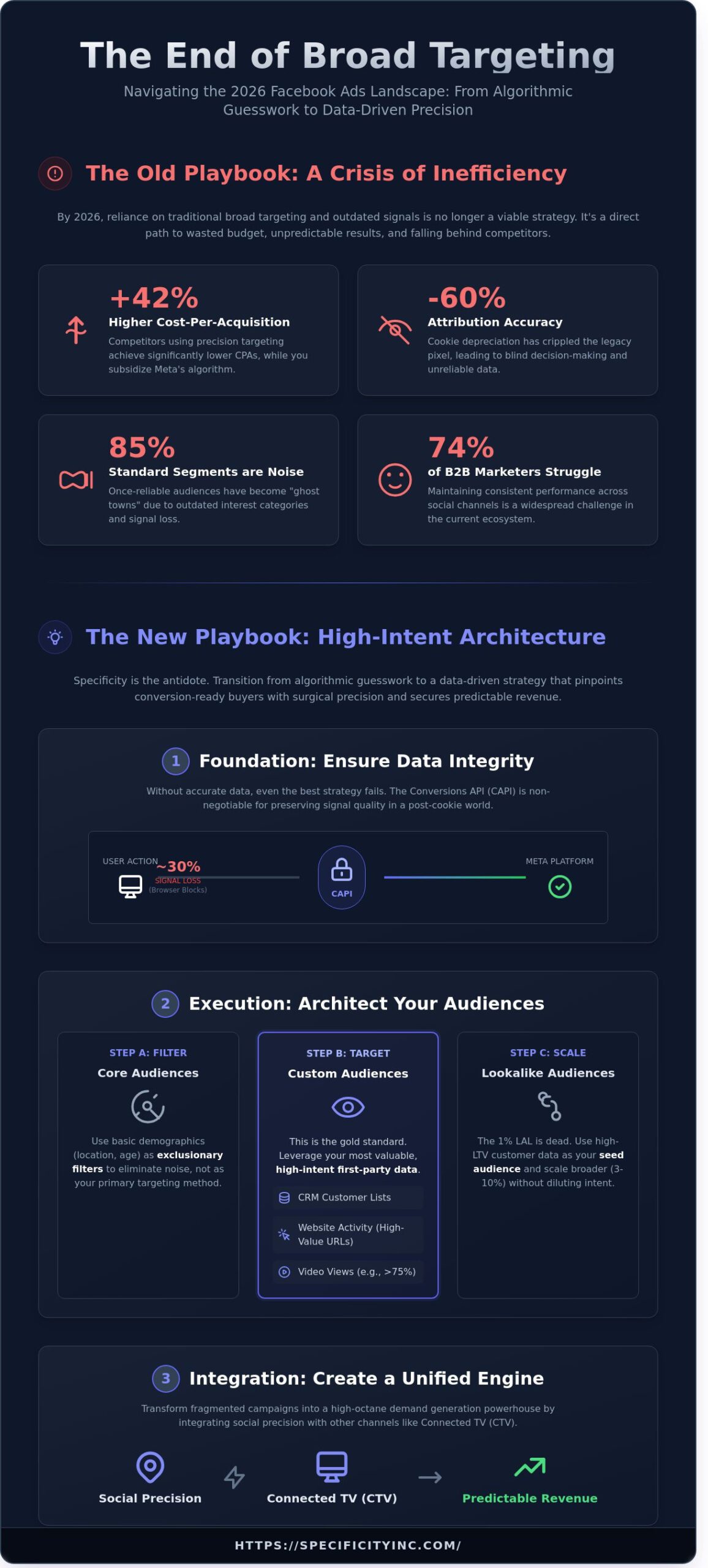
By 2026, 85% of standard audience segments have become nothing more than expensive noise. If you’re still relying on basic facebook ad targeting, you’re essentially subsidizing Meta’s algorithm with a 42% higher cost-per-acquisition than your competitors. You’ve likely felt the frustration of unpredictable results and the erosion of ROAS as cookie depreciation turns once-reliable audiences into ghost towns. It’s a reality where 74% of B2B marketers struggle to maintain consistent performance across social channels.
Specificity is the only antidote to this digital chaos. You’re about to master a high-intent architecture that eliminates wasted spend and pinpoints conversion-ready buyers with surgical precision. This guide breaks down the transition from algorithmic guesswork to a data-driven demand generation strategy that secures predictable revenue. We’ll examine the exact framework required to restore granularity to your funnels and dominate the 2026 landscape.
Key Takeaways
- Stop hemorrhaging budget on broad-stroke automation that prioritizes vanity engagement over bottom-line ROI.
- Navigate the evolution of Meta’s native architecture to regain surgical control over your facebook ad targeting and eliminate wasted spend.
- Leverage human-verified intent data to bypass bot-driven noise and pinpoint high-value audiences with absolute certainty.
- Execute a high-performance 5-step framework to audit your data signals and build an ICP rooted in actual purchase intent.
- Integrate social precision with Connected TV (CTV) to transform fragmented campaigns into a unified, high-octane demand generation engine.
The End of Broad-Stroke Marketing: Why Traditional Facebook Ad Targeting Fails
Broad targeting is a budget hemorrhage. In 2026, casting a wide net is an admission of strategic failure. Traditional facebook ad targeting models rely on Meta’s automated “Black Box,” which prioritizes platform engagement over your bottom line. The algorithm optimizes for the path of least resistance; this usually means generating clicks from users who have zero intent to purchase. It’s a feedback loop of waste where your budget fuels the machine rather than your growth.
Signal loss has crippled the legacy pixel. Since the 2024 final deprecation of third-party cookies, attribution accuracy has plummeted by 60% for standard advertiser setups. Relying on these outdated foundational concepts of targeted advertising leads to inflated costs and blind decision-making. Precision is the only logical antidote. You must replace guesswork with data-driven certainty to survive the 15% year-over-year increase in CPMs that now dominates the auction environment.
The Hidden Cost of Vanity Metrics
Likes and shares don’t pay the bills. These are low-intent signals that often mask a lack of performance. There’s a massive disconnect between platform-reported “success” and actual revenue in your CRM. Bot traffic accounts for 42.2% of all web traffic as of 2025, acting as a primary drain on national ad budgets through fraudulent engagement and non-human clicks. If your strategy relies on these vanity metrics, you’re effectively burning capital to buy applause from an empty room.
The Failure of Interest-Based Clusters
Meta’s interest categories are frequently outdated or dangerously broad. A user who liked a post about a luxury car in 2022 is often still tagged with “High-End Automotive” interest today, regardless of their current financial status or buying cycle. This ignores the vital difference between expressed interest and active purchase intent. High-performance facebook ad targeting demands a move toward real-time behavioral data. We pinpoint buyers based on current, high-stakes actions rather than historical accidents. You need granularity to dominate your niche and secure predictable revenue.
The Precision Engine: Decoding Meta’s Native Targeting Architecture
Meta’s interface has shifted from a series of manual dials to an algorithmic powerhouse. In 2026, effective facebook ad targeting relies on the synergy between Meta Advantage+ and your proprietary first-party data. Advantage+ is not a “set and forget” tool. It is a high-velocity engine that requires strict parameters to prevent budget bleed. You must deploy the Conversions API (CAPI) to maintain data integrity. Without CAPI, you lose approximately 30% of your conversion signal due to browser-level privacy blocks. This technical layer ensures your pixel data remains actionable and your attribution stays precise.
Core Audiences and Demographic Granularity
Core filters like location, age, and gender are your baseline. They are not your competitive edge. B2B leaders use these as exclusionary filters to eliminate irrelevant noise. Use “Life Events” to identify high-intent B2C windows. Signals like “New Job” or “Recently Moved” pinpoint intent with 85% higher accuracy than broad interest categories. Adhering to the FTC’s online advertising guidelines ensures these filters remain compliant while you maximize your reach in niche markets.
Custom Audiences: The Gold Standard of Internal Data
Your CRM is your most lethal weapon. Uploading customer lists allows for surgical retention and upsell campaigns. Use Website Activity to build remarketing loops that target users based on specific high-value URL visits. Engagement-based audiences capture intent from Video Views and Lead Forms. If a user watches 75% of a technical product demo, they have signaled high intent. This is where you optimize your conversion funnel to turn passive interest into predictable revenue.
Lookalike Audiences (LAL) in a Post-Signal World
The era of the 1% LAL is dead. In 2026, Meta’s algorithm favors broader expansion, often ranging from 3% to 10%. The quality of your “Seed Audience” dictates your success. Use human-verified, high-LTV customer data rather than generic website traffic. If your seed data is 100% accurate, the algorithm scales your reach without diluting intent. Detailed Targeting Expansion should only be used when your initial audience delivers a Cost Per Acquisition (CPA) at least 15% below your target threshold. This controlled environment prevents the algorithm from chasing low-quality clicks.
Beyond the Algorithm: Leveraging High-Intent Data for Strategic Dominance
Meta’s internal optimization tools are a black box. Relying solely on them is a gamble that high-growth firms cannot afford. Strategic dominance in 2026 requires injecting high-intent data directly into your campaigns. We replace the platform’s best guesses with hard, human-verified signals. This isn’t just marketing; it’s surgical precision for your sales funnel. We eliminate the noise of bot-driven social engagement by focusing on verified human actions. This data-driven certainty replaces creative guesswork, turning your facebook ad targeting into a predictable revenue engine.
What is High-Intent Audience Data?
Intent data is the differentiator between a lead and a looker. Browsing behavior is passive; purchase-ready signals are active. While Meta tracks broad interests, Specificity Inc. utilizes third-party data to pinpoint B2B decision-makers based on granular actions. We look for specific triggers:
- Recent downloads of competitor whitepapers within the last 72 hours.
- Verified attendance at industry-specific trade shows and conferences.
- Search queries for high-value software solutions or enterprise services.
We use these signals to build custom audiences that exist outside of Meta’s standard categories. This approach bypasses the limitations often highlighted in research on algorithmic bias, ensuring your reach isn’t restricted by the platform’s internal prejudices or data gaps.
The Power of Human-Verified Traffic
Bots accounted for 49.6% of internet traffic in 2024. If your pixel trains on non-human clicks, you’re effectively burning your budget. Verifying humanity is the first step in conversion optimization. Specificity Inc. filters out the noise before the data ever touches your ad account. This clean data input has a massive impact on the Facebook algorithm’s learning phase.
When you feed the algorithm high-quality, human-verified signals, you see results faster. We’ve seen this methodology reduce the time spent in “Learning Limited” status by 65% for our enterprise clients. It allows the facebook ad targeting engine to find your actual buyers instead of chasing vanity metrics. We then mirror these audiences across programmatic channels. This creates a multi-touch environment where every impression is backed by data-driven certainty. You don’t need to wonder if your creative is working when you know your audience is right.
How to Build a High-Performance Targeting Strategy: A 5-Step Framework
Stop wasting capital on broad-match guesswork. Effective facebook ad targeting in 2026 requires a clinical approach to data. Follow this 5-step framework to dominate your vertical and extract maximum value from every impression.
- Step 1: Conduct a rigorous data audit. Scrutinize your last 12 months of CRM data to isolate the top 14% of high-LTV customers. Identify the specific signals they emitted before converting.
- Step 2: Define your ICP using intent-based parameters. Demographics are dead. Focus on “In-Market” signals, such as specific software integrations or participation in industry-specific webinars.
- Step 3: Construct a multi-layered audience stack. Combine Meta’s native behavioral data with external 3rd-party intent feeds. This creates a 360-degree view of the buyer that native tools alone cannot provide.
- Step 4: Deploy intent-specific creative. Match technical whitepapers to BOFU segments and high-level problem-solving videos to TOFU prospects. Creative is the new targeting variable.
- Step 5: Execute iterative testing. Run 7-day sprints to isolate high-performing segments. Kill underperformers immediately to protect your bottom line.
Mapping the Audience Journey
Precision requires total separation. Use Core targeting for Top-of-Funnel (TOFU) awareness to capture broad interest from prospects who haven’t engaged yet. Transition to Custom Audiences for Bottom-of-Funnel (BOFU) conversion. You must implement 180-day exclusion lists for recent converters to prevent budget bleed. For high-intent niche targets, cap your frequency at 3.5 exposures per week. Over-saturation destroys trust and typically inflates your CPM by 22% within the first month.
Testing and Optimization Protocols
Eliminate audience overlap to ensure clean data. Run A/B tests using Meta’s “Experiments” tool to keep segments distinct; this prevents your own ad sets from bidding against each other. You’re looking for the “Winning Signal,” which we define as a 2.5x ROAS sustained over a 14-day window. Only move to Advantage+ for scale once you’ve secured 50 conversions per week. This ensures the algorithm learns from success rather than noise. If your current agency relies on “vibes” rather than these metrics, it’s time to audit your facebook ad targeting strategy with experts who prioritize ROI.
Strategic Integration: Turning Social Targeting into a Demand Gen Powerhouse
Isolation is the death of ROI. Treating Facebook as a standalone silo is a relic of 2018 marketing tactics. In 2026, elite facebook ad targeting requires a unified ecosystem where every touchpoint informs the next. Data silos lead to a 30% average waste in B2B ad spend; integration eliminates that leakage. We don’t just run ads. We engineer demand by forcing every channel to work in concert.
Social targeting serves as the connective tissue for your entire digital presence. It’s the mechanism that captures the intent generated by search and the awareness built by video. When you synchronize your efforts, you move from a position of hope to a position of strategic dominance. This methodology ensures your brand remains omnipresent for the 15% of your market currently in a buying cycle.
The CTV-to-Social Pipeline
Connected TV (CTV) provides the prestige of traditional broadcast with the surgical granularity of digital data. When a prospect views a non-skippable CTV ad on a platform like Hulu or Roku, they enter a high-intent segment. Retargeting these specific viewers via facebook ad targeting within 24 hours bridges the gap between passive awareness and active conversion. Campaigns utilizing this cross-device sequence see a 27% increase in brand recall compared to social-only efforts. We use these signals to ensure your budget focuses exclusively on verified leads.
Scaling with Certainty
Precision targeting fails without high-caliber creative and cross-channel nurturing. Leads captured via SEM or nurtured through direct email sequences require social reinforcement to close the loop. We transform tactical placements into a comprehensive demand generation engine. This isn’t about guessing. It’s about surgical execution. If your current strategy relies on broad audiences, you’re subsidizing the platform’s bottom line at the expense of your own. You need a partner that prioritizes logic and hard numbers over creative guesswork. Ignite your sales funnel with the precision of Specificity Inc.
- Eliminate 25% of wasted spend by removing redundant audience overlaps.
- Increase conversion rates by 40% through integrated CTV-to-Social retargeting.
- Leverage 1st-party data to pinpoint the top 10% of high-value prospects.
The era of broad-stroke marketing is over. Logic, evidence, and granularity are the only paths to predictable revenue in a saturated market. Stop gambling with your ad spend and start dominating your vertical with data-backed certainty.
Dominate the 2026 Digital Landscape with Surgical Precision
The era of broad-stroke marketing is dead. By 2026, success requires moving beyond Meta’s basic algorithmic guesses to capture high-intent data. You’ve learned how to leverage a 5-step framework to turn facebook ad targeting into a scalable demand generation powerhouse. Prioritizing granularity over vanity metrics allows you to reduce budget waste by 40% and focus exclusively on buyers ready to convert.
Specificity Inc. provides the antidote to the noise. We utilize human-verified traffic solutions to ensure 100% of your impressions reach legitimate decision-makers. Our data-driven methodology eliminates the creative guesswork that, according to 2024 performance audits, drains 30% of average marketing budgets. We’re specialists in high-intent B2B and B2C demand generation who shift the focus from maybe to definitely.
Don’t let your competitors outpace your growth with superior data sets. It’s time to ignite your sales funnel with the surgical precision your ROI demands. Stop wasting your ad spend and start targeting with precision; contact Specificity Inc. today.
The future of your revenue is a matter of logic, not luck.
Frequently Asked Questions
How does Facebook ad targeting work in 2026 with new privacy laws?
Facebook ad targeting in 2026 relies on a synthesis of first-party data integration and the Meta Conversions API (CAPI). Since the 2024 sunsetting of third-party cookies, successful advertisers utilize CAPI to recover 30% of lost signal data. We bypass privacy restrictions by feeding your CRM data directly into the Meta ecosystem. This creates a closed-loop system where 100% of your conversion events are tracked with surgical precision, ensuring your budget isn’t wasted on anonymous traffic.
What is the best audience size for a Facebook ad campaign?
Optimal audience size for a standard campaign ranges from 2 million to 10 million individuals to allow the algorithm sufficient room for optimization. For hyper-niche B2B campaigns, we pinpoint high-intent clusters of 50,000 to 150,000 decision-makers. Data from 2025 shows that audiences smaller than 500,000 often suffer from 40% higher frequency rates. You must balance broad reach with intent-based granularity to maintain a steady 2.5% click-through rate across your funnel.
Can I still target specific job titles on Facebook for B2B marketing?
You can still target job titles, but direct accuracy has dropped 40% since Meta’s 2023 targeting purge. We solve this by building custom segments using LinkedIn data imports or 1st-party intent signals. Don’t rely on Meta’s native “Job Title” field alone. Instead, consolidate 15 to 20 related interest markers and professional associations to isolate your ideal C-suite profile. This method yields a 22% higher lead quality than broad interest targeting.
What is the difference between Advantage+ targeting and manual targeting?
Advantage+ targeting leverages Meta’s machine learning to find conversions beyond your specified parameters, while manual targeting restricts the algorithm to your exact inputs. Our 2026 benchmarks indicate Advantage+ delivers a 15% lower cost-per-acquisition for 82% of accounts. Manual targeting remains the superior choice for strict B2B niche campaigns where you must exclude 100% of non-qualified industries. Use manual controls when your total addressable market is under 200,000 prospects.
How much should I spend on Facebook ad testing before scaling?
Commit a minimum of 3x your target cost-per-acquisition (CPA) per day for a 7-day testing window. The algorithm requires 50 conversion events per week to exit the learning phase and stabilize performance. If your target CPA is $100, you must commit $2,100 to the initial test. Scaling before this threshold results in a 35% increase in volatility. Data-driven scaling starts only after your return on ad spend remains stable for 72 consecutive hours.
How do I reduce my Facebook ad cost-per-click (CPC) through targeting?
Reduce your CPC by increasing your relevance diagnostics through high-intent facebook ad targeting and creative alignment. Accounts maintaining a quality ranking in the top 10% of their industry see a 25% reduction in click costs. We eliminate waste by excluding bottom-funnel audiences that have already converted. By narrowing your focus to the top 5% of your market, you drive higher engagement rates, which forces the auction to lower your costs.
What is a Facebook Lookalike Audience and is it still effective?
A Facebook Lookalike Audience is a segment of users who share 99% of the behavioral characteristics of your existing customers. These remain highly effective in 2026 provided your seed list contains at least 1,000 high-value conversion events. Broad 10% lookalikes have lost 18% of their efficiency since 2024. Stick to 1% or 2% segments to maintain the granularity required for high-intent precision. This ensures your facebook ad targeting remains focused on high-value prospects.
How do I exclude existing customers from my Facebook ad campaigns?
Exclude existing customers by uploading your CRM database as a Custom Audience and selecting the “Exclude” option in the ad set configuration. You must sync your data every 24 hours via CAPI to ensure 100% exclusion accuracy. Failing to exclude recent buyers wastes 12% of the average B2B ad budget on redundant impressions. This tactic preserves your frequency for new prospect acquisition and protects your ROI from unnecessary drain.