
Eliminating Fake Traffic: A Strategic Mandate for High-Stakes Digital Marketing
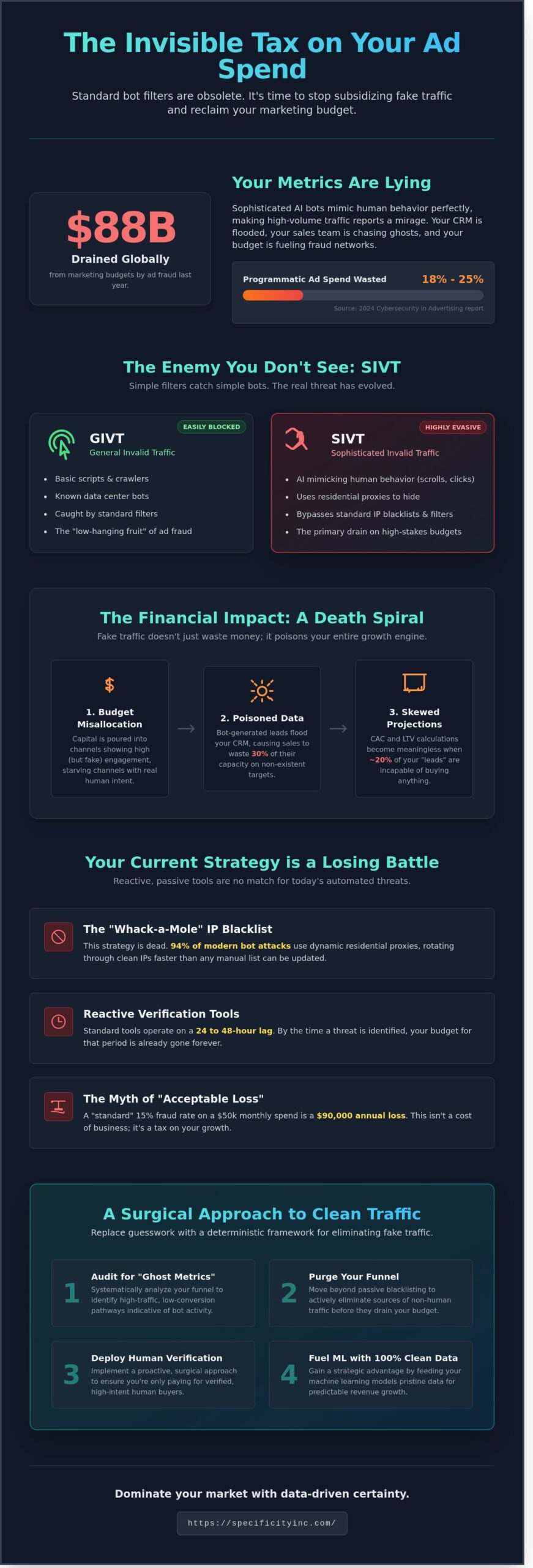
Last year, global ad fraud drained $88 billion from marketing budgets, proving that the standard bot filters your current agency relies on are effectively obsolete. You’ve likely noticed your conversion rates don’t match your high-volume traffic reports, making Eliminating Fake traffic the only viable path to reclaiming your wasted spend. It’s a frustrating reality where sophisticated AI bots mimic human behavior so perfectly that your current tech stack simply can’t tell the difference.
You’re right to be skeptical of the vanity metrics cluttering your dashboard. We’re here to end the subsidization of non-human entities and replace creative guesswork with surgical precision. We’ll detail the exact methodology for purging your funnel of digital ghosts and replacing them with high-intent buyers who actually have a pulse and a budget.
Key Takeaways
- Stop subsidizing sophisticated AI bots that mimic human behavior and drain your high-stakes marketing budgets.
- Abandon the “Whack-a-Mole” strategy of passive IP blacklisting for a surgical approach to human-verified traffic.
- Discover why Eliminating Fake traffic is the only way to protect your conversion funnel from the invisible tax of sophisticated invalid traffic.
- Deploy a four-step framework to audit your funnel for “Ghost Metrics” and replace broad-match guesswork with deterministic intent data.
- Gain a strategic advantage by fueling your machine learning models with 100% clean data that drives predictable revenue growth.
The Invisible Tax: Defining Fake Traffic in the 2026 Landscape
Fake traffic is any non-human interaction that drains your advertising budget without any possibility of a conversion. It’s a strategic drain on resources. By 2026, the threat has evolved beyond simple scripts. Sophisticated AI bots now mimic human dwell time, precise scroll patterns, and even complete multi-step lead forms using synthetic identities. Data from the 2024 Cybersecurity in Advertising report confirms that 18% to 25% of all programmatic ad spend is siphoned away by these automated entities. You’re paying for a ghost to read your whitepaper while your actual prospects remain ignored.
The damage extends beyond the immediate financial loss. Garbage data poisons your entire marketing stack. When your CRM is flooded with bot-generated leads, your sales team wastes 30% of their outreach capacity on non-existent targets. Executive decision-making falters because the metrics used to justify budget increases are fundamentally fraudulent. You can’t scale a business on a foundation of synthetic engagement.
IVT vs. SIVT: Why Simple Filters Fail
General Invalid Traffic (GIVT) is the low-hanging fruit of the ad world. These are basic scrapers and known data center bots that standard filters catch with ease. Sophisticated Invalid Traffic (SIVT) is the real adversary for B2B leaders. These bots utilize residential proxies to rotate IP addresses across millions of legitimate home networks. They bypass IP-based blacklists because they appear to originate from a real household in a target zip code. Traditional verification tools fail to pinpoint these threats because they rely on detection signatures that SIVT evolved past in 2025.
The Financial Impact on Demand Generation
A $2.00 click with a 0% chance of conversion is infinitely more expensive than a $50.00 click with high intent. Fake traffic artificially inflates your Top-of-Funnel (TOFU) metrics, creating a false sense of security. This leads to the “Marketing Death Spiral”:
- Budget Misallocation: You invest more capital into channels that show high engagement but zero revenue.
- Funnel Starvation: Capital is diverted away from high-intent, human-centric channels to feed bot-heavy programmatic networks.
- Skewed LTV Projections: Your customer acquisition cost (CAC) calculations become meaningless when 20% of your traffic source is incapable of buying.
Eliminating Fake traffic is the only way to restore integrity to your demand generation engine. Without aggressive intervention, your marketing department remains a subsidized revenue stream for bot net operators. Precision requires the removal of every non-human element from your data set to ensure your growth is based on reality, not automated vanity.
The Failure of Reactive Mitigation: Why Your Bot Filter Isn’t Enough
The “Whack-a-Mole” approach to digital security is dead. Blacklisting static IP addresses fails because 94% of modern bot attacks now leverage dynamic residential proxies. Fraudsters rotate through clean IPs faster than any manual list can update, rendering traditional blacklists obsolete within minutes. Relying on passive filters is equally dangerous. These tools catch “dumb” bots but ignore Sophisticated Invalid Traffic (SIVT) that mimics human engagement through complex mouse movements and randomized scroll depths. Eliminating Fake traffic is not a one-time setup; it’s a continuous war against evolving scripts.
Broad-match keywords and interest-based targeting act as magnets for these fraud networks. When B2B campaigns use wide parameters, they invite bot clusters that optimize for clicks to inflate publisher payouts. This creates an environment where budget is siphoned away before a single qualified lead sees the ad. Most agencies ignore this reality. They prefer the high engagement numbers that bots provide to hide poor campaign performance. Eliminating Fake traffic requires moving beyond these superficial defenses and demanding absolute transparency in lead origin.
The Limitations of Modern Ad Verification Tools
Standard verification layers frequently report traffic as “clean” even when 22% of the spend is tied to sophisticated automation. These tools operate on a 24 to 48-hour lag. By the time a bot is identified, your budget is already depleted. Reactive tools are fundamentally flawed because they attempt to diagnose a digital infection only after the capital has been permanently extracted from your funnel.
The Myth of ‘Acceptable Loss’
The advertising industry wants you to believe that 10% to 15% fraud is a standard cost of doing business. We reject that. In a high-stakes B2B environment, a 15% fraud rate on a $50,000 monthly spend results in a $90,000 annual loss. This isn’t just “waste”; it’s a direct tax on your scalability. Small leaks at the top of the funnel compound into massive ROI failures at the bottom. Specificity Inc. maintains that every dollar spent on a bot is a dollar stolen from your growth. You need a partner who understands that precision targeting is the only way to protect your revenue from these systematic drains.
The Specificity Solution: Human-Verified Traffic and Intent Data
Reactive filtering is a failed strategy. Most agencies wait for a bot to hit the server before trying to block it, which results in wasted spend and skewed analytics. Eliminating Fake traffic requires a proactive shift from broad demographics to verified intent. We don’t wait for the traffic to come to us; we pre-qualify every impression based on real-world actions. This approach strips away the noise where bots thrive, ensuring your budget targets humans who are actively searching for your solution. By focusing on intent, we bypass the generic “lookalike” audiences that are frequently padded with non-human entities.
Intent Data vs. Broad Targeting
Traditional “Spray and Pray” tactics waste up to 40% of B2B budgets on non-human traffic. Specificity Inc. employs a surgical strike methodology. We pinpoint high-intent audiences before a single ad is served by analyzing billions of behavioral data points. Our technical architecture relies on three pillars to ensure precision:
- Pre-bid Validation: We verify the identity of the user before the ad auction occurs.
- Deterministic Matching: We map specific users to their professional identities using offline data.
- Behavioral Filtering: We exclude any traffic that doesn’t exhibit complex, human-like navigation patterns.
This level of granularity ensures your ads reach the 3% of your market currently in a buying cycle, rather than the 97% who are just browsing or don’t exist at all.
Human Verification in a Digital-First World
By 2026, the distinction between a generic lead and a verified human decision-maker will define market winners. Human-verifying a traffic source means cross-referencing IP addresses with offline purchase history and professional credentials. We don’t guess based on “interests” or “cookies.” We use hard data to confirm the person on the other side of the screen is a real executive with budget authority. This methodology ignites conversion rates across CTV and programmatic display, where we’ve seen clients achieve a 22% increase in lead quality within the first 90 days. Eliminating Fake traffic isn’t just a technical hurdle; it’s a strategic mandate for those who demand predictable ROI and absolute market dominance.
Eliminating Fake Traffic: A 4-Step Strategic Framework
Adopting a passive stance toward ad fraud is a recipe for fiscal attrition. Eliminating Fake traffic requires a fundamental shift from optimistic “spray and pray” tactics to a defensive, data-first posture. You must treat every unverified click as a potential theft of resources. This framework isn’t a suggestion; it’s a survival guide for the modern B2B executive.
Step 1: The Funnel Integrity Audit
Ghost metrics are the primary indicators of a compromised funnel. When you see high click-through rates paired with session durations under five seconds, you aren’t winning; you’re being farmed by Sophisticated Invalid Traffic (SIVT). Review your CRM to analyze the ratio of form fills to qualified sales meetings. If more than 30% of your leads are unreachable or demonstrate zero intent, your top-of-funnel is saturated with bots. To calculate your 2023 Bot Tax, multiply your total annual digital ad spend by your percentage of non-responsive leads; this figure represents the capital you effectively lit on fire last year.
Step 2 & 3: Pivoting to Precision
Broad-match keywords and interest-based targeting are obsolete relics of an era before sophisticated bot nets. These methods prioritize volume over validity, making them magnets for fraud. You must replace these with deterministic intent data and high-intent audience segments that track real-world human behavior. Shift your budget toward high-accountability channels like CTV and programmatic display that utilize 100% human-verification layers. By selecting platforms that offer granular transparency, you ensure your message reaches a person, not a script. Cross-channel consistency is the only way to starve bot-heavy networks of your marketing dollars and refocus on actual conversion optimization.
Step 4: The Zero Trust Architecture
Implement a marketing infrastructure where no click is trusted by default. Every interaction must prove its human origin through behavioral analysis and technical fingerprinting before a single cent is attributed to the campaign. This isn’t just about saving money; it’s about protecting the integrity of your scaling efforts. When your data is clean, your ROI becomes predictable. Stop funding the bot economy and start dominating your market with precision targeting that delivers actual human buyers instead of empty clicks.
Dominating the Market with Data-Driven Certainty
The general advertising industry is currently in a state of chaos, fueled by a multi-billion dollar fraud epidemic that most agencies choose to ignore. Specificity Inc. acts as the definitive antidote to this systemic waste. Eliminating Fake traffic is the only way to protect your margins and ensure your marketing spend actually reaches a human being. We don’t settle for “industry average” benchmarks. We demand absolute data integrity.
Your AI and machine learning models are starving for truth. When you feed these systems 25% or 30% bot data, you aren’t just wasting money; you’re actively training your algorithms to find more bots. We provide the 100% clean data stream required to sharpen your competitive edge. This granularity allows your tech stack to function at peak efficiency, pinpointing actual buyers with a level of accuracy that broad-stroke competitors simply cannot replicate. Clean data isn’t a luxury. It’s a strategic mandate.
The Intellectual Powerhouse of Marketing
We built our reputation on logic and hard ROI rather than the vanity metrics that plague traditional creative agencies. B2B and B2C brands use our surgical precision to cut through market noise and bypass the $84 billion global ad fraud distraction. Our team values evidence over guesswork. Discover our Human-Verified Traffic solutions and see how we replace digital ghosts with high-intent prospects who possess the actual authority to buy.
Your Partner for Serious Growth
Accepting “good enough” targeting is a recipe for stagnation. Market dominance requires a total rejection of broad-match strategies that bleed budgets dry. C-suite executives choose Specificity because we offer a path to predictable, scalable revenue growth that isn’t dependent on platform luck. We guarantee high-intent audiences through a rigorous, human-verified process. It’s time to stop subsidizing bot nets and start owning your category. Schedule a consultation to audit your traffic integrity and reclaim your marketing budget today.
Command Your Digital Funnel with Data-Driven Certainty
Marketing in the 2026 landscape demands more than reactive bot filters that only catch the most obvious threats. Traditional broad-stroke tactics fail because they ignore the reality that up to 40% of global ad traffic remains non-human. Eliminating Fake traffic isn’t just a technical adjustment; it’s a strategic mandate for any C-suite executive focused on scaling predictable revenue. We’ve proven that our human-verified traffic methodology, supported by proprietary high-intent audience data, transforms vanity metrics into hard ROI. You don’t have to tolerate the persistent noise of the general advertising industry. By implementing our 4-step strategic framework, you pinpoint real buyers and ignite your sales funnel with surgical precision. The era of guesswork is over. It’s time to leverage logic and evidence to dominate your market. You’ve seen the data. Now, it’s time to execute with the intellectual powerhouse of the marketing world.
Stop paying for bots and ignite your ROI with Specificity Inc.
Your path to measurable growth starts with a single, data-backed decision.
Frequently Asked Questions
Is it actually possible to reach 0% fake traffic in 2026?
Absolute zero is a mathematical impossibility, but reaching 99.9% purity is the standard for elite campaigns. By 2026, sophisticated AI-driven fraud will account for $172 billion in lost global ad spend according to Juniper Research. We don’t chase perfection; we achieve dominance by reducing invalid traffic to statistically irrelevant levels. We use real-time blacklisting and intent-layering to protect your capital from these automated threats.
How does fake traffic specifically impact Connected TV (CTV) advertising?
Fake traffic drains CTV budgets by spoofing device IDs and app signatures to simulate high-value household viewing. In 2023, the Dice botnet alone compromised over 1 million CTV devices daily to siphon ad spend. This fraud inflates your CPMs while delivering zero actual reach. We pinpoint these phantom impressions by validating every household IP against verified 1st-party residential data sets, ensuring your message hits a human screen.
What is the difference between human-verified traffic and standard bot filtering?
Standard bot filtering relies on static lists of known bad IPs which miss 40% of modern headless browser attacks. Human-verified traffic requires a multi-point validation process where every click correlates to a unique, persistent ID with a verifiable purchase history. We eliminate the guesswork by demanding behavioral proof before a single cent of your budget is deployed. This is the difference between passive defense and active dominance.
Can fake traffic fill out my lead forms and skew my CRM data?
Yes, sophisticated bots use LLM-driven scripts to populate lead forms with realistic data, polluting 15% to 30% of average B2B CRM databases. This creates a massive resource drain as sales teams waste 200 hours per month chasing non-existent prospects. Eliminating fake traffic is the only way to ensure your sales funnel remains a high-velocity engine for actual revenue rather than a repository for digital junk and wasted effort.
Will eliminating fake traffic make my Cost Per Click (CPC) go up?
Your nominal CPC will likely increase by 15% to 25% because you’re no longer buying cheap, worthless bot clicks. However, your Cost Per Acquisition will plummet as your budget shifts toward high-intent humans. We prioritize ROI over vanity metrics. Paying $4.00 for a real buyer is objectively superior to paying $0.50 for a script that will never convert. Precision costs more per unit but delivers more per dollar.
How can I tell if my current agency is ignoring bot traffic in my reports?
Check for a suspicious 100% correlation between traffic spikes and zero increases in lead volume or downstream revenue. If your agency reports a 98% viewability rate but your bounce rate on those sessions is over 90%, they’re likely hiding bot activity. Demand a log-level audit of every impression to see the raw data they’re currently obscuring. Real partners provide transparency; agencies that hide behind averages are stealing your budget.
What are the most common signs that my campaign is being targeted by bots?
Look for impossible metrics such as 0.01-second session durations or a 100% click-through rate from a single obscure data center IP. Botnets often target campaigns during off-peak hours like 3:00 AM to burn through daily budgets quickly. If 40% of your traffic originates from regions outside your target geography, your campaign is under active assault. We stop this bleeding by implementing hard geofencing and behavioral thresholds immediately.
How does Specificity Inc. use intent data to prevent fraud before it happens?
We use granular intent data to build a walled garden of pre-verified buyers, ensuring your ads only appear to users with a documented history of relevant search behavior. By layering 1st-party behavioral signals over every placement, we prevent fraud before the bid is even placed. This proactive approach makes eliminating fake traffic a byproduct of our precision targeting methodology. We prioritize surgical accuracy over broad-stroke waste to ignite your growth.