

Viewability Metrics vs. Human Traffic: The Executive Guide to Real ROI in 2026
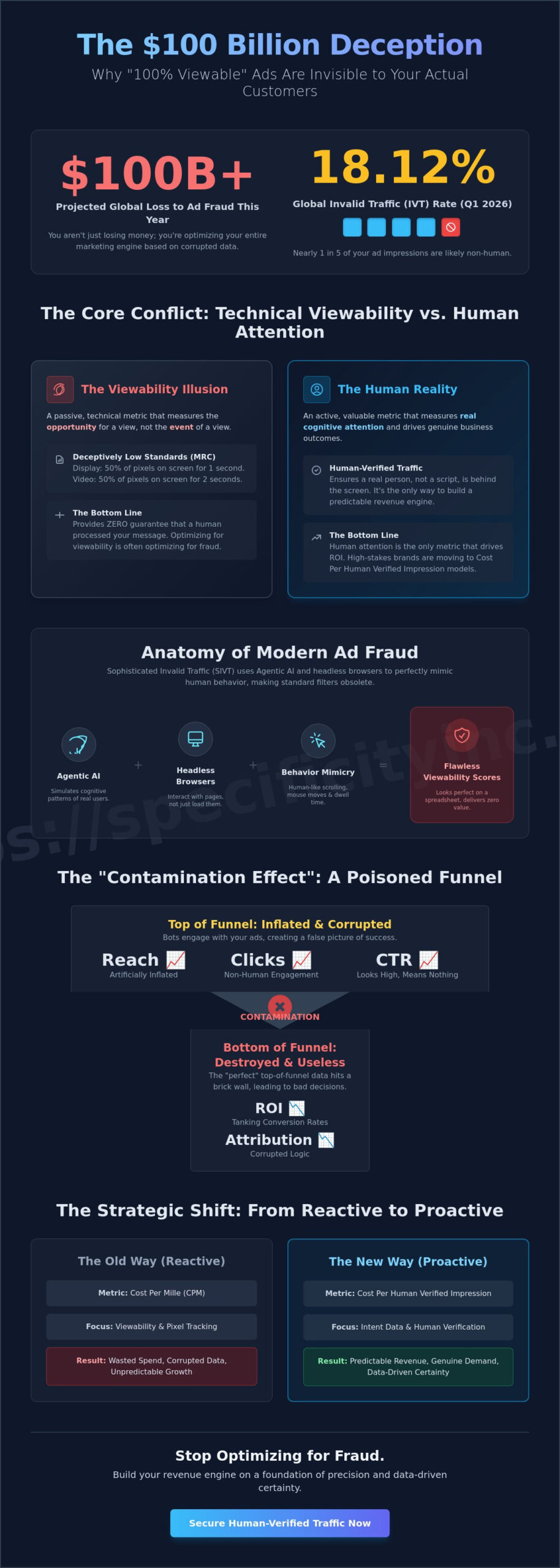
Global losses from digital advertising fraud are projected to exceed $100 billion this year, even as brands report record-high viewability scores. This paradox exists because viewability measures pixel placement, not human presence. In the first quarter of 2026, the global Invalid Traffic rate reached 18.12%. This means nearly one in five of your ad impressions is likely fueling autonomous AI agents designed to mimic human browsing patterns. If your strategy fails to distinguish between viewability metrics vs human traffic, you aren’t just losing money; you’re optimizing your entire marketing engine based on corrupted data.
You recognize that a viewable impression is a vanity metric if no human eyes ever see it. It’s time to stop accepting opaque programmatic supply chains as an unavoidable cost of doing business. This guide provides a clear, aggressive framework to audit your traffic quality and eliminate ad waste. You’ll learn how to shift your focus toward human-verified traffic and intent data targeting to build a predictable revenue engine. We’ll move past superficial metrics to establish a foundation of data-driven certainty that drives genuine demand generation.
Key Takeaways
- Learn why high viewability scores often mask fraudulent activity and how the debate of viewability metrics vs human traffic determines if your funnel’s data is actually usable.
- Identify the mechanics of Sophisticated Invalid Traffic (SIVT) that allow bots to bypass standard platform filters by mimicking human scrolling and dwell time.
- Recognize the “Contamination Effect” where non-human traffic inflates top-of-funnel metrics while it’s silently destroying your bottom-line conversion rates and attribution accuracy.
- Transition from reactive fraud detection to a proactive, human-verified traffic strategy that doesn’t just track pixels but prioritizes real intent data.
- Build a predictable revenue engine by architecting a multi-channel framework focused on precision, exactness, and data-driven certainty.
The Viewability Illusion: Why 100% Viewable Does Not Mean 100% Human
The industry standard for a Viewable impression is deceptively low. According to Media Rating Council (MRC) standards, a desktop display ad is considered viewable if 50% of its pixels are on screen for just one continuous second. For video, the threshold is two seconds. These metrics were designed to measure technical delivery, not human consumption. They provide zero guarantee that a person actually processed your message. In 2026, relying on these benchmarks alone is a strategic failure. Viewability is a passive metric. It tracks the opportunity for a view, not the event of a view.
The “Viewability Illusion” occurs when high-performance bots exploit these technical definitions. Sophisticated scripts now simulate human scrolling patterns, mouse movements, and variable dwell times. They trigger viewability sensors with surgical precision. This allows fraudulent operators to sell inventory that looks perfect on a spreadsheet but offers zero commercial value. If you don’t prioritize the distinction between viewability metrics vs human traffic, you’re essentially donating your budget to bot farms. Technical viewability lacks the one thing that drives ROI: human cognitive attention.
The Technical Gap Between Pixels and People
Modern bot farms utilize headless browsers and Agentic AI to achieve flawless viewability scores. These autonomous entities don’t just load a page; they interact with it. They mimic the cognitive patterns of a real user, making them nearly indistinguishable from humans to standard verification tools. The evolution of ad fraud has moved far beyond simple click-bots. Today, fraud is behavioral. By the first quarter of 2026, the global Invalid Traffic (IVT) rate reached 18.12%, proving that “pixel-on-screen” metrics are no longer sufficient. You need verification that proves a human, not a script, is behind the screen. Without this layer of certainty, your data is a hallucination.
Why High-Stakes Brands Are Moving Beyond Standard Metrics
Elite organizations are abandoning traditional cost-per-thousand (CPM) models in favor of cost per human verified impression. Superficial metrics lead to executive-level miscalculations. When you optimize for viewability without filtering for humanity, you’re optimizing for fraud. This creates a feedback loop of wasted spend. Strategic dominance in the programmatic display landscape requires a rejection of broad-stroke industry tactics. High-stakes growth demands exactness. It requires shifting your spend toward human verified traffic to ensure every dollar fuels genuine demand generation. Only by securing human-verified traffic can you build a predictable revenue engine that scales with logical certainty.
The Contamination Effect: How Non-Human Traffic (NHT) Destroys ROI
Non-human traffic (NHT) is a silent toxin in your marketing ecosystem. It creates a “Contamination Effect” that renders your strategic data useless. When bots engage with your ads, they inflate top-of-funnel metrics like reach and click-through rates. However, these metrics eventually hit a brick wall at the conversion stage. This discrepancy is the fundamental flaw when analyzing viewability metrics vs human traffic. While an ad might be “viewable,” its failure to convert reveals the non-human reality. This disconnect depresses your overall ROI and hides the true performance of your human-facing channels. Executive leadership must demand a granular breakdown of viewability metrics vs human traffic to identify where the contamination begins.
The industry often underestimates the scale of this issue. As noted in Ad Fraud: The Biggest Threat To The Advertising Industry, the sophistication of invalid traffic makes detection a moving target. This fraud doesn’t just steal budget; it corrupts the logic of your entire growth strategy. When your data is poisoned, digital advertising appears less effective than it actually is. You lose the ability to see which creative or channel is truly resonating with your market. This leads to a defensive posture where teams cut spend on viable channels because the data suggests they aren’t performing, when in reality, they’re simply being drowned out by bot activity.
Skewing the Marketing Mix Model (MMM)
Marketing Mix Modeling relies on clean inputs to determine budget allocation. When bot activity inflates the perceived efficiency of a channel, the model incorrectly recommends more spend there. You end up chasing “ghost” performance. This pulls down the actual ROI of the entire campaign because you’re diverting funds away from high-performing human audiences. Strategic miscalculation is the inevitable result of NHT-driven data. Catastrophic budget misallocation occurs when algorithms optimize for bot-heavy environments that appear statistically efficient but are commercially dead.
The Erosion of Audience Data Integrity
The damage extends to your long-term audience data and retargeting pools. When a bot mimics human behavior, your tracking systems tag it as a high-intent prospect. You then spend additional capital retargeting a script that will never buy. This pollutes your intent data segments and destroys the precision of your demand generation engine. Over time, your entire CRM can become a graveyard of non-human signals, making it impossible to predict future revenue. Reclaiming your strategy requires purging these non-human signals to protect your brand safety and audience integrity. Shifting to human verified traffic is the only way to ensure your retargeting efforts are focused on real opportunities rather than digital noise.
Sophisticated Invalid Traffic (SIVT) vs. Human Verification
The distinction between General Invalid Traffic (GIVT) and Sophisticated Invalid Traffic (SIVT) is the baseline for strategic dominance. GIVT is rudimentary. It consists of known crawlers and data center traffic that standard platform filters identify with ease. SIVT is the real threat. It is engineered to mimic human behavior, bypass detection, and exploit the gap between viewability metrics vs human traffic. In 2026, SIVT is no longer just a nuisance; it is a sophisticated industry of its own that drains billions from high-performance campaigns. If your team treats all invalid traffic as a single bucket, you’re missing the most dangerous leak in your funnel.
The Anatomy of Sophisticated Invalid Traffic (SIVT)
SIVT utilizes hijacked devices, residential proxies, and advanced ad-stacking techniques to mask its true nature. These bots don’t just load a page. They scroll, pause, and move cursors to trigger viewability sensors with surgical precision. This creates a perfect technical profile that fools most legacy verification vendors. Because SIVT specifically targets high-value inventory in B2B and CTV environments, the ROI destruction is immediate and severe. Reactive bot mitigation fails because it addresses the problem after the budget has been spent. Traditional filters are often blind to Agentic AI entities that can navigate complex funnels. You can’t win a high-stakes growth war using reactive tools that only identify fraud in the rearview mirror.
Human-Verified Logic: The Antidote to Ad Waste
Broad programmatic tactics rely on superficial audience segments and hope for the best. This is guesswork, not strategy. We replace this uncertainty with the exactness of human verified traffic. This shift moves your operations from automated filtering to proactive audience targeting. By integrating intent data, we validate the human identity of a decision-maker before the ad serves. This ensures that every dollar is deployed against a verified person with a documented interest in your solution. We don’t just filter out the bad; we verify the good.
This methodology is the only logical choice for businesses seeking predictable revenue. It cuts through the noise of the broader market by focusing on real intent rather than technical delivery. When you prioritize human verified traffic over simple viewability scores, you reclaim control of your demand generation engine. You stop paying for impressions and start investing in human outcomes. The choice between viewability metrics vs human traffic is no longer optional; it is the prerequisite for scaling in a fraud-saturated landscape. This is how you achieve a level of growth efficiency that competitors using broad-stroke tactics simply cannot match.
Architecting a Human-Verified Strategy for High-Intent Demand Gen
Executing a high-performance growth strategy requires a total rejection of broad-stroke industry tactics. You can’t scale on a foundation of “maybe.” Architecting a human-verified strategy means moving beyond the passive debate of viewability metrics vs human traffic and implementing a proactive filter at the point of entry. This “Human-First” framework demands that every impression be tied to a verified identity before a bid is even placed. It’s a shift from buying inventory to buying access to real decision-makers. By centering your operations on human verified traffic, you eliminate the noise and focus purely on high-intent demand generation.
Precision data is the only tool capable of cutting through the complexity of the modern supply chain. We don’t just track pixels. We track intent. This methodology ensures that your multi-channel digital marketing isn’t just visible, but effective. When you prioritize human verified traffic, your funnel remains clean, your attribution stays accurate, and your revenue becomes predictable. The choice between viewability metrics vs human traffic is the difference between a vanity campaign and a high-velocity revenue engine.
Precision Targeting Across CTV and Programmatic
Connected TV advertising stands as the premier channel for this level of engagement. Unlike the open web, where bots roam with impunity, CTV offers a high-fidelity environment where household-level intent can be mapped with exactness. By utilizing strategic dominance in programmatic display, you can eliminate “ghost impressions” that look good on paper but fail to convert. Creative services must also align with these human behavior patterns. We don’t guess what might work. We use data-driven certainty to deliver messages that resonate with real humans, not scripts.
The Executive Audit: Assessing Your Current Traffic Quality
CMOs must pivot from monitoring “views” to auditing “humanity.” If your reports show 90% viewability but stagnant pipeline growth, your data is compromised. Conduct a rigorous audit of your current search engine marketing (sem) and display reports. Look for red flags, such as traffic spikes originating from cloud infrastructure like AWS, which showed a 79.24% IVT rate in early 2026. Ask your agency these three high-stakes questions:
- What percentage of our “viewable” impressions was filtered for SIVT before being recorded in our attribution model?
- Can you provide a granular breakdown of our traffic sources by infrastructure origin to identify data center anomalies?
- How are we correlating top-of-funnel clicks with verified human identity and historical intent data?
Stop settling for superficial metrics that hide ad waste. If you’re ready to purge the noise and build a predictable engine for growth, partner with an elite specialist that prioritizes human verified traffic above all else.
The Specificity Advantage: Precision Through Data-Driven Certainty
Traditional agencies thrive in the ambiguity of “industry average” performance. They hide behind vanity metrics and technical delivery scores because they lack the methodology to guarantee human engagement. Specificity Inc. is the antidote to this noise. We don’t just manage campaigns; we engineer high-velocity revenue engines built on the foundation of human verified traffic. By resolving the conflict between viewability metrics vs human traffic at the source, we ensure your budget is never a donation to bot-driven infrastructure. We replace creative guesswork with data-driven certainty.
Our commitment to exactness is non-negotiable. While the broader market accepts a 20% fraud rate as a cost of doing business, we treat it as a strategic failure. We utilize a high-stakes style of media buying that prioritizes quantitative outcomes over superficial reach. This results-oriented approach transforms your digital presence from a cost center into a predictable engine for growth. If you’re tired of paying for “viewable” impressions that never convert, you’re ready for a partnership that values logic and evidence above all else.
Dominating the Digital Landscape with Intent Data
We identify your buyers before they even reach a search engine. By leveraging intent data targeting, we map the digital journey of real decision-makers in real-time. This allows us to deploy human verified traffic across programmatic display and B2B marketing channels with surgical precision. We don’t wait for the market to come to you. We find the market where it lives and engage it with verified intent. Specificity’s methodology is the only logical choice for executive leadership seeking predictable, scalable growth in a contaminated digital landscape.
Executing with Strategic Dominance
Once we verify human presence, our creative services take over to capture and hold cognitive attention. We align your messaging with documented behavioral patterns to ensure maximum resonance. This synergy between connected TV, programmatic display, and human-verified demand gen creates a precision-engineered machine that competitors cannot replicate. We move your brand from broad, wasteful targeting to a state of strategic dominance. It’s time to stop funding the bot economy and start reclaiming your ROI with exactness.
The complexity of the programmatic supply chain shouldn’t be a mask for fraud. You deserve total transparency and a partner that understands the nuances of the 2026 digital landscape better than the competition. Request a consultation to audit your traffic quality and reclaim your ROI.
Reclaiming Strategic Dominance in a Post-Viewability Era
Relying on pixel-based benchmarks is a high-stakes gamble that most executives are losing. We’ve established that the gap between viewability metrics vs human traffic is where your budget disappears into the void of non-human activity. Sophisticated AI agents now mimic human behavior with enough precision to bypass every standard filter in the programmatic chain. If your strategy doesn’t prioritize human-verified traffic solutions and high-intent audience targeting, you’re optimizing for scripts rather than sales. Data contamination isn’t just a technical glitch; it’s a strategic threat to your attribution and long-term revenue growth.
Reclaiming your ROI requires an immediate shift toward strategic dominance in CTV and programmatic display. You need an elite specialist that understands exactness and rejects the broad-stroke tactics of the noise-filled market. It’s time to build a predictable revenue engine on a foundation of data-driven certainty rather than creative guesswork. Eliminate ad waste and secure human-verified traffic today. You now have the framework to purge the contamination and scale your demand generation with absolute confidence. Success in 2026 belongs to those who prioritize human intent over vanity impressions.
Frequently Asked Questions
What is the difference between viewability and human traffic?
Viewability is a technical measurement of pixel delivery to a screen while human traffic confirms a real person’s presence. An ad can meet all MRC standards for being “viewable” without ever being seen by a human eye. This gap is where billions in ad spend disappear. Understanding the distinction between viewability metrics vs human traffic is the first step in protecting your marketing budget from sophisticated automation.
How does non-human traffic (NHT) affect my ad campaign ROI?
NHT destroys ROI by siphoning capital into non-productive impressions and corrupting your optimization algorithms. When your data is poisoned by bot activity, your Marketing Mix Modeling suggests budget shifts toward fraudulent channels that appear efficient. This creates a cycle of waste. You lose money on the initial spend and additional funds on misguided strategic decisions based on contaminated attribution data.
Can bots trigger viewability metrics in programmatic advertising?
Sophisticated bots utilize headless browsers and Agentic AI to simulate human interactions with surgical precision. They can scroll, pause, and move cursors to trigger viewability sensors. These bots are specifically engineered to bypass standard platform filters. High viewability scores in programmatic environments are often a red flag for Sophisticated Invalid Traffic (SIVT) rather than a sign of actual campaign success.
What is human-verified traffic and why is it superior to standard filtering?
Human-verified traffic uses proactive intent data and identity validation to confirm a real person before an ad serves. Standard filtering is reactive; it attempts to identify fraud after the impression is bought. Verified traffic ensures your message reaches a documented decision-maker. This methodology provides the exactness required for predictable revenue, replacing broad programmatic guesswork with data-driven certainty and high-intent audience targeting.
Why are my viewability scores high but my conversions low?
High viewability paired with low conversions is the primary symptom of the “Viewability Illusion.” Bots are experts at being viewable but they lack the capacity to enter your sales funnel. When you prioritize viewability metrics vs human traffic, you often end up optimizing for bot-heavy inventory that delivers perfect technical scores but zero commercial value. Real ROI requires shifting your focus from pixel delivery to human engagement.
How can I tell if my B2B demand generation campaigns are being hit by bots?
Look for high traffic volumes originating from data centers and cloud infrastructure, which often show IVT rates exceeding 79%. Another indicator is a high click-through rate that fails to produce a corresponding increase in pipeline velocity. If your top-of-funnel metrics are booming while your sales team reports a lack of qualified leads, your B2B demand generation engine is likely contaminated by sophisticated bot activity.
Is viewability a reliable metric for Connected TV (CTV) advertising?
Viewability in CTV is a baseline technical requirement, not a guarantee of attention. While an ad may play on a screen, it doesn’t confirm a human is in the room or watching. Fraudsters exploit the high CPMs of CTV inventory by using device spoofing and server-side ad insertion manipulation. You must look beyond simple playback metrics to verify that your ads are reaching real households with documented intent.
What steps should I take to purge invalid traffic from my marketing data?
Start with a rigorous audit of your traffic sources to identify infrastructure-level anomalies. Demand transparency from your programmatic partners regarding their SIVT detection methodologies. Transition your budget toward channels that utilize human-verified traffic and intent data targeting. Finally, purge non-human signals from your retargeting pools to ensure your demand generation engine is built on a foundation of real, verified human behavior.