Why Is My Ad CPA So High? The Shift to Intent-Based Targeting in 2026
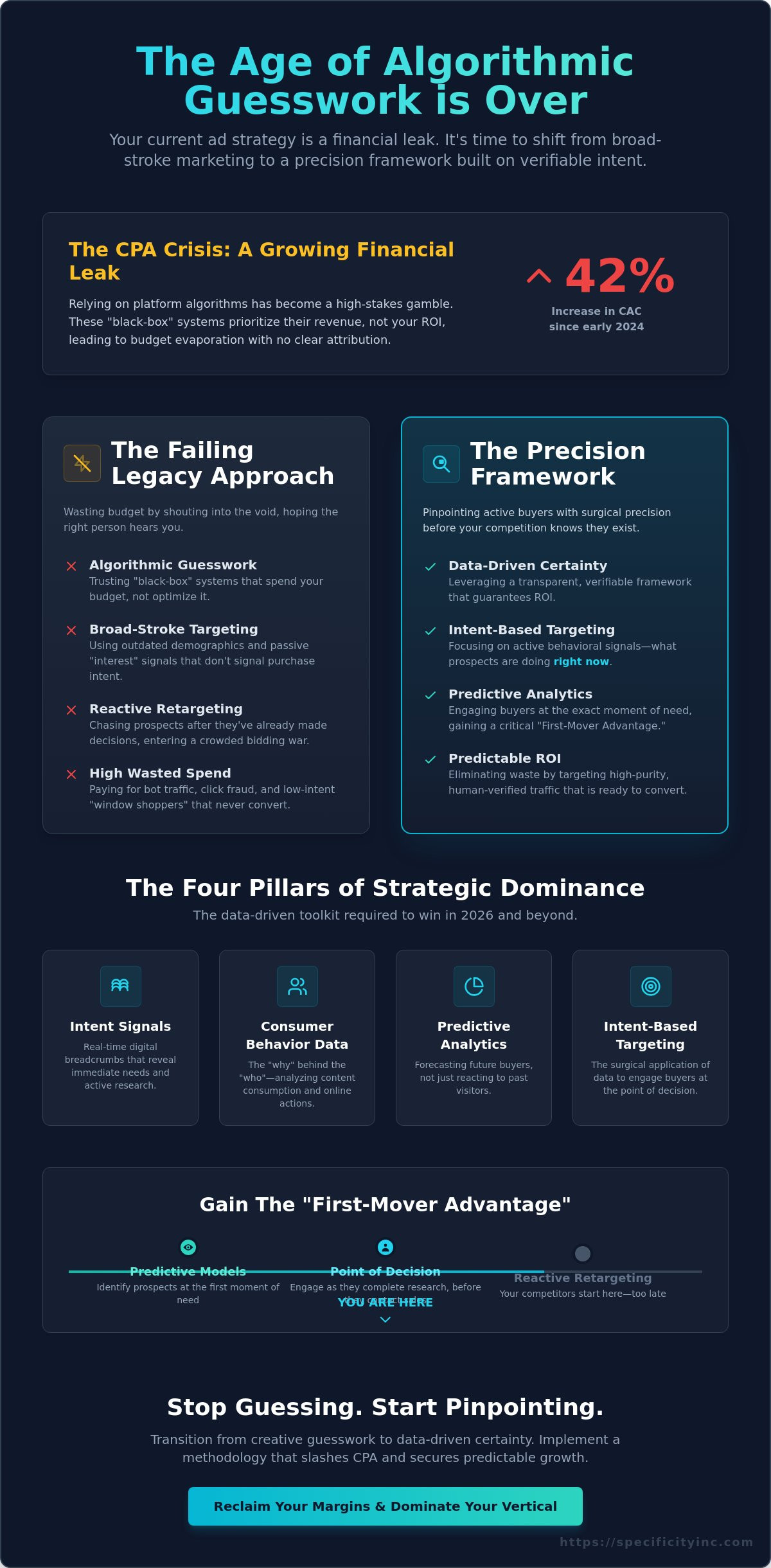
Your current advertising strategy is a financial leak that likely increased your customer acquisition costs by 42% since early 2024. The era of trusting platform algorithms to find your audience is over. These systems prioritize their own ad revenue while you’re forced to absorb the cost of bot traffic and low-intent clicks that never convert. You’ve felt the fatigue of chasing moving targets, yet your budget continues to evaporate into the digital void without clear attribution or surgical precision.
Specificity Inc. doesn’t guess. We pinpoint. We’ll show you how to eliminate wasted spend by leveraging intent signals, consumer behavior data, predictive marketing analytics, and intent based targeting to identify active buyers before your competition even knows they’re in-market. This isn’t about creative guesswork; it’s about strategic dominance. We’re moving past the noise of broad-stroke marketing to deliver a scalable, data-driven framework that slashes CPA and secures predictable ROI. This guide outlines the exact shift required to reclaim your margins and dominate your vertical as we head into 2026.
Key Takeaways
- Stop burning budget on broad-stroke tactics and learn why the death of the cookie has rendered traditional platform algorithms ineffective for your ROI.
- Dominate your market by utilizing intent signals, consumer behavior data, predictive marketing analytics, and intent based targeting to identify active buyers before they even define their requirements.
- Gain the “First-Mover Advantage” by shifting from reactive retargeting to predictive models that pinpoint prospects at the exact moment of need.
- Discover a precision framework for sourcing high-purity, human-verified intent data that eliminates the waste and noise of the general advertising industry.
- Transition from creative guesswork to data-driven certainty by implementing a methodology that prioritizes high-intent CTV and programmatic display for predictable growth.
The CPA Crisis: Why Broad-Stroke Marketing Fails in 2026
The era of easy digital wins is over. If your cost per acquisition (CPA) is climbing, it’s because the tools you’ve relied on for a decade are now working against you. The complete deprecation of third-party cookies has blinded traditional targeting. This data vacuum forced major platforms to retreat into “walled gardens” where they control the narrative and the metrics. They’ve replaced transparency with black-box algorithms that prioritize platform reach over your ROI. This isn’t a minor market correction; it’s a fundamental failure of broad-stroke marketing.
Algorithms are designed to spend your budget, not save it. When you use legacy interest-based targeting, you’re entering a high-stakes bidding war for users who haven’t shown any real intent marketing indicators. Interest is a passive metric. It doesn’t signal a purchase. Relying on it ensures you’re paying premium prices for low-intent “window shoppers.” To win in 2026, you must pivot to intent based targeting rooted in actual consumer behavior data. Precision is the only antidote to the rising cost of digital noise.
The Hidden Cost of Algorithmic Guesswork
Platforms like Meta and Google don’t admit when they lack data. They “fill the gaps” with lookalike audiences. These are statistical guesses that lack the specific intent signals required for conversion. You’re effectively paying for clicks from users who are merely browsing. This waste compounds quickly. You can see the math behind this wasted spend in this Digital Advertising ROI guide. Without predictive marketing analytics, you’re subsidizing the platform’s growth at the expense of your own margins. Guesswork is a luxury your balance sheet can no longer afford.
Market Saturation and the Noise Floor
The noise floor has never been higher. In 2026, the average consumer encounters over 10,000 digital touchpoints every single day. Broad ads have become invisible. There’s a direct, measurable correlation between high CPA and a lack of audience granularity. If your targeting isn’t surgical, it’s ignored.
- Broad-stroke ads fail to penetrate the “attention shield” of modern consumers.
- High-intent users are buried under a mountain of irrelevant content.
- Human-verified traffic is the only defense against bot farms and click fraud.
Precision isn’t a luxury anymore. It’s the only way to ensure your budget isn’t fueling a machine that doesn’t care about your bottom line. You don’t need more reach; you need more relevance.
Intent Signals: The New Currency of Consumer Behavior Data
Demographics are a relic of 2015. In 2026, knowing a prospect’s age or job title is insufficient; it’s static data in a dynamic market. Intent signals are the real-time digital breadcrumbs that reveal an immediate, pressing need. These signals represent the pulse of consumer behavior data. They tell you exactly what a prospect is doing right now, not who they were three years ago. While your competitors target “CEOs at mid-sized firms,” we target the CEO who just spent 40 minutes researching your specific solution on a niche industry forum. You shouldn’t settle for “who” when you can target “why.”
Traditional marketing forces you to waste capital on the awareness stage. This is a strategic error. According to 2024 industry benchmarks, 68% of the B2B buyer’s journey is completed before a prospect even talks to sales. Intent based targeting allows you to bypass the noise and engage users at the point of decision. By the time they reach a search engine, you should already be their top choice. You can leverage precision targeting to build a first-party data fortress that protects your ROI from the volatility of broad-stroke platforms. This approach turns your marketing budget into a weapon rather than a gamble.
Active vs. Passive Intent
Active intent is loud; it’s a search query or a direct site visit. Passive intent is the silent behavior that precedes the sale. It includes consuming specialized content, downloading whitepapers, or participating in technical forums. We capture these signals from third-party sites and B2B publications to identify buyers before they enter the open market. Specificity Inc. pinpoints these signals to ignite demand before the competition even realizes there is a lead to chase. We don’t wait for the search; we anticipate it. This is how you dominate a vertical.
Aggregating High-Granularity Data
Tracking in-market behavior across the open web requires sophisticated predictive marketing analytics. B2B marketing demands a higher level of granularity than B2C. We analyze firmographics, job changes, and departmental shifts to ensure your ads hit the right desk. Since early 2024, the industry has seen a massive move toward this technical depth. You can explore the mechanics of this in our analysis of the B2B Marketing strategic shift. This methodology replaces guesswork with surgical precision; ensuring every dollar spent is an investment in a high-intent lead. Logic dictates that precision wins every time.
Predictive Marketing Analytics vs. Reactive Retargeting
Reactive retargeting is a post-mortem strategy. It relies on the hope that a user who already left your site will suddenly develop the conviction to return and convert. This is marketing in the rearview mirror. Predictive marketing analytics flips this dynamic by identifying high-value prospects before they ever reach your domain. You aren’t chasing ghosts; you’re engineering arrivals.
The “First-Mover Advantage” is the difference between winning a contract and losing a bidding war. When you reach a prospect while they’re still defining their requirements, you dictate the criteria for the sale. Waiting for a lead to fill out a form is the most expensive way to acquire a customer. By that point, the prospect has likely engaged with three or four competitors; your CPA is inflated by the sheer weight of market noise. Intent based targeting allows you to bypass this competition entirely.
Modern predictive models utilize historical consumer behavior data to assign “propensity scores” to every prospect in your ecosystem. These scores aren’t guesses. They’re mathematical certainties based on thousands of data points that indicate a high probability of conversion. If a prospect doesn’t hit the threshold, they don’t get your ad spend. It’s that simple. This granularity ensures that every dollar is weaponized against a target that actually intends to buy.
Moving Upstream in the Buyer Journey
Predictive marketing is the shift from “what happened” to “what will happen.” By mapping specific intent signals to various funnel stages, you ensure your messaging hits with surgical precision. This proactive approach has been shown to reduce sales cycle lengths by as much as 25% for B2B enterprises. You’re no longer reacting to market movements; you’re anticipating them. This upstream movement ensures you’re the first brand a prospect sees when their need becomes critical.
The ROI Difference: A Comparison
The financial disparity between these two methodologies is stark. Reactive strategies result in a high CPA and low conversion purity because you’re bidding on a broad pool of “past visitors” regardless of their current intent. Predictive models immediately lower your CPA floor by filtering out non-buyers before a single cent is spent on an impression.
- Reactive: High CPA, high waste, 15% lower conversion rates, and a reliance on “hope” as a strategy.
- Predictive: Controlled CPA, high lead purity, 40% improvement in lead quality, and data-backed certainty.
Integrating these predictive insights into your Search Engine Marketing (SEM) in 2026 ensures that your brand dominates high-intent demand. You don’t need more traffic. You need the right traffic, delivered at the exact moment the buyer’s intent peaks. Logic dictates that the first company to solve the prospect’s problem wins the deal 65% of the time. Predictive analytics puts you in that position by default.
Implementing Intent-Based Targeting: A Precision Framework
Broad-stroke marketing is a relic. If your CPA is climbing, it’s because you’re paying for reach instead of relevance. Success in 2026 requires a surgical approach to intent based targeting. This framework eliminates waste by focusing spend exclusively on prospects currently in a buy-cycle. According to 2025 industry benchmarks, 68% of B2B buyers complete their research before ever engaging with a sales representative; if you aren’t visible during that silent research phase, you’ve already lost the deal.
- Step 1: Identify Behavioral Triggers. Pinpoint the exact actions that precede a purchase. In the SaaS sector, this isn’t a simple homepage visit. It’s a 45-second dwell time on a technical integration page or three distinct searches for competitor pricing within a 48-hour window.
- Step 2: Source High-Purity Intent Data. Roughly 82% of third-party data is polluted with bot traffic and outdated profiles. You must source data from verified, human-centric providers that track real-time intent signals.
- Step 3: Map Signals to Multi-Channel Execution. Deploy these signals across CTV, programmatic, and social platforms simultaneously to surround the prospect.
- Step 4: Continuous Optimization. Use 24-hour feedback loops to feed conversion data back into your predictive marketing analytics engine.
Defining Your “Ideal Buyer” Heuristics
Demographics are a distraction. Targeting “Male, 35-50” is a recipe for a bloated budget and stagnant ROI. You must target the “CEO of a $10M tech firm currently researching cloud migration tools.” This level of granularity allows you to build a Dynamic Audience that updates in real-time based on consumer behavior data. These audiences reduce ad waste by 30% because they are temporary; if a prospect stops exhibiting buying behavior, they drop out of the funnel immediately. Your creative must align with this precision. If the intent signal is “security concerns,” your ad must solve for security, not price.
Multi-Channel Orchestration
Intent data should ignite your Social Media Advertising and CTV campaigns at the same time. This creates a high-stakes narrative that follows the prospect across every professional and personal touchpoint. Measuring this impact requires moving away from flawed last-click metrics. Use attribution models that recognize the 12 to 15 touchpoints typical in a modern B2B journey. Precision isn’t just about the first click; it’s about dominating the entire path to conversion with data-driven certainty.
Stop wasting your budget on broad audiences and start targeting buyers with clinical certainty. Partner with Specificity Inc. to dominate your market.
Strategic Dominance: How Specificity Inc. Pinpoints High-Intent Audiences
Broad-stroke marketing is a relic of a less competitive era. At Specificity Inc., we reject the “spray and pray” model that inflates your CPA and drains your capital. We replace creative guesswork with surgical data-driven certainty. Our methodology doesn’t just reach people; it isolates the 3% of your market currently in a buy cycle. We achieve this by layering intent signals, consumer behavior data, predictive marketing analytics, and intent based targeting into a single, cohesive strike force.
We leverage human-verified traffic to ensure your budget isn’t consumed by bots or passive scrollers. By combining this verification with high-intent CTV and programmatic display, we build a fortress of predictable revenue growth. We’re the intellectual powerhouse for brands that have outgrown the “hope-based” strategies of traditional agencies. We find the buyers your competitors are missing because we look at the data they’re too lazy to analyze.
- Human-Verified Precision: We eliminate the 40% of digital traffic typically attributed to non-human entities.
- Behavioral Certainty: We track 1.9 billion monthly intent signals to identify active researchers.
- Algorithmic Dominance: Our stack uses predictive modeling to stay 48 hours ahead of your competitor’s next move.
Connected TV (CTV) as an Intent-Driven Engine
CTV is no longer just a branding play for consumer goods. In the 2026 B2B landscape, Connected TV Advertising has become the ultimate high-trust medium for conversion-ready audiences. We use intent signals to serve unskippable, high-definition ads directly to the living rooms and offices of the exact decision-makers you need. This isn’t mass-market broadcasting; it’s a precision strike on the C-suite. When a prospect sees your solution on the largest screen in their home after researching your category, your authority is instant. This medium delivers the trust required to move high-ticket leads through the funnel 22% faster than standard display alone.
Your Antidote to Broad Marketing Waste
Stop paying for clicks that will never convert. The era of accepting a high CPA as “the cost of doing business” is over. You’re either using data to dominate your niche, or you’re subsidizing the platforms’ bottom lines. Specificity Inc. provides the surgical precision required to cut through the noise and capture market share. We don’t offer fluff; we offer a roadmap to predictable ROI. It’s time to audit your current inefficiencies and pivot to a strategy that prioritizes intent over volume. Contact us today for a strategic consultation to see exactly where your budget is leaking and how we’ll fix it.
Secure Your Strategic Dominance in 2026
The era of broad-stroke marketing has reached its definitive expiration date. High CPA isn’t a mere market fluctuation; it’s a systemic failure of outdated methodologies that prioritize reach over relevance. Success in the 2026 landscape demands a pivot toward extreme granularity where every dollar spent is backed by verifiable logic. Specificity Inc. replaces creative guesswork with a rigorous framework built on intent signals, consumer behavior data, predictive marketing analytics, intent based targeting to ensure your message lands with surgical precision. Our methodology focuses on human-verified traffic solutions and high-intent CTV and Programmatic environments, discarding the vanity metrics that inflate reports but starve bottom lines. Industry data shows that precision targeting can reduce wasted ad spend by up to 40 percent, a margin that separates market leaders from those who simply struggle to stay afloat. It’s time to stop chasing ghosts and start converting real intent into scalable revenue.
Stop wasting your budget and ignite your sales funnel with Specificity Inc.
Your brand’s dominance is within reach when you choose data-driven certainty over industry noise.
Frequently Asked Questions
What are intent signals in digital marketing?
Intent signals are digital footprints that indicate a prospect is actively searching for a solution. These include specific keyword searches, whitepaper downloads, and high-value URL visits. In 2024, Gartner reported that 60% of the B2B buying journey happens before a prospect ever contacts sales. We capture these signals to identify the 3% of your market ready to buy right now.
How does intent-based targeting lower my CPA?
Intent based targeting lowers your CPA by eliminating waste on passive audiences who have no current need for your product. Traditional ads blast 100% of a demographic, but only 5% to 10% are actually in-market at any given time. By focusing spend exclusively on high-intent users, you stop paying for impressions that never had a chance of converting. This surgical precision typically reduces cost per acquisition by 30% to 50% compared to broad-match strategies.
Is consumer behavior data compliant with 2026 privacy regulations?
Yes, our consumer behavior data protocols exceed the requirements set by the CCPA and the 2023 CPRA updates. We utilize privacy-safe, deterministic data sets that don’t rely on third-party cookies, which Google began phasing out in early 2024. Our methodology ensures your brand remains compliant while still maintaining the granularity needed for effective targeting. We prioritize first-party data and ethical collection methods to protect your reputation and your ROI.
Can predictive marketing analytics work for B2B companies?
Predictive marketing analytics are essential for B2B firms dealing with long sales cycles and multiple stakeholders. By analyzing historical conversion patterns and current market trends, we forecast which accounts are most likely to close within the next 90 days. This allows your sales team to stop chasing cold leads and start dominating high-value opportunities. Forrester research indicates that companies using predictive insights see a 2.9x increase in revenue growth.
What is the difference between intent data and interest-based targeting?
Interest-based targeting focuses on what a person likes, while intent data focuses on what a person is doing right now. Someone might be interested in enterprise software for years without ever making a purchase. Intent signals capture the moment they start comparing vendors or reading technical reviews. We don’t care what they liked three months ago; we care about the specific actions they took in the last 48 hours.
How long does it take to see results from an intent-based campaign?
Initial data patterns emerge within the first 14 days of campaign launch. Because we’re targeting active buyers, you’ll often see a lift in lead quality and a decrease in CPA within the first 30 to 45 days. This isn’t a slow burn like SEO. It’s an aggressive, data-driven strike designed to capture immediate market share and deliver measurable ROI before the first quarter ends.
Why is my Facebook/LinkedIn CPA significantly higher than it was last year?
Platform CPAs have spiked because algorithmic targeting has lost its edge due to Apple’s iOS 14.5 update and subsequent privacy shifts. LinkedIn’s average CPC increased by 22% in 2023 alone, forcing advertisers to bid higher for the same shrinking pool of visible users. You’re paying a premium for black box optimization that no longer works. High CPAs are the market’s way of telling you that broad-stroke social advertising is dead.
Does Specificity Inc. provide the data or just manage the ads?
Specificity Inc. provides the proprietary data and executes the full management of your campaigns. We don’t rely on the basic targeting tools provided by Google or Meta. We bring our own high-granularity data sets to the table, ensuring your ads only appear in front of verified, high-intent prospects. We’re an end-to-end partner that owns the data, the strategy, and the results.