The Bot Problem in Digital Advertising (And What It’s Costing You)
The $63 Billion Drain: Impact of Invalid Traffic on Digital Advertising ROI in 2026
By 2026, global advertising fraud will siphon $63 billion from marketing budgets, effectively transforming your growth capital into a subsidy for sophisticated bot farms. You’ve already seen the symptoms in your own data. Your LinkedIn and TikTok dashboards show soaring engagement, yet your CRM remains a graveyard of ghost leads. Your campaigns are currently being undermined by bot traffic digital advertising, skewed ad fraud statistics, and the persistence of invalid traffic ads. This widespread advertising fraud means your budget is being drained by bots rather than reaching real prospects. It’s a frustrating paradox where high click-through rates mask a total lack of human intent.
We’ll expose the hidden mechanics of this algorithmic pollution and show you how to protect your performance with surgical precision. You’ll learn how to reclaim your ROI by pivoting to human-verified traffic and cleaning the data fed to your automated bidding models. This is about more than just saving money; it’s about restoring the integrity of your entire sales engine. We’ll break down the exact steps to identify these digital parasites and ensure every dollar you spend targets a real person with genuine buying power.
Key Takeaways
- Confront the $63 billion drain as ad fraud becomes the world’s second-largest organized crime category, decimating ROI across the digital landscape.
- Analyze the 2026 threat landscape using the latest data on bot traffic digital advertising, ad fraud statistics, invalid traffic ads, advertising fraud, bots to pinpoint your campaign vulnerabilities.
- Break the “Algorithmic Death Spiral” by learning how invalid traffic pollutes Smart Bidding models and tricks your AI into optimizing for non-human engagement.
- Shift from reactive detection to proactive strategic dominance through intent-based targeting that prioritizes human-verified prospects over algorithmic noise.
- Adopt a specificity-driven standard to eliminate wasted spend and ensure every advertising dollar is deployed with surgical precision against legitimate leads.
The $63 Billion Drain: How Bot Traffic Decimates Digital Advertising ROI
Your marketing budget is under siege. Invalid Traffic (IVT) isn’t just a technical glitch; it’s a systematic siphoning of capital. It spans a spectrum from accidental double-clicks by real users to highly orchestrated bot networks designed to drain budgets with surgical precision. This is a high-stakes game where your ROI is the primary target.
By 2026, ad fraud will solidify its position as the second-largest organized crime category globally. This isn’t amateur hour. We distinguish between General IVT (GIVT), which standard filters catch, and Sophisticated IVT (SIVT). SIVT is the real threat. It bypasses conventional detection by mimicking human signatures. While you’re celebrating a high Click-Through Rate (CTR), bots use that exact metric as camouflage. High CTRs often hide the reality of bot traffic digital advertising, masking the theft of your acquisition budget with vanity data.
The Economic Reality of Ad Fraud
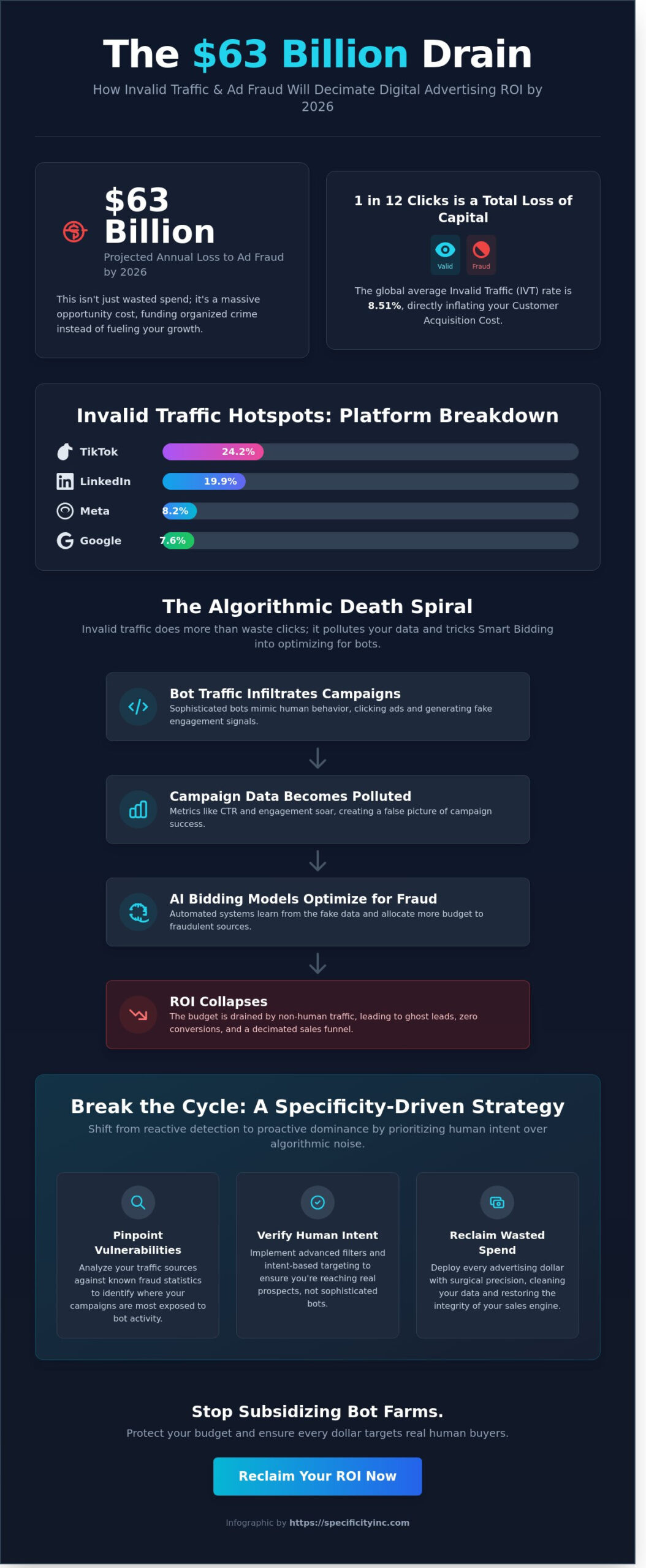
The numbers are staggering. The global average IVT rate currently sits at 8.51%. This isn’t just a rounding error; it’s a direct tax on your Customer Acquisition Cost (CAC). Statistically, one in every 12 paid clicks is a total loss of capital. When you scale that across the industry, we’re looking at a $63 billion drain. That capital doesn’t just vanish. It represents a massive opportunity cost. If that $63 billion were reallocated to high-intent targeting, it would generate billions in actual revenue instead of padding the pockets of bad actors. You aren’t just losing money; you’re losing the growth that money was supposed to ignite.
Why Platform Protections Are Insufficient
Ad platforms aren’t your allies here. They face a fundamental conflict of interest. Aggressive fraud detection reduces billable inventory, which directly impacts their bottom line. They lack the incentive to be truly surgical. Today’s advertising fraud uses scripts that simulate human scrolling and mouse hovering. These invalid traffic ads look identical to real prospects to basic algorithms. Even when platforms identify fraud, the lag time for credits or refunds is often 30 to 90 days. You’re essentially giving interest-free loans to the very systems failing to protect your ROI. Relying on default platform settings is a strategy for failure. You need granularity and precision to protect your funnel from ad fraud statistics that only trend upward.
Decoding the 2026 Ad Fraud Landscape: Statistics and Tactics
Ad fraud isn’t a minor budget leakage. It’s a systematic heist of your marketing capital. In 2026, the data confirms that bot traffic digital advertising has evolved into a sophisticated, multi-billion dollar industry. TikTok currently leads the invalid traffic (IVT) metrics at 24.2%. LinkedIn follows closely at 19.88%, while Google maintains a lower but still damaging rate of 7.57%. These figures represent more than just ad fraud statistics; they represent a direct assault on your customer acquisition costs and overall market position.
Social Media: The New Frontier for Bots
LinkedIn’s high CPC makes it a primary target for professional-grade bots. Fraudsters deploy complex scripts that mimic C-suite behavior to trigger high-value payouts from unsuspecting B2B advertisers. On TikTok, the “engagement trap” is the primary weapon. Bots inflate video views and likes to manipulate the algorithm, creating a facade of viral success that lacks any genuine commercial intent. Meta remains a significant hazard. Even with an 8.2% IVT rate, the sheer scale of its network means billions in advertising fraud losses annually. Organizations that rely on vanity metrics are essentially subsidizing bot farms.
Programmatic Display and CTV Vulnerabilities
The programmatic supply chain is a labyrinth designed for concealment. Scraper bots now dominate programmatic display budgets by generating millions of invisible ad calls, harvesting your budget without a single human eyeball ever seeing the creative. In the CTV sector, “ghost” devices are the preferred tactic. These software-emulated devices simulate viewership on premium streaming apps, tricking advertisers into paying for high-definition impressions that occur in a digital void. Sophisticated Invalid Traffic (SIVT) in 2026 is defined as non-human traffic that utilizes advanced techniques, such as residential proxies and behavioral biometric spoofing, to bypass standard verification filters.
Strategic dominance requires understanding where the attacks originate. Malicious competitors frequently utilize click farms to deplete your daily budget by 10 AM, effectively removing you from the auction during peak conversion hours. This geographic distribution of fraud is rarely uniform. High-risk regions, particularly across Southeast Asia and parts of Eastern Europe, show fraud densities 315% higher than the global median. If you aren’t applying intent-based targeting with surgical precision, you’re likely funding these operations. To protect your ROI, you must look beyond invalid traffic ads and focus on the hard data that proves human intent.
The Algorithmic Death Spiral: Why Invalid Traffic is More Than a Wasted Click
Dismissing invalid traffic ads as a minor cost of doing business is a strategic failure. Most marketers look at ad fraud statistics and see an 8% or 12% loss. They think they’re losing a fraction of their budget. They’re wrong. In an ecosystem driven by automated bidding, that 8% doesn’t just disappear; it mutates. It pollutes every decision your platform makes. If 10% of your data is fake, 100% of your strategy is compromised. This is the algorithmic death spiral.
The compounding waste of advertising fraud is catastrophic. You aren’t just losing the initial click cost. You’re losing the opportunity cost of the human lead you didn’t reach. Worse, you’re paying the platform to learn how to fail. When your “Smart Bidding” models ingest bot data, they stop seeking buyers and start seeking patterns. Bots are experts at mimicking those patterns.
Polluting the Machine Learning Model
Modern platforms like Google’s Performance Max and Meta’s Advantage+ rely on signals to find your next customer. Bots are designed to provide the perfect signal. They click, they scroll, and they stay on page for the exact duration an algorithm loves. When bot traffic digital advertising goes undetected, your pixel records a successful interaction. It then optimizes to find more users exactly like that successful bot.
- Bot clicks train your pixel to prioritize fraudulent environments over high-intent ones.
- Lookalike audiences break because the seed data is built on non-human behavior.
- The “Garbage In, Garbage Out” principle in modern SEM means your automation is only as intelligent as the traffic it analyzes.
You’re effectively paying platforms to learn how to waste your money more efficiently. This feedback loop creates a broader, lower-intent targeting profile that further increases your exposure to fraud. It’s a self-sustaining cycle of waste.
Eroding Strategic Dominance
Precision requires clean data. When advertising fraud saturates your reporting, you lose the granularity needed to identify true market opportunities. Noise in the data masks the subtle signals of high-intent human behavior. This leads to a total collapse of attribution. You might scale a channel that appears to be performing well, only to find that your actual revenue remains stagnant because you were chasing bot-inflated metrics.
Misallocated budgets are the inevitable result of this distortion. To win, you must reclaim control over your data stream and ensure every dollar fuels actual growth. Understanding the true impact of these losses is the first step toward achieving Digital Advertising ROI and maintaining strategic dominance in your vertical. Stop optimizing for clicks. Start optimizing for reality.
Beyond Detection: Strategies for Clean Traffic and Precision Targeting
Detection is a post-mortem. Prevention is the only way to protect your capital from the $84 billion drain that ad fraud statistics from Juniper Research identified in 2023. You must move from reactive detection to proactive prevention through intent-based targeting. Third-party verification tools are mandatory. They provide an unbiased audit of traffic that internal platform metrics often overlook. If you rely solely on a pixel, you’re missing the sophisticated bots that mimic human behavior with surgical precision.
Audit your log files immediately. Pixels are easily fooled by script-based interactions, but server logs reveal the truth. You’ll identify patterns of non-human behavior that standard analytics miss, such as 100% bounce rates from specific data center IP ranges or traffic spikes at 3:00 AM UTC from regions outside your service area. Tightening geographic and behavioral parameters to exclude known bot-heavy segments isn’t just an optimization; it’s a defensive necessity for bot traffic digital advertising hygiene.
Tactical Mitigation Framework
Stop treating every click as equal. You need a framework that aggressively filters out garbage before it hits your budget. High-stakes B2B campaigns require a “Human-in-the-loop” monitoring system where data analysts verify lead quality in real-time. This level of granularity ensures you aren’t paying for invalid traffic ads that never intended to convert. Efficiency in the digital space demands constant vigilance, not set-it-and-forget-it automation.
- Implement exclusion lists for low-quality placements and suspicious IP ranges identified in your log audits.
- Blacklist data center IPs and VPN exit nodes that frequently host non-human traffic.
- Leverage Search Engine Marketing (SEM) strategies that prioritize high-intent keywords over broad-match volume.
Shifting to High-Intent Precision
Broad-stroke marketing is a suicide mission for your ROI and a primary magnet for advertising fraud. When you cast a wide net, you invite the entire ecosystem of fraudulent scripts to feast on your spend. Focus on “Intent Data” to pinpoint buyers before they enter the bot-polluted open market. Intent-Based Targeting is a defense mechanism against IVT that isolates users demonstrating specific, verifiable purchasing behaviors, effectively bypassing the generic traffic pools where bots thrive. Precision isn’t just about finding the right person; it’s about excluding the wrong machine.
The Specificity Standard: Achieving Growth Through Human-Verified Traffic
Traditional agencies treat your budget like a gamble. They rely on the “spray and pray” model, pushing impressions to anonymous masses and hoping for a conversion. This approach is dead. In a landscape where advertising fraud consumes billions in capital, hope isn’t a strategy. Specificity Inc. operates on a different plane. We reject broad-stroke tactics in favor of Human-Verified Traffic. This ensures every dollar you spend targets a legitimate prospect, not a script or a server farm. We don’t just buy ad space; we buy outcomes.
Our methodology transforms your marketing from a cost center into a predictable revenue engine. By integrating CTV, programmatic, and social channels into a unified system, we create a fraud-resistant demand generation machine. This isn’t about being present on every platform. It’s about being present where your buyers are actually making decisions. We use data science to identify the specific human signals that bot traffic digital advertising can’t replicate, ensuring your message reaches eyes, not algorithms.
- Eliminate the 26% average budget waste associated with invalid traffic ads.
- Unify cross-channel data to create a single source of truth for your sales team.
- Convert raw intent signals into scalable growth through surgical audience pinpointing.
- Maintain total transparency with reporting that prioritizes ROI over vanity metrics.
The Antidote to Digital Noise
We bypass mass-market fraud traps by applying extreme granularity to every campaign execution. Most agencies focus on the click; we focus on the intent behind it. Our creative services serve as the first line of defense, designed to qualify traffic before a single cent is spent on the bid. This methodology aligns perfectly with the B2B Marketing shift toward intent-based precision. We don’t just reach people. We reach the right people at the exact moment they’re ready to buy, effectively silencing the noise that distracts your competitors and drains their resources.
Ignite Your Sales Funnel with Precision
The numbers don’t lie. In a recent 2024 deployment, we moved a client from a staggering 15% IVT (Invalid Traffic) rate to less than 1% within the first 90 days. We achieved this by abandoning broad demographics for high-intent targeting. For C-suite leaders, this isn’t just a marketing preference; it’s a financial imperative. Surgical precision is the only logical choice for maintaining a competitive edge. You can continue subsidizing the bots, or you can dominate your vertical with clean, actionable data. Ready to stop paying for bots? Pinpoint your audience with Specificity Inc.
Secure Your ROI Against the $63 Billion Erosion
The digital landscape is at a breaking point. By 2026, the industry faces a staggering $63 billion loss due to sophisticated bot traffic digital advertising, ad fraud statistics, invalid traffic ads, advertising fraud, bots. This isn’t just a budget leak; it’s a systemic failure that poisons your optimization algorithms and kills your scalability. If you rely on broad-stroke marketing, you’re subsidizing a criminal enterprise while your competitors capture the human market. Traditional detection tools are failing because they react to yesterday’s threats. You need a proactive strategy that prioritizes granularity and intent over raw volume.
Specificity Inc. has led this fight since 2018. We focus on high-intent demand generation through surgical precision. Our methodology eliminates the noise, ensuring your data remains pure and your sales funnel stays populated with actual buyers. We’ve built a reputation as elite specialists who value hard numbers over vanity metrics. You can’t afford to wait for the industry to fix itself. Take command of your growth by demanding human-verified traffic that delivers predictable revenue. Stop wasting your budget on bots; secure human-verified traffic with Specificity Inc. It’s time to dominate your vertical with data-driven certainty.
Frequently Asked Questions
What exactly is considered “invalid traffic” in 2026?
Invalid traffic encompasses any ad engagement that doesn’t originate from a real human with genuine commercial intent. This includes sophisticated AI-driven bots, data center traffic, and coordinated click farms. According to the 2025 ANA report, ad fraud accounts for 22 percent of global digital spend. We define it as any interaction that fails our 30 point granular verification process. It’s a drain on your capital and a direct threat to your scalability.
How can I tell if my Google Ads or Meta campaigns are being hit by bots?
You pinpoint bot traffic digital advertising by monitoring bounce rates exceeding 90 percent and session durations under two seconds. Analyze your log files for suspicious IP clusters originating from data centers like AWS or Google Cloud. A 2024 study by Juniper Research found that 25 percent of all ad spend is lost to fraud. If your conversion rate is 0 percent despite high click-through rates, you’re likely paying for non-human interactions.
Does invalid traffic actually affect my automated bidding strategy?
Invalid traffic ads poison your machine learning models and force your algorithms to optimize for failure. When bots trigger conversion pixels, Google’s Smart Bidding or Meta’s Advantage+ shifts budget toward those fraudulent sources. This creates a feedback loop of wasted spend. Data from the 2024 Cybersecurity Report shows that 37 percent of automated bidding decisions are based on corrupted data. You can’t scale a strategy built on fiction.
Are certain platforms like TikTok or LinkedIn more prone to ad fraud?
Every platform has vulnerabilities, but the nature of the fraud varies by ecosystem. LinkedIn faces sophisticated scraping bots while TikTok deals with massive click farms. A 2025 DoubleVerify report indicated that mobile app environments see 12 percent higher fraud rates than desktop. We don’t trust platform-native reporting. We use cross-platform granularity to identify where your budget is being siphoned off by non-human actors.
What is the difference between GIVT and SIVT?
GIVT consists of routine crawlers and search engine spiders that are easily identified via standard lists. SIVT is more dangerous because it mimics human behavior using hijacked devices and residential IPs. The Media Rating Council notes that SIVT requires advanced analytics to detect. SIVT represents roughly 70 percent of all advertising fraud in high-value B2B niches. It’s the primary driver of wasted ad spend in the modern landscape.
Can I get a refund from ad platforms for fraudulent clicks?
You can request credits, but platforms rarely provide full refunds for sophisticated bot traffic. Google and Meta typically only credit for the basic traffic they catch themselves. According to 2024 industry data, platforms only proactively catch about 15 percent of sophisticated fraud. You need independent, third-party verification data to prove your case. Waiting for a platform to police itself is a losing strategy for your ROI.
How does human-verified traffic improve digital advertising ROI?
Human-verified traffic ensures every dollar spent targets an individual with genuine purchase intent. By eliminating the 20 percent of budget typically lost to bots, you immediately lower your Customer Acquisition Cost. This precision allows your sales team to focus on high-quality leads instead of chasing ghost data. Verified traffic ignites your funnel and provides the clean data necessary for predictable revenue growth.
Is it possible to completely eliminate ad fraud from my digital marketing?
No one can promise 100 percent elimination because fraud evolves constantly. However, you can reduce it to negligible levels by implementing rigorous, intent-based targeting and real-time filtering. Companies using active bot mitigation see a 30 percent increase in conversion efficiency compared to those relying on standard settings. We don’t aim for “better”; we aim for total dominance over your data integrity.