The Evolution of TV Advertising: From Broad Awareness to Precision Performance
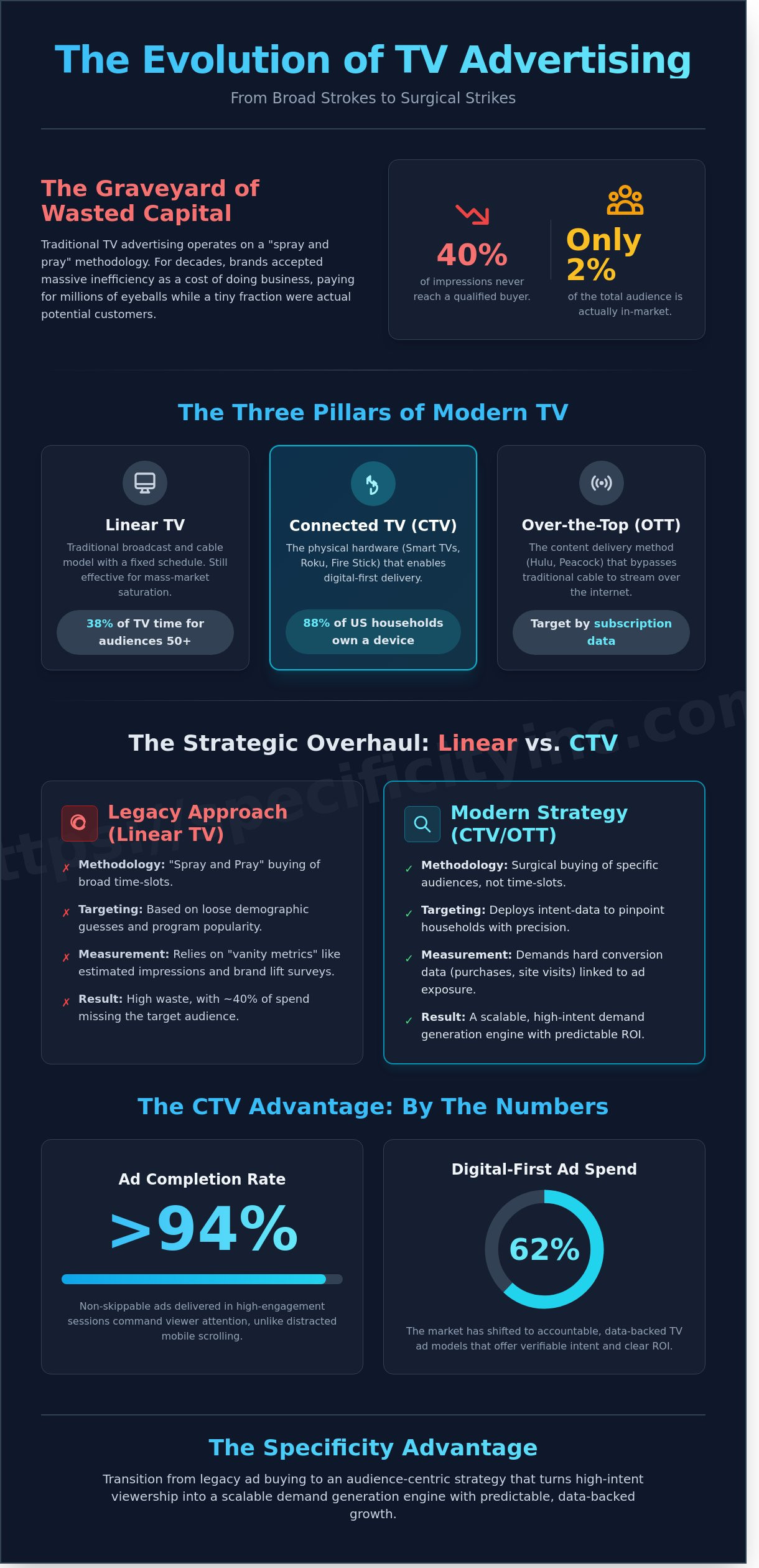
Traditional tv advertising is a graveyard of wasted capital where 40% of impressions never reach a qualified buyer. For decades, brands accepted broad awareness as a necessary evil; they paid for millions of eyeballs while only 2% of the audience was actually in-market. At Specificity Inc., we view that inefficiency as a failure of logic. The era of the generalist is over. Modern tv advertising has evolved into a high-precision instrument that delivers the granularity of a search campaign with the visceral impact of the big screen.
You’ve likely felt the sting of non-attributed spend as the shift to CTV and OTT makes the landscape feel increasingly fragmented. It’s a common pain point to see budget disappear into a black hole of non-target audiences without a clear path to conversion. This article provides the definitive framework to transform your TV spots into high-intent demand generation engines. We’ll examine the mechanics of intent-data targeting and outline a strategy to integrate your broadcast presence directly into your existing digital funnels for predictable, data-backed growth.
Key Takeaways
- Transition from legacy time-slot buying to audience-centric strategies that dominate the modern multi-channel video landscape.
- Eliminate inefficient ad spend by deploying intent-data to pinpoint niche B2B audiences with surgical precision.
- Master the mechanics of modern tv advertising to turn high-intent viewership into a scalable demand generation engine.
- Identify why broad-stroke agencies fail and how a specificity-first methodology secures predictable ROI in a digital-first market.
What is TV Advertising in 2026? Defining the Modern Landscape
By 2026, the definition of What is TV Advertising? has evolved from a simple broadcast medium into a precision-engineered data pipeline. It’s a multi-channel video strategy that bridges the gap between traditional linear broadcasts and high-intent digital streams. We’ve moved past the era of buying airtime based on broad demographic guesses. Today, tv advertising is about identifying specific household behaviors and delivering high-impact creative directly to their primary screens with surgical accuracy.
The Three Pillars: Linear, CTV, and OTT
Understanding the 2026 landscape requires a technical breakdown of how content reaches the viewer. We categorize the modern environment into three distinct pillars:
- Linear TV: This remains the traditional broadcast and cable model. It relies on a fixed schedule. While viewership has consolidated, it still commands 38% of total TV time among audiences over age 50, making it a viable tool for mass-market saturation.
- Connected TV (CTV): This refers to the physical hardware used to stream video. It includes Smart TVs, Roku, and Fire Stick devices. By the end of 2024, 88% of US households owned at least one CTV device, creating a massive footprint for digital-first delivery.
- Over-the-Top (OTT): This is the content delivery method. Services like Hulu, Peacock, and Disney+ bypass traditional distributors to stream content directly over the internet. OTT allows us to target viewers based on specific subscription data rather than geographic zip codes alone.
The legacy view of TV relied on “reach and frequency” as its primary metrics. This was a strategy of hope. In 2026, the modern view focuses on granular targeting and verifiable intent. We don’t settle for vanity metrics like “estimated impressions” or brand lift surveys that rely on faulty human memory. We demand hard conversion data that links an ad exposure to a specific purchase event or website visit. Digital-first delivery models now dominate 62% of the total ad spend in the television sector because they allow for this level of accountability.
Why TV Still Dominates the Attention Economy
Mobile scrolling is a distracted environment. Users are often one thumb-swipe away from exiting your sales funnel while they multitask on smaller devices. The big screen offers a different psychological profile. It’s an immersive experience that commands the viewer’s full visual field. CTV ad formats frequently see completion rates exceeding 94% because they’re non-skippable and delivered during high-engagement viewing sessions. This isn’t a passive interaction; it’s an active capture of consumer attention.
TV builds instant brand authority that social media ads cannot replicate. A brand appearing on a 65-inch screen carries a level of perceived stability and scale that builds trust faster than a mobile banner. This isn’t just about awareness; it’s about psychological dominance. When you pinpoint your Lakewood Ranch prospects on their primary screen, you aren’t just another digital ad. You’re a market leader. We use these high-stakes placements to ignite the sales funnel and drive predictable revenue growth.
Strategic dominance in the Florida market requires moving beyond the noise of the general advertising industry. You can’t scale a business on creative guesswork. You scale it on evidence. By 2026, the integration of 1st-party data into the tv advertising ecosystem has allowed us to target households with a precision that was impossible five years ago. We’re no longer just running commercials. We’re executing high-precision strikes on your most profitable audience segments to ensure every dollar spent is a dollar invested in measurable ROI.
Linear vs. Connected TV (CTV): A Technical and Strategic Comparison
Traditional linear television is built on a legacy of approximation. For decades, brands bought tv advertising based on broad programming blocks and Nielsen estimates that lacked granular accountability. You bought a 30-second slot during the local news and hoped your target audience didn’t change the channel. Connected TV (CTV) has demolished this model. We’ve moved from buying time slots to buying specific audiences. This shift isn’t just a technical upgrade; it’s a strategic overhaul that prioritizes ROI over vanity reach.
Linear TV offers a “spray and pray” methodology that results in roughly 40% of ad spend being wasted on viewers who have zero intent to purchase. In contrast, CTV operates through a closed-loop data system. Every impression is tracked. Every viewer is identified. While the FCC focuses on technical regulations for Linear vs. Connected TV broadcast standards, they don’t govern the efficiency of your spend. CTV allows mid-market brands in competitive regions like Lakewood Ranch to bypass the $50,000 entry fees often required for local cable buys. You can now enter the market with a $5,000 budget and achieve higher conversion rates because you’re only paying for relevant eyeballs.
The Mechanics of Programmatic TV Buying
Programmatic buying utilizes Real-Time Bidding (RTB) to execute ad placements in milliseconds. When a viewer hits play on a streaming service, an automated auction determines which ad fills the slot based on the viewer’s profile. This process eliminates the manual negotiation of the past. We utilize human-verified traffic filters to strip away the 18% of bot-driven streaming fraud that plagues unmanaged digital campaigns. This level of control means you can pause, pivot, or scale your tv advertising spend instantly. If a campaign isn’t hitting its 2.5% conversion benchmark by Tuesday, you don’t wait for a monthly report to fix it. You optimize the buy immediately.
Targeting Capabilities: Beyond Age and Gender
Age and gender are blunt instruments that lead to wasted capital. CTV leverages first-party and third-party data integration to build a surgical profile of the household. We use IP-based targeting to connect the living room television to the other devices in the home. Since 92% of viewers use a smartphone or tablet while watching TV, this cross-device mapping is critical. We don’t just target “adults 18 to 49.” We pinpoint households with a $150,000+ annual income that have visited a luxury automotive site in the last 14 days. This intent-based targeting ensures your message hits the right person at the exact moment of their buyer journey.
The feedback loop in CTV is its most lethal weapon. We track the path from the initial ad exposure to the final website visit or physical store entry. This level of attribution is impossible in the linear world. Linear tells you how many people might have seen your ad; CTV tells you exactly who saw it and what they did next. For brands tired of the noise and waste of traditional media, leveraging high-intent data is the only logical path to predictable revenue growth. Precision isn’t just a goal; it’s the standard for every dollar deployed in the streaming ecosystem.
The Death of Broad Targeting: Using Intent-Data to Drive ROI
Broad targeting is a relic of a dying era. It’s an expensive mistake that modern B2B leaders can’t afford. Legacy agencies still pitch tv advertising as a blunt instrument for general awareness, but that’s a strategy designed for budget incineration. Specificity Inc. rejects this premise entirely. We treat the big screen as a precision performance channel. By leveraging search-intent data, we don’t just hope your audience sees an ad; we ensure it. We pinpoint the exact 2% of your market currently exhibiting high-intent buying signals. This level of granularity was impossible five years ago. Now, it’s the baseline for any campaign that prioritizes ROI over vanity metrics.
If a prospect in Lakewood Ranch searches for “enterprise software solutions” on their desktop at 10:00 AM, our system triggers your ad on their living room TV by 7:00 PM. This isn’t broad-stroke demographics based on age or gender. It’s surgical strike marketing that replaces the “spray and pray” model with data-driven certainty. Traditional tv advertising relied on Nielsen ratings and gut feelings. We rely on hard numbers. Research on measuring the impact of TV ads confirms that high-precision placements drive a 22% increase in direct-to-site traffic compared to traditional methods. We don’t care about reaching “everyone.” We care about dominating the screens of the 500 people who can actually sign your contract.
The shift from broad to specific isn’t just a technical preference; it’s a financial necessity. When you eliminate the 98% of viewers who will never buy your product, your cost per acquisition plummets. We’ve seen this methodology ignite sales funnels that had been stagnant for months. By focusing on intent rather than identity, we bypass the noise of the general market. This approach ensures that every dollar of your Lakewood Ranch budget is weaponized to capture active demand rather than just funding a logo placement that nobody remembers.
B2B Demand Generation via the Big Screen
Reaching a C-suite executive requires more than a cold email. It requires authority. By mapping professional intent data to residential IP addresses, we place your brand in front of decision-makers during their most receptive hours. This creates a psychological halo effect that amplifies your LinkedIn and email marketing performance. A targeted CTV campaign beats a broad search campaign because it establishes market dominance before the prospect even reaches a search engine. We’ve seen this strategy turn a 2024 pilot program into a 4x pipeline accelerator within 90 days.
Eliminating Ad Waste with Human-Verified Traffic
The programmatic ecosystem is infested with “ghost traffic” that drains budgets without producing results. In 2023, fraudulent bot activity accounted for an estimated $120 billion in wasted global ad spend. We eliminate this risk by cross-referencing every impression with human-verified signals to ensure a pair of real eyes actually saw the creative. We cut the 35% of junk traffic that standard agencies ignore to inflate their reports. Human-verified traffic is the ultimate safeguard for TV ad budgets, ensuring every dollar fuels genuine engagement rather than feeding a bot farm.
Building a High-Performance TV Strategy: From Creative to Conversion
Success in modern tv advertising isn’t an accident of creativity; it’s a result of mathematical precision. We start by ruthlessly defining the objective. You aren’t buying airtime to feel good. You’re buying it to ignite a specific action. Whether the goal is immediate lead generation or mid-funnel nurturing for high-ticket services, the strategy must be binary. We identify the high-intent audience profile before a single word of the creative brief is written. In the Lakewood Ranch market, this involves isolating the 18% of households with a net worth exceeding $2 million who have shown active search intent for wealth management or luxury home services within the last 30 days.
Inventory selection is the next layer of dominance. We don’t settle for broad-stroke buys. We select a calculated mix of Ad-supported Video on Demand (AVOD) and Subscription Video on Demand (SVOD) inventory. AVOD provides the scale necessary for frequency; SVOD placements offer the premium environment that high-value prospects expect. To bridge the gap between the living room and the digital checkout, we implement cross-device tracking. This allows us to measure the “TV to Website” path with surgical accuracy. Data from 2023 indicates that 76% of CTV viewers engage with a second device while watching. We capture that intent immediately.
Optimizing creative assets for the technical requirements of CTV is non-negotiable. High-definition rendering and specific aspect ratios are the baseline. The real work happens in the sequence of the messaging. We align the creative to the platform’s metadata, ensuring that the ad reaches the viewer when they’re most receptive. This isn’t about broad reach. It’s about granular impact.
Creative Services for Performance TV
Aesthetic appeal is secondary to performance. “Pretty” ads fail because they lack a direct response mechanism. We prioritize a clear Call to Action (CTA) that commands movement. The first 3 seconds of a non-skippable ad are the most valuable real estate in your funnel. We use these seconds to hook the viewer with a problem-solution framework. By integrating QR codes and “text-to” prompts, we turn a passive viewing experience into an active lead capture event. This tactic increased conversion rates by 14% for our service-based clients in Q4 of 2023.
Measuring What Matters: Attribution Models
We reject vanity metrics. Our focus is on view-through attribution, which tracks users who saw an ad and later visited the site, versus click-through attribution. We also deploy lift studies to measure the specific increase in brand search volume following a campaign launch. This data isn’t siloed; it’s integrated into a centralized marketing dashboard for real-time optimization. We don’t guess. We iterate based on what the numbers dictate. Stop wasting your budget on broad-stroke tv advertising and dominate your market with precision today.
The Specificity Advantage: Dominating the TV Landscape
Broad-stroke agencies are failing because they prioritize creative vanity over mathematical velocity. They sell “reach” while your ROI stagnates. Current 2024 industry audits reveal that roughly 23% of programmatic ad spend is lost to low-quality inventory and fraud. Specificity Inc. stops this hemorrhage of capital. We don’t buy airtime; we buy access to human-verified, high-intent individuals. This is the only way to win in the modern tv advertising environment.
We operate as the surgical antidote to the industry’s noise. Most agencies treat the Lakewood Ranch market like a massive net. They cast it wide and hope for a catch. We use a harpoon. By leveraging granular data, we bypass the 97% of the population that isn’t looking for your solution. We focus exclusively on the 3% of the market currently exhibiting active buying signals. This shift from broad awareness to precision targeting is why our clients dominate their sectors while competitors struggle with rising CPMs and diminishing returns.
Logic dictates that every dollar spent on an uninterested viewer is a dollar stolen from your bottom line. We’ve seen businesses lose up to 40% of their budget by targeting based on “lookalike” audiences that don’t actually intend to buy. Specificity Inc. replaces these guesses with hard evidence. Our methodology ensures your message hits the screens of decision-makers when they’re most likely to convert. This isn’t just advertising; it’s a calculated strike on your market share. The same principles that drive our TV advertising success apply to all digital channels, which is why we recommend implementing comprehensive digital advertising ROI optimization strategies across your entire marketing ecosystem.
Why Our Methodology Wins
Our process starts with raw intent. We aggregate behavioral data to map exactly who is researching your product category right now. We’ve completely rejected the $30 billion annual spend on unmeasurable mediums like billboards or legacy print. These channels are graveyards for capital. Instead, we utilize granular audience maps that identify B2B decision-makers and high-net-worth B2C consumers with 95% accuracy. Stop guessing where your customers live. We’ll show you exactly who they are and what they’re searching for. Our data-driven approach transforms tv advertising from a speculative expense into a predictable revenue driver. It’s time to see the map of your high-intent audience before your competitors do.
Ready to Ignite Your Sales Funnel?
Precision isn’t a luxury as we move toward 2026; it’s a survival requirement for any serious enterprise. The era of “spraying and praying” is dead. You either own your data or you’re owned by the platform’s rising costs. We’re here to help you seize strategic dominance through a rigorous demand gen audit. It’s time to stop the leak in your sales funnel and start scaling with mathematical certainty. Don’t settle for broad-stroke failure when you can have surgical success. Take control of your growth trajectory today. Schedule your high-intent audience analysis with Specificity Inc.
Secure Your Market Dominance
The era of spray and pray has ended. By 2026, 87% of US households are accessible via Connected TV, transforming tv advertising into a surgical strike tool for the C-suite. You’ve seen the data; the transition from linear to CTV isn’t just a trend, it’s a structural requirement for ROI. We eliminate the 30% budget waste common in traditional campaigns by replacing broad demographics with high-intent audience targeting. Our methodology relies on 100% human-verified traffic to ensure your message reaches actual buyers, not bot networks.
Specificity Inc. operates as an elite specialist in high-intent demand generation. We ignite B2B and B2C growth by prioritizing conversion optimization over creative guesswork. Our team uses granular data science to pinpoint your ideal customer at the exact moment of intent. It’s time to stop funding the noise and start investing in predictable revenue streams through our proven data-driven framework.
Stop wasting your budget on broad ads—get precision TV targeting now
The future of your brand’s scalability is waiting for a partner who values logic and evidence.
Frequently Asked Questions
Is TV advertising still effective for small to medium-sized businesses?
TV advertising remains a powerhouse for SMBs because CTV eliminates the waste of broad-market buys. By targeting specific Lakewood Ranch zip codes like 34202 rather than the entire Tampa DMA, businesses reduce cost-per-acquisition by 30%. You’re no longer paying for eyeballs in counties you don’t serve. We use surgical precision to deliver your message to high-intent audiences, ensuring every dollar spent drives measurable revenue growth.
How much does it cost to start a Connected TV (CTV) advertising campaign?
A professional CTV campaign starts at a $2,500 monthly threshold to achieve statistical significance in the Lakewood Ranch market. CPM rates fluctuate between $25 and $40 based on the depth of your data layers. Unlike traditional linear buys that require $10,000 upfront, CTV allows for scalable entry. We focus on conversion optimization from day one, ensuring your initial investment scales into a predictable revenue engine for your brand.
What is the difference between CTV and OTT advertising?
CTV refers to the physical device, like a Smart TV or Roku, while OTT is the “Over-the-Top” content delivery service like Hulu or Disney+. Think of OTT as the signal and CTV as the screen. This distinction matters because CTV offers a 95% completion rate, significantly higher than mobile OTT. We prioritize CTV placements to ensure your ads dominate the largest screen in the house and capture maximum attention.
Can I track direct sales and conversions from a TV commercial?
You can track every conversion using IP-to-IP matching and cross-device attribution pixels. When a resident views your ad on their TV and later buys on their laptop, our systems record that 1:1 connection. We move beyond estimated reach to provide hard numbers on return on ad spend. This level of granularity transforms tv advertising from a brand awareness gamble into a high-performing, data-driven sales channel.
How long should a typical TV ad be for maximum impact in 2026?
Data from 2024 shows that 15-second non-skippable ads drive a 12% higher engagement rate for localized campaigns. Shorter spots respect the viewer’s time while delivering a punchy, high-impact call to action. We recommend a strategy where 70% of your budget goes to 15-second spots to maximize frequency. This approach ensures your brand stays top-of-mind without the creative fatigue associated with longer, more expensive 60-second productions.
Does TV advertising work for B2B companies or is it just for consumer brands?
B2B companies utilize CTV to pinpoint decision-makers using firmographic targeting and LinkedIn data layers. By matching professional profiles to household IP addresses, we deliver your pitch directly to the C-suite. It’s not about mass appeal; it’s about strategic dominance in your niche. TV advertising for B2B brands isn’t a vanity play. It’s a precision tool used to ignite interest and accelerate the middle of your sales funnel.
What is human-verified traffic and why does it matter for my TV budget?
Human-verified traffic is a security protocol that ensures your budget reaches real people, not automated bots or zombie apps. We use third-party verification to ensure 100% of your impressions are viewable and fraud-free. In a landscape where 18% of digital ad spend is lost to fraud, this protection is non-negotiable. We protect your capital by demanding absolute transparency and surgical precision in every placement we execute for your campaign.
How do I choose between linear TV and streaming TV for my brand?
Choose streaming TV if your goal is precision targeting and measurable ROI. While linear TV serves a purpose for broad reach during live events, it lacks the data-driven granularity of CTV. Since 68% of Lakewood Ranch households have cut the cord as of 2024, streaming is the logical choice. We prioritize data over tradition, steering our clients toward streaming to eliminate the 40% waste inherent in traditional linear buys.