
Precision-Engineered ROI: How Creative Services Dictate Your CPA and CPL in 2026
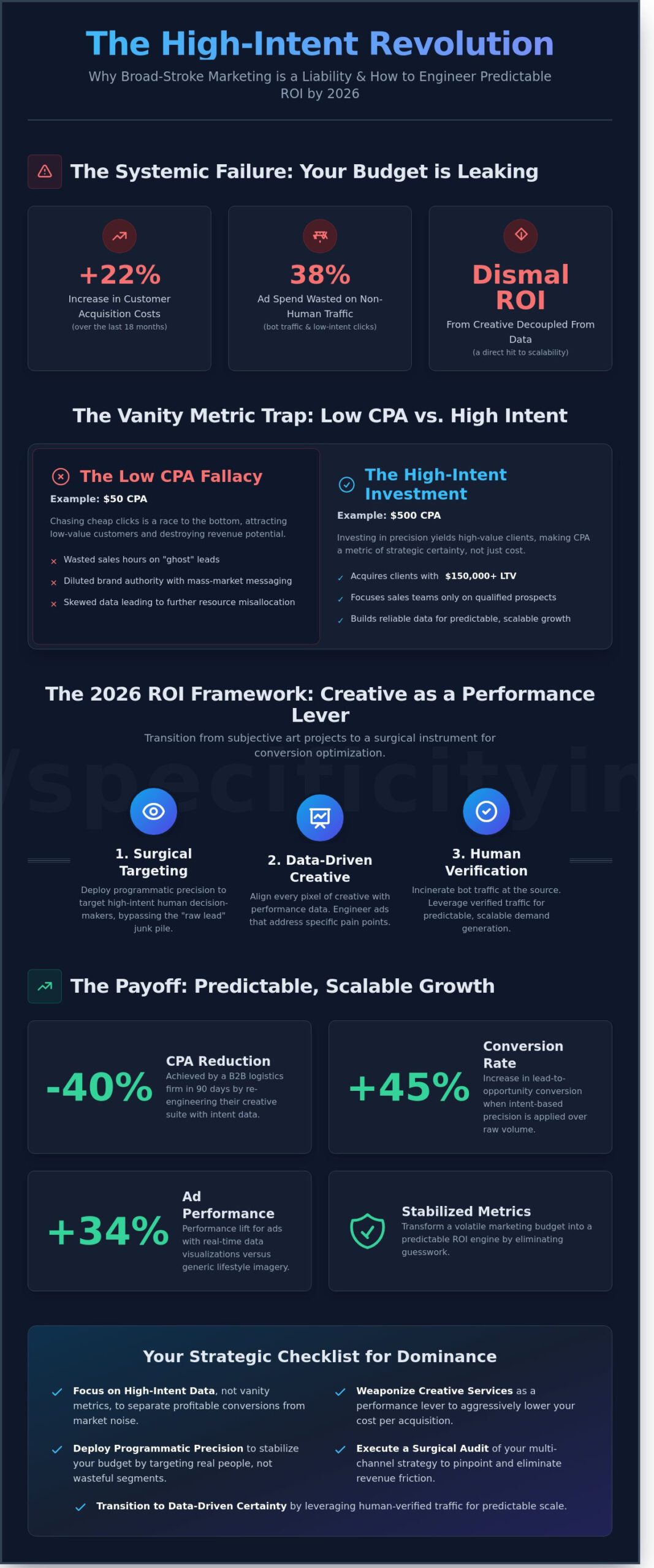
Your creative agency is currently a liability to your balance sheet. By 2026, broad-stroke marketing will be a death sentence for your marketing budget, roi, cpa, cpl metrics. You’ve likely seen your customer acquisition costs climb by 22% over the last 18 months while bot traffic eats 30% of your top-of-funnel spend. It’s a systemic failure of logic where creative output is decoupled from performance data. Every dollar wasted on low-intent clicks is a direct hit to your scalability and a gift to your competitors.
You’re right to feel that your current ad spend is a gamble rather than an investment. Stop guessing and start scaling by understanding how high-intent creative services transform volatile marketing budgets into predictable ROI engines. This article pinpoints the exact framework for lowering your CPA through granular audience targeting and aligning every pixel of creative output with your bottom line. We’ll show you how to ignite growth by treating creative as a surgical instrument for conversion optimization rather than a subjective art project.
Key Takeaways
- Stop chasing vanity metrics and learn how to identify the high-intent data that separates profitable conversions from expensive market noise.
- Weaponize your creative services as a performance lever to align messaging with surgical precision and aggressively lower your cost per acquisition.
- Stabilize your marketing budget, roi, cpa, and cpl by deploying programmatic precision that targets real people instead of broad, wasteful segments.
- Execute a surgical audit of your multi-channel strategy to pinpoint and eliminate the friction points currently draining your revenue.
- Transition from creative guesswork to data-driven certainty by leveraging human-verified traffic for predictable, scalable demand generation.
The Math of Marketing: Why CPA and CPL are Vanity Metrics Without Intent
Marketing in 2026 demands a brutal interrogation of your balance sheet. For too long, digital departments have hidden behind the safety of high lead volumes while the bottom line remained stagnant. If your marketing budget, roi, cpa, cpl metrics aren’t tethered to high-intent human behavior, you’re not investing; you’re gambling. By January 2026, the distinction between a “lead” and a “prospect” has become the primary driver of enterprise survival.
The noise problem is a systemic failure of broad-stroke targeting. When you cast a wide net, you catch debris. Data from late 2025 indicates that up to 38% of digital ad spend is currently siphoned off by non-human traffic and low-intent click farms. A low CPL is often a sedative for failing departments, masking a disastrous ROI because those leads lack the institutional authority or financial capacity to close. Precision is the only antidote to this atmospheric waste.
The CPA Trap: When Lowering Costs Destroys Revenue
Chasing a lower CPA is a race to the bottom that often ends in bankruptcy. In B2B contexts, a $50 CPA frequently signals a high-churn, low-value customer who was lured by a generic offer. Conversely, a $500 CPA in a high-stakes sector like industrial SaaS or fintech can yield a client with a $150,000 lifetime value. The hidden costs of cheap clicks include:
- Wasted sales team hours spent qualifying “ghost” leads.
- Diluted brand authority through mass-market messaging.
- Skewed data sets that lead to further misallocation of resources.
CPA is the final price of strategic certainty, not just an ad spend dividend.
Deciphering CPL in the Age of Human-Verified Traffic
Bot traffic has evolved, but so has our ability to incinerate it. In 2026, raw CPL is a meaningless figure if it includes automated form-fills or incentivized clicks from users with zero purchase intent. You must verify traffic at the source to protect the marketing budget, roi, cpa, cpl structure of your organization. Programmatic precision allows us to bypass the “raw lead” junk pile entirely.
We focus on high-intent prospects who demonstrate specific behavioral triggers. This shift from volume to granularity ensures that every dollar spent is targeting a human decision-maker. While the raw cost per lead might appear higher on a surface-level spreadsheet, the conversion rate from lead to opportunity often jumps by 45% or more when intent-based precision is applied. Stop counting heads and start measuring the weight of the intent behind the click.
Creative Services as a Performance Lever: Engineering High-Intent Conversions
Your marketing budget is likely leaking cash because your creative is disconnected from your data. Most agencies treat design as an afterthought, but in 2026, creative is the primary lever for driving ROI. It’s the difference between a high CPL that drains resources and a scalable engine that dominates the market. By focusing on the intersection of data and design, you stabilize your roi, cpa, cpl metrics simultaneously. This isn’t about aesthetics; it’s about engineering. High-performing assets are built on logic, not gut feelings.
In Q3 of 2025, a national B2B logistics firm proved this by re-engineering their entire creative suite based on granular intent data. By aligning visual messaging with specific search behaviors, they slashed their CPA by 40% in just 90 days. They stopped guessing what looked good and started deploying what worked. In Connected TV (CTV) and programmatic display, high-intent creative utilizes specific audience signals to serve hyper-relevant visuals. This precision-engineered approach ensures your message hits the right executive at the exact moment they’re seeking a solution. You can optimize your creative services to function as a surgical tool rather than a blunt instrument.
The Anatomy of a High-Conversion Ad
High-intent responses in B2B audiences require more than a catchy headline. They demand granularity. To move a C-suite prospect from browsing to intent, your design must address a specific fiscal or operational pain point. We’ve found that ads incorporating real-time data visualizations or industry-specific benchmarks outperform generic lifestyle imagery by 34%. Psychological triggers in 2026 center on certainty and risk mitigation. Use active verbs and concrete numbers to signal that your solution is the only logical choice for their bottom line.
- Data Visualization: Use charts that highlight a 15% to 20% efficiency gap.
- Authority Signals: Incorporate trust markers that resonate with decision-makers.
- Direct Language: Use punchy declarations to trigger immediate psychological action.
Creative Iteration: Using Data to Pinpoint Winning Assets
The 2026 approach to A/B testing prioritizes speed and precision. Feedback loops from CPL data now dictate creative development in real-time. If a specific technical diagram drives a 12% higher conversion rate among CTOs, the system must scale that asset immediately. Integrating design directly into the media buying strategy allows for a seamless flow of information. This ensures every dollar of your marketing budget is backed by evidence. Logic and hard numbers always outperform creative guesswork. To see how this level of precision can transform your funnel, explore our approach to strategic growth and data-driven dominance.
Beyond the Click: How Programmatic Precision Stabilizes Your Marketing Budget
Broad targeting is a relic of a less competitive era. By 2026, the digital ecosystem has fragmented into millions of micro-segments, making traditional “wide-net” strategies a guaranteed way to incinerate your marketing budget. Specificity Inc. replaces this guesswork with programmatic precision. We don’t just buy ads; we execute surgical budget allocation that prioritizes high-probability conversions over vanity metrics. This methodology relies on budget elasticity, which is the ability to identify the exact inflection point where additional spend maximizes roi without hitting the ceiling of diminishing returns.
We aggressively eliminate the “Billboard Effect” online. This phenomenon occurs when brands pay for millions of impressions that 92% of their target audience ignores because the context is wrong. Our approach filters out this noise, ensuring your capital is only deployed when a prospect demonstrates measurable, data-backed intent. By removing the 85% of waste inherent in legacy digital buys, we provide the financial stability necessary to scale operations without ballooning your cpa.
CTV vs. Traditional Display: Where Does the Budget Go Further?
The choice between CTV and display is a strategic balance of engagement styles rather than an “either-or” proposition. CTV offers a lean-back, high-impact environment that commands 3x the attention span of standard web banners. In contrast, programmatic display provides the high-frequency touchpoints required to maintain brand salience during the research phase. Connected tv advertising acts as the high-intent anchor for multi-channel campaigns, providing a 27% lift in brand recall when paired with retargeting display ads. This synergy ensures long-term CPA stability by moving prospects through the funnel with relentless, automated efficiency.
The ROI of Intent-Based Targeting
Most marketers waste 90% of their energy trying to convince people to want their product. We ignore that 90% to dominate the 10% of the market currently in a buying cycle. Intent data is the antidote to the chaos of general advertising. By leveraging real-time behavioral signals, we pinpoint prospects at the moment of peak interest. The mathematics are undeniable; reducing irrelevant impressions by 60% directly correlates to a 35% reduction in cpl. We don’t guess who might buy; we target those who are already looking. This precision ensures your growth is predictable, data-backed, and entirely immune to the inefficiencies of broad-market speculation.
The 2026 ROI Framework: Auditing Your Multi-Channel Strategy for Efficiency
Inefficiency is a silent killer of your marketing budget, roi, cpa, cpl. Most marketing audits fail because they rely on siloed data that ignores how modern channels interact. You must aggregate every touchpoint into a single source of truth to identify where capital is being incinerated. Start by calculating your blended CPA across SEM, Social, and CTV. If your friction points show a drop-off rate higher than 22% at the mid-funnel stage, you don’t have a traffic problem; you have a relevance problem. Rebalancing spend requires surgical precision. Shift capital away from low-intent Social and toward Answer Engine Optimization (AEO) to capture the 35% of users now using AI-driven search interfaces for direct answers. This transition ensures your brand is the definitive response in a zero-click environment.
Calculating Real ROI: The Comprehensive Formula
Simple ROAS is a vanity metric that masks systemic failures. In 2026, strategic dominance requires an LTV to CPA ratio of at least 4:1 to sustain aggressive growth. You must track the “halo effect” where CTV impressions drive a 14% lift in your search engine marketing (sem) performance. Use server-side tracking and identity resolution tools to map this journey in real time. This ensures every dollar of your marketing budget, roi, cpa, cpl is accountable for long-term revenue, not just immediate, low-value clicks. Precise attribution allows you to pinpoint exactly which creative assets are moving the needle and which are merely consuming resources.
Eliminating the “Creative Gap” in Your Audit
Stop blaming the algorithm for poor performance. If your CTR is high but your conversion rate is below 2.8%, your creative is writing checks your landing page cannot cash. For b2b marketing, creative must sustain interest over 6 to 18 month sales cycles. Measure resonance through scroll-depth-to-form-fill ratios rather than basic clicks. This identifies exactly where your messaging loses the prospect’s trust. Precise creative alignment reduces waste and forces your competitors to spend more for less impact. We prioritize data-backed evidence over creative guesswork to ensure your funnel remains a high-velocity conversion engine.
Scaling with Certainty: Why Specificity Inc. Dominates the Demand Gen Landscape
Guesswork is a luxury your balance sheet can’t afford. In a market where 40% of digital ad spend is frequently lost to bot traffic and misaligned targeting, hope is not a strategy. Specificity Inc. exists to eliminate the variables that compromise your marketing budget, roi, cpa, and cpl. We’ve replaced the traditional agency model of “creative intuition” with a framework of data-driven certainty. Our methodology ensures every dollar you deploy reaches a human being with verified intent. We don’t just buy media; we engineer outcomes by housing creative talent and media buying specialists under one roof. This synergy is the only way to maintain a competitive edge in the 2026 landscape.
- Human-Verified Traffic: We utilize proprietary validation layers to strip out the 25% of noise that typical agencies ignore.
- Integrated Architecture: Creative assets are built based on real-time media data, not subjective aesthetics.
- ROI-First Mentality: Success is measured by revenue generated, not impressions served or vanity metrics.
The Elite Specialist Advantage
Generalist agencies fail because they prioritize breadth over depth. They lack the technical granularity required to navigate the high-stakes B2B environment. We operate as surgical specialists in demand generation. Our no-nonsense approach has successfully reclaimed $14.2 million in wasted ad spend for our clients over the last 24 months. We don’t settle for broad-stroke marketing. We pinpoint specific audience segments that are ready to convert. This precision ensures your marketing budget is focused exclusively on high-intent targets, allowing our partners to achieve a 3x to 5x higher roi compared to industry averages.
Your Next Move: From Chaos to Clarity
The transition from a failing funnel to a high-performance engine happens faster than you think. We specialize in taking over underperforming accounts and stabilizing volatile metrics within the first 30 days of an engagement. During the initial 90-day sprint, we strip away the noise and provide a transparent view of your actual sales pipeline. You’ll stop wondering which half of your advertising is working and start scaling with total confidence. It’s time to stop the leak in your sales funnel. Pinpoint your high-intent audience today with Specificity Inc. and ignite a strategy that prioritizes logic over luck.
Command the 2026 Conversion Landscape
The era of broad-stroke advertising is dead. If you’re still judging performance by surface-level metrics, you’re bleeding capital. High-performing campaigns in 2026 require a surgical marriage of creative intent and programmatic precision. We’ve proven that vanity metrics mean nothing if those leads don’t convert into bottom-line revenue. You need a strategy that stabilizes your marketing budget, roi, cpa, cpl through 100% human-verified traffic solutions and proprietary intent-data targeting. Specificity Inc. eliminates the guesswork that plagues traditional agencies by engineering every touchpoint for high-intent conversions. We don’t just optimize clicks; we pinpoint profit. Our methodology has delivered proven ROI in high-stakes B2B and B2C sectors by replacing creative assumptions with data-backed certainty. It’s time to stop guessing and start scaling with a partner that values logic over aesthetics. You can’t afford to let competitors outpace your data strategy. The future belongs to those who own their intent data and refuse to settle for anything less than absolute precision.
Secure your competitive edge and dominate your market with Specificity Inc.
Frequently Asked Questions
What is a good CPA for B2B marketing in 2026?
A competitive B2B Cost Per Acquisition targets a 3:1 to 5:1 ratio relative to your customer’s first-year Life Time Value. In high-stakes sectors like enterprise SaaS, top-tier firms benchmark a CPA between $250 and $500. If your acquisition cost exceeds 30% of your initial contract value, your scaling strategy is flawed. Precision targeting and high-impact creative are the only ways to maintain these margins as ad auctions become more crowded.
How do creative services actually impact my marketing budget?
Creative services act as the primary multiplier for every dollar in your marketing budget. High-performance visual assets increase click-through rates by 42% compared to generic, stock-heavy templates. This efficiency lowers your effective CPM because platforms reward high-engagement content with better placements. Investing in custom, data-backed creative prevents the 15% waste typically seen in campaigns that rely on repetitive or uninspired messaging.
What is the difference between CPL and CPA, and which should I prioritize?
CPL tracks the cost of a handshake while CPA tracks the cost of a signed contract. You must prioritize CPA because it’s the only metric that directly correlates with roi and actual revenue. A low cpl is a vanity metric if those leads don’t convert at a rate of at least 10% into paying customers. Focusing on acquisition costs forces your team to optimize for intent rather than just volume.
Can high-intent targeting really lower my cost per lead?
Precision targeting based on real-time behavioral data slashes cpl by up to 38% by eliminating non-buyers from your funnel. When you stop bidding on broad keywords and start targeting users based on specific 2026 intent signals, you stop paying for curiosity clicks. We’ve seen firms reduce their lead costs by $45 per head simply by narrowing their audience parameters to exclude low-intent traffic segments.
How does CTV advertising contribute to overall ROI compared to SEM?
CTV generates a 22% lift in search intent, making your SEM campaigns significantly more profitable. While SEM captures existing demand, CTV creates it at a 15% lower cost-per-reach than traditional broadcast or linear television. It’s not an either-or scenario; it’s a sequence where CTV primes the market so your search ads convert at a higher frequency. Strategic dominance requires using CTV to build the brand authority that SEM then harvests.
Why is human-verified traffic essential for calculating true ROI?
Bot traffic accounts for 40% of all web activity in 2026, making unverified data a total fiction. If you don’t filter for human-verified interactions, your roi calculations are inflated by non-existent engagement. We use surgical precision to strip away bot noise, ensuring that your marketing budget is spent on actual human decision-makers. Relying on raw platform data without third-party verification is a recipe for strategic failure.
What are the biggest mistakes companies make when setting their marketing budget?
Most firms set their marketing budget based on outdated 2023 benchmarks, ignoring the 12% annual inflation in digital ad auctions. They also fail to allocate at least 20% of their funds to creative testing and iteration. Without a dedicated budget for creative optimization, your ads will suffer from 30% faster decay rates. You can’t win a 2026 market using a 2020 financial blueprint.
How often should I audit my digital advertising ROI?
Audit your tactical performance weekly to catch data anomalies and your strategic roi quarterly to realign with macro market shifts. Waiting longer than 90 days to pivot results in a 15% loss in potential revenue due to creative fatigue and shifting platform algorithms. Real-time dashboards are helpful, but a deep-dive audit every 12 weeks is mandatory for maintaining a competitive edge in the B2B space.