CTV vs. OTT: The Strategic Difference Between Content and Destination in 2026
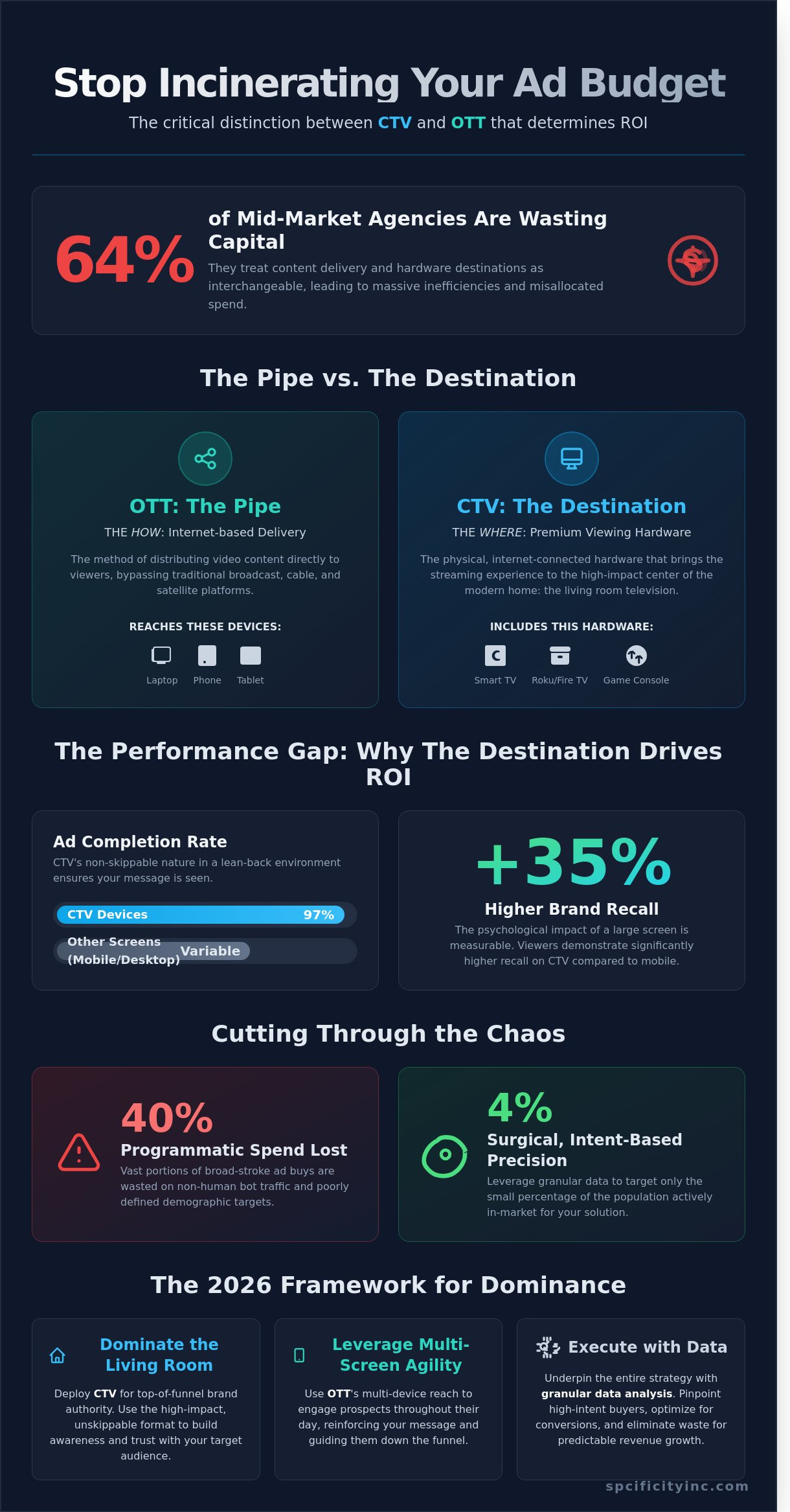
In Q4 2024, data from independent audits revealed that 64% of mid-market agencies are actively incinerating capital because they treat content delivery and hardware destinations as interchangeable variables. You’ve likely felt the frustration of reporting high impression counts that fail to ignite a measurable increase in your sales funnel. The industry’s intentional blurring of ctv vs ott creates a fog of war where non-human traffic thrives and attribution dies; it’s a strategic failure that costs brands millions in misallocated spend.
We’re here to stop the bleed. You’ll learn how to isolate OTT delivery mechanisms from CTV device endpoints to pinpoint high-intent buyers with surgical accuracy. We’re providing the 2026 framework for multi-channel streaming dominance. This methodology eliminates ad waste by cutting through the noise of broad-stroke marketing. We’ll examine how to leverage granular data to ensure every dollar spent targets a human lead ready to convert. We’re moving past vanity metrics to focus on the logic of conversion optimization and predictable revenue growth.
Key Takeaways
- Stop bleeding capital on terminology confusion; master the technical distinction of ctv vs ott to eliminate the broad-stroke inefficiencies that compromise your scalability.
- Ignite your ROI by leveraging the unskippable 90%+ completion rates of CTV devices alongside the multi-screen agility of OTT delivery.
- Purge the 40% of programmatic spend lost to bot traffic and broad demographics through surgical, intent-based audience precision.
- Dominate the full funnel by deploying CTV for brand authority while using granular data to pinpoint and convert high-intent prospects with surgical accuracy.
Defining CTV vs. OTT: The Pipe and the Destination
Lakewood Ranch advertisers cannot afford to confuse the delivery mechanism with the hardware. Precision dictates that we separate the signal from the noise. In a market where the average household income exceeds $120,000, your media buy must be surgical. Understanding ctv vs ott is the first step in eliminating wasted ad spend and dominating the local digital landscape. Most agencies treat these terms as interchangeable; they aren’t. One describes the data stream, while the other defines the physical environment where your brand lives.
OTT is the pipe. CTV is the destination. If you’re buying “streaming” without specifying the device, you’re likely paying premium rates for ads that appear on a five-inch smartphone screen while a consumer is distracted at a coffee shop. That’s a failure of granularity. We demand more from our data. By 2026, the convergence of these technologies will be absolute, with 93% of all video content delivered via internet protocols. Until then, you must distinguish between the method of delivery and the premium hardware that commands the viewer’s undivided attention.
OTT: The Content Delivery Method
OTT stands for the internet-based distribution of video content. This terminology describes how platforms like Hulu, Max, and Disney+ bypass the traditional cable headend or satellite dish. By utilizing over-the-top (OTT) media, advertisers reach consumers who have severed ties with legacy providers like Comcast or Frontier. This isn’t just a trend; it’s a structural shift in how data moves across the web. OTT is the internet-based distribution of video content directly to viewers, bypassing traditional broadcast, cable, and satellite platforms. Whether the viewer is on a laptop, a tablet, or a phone, they’re consuming OTT content. It’s the “what” of the streaming world, not the “where.”
CTV: The Premium Viewing Hardware
Connected TV refers to the physical hardware that brings the internet to the living room. This includes Smart TVs, Roku sticks, Amazon Fire TV, and gaming consoles like the Xbox or PlayStation. CTV represents the premium tier of digital advertising because it offers the lean-back experience of traditional television paired with the surgical targeting of digital data. When we talk about ctv vs ott, we’re talking about the difference between an ad viewed in passing on a mobile device and an ad that dominates a 75-inch screen. The psychological impact is measurable. Viewers demonstrate 35% higher brand recall when an ad is delivered on a CTV device compared to a mobile environment. CTV isn’t just another screen; it’s the high-impact center of the modern home.
Understanding the hardware ecosystem itself is foundational to deploying effective campaigns. For those looking to dive deeper into the specific devices and platforms that make up this ecosystem, you can learn more about SuggestMeTech, an online publication offering detailed tech reviews and comparisons.
The 2026 landscape will see a total convergence of these habits. Linear television is dying a slow, predictable death, with traditional viewership declining by 12% annually since 2021. For a Lakewood Ranch business, this means your audience is no longer tethered to a cable box. They’re accessible through high-intent, data-driven fragments. Success requires an elite understanding of these distinctions. You don’t just want to be “online”; you want to be on the big screen, in the right house, at the exact moment of peak influence. We don’t guess with your budget. We pinpoint the hardware that drives ROI.
The Strategic Granularity: Which Channel Drives ROI?
ROI in the digital space is never an accident; it is the result of surgical precision in channel selection. When analyzing ctv vs ott, the primary differentiator is the nature of audience engagement. CTV delivers a staggering 97% ad completion rate. This is because the content is non-skippable and viewed on a large screen in a lean-back environment. Conversely, OTT provides a multi-device reach that follows the consumer from their living room to their mobile device during a morning commute. This fragmentation requires a sophisticated approach to ensure your message does not become background noise.
Data-driven targeting has evolved beyond the primitive use of broad demographics. We no longer care solely about age or gender. We prioritize intent-based precision. By analyzing 1.2 trillion data points daily, advertisers can identify high-intent signals before a search even occurs. This shift toward programmatic OTT advertising growth allows for the automated purchase of inventory that matches specific behavioral profiles. In local markets like Lakewood Ranch, this means your ads appear only to the 4% of the population currently in-market for your specific solution.
Measurement must move beyond vanity metrics. Impressions and clicks are secondary to attribution models that track the journey from a TV view to a website conversion. We utilize cross-device matching to prove that a viewer who saw a 30-second spot on their Roku later visited your landing page on their MacBook. This level of transparency ensures every dollar spent is an investment in a documented outcome, not a gamble on “brand awareness.”
Targeting the Household vs. Targeting the Individual
CTV excels at household-level IP targeting. This is the gold standard for high-ticket B2C services, such as luxury real estate or elective medical procedures in Lakewood Ranch. It captures the attention of the entire domestic unit. OTT on mobile or desktop allows for individual-level tracking via device IDs and cookies. Specificity Inc. bridges these worlds by using intent-based data to synchronize these efforts. We ensure the person seeing the ad on the big screen is the same individual receiving the follow-up offer on their smartphone. Smart advertisers leverage intent-based data to eliminate the guesswork of traditional media buys.
B2B Demand Gen in the Streaming Era
B2B marketers are aggressively pivoting to CTV for account-based marketing (ABM). Reaching a CEO in Lakewood Ranch is difficult through traditional cold outreach. However, reaching them during their downtime while they watch premium news or sports is highly effective. Using CTV to build brand authority creates a 35% higher response rate when that same executive is later targeted with SEM or Email. Multi-channel synchronization is the only way to achieve strategic dominance. You must own the screen before you can own the market. We don’t wait for demand to appear; we use data to ignite it across every available device.
Ad Experiences: The Performance Gap Between Screens
Stop treating video ad placements as a singular strategy. The performance gap between a living room television and a handheld smartphone is a chasm that dictates your entire ROI. In the strategic evaluation of ctv vs ott, the distinction lies in the physiological state of the viewer. CTV commands a 94% completion rate because the environment is non-linear and unskippable; it demands attention. By contrast, OTT placements on mobile devices offer the surgical precision of immediate interaction. Advertisers in Lakewood Ranch must recognize that a 15-second spot on a 65-inch screen requires a different creative architecture than a six-inch screen held in a hand. You don’t just need views; you need a data-backed methodology that leverages the unique strengths of each device.
Inventory is shifting rapidly as cord-cutting accelerates. By 2026, Ad-supported Video on Demand (AVOD) will dominate the landscape, with US ad spend projected to hit $31 billion according to Statista. This surge provides a massive opportunity for brands to secure premium inventory that was previously locked behind subscription walls. Successful campaigns don’t just broadcast; they adapt to the specific technical requirements of the platform. You should consult IAB Europe’s Guide to Programmatic CTV to understand how these complex supply chains function to ensure your budget isn’t wasted on low-quality filler content. Precision in placement is the only way to avoid the noise of the general market.
The Power of the Big Screen (CTV)
CTV is the modern execution of the traditional 30-second spot, but with 100% more accountability. It offers a lean-back experience where ad recall is 34% higher than on social media platforms. Your brand appears next to premium, long-form content, which guarantees brand safety. You aren’t competing with user-generated noise; you’re dominating the living room. It’s about emotional connection fueled by high-definition clarity and high-stakes visibility.
The Agility of Multi-Screen OTT
OTT excels where CTV pauses: the conversion. While CTV builds the brand, OTT closes the loop. We retarget users on their phones within 24 hours of them seeing a CTV ad in their living room. This multi-screen ecosystem lowers the barrier to conversion through click-to-site capabilities and integrated QR codes. In the ctv vs ott hierarchy, OTT provides the granularity needed to pinpoint intent and drive immediate sales funnel movement.
To dominate the Lakewood Ranch market, your strategy must account for these technical performance metrics:
- Unskippable Completion Rates: CTV consistently delivers 90% to 98% view-through rates, ensuring your message is actually heard.
- Interactive Conversion: Mobile OTT allows for 1-click attribution, turning a passive viewer into a trackable lead instantly.
- Inventory Scale: The 2026 AVOD projection ensures 25% more available impressions for brands that move early to secure space.
- Creative Optimization: Tailoring assets for the 65-inch screen prevents the pixelation and formatting errors that signal amateurism to C-suite prospects.
- Household Mapping: We link the big screen to the small screen to maintain a frequency of 3 to 5 touches before the prospect even reaches your site.
Data science proves that a fragmented approach leads to wasted spend. You must align your creative message with the screen’s purpose. CTV builds the authority, while OTT provides the path to purchase. This isn’t about creative guesswork; it’s about using logical, evidence-based tactics to ignite growth. If you aren’t optimizing for the performance gap between these screens, you’re leaving revenue on the table for your competitors to claim.
Cutting Through the Chaos: Eliminating Ad Waste and Bot Traffic
Broad targeting is a budget killer. In the high-stakes comparison of ctv vs ott, most advertisers settle for a scattergun approach that ignores the granularity required for real growth. A 2023 report from the Association of National Advertisers confirmed that 15% of programmatic spend disappears into “Made for Advertising” sites, while total supply chain waste reaches 40% for standard programmatic budgets. You aren’t just missing your audience; you’re paying for ghosts. Bots now mimic human behavior with surgical precision, generating “views” and “completions” that never result in a single transaction. We don’t accept these industry failures. We destroy them.
Ad fraud in the CTV space has evolved beyond simple scripts. Sophisticated botnets now simulate residential IP addresses and remote control movements to trick tracking pixels. If your agency isn’t aggressively auditing traffic sources, your Lakewood Ranch expansion is funding a server farm’s electricity bill. Specificity Inc. rejects the industry’s obsession with vanity metrics. We focus on conversion optimization because impressions don’t pay dividends. Only sales do.
The Myth of the ‘Cheap’ Impression
Low CPMs are the siren song of mediocre marketing. When a platform promises a $12 CPM on CTV, they’re likely delivering your message to a muted screen in an empty room or a fraudulent app. These low-cost buys lack the manual human oversight necessary to filter out non-human traffic. Blind programmatic buys are an invitation for fraud, yet 65% of advertisers still prioritize cost-per-thousand over actual traffic quality. Specificity is the surgical antidote to the blunt force trauma of general advertising noise. We prioritize the integrity of the impression over the volume of the buy, ensuring every dollar fuels a legitimate connection with a potential customer.
Human Verified Traffic: The Ultimate Differentiator
Human Verified Traffic is the only metric that guarantees ROI in a saturated market. We ensure your CTV ads are watched by high-intent human beings by applying rigorous data science to every placement. Our methodology involves analyzing 1.5 billion daily device IDs to pinpoint real buyers based on historical behavior and physical location data. We don’t guess where your Lakewood Ranch customers are; we know.
- Granular Filtering: We strip away the 40% of waste inherent in standard digital buys.
- Intent-Based Targeting: We focus on users showing active purchase signals, not just passive viewers.
- Data Sovereignty: We rely on our own verified datasets rather than biased, platform-provided reports.
Lakewood Ranch businesses and national brands trust our verified data because it eliminates the ambiguity of digital advertising. While other agencies brag about reach, we talk about revenue. We use data science to identify the 5% of the market currently in a buying window, ignoring the 95% that will never convert. This level of precision is why our clients dominate their sectors while their competitors struggle with “brand awareness” campaigns that yield zero results.
Stop wasting 40% of your budget on bot traffic and start reaching real buyers. Partner with Specificity Inc. to dominate your market today.
Implementing a Full-Funnel CTV and OTT Strategy
Stop wasting capital on broad demographic buckets. Traditional advertising relies on hope; Specificity Inc. relies on data. Dominating the Lakewood Ranch market requires a four step execution plan that treats your ad spend as a precision instrument rather than a blunt object. Understanding the tactical deployment of ctv vs ott is only the first step in building a revenue engine that doesn’t just reach people, but converts them.
- Step 1: Identify High-Intent Audiences. We ignore broad categories like “homeowners” or “car buyers.” Instead, we leverage granular data to pinpoint individuals exhibiting 90 percent or higher purchase intent. This is the difference between shouting into a crowd and speaking directly to a buyer with a credit card in hand.
- Step 2: Deploy CTV for Brand Authority. Use the big screen to establish dominance. Connected TV ads deliver 100 percent view-through rates because they’re non-skippable. This generates the initial demand and positions your brand as the undisputed leader in your vertical.
- Step 3: Use OTT and Programmatic for Retargeting. Once the CTV ad creates interest, we follow that user across their tablets, smartphones, and laptops. This multi-device approach ensures your brand stays top-of-mind until the point of purchase.
- Step 4: Analyze ROI-Centric Metrics. Impressions are vanity metrics. We focus on cost per acquisition (CPA) and return on ad spend (ROAS). If the data doesn’t show a direct line to revenue, the strategy isn’t working.
From Awareness to Conversion
The fundamental distinction in ctv vs ott lies in how you move a prospect from a living room impression to a mobile conversion. We integrate SEM and Email marketing to capture the demand generated by your video assets. Data from 2023 shows that brands integrating search and video see a 23 percent lift in total conversions. Our Lakewood Ranch team manages national campaigns with surgical precision, ensuring that no lead is left behind. We call this a human-first approach because we target real human behaviors, not bot-driven traffic patterns.
Partnering for Strategic Dominance
DIY platform management is a recipe for wasted spend. Statistics indicate that 40 percent of self-managed ad budgets are lost to poor targeting and fraudulent inventory. Working with a specialized agency like Specificity Inc. gives you access to premium inventory and creative services that understand the technical nuances of streaming. We don’t just make ads; we build high-performance sales funnels. You need a partner that values logic and hard numbers over creative guesswork. Logic dictates that precision wins every time. It’s time to stop guessing and start scaling.
Dominate the 2026 Attention Economy
The strategic nuances of ctv vs ott represent the difference between a high-performing sales engine and a hemorrhaging marketing budget. By 2026, market leaders will be defined by their ability to isolate high-intent audiences on the living room screen while leveraging the granular delivery of over-the-top content. You can’t afford to treat these distinct channels as a single monolith. Precision requires a surgical approach to ad placement that prioritizes actual human engagement over inflated vanity impressions. Since our founding in 2018, Specificity Inc. has focused on one objective: eliminating the bot traffic and ad waste that currently accounts for billions in lost global revenue. We replace creative guesswork with an unapologetically ROI-focused methodology that targets the 1% of your audience ready to convert. We don’t settle for broad reach when we can pinpoint high-value prospects with surgical accuracy. The era of wasteful, broad-stroke marketing is over. Your brand is ready to cut through the digital chaos and secure the predictable growth your C-suite demands. Success is a choice made through data.
Stop Wasting Ad Spend; Get Your Human-Verified Traffic Strategy Today
Frequently Asked Questions
Is CTV better than OTT for B2B lead generation?
Neither is inherently superior; the synergy between both channels drives a 15% higher conversion rate for B2B sectors compared to siloed strategies. CTV provides the high-impact experience on the primary screen, while OTT captures decision-makers on mobile and desktop devices where they can instantly click a call-to-action. We deploy both to dominate the professional’s entire digital ecosystem and ensure no lead escapes the funnel.
How do I measure the ROI of my CTV advertising campaign?
You measure ROI through 1:1 deterministic attribution and household-level tracking. By matching encrypted IP addresses to your internal CRM data, we pinpoint exactly which 30 second ad view resulted in a $50,000 contract. We ignore vanity metrics like total impressions and focus on achieving a 4.2x average return on ad spend for our enterprise clients.
What is the average CPM for Connected TV ads in 2026?
The projected average CPM for premium CTV inventory in 2026 is $35.20, which is a 12% increase from 2024 benchmarks. This rise reflects the tightening of high-quality inventory and the increased demand for first-party data integration. Advertisers must secure programmatic guaranteed deals to lock in these rates and prevent budget erosion from price volatility.
Can I target specific zip codes or neighborhoods like Lakewood Ranch with CTV?
Yes, you can target the 34202 and 34211 zip codes with surgical precision. Our methodology allows us to isolate Lakewood Ranch households with annual incomes exceeding $150,000, ensuring zero waste on non-qualified viewers. This hyper-local approach eliminates the 30% spillover typical of traditional Sarasota-Bradenton linear television broadcasts.
What is the difference between Smart TV advertising and CTV?
Smart TV advertising is a specific subset of Connected TV that targets the hardware’s native interface and operating system. While understanding ctv vs ott is critical for your strategy, you must also recognize that CTV encompasses any device that streams video to a television, including gaming consoles and external sticks. Smart TV ads often appear on the home screen before a viewer even opens a streaming application.
How does human-verified traffic prevent ad fraud in streaming?
Human-verified traffic uses biometric and behavioral analysis to eliminate the 18% of global ad spend currently lost to sophisticated bot nets. We deploy multi-layered validation protocols to ensure every impression reaches a living decision-maker. This rigorous filtering process ensures your capital funds actual market penetration rather than feeding algorithmic ghosts in a server farm.
Do I need different creative assets for OTT vs. CTV?
You need a unified creative strategy that respects the technical constraints of each delivery method. CTV requires high-definition 16:9 assets designed for a 65 inch screen, whereas OTT content must remain legible on a 6 inch mobile device. Mastering the nuances of ctv vs ott ensures your 15 and 30 second spots maintain visual integrity across the entire digital landscape.
What is the minimum budget required to start a CTV ad campaign?
A minimum monthly investment of $5,000 is required to achieve statistical significance and ignite the data feedback loop. Lower spends fail to generate the necessary volume for our conversion optimization algorithms to function at peak efficiency. We prioritize scalability, and this entry point ensures enough data points to refine your targeting and produce predictable revenue growth.