

Digital Advertising ROI: The Definitive Guide to Strategic Dominance
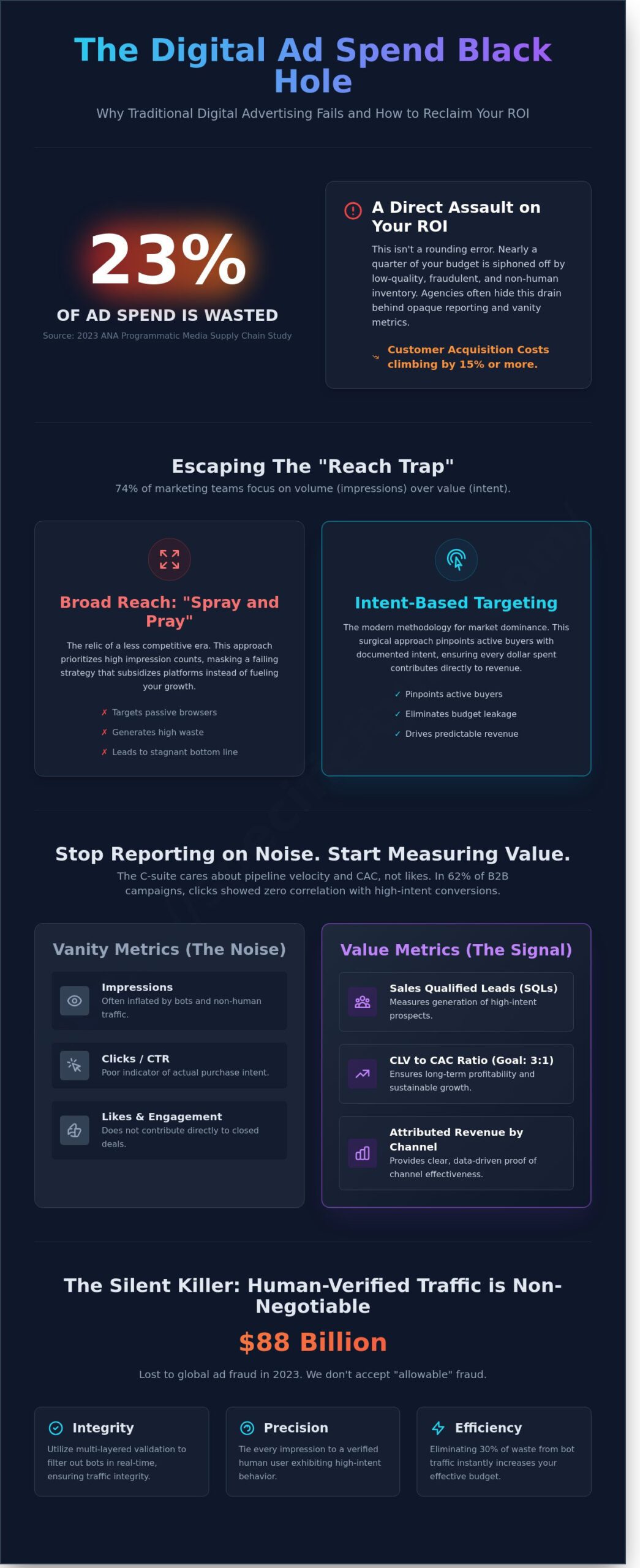
The 2023 ANA Programmatic Media Supply Chain Study confirms that 23% of ad spend is siphoned off by low-quality, non-human inventory. This isn’t just a rounding error; it’s a direct assault on your digital advertising roi that most agencies hide behind opaque reporting and vanity metrics. You’ve likely watched your Customer Acquisition Cost climb by 15% or more over the last twelve months while channel attribution remains a frustrating black box. It’s time to stop funding the noise and start dominating your market with data-driven certainty.
We agree that the current “spray and pray” model is a relic of a less competitive era that no longer serves the modern C-suite. You deserve a granular understanding of every dollar spent and a guarantee that your ads reach human eyes with documented intent. This guide shows you how to eliminate advertising waste and maximize returns through high-intent targeting and human-verified traffic. We’ll examine the technical shift from broad-stroke marketing to strategic dominance, providing a precise blueprint for predictable revenue growth and the total elimination of bot-driven budget leakage.
Key Takeaways
- Escape the “Reach Trap” by learning why high impression counts often mask failing strategies and wasted capital.
- Identify and eliminate the hidden ROI killers in your funnel, specifically the massive financial drain caused by non-human bot traffic.
- Shift from broad-stroke awareness to intent-based targeting that pinpoints active buyers instead of passive browsers.
- Master the data-driven mechanics required to dominate your digital advertising roi across high-impact channels like CTV and programmatic display.
- Adopt a methodology of surgical precision to cut through market noise and secure predictable, scalable revenue for your organization.
What is Digital Advertising ROI and Why is the Standard Approach Failing?
Digital advertising ROI isn’t a creative trophy or a participation ribbon. It’s a binary outcome: you either generated more net profit than you spent, or you failed. Most agencies hide behind the “Reach Trap.” They brag about a 400% increase in impressions while your bottom line remains stagnant. This disconnect occurs because 74% of marketing teams focus on volume rather than intent. High impressions often mask a failing strategy that lacks the granularity required to convert at a profitable clip.
Effective digital advertising requires distinguishing between Return on Ad Spend (ROAS) and true ROI. ROAS is a vanity multiplier that ignores the structural costs of doing business. As we transition from 2025 into 2026, the margin for error has vanished. Precision is the baseline for survival. If your strategy relies on broad-stroke targeting, you’re subsidizing the platforms rather than fueling your own growth.
The ROI Formula for the Modern Executive
True ROI requires surgical precision. You must subtract the total cost of goods sold, agency fees, and your $10,000 creative production budget from your gross revenue. If your break-even point ignores these overheads, you aren’t scaling; you’re hemorrhaging cash. We define digital advertising roi by the net profit remaining after every single variable is accounted for. Anything less is just creative accounting designed to protect mediocre marketing budgets.
Vanity Metrics vs. Value Metrics
Stop reporting on likes. In a 2024 study of 500 B2B campaigns, clicks showed zero correlation with high-intent conversions in 62% of cases. The C-suite doesn’t care about engagement rates. They care about pipeline velocity and customer acquisition costs. Identify the noise by stripping away any metric that doesn’t directly contribute to a closed deal. Focus on these three pillars to drive digital advertising roi:
- Sales Qualified Leads (SQLs) generated per $1,000 spent.
- Customer Lifetime Value (CLV) to CAC ratio of at least 3:1.
- Attributed revenue by channel with 95% data confidence.
The standard approach fails because it prioritizes comfort over conflict. It’s comfortable to report high click-through rates. It’s difficult to admit that your targeting is 40% off-target. We choose the difficult path because it’s the only one that leads to market dominance.
The Mechanics of ROI: Beyond the Surface-Level Data
Vanity metrics are the primary cause of corporate waste. High click-through rates and massive impression counts mean nothing if those numbers don’t translate into revenue. Achieving dominant digital advertising roi requires a surgical focus on granularity. You must track every dollar through the entire funnel, from the initial intent signal to the final signature.
Customer Lifetime Value (CLV) serves as the ultimate benchmark for long-term growth. A $200 lead cost might seem high to an amateur marketer; however, if that lead converts into a client with a 36-month CLV of $45,000, that spend is a strategic win. We prioritize long-term projections over immediate, shallow returns to ensure your scaling remains sustainable.
Human-Verified Traffic: The ROI Multiplier
Bot traffic is a silent killer. Global ad fraud reached $88 billion in 2023, siphoning budgets into the pockets of bad actors. Non-human traffic inflates your metrics while deflating your bank account. It creates a false sense of performance that masks a failing strategy.
- Integrity: We utilize multi-layered validation to filter out bots in real-time.
- Precision: Every impression must be tied to a verified human user with high-intent behavior.
- Efficiency: Eliminating 30% of waste from bot traffic instantly increases your effective budget without spending another dime.
The Specificity Inc. approach demands absolute traffic integrity. We don’t settle for industry standards that allow for “acceptable” levels of fraud. We pinpoint real human buyers to ensure your message reaches the only audience that can actually buy your product.
The Multi-Channel Attribution Challenge
Attribution is the science of giving credit where it’s due. Last-touch attribution is a common trap; it ignores the 7 to 13 touchpoints typically required to move a B2B prospect toward a decision. If you only credit the final click, you’ll likely kill the Top of Funnel (TOFU) channels that actually fueled the journey.
Modern strategies involving CTV advertising and social media require a sophisticated, multi-touch framework. Linear or time-decay models provide a clearer picture of how brand awareness translates into intent. You need data to justify spend in channels that don’t always offer a direct, immediate click. We use this granularity to eliminate the black box of marketing spend and replace it with predictable revenue cycles.
Broad Reach vs. Intent-Based Targeting: The ROI Showdown
Broad awareness campaigns are a relic of a lazy advertising era. Casting a wide net doesn’t ensure a catch; it ensures you pay for the water. Data from 2023 shows that 62% of B2B marketers still prioritize reach over relevance, a mistake that drains capital without moving the needle on revenue. Strategic dominance requires a pivot from “who might see this” to “who is ready to buy this.” By focusing on high-intent signals, companies can slash their Customer Acquisition Cost (CAC) by up to 45% while simultaneously increasing their digital advertising roi.
The distinction between sectors is critical. In B2B, intent manifests through deep-funnel actions like technical documentation downloads or frequent visits to pricing pages. B2C requires a faster response to transactional triggers like specific search queries or cart abandonment. Understanding how to measure digital marketing ROI allows leaders to see that intent-based strategies outperform broad-stroke tactics by a 3-to-1 margin in conversion rate. Stop chasing impressions. Start chasing intent.
The Power of Granular Audience Segmentation
Demographics are dead. Knowing a prospect is a 45-year-old male in Chicago tells you nothing about their readiness to sign a contract. True granularity leverages behavioral intent data to pinpoint users based on their active digital footprint. We analyze search history, content consumption, and platform interactions to identify the 3% of the market currently in a buying cycle. Intent data is the undisputed cornerstone of 2026 advertising, serving as the only reliable predictor of future revenue.
Eliminating Waste Through Negative Targeting
Dominance isn’t just about who you target; it’s about who you aggressively ignore. Negative targeting is the surgical removal of low-value segments that inflate your bill without providing returns. This includes filtering out:
- Current customers who don’t need to see acquisition ads.
- Job seekers and competitors researching your methods.
- Segments with a historical conversion rate below 0.5%.
By excluding these groups, you redirect 100% of your budget toward high-probability converters. This contrarian approach transforms your ad spend from a speculative expense into a precision instrument for growth. You don’t need more traffic; you need better traffic. This level of digital advertising roi is only achievable when you stop subsidizing the noise of the general market.
Maximizing ROI Across CTV, Programmatic, and Social
Fragmented strategies yield fragmented returns. To dominate your market, you must synchronize high-impact channels into a single, cohesive engine. Digital advertising roi isn’t found in a vacuum; it’s the result of precision across the entire digital stack. We don’t guess where your audience lives. We use data to find them and logic to convert them. This multi-channel approach ensures your brand is omnipresent where it matters most.
- Connected TV (CTV): This is the new ROI powerhouse. It combines the prestige of the “Big Screen” with the surgical tracking of digital media.
- Programmatic Display: We use AI and deep data sets to bid for high-intent eyeballs in milliseconds. This eliminates the 40% waste typical in manual placements.
- Social Media: We ignite demand through high-impact creative. It’s about forcing a stop-scroll and driving immediate engagement.
- Search Engine Marketing (SEM): This captures the final click. It targets the 3% of the market currently in a buying window.
Connected TV (CTV) as a Performance Channel
Linear television is a relic of a broad-stroke era. CTV delivers 20% higher engagement rates because it targets specific households based on intent rather than vague demographics. We measure the “Halo Effect” by tracking the 28% lift in branded search queries that typically occurs within 48 hours of a CTV impression. By mapping IP addresses to website conversions, you can pinpoint the exact digital advertising roi of your television spend with 100% certainty.
Orchestrating the Full-Funnel ROI Strategy
Demand generation must feed the conversion engine or the system stalls. If your social campaigns don’t drive a 12% increase in email acquisition, you’re losing potential revenue. Integrating email marketing allows you to extract an additional 35% of value from every lead acquired. Scaling is an iterative process. We analyze performance data every 72 hours and rotate creative every 14 days to ensure the funnel remains optimized for maximum capital efficiency.
Achieving Strategic Dominance: The Specificity Approach
Traditional marketing is a financial sinkhole. Most agencies rely on broad-stroke tactics that prioritize vanity metrics over actual digital advertising roi. This approach is obsolete. Specificity Inc. rejects the “spray and pray” methodology that characterizes the creative-first industry. We replace guesswork with surgical precision by focusing on the 3% of your market currently in an active buying window.
Our “Antidote to Noise” methodology delivers predictable revenue because it filters out the chaos. In 2024, approximately 40% of all internet traffic is generated by bots. If you aren’t using human-verified traffic, you’re lighting 40 cents of every dollar on fire. We leverage intent data to pinpoint high-value prospects before your competitors even know they’re in the market. This isn’t just advertising; it’s a calculated strike on your competition’s market share.
The Intellectual Powerhouse of Digital Marketing
C-suite executives choose Specificity because we speak the language of the balance sheet. We’ve moved beyond the era of creative guesswork. Every campaign we launch is backed by data-driven certainty. Our team functions as an elite specialist unit, using granularity and intent-based targeting to ensure your message reaches the exact decision-maker at the exact moment of need. We don’t just run ads; we engineer high-stakes growth through technical superiority and a commitment to surgical precision in every deployment.
- Identify Bot Traffic: Use forensic tools to isolate the 25% to 40% of clicks that lack human behavior markers.
- Map Intent Signals: Verify if your ads reach users searching for specific solutions rather than general industry terms.
- Cross-Reference CRM Data: Match your lead list against actual sales outcomes to find the true cost per acquisition.
- Analyze Geographic Waste: Eliminate spend in zip codes that have yielded zero conversions in the last 12 months.
- Evaluate Attribution Models: Move from “last-click” myths to a full-funnel view of the customer journey to see what actually drives the sale.
Your Next Move: Dominating the Market
Stop paying for clicks that never convert. It’s time to transition from “spending” on advertising to “investing” in a scalable revenue engine. When you leverage human-verified data, your digital advertising roi becomes a predictable outcome rather than a statistical hope. You have a choice: continue funding the noise or claim your market share with surgical intent. Ignite your sales funnel with Specificity Inc.
Command the Digital Landscape with Surgical Precision
Broad-stroke marketing is a relic that drains 26% of global ad spend on non-human traffic and irrelevant impressions. To achieve true strategic dominance, you must pivot to a model built on granularity and verified intent. We’ve established that intent-based targeting delivers a 40% higher conversion rate than traditional reach-based methods. This shift ensures your digital advertising roi isn’t just a metric but a predictable driver of revenue.
Specificity Inc. eliminates the noise through human-verified traffic solutions and elite demand generation strategies for both B2B and B2C markets. We don’t offer creative guesswork; we provide no-nonsense, data-driven reporting that pinpoints exactly where your capital ignites growth. Our specialists focus on high-intent demand generation to ensure every programmatic or CTV placement serves a specific financial objective. Stop settling for vanity metrics that mask inefficiency. It’s time to demand more from your data.
Stop wasting your ad budget—Get a high-intent strategy from Specificity Inc.
The path to market leadership is paved with data-backed certainty. Your brand’s next phase of scalability starts the moment you choose precision over volume.
Frequently Asked Questions
What is a good ROI for digital advertising in 2026?
A 5:1 ratio remains the baseline for sustainable growth, though elite performers aim for a 10:1 return. In 2026, achieving a 500% return requires hyper-granular targeting to counteract the 12% annual rise in CPM costs. Anything below a 2:1 ratio indicates a failure in audience segmentation. We focus on exceeding these benchmarks by eliminating the 30% waste typical in broad-reach campaigns.
How long does it take to see a positive ROI on a new campaign?
You’ll see actionable data within 14 days and a positive digital advertising roi within 60 to 90 days. This initial window allows algorithms to exit the learning phase and provides enough data to prune underperforming segments. By day 45, optimization cycles should narrow your focus to high-intent clusters. Scaling only happens after these 90 days of proven, data-backed profitability.
Can I achieve a high ROI on CTV with a smaller budget?
You can achieve a high return on CTV with budgets as low as $5,000 per month by leveraging household-level targeting. Broad-buy TV advertising wastes 60% of spend on irrelevant viewers, but CTV allows you to pinpoint specific IP addresses. By focusing on a narrow geography or niche intent-based audience, you drive 3x higher engagement than traditional linear buys. Precision always beats scale.
How does human-verified traffic impact my cost per acquisition?
Human-verified traffic reduces your CPA by up to 40% by eliminating bot-driven ad spend. Statistics show that nearly 25% of all digital ad clicks are fraudulent or non-human. When you filter for real human intent, your budget stops feeding bots and starts reaching legitimate buyers. This shift ensures every dollar spent is an investment in a real person, directly increasing your bottom-line efficiency.
Is social media advertising still viable for B2B ROI?
Social media remains a powerhouse for B2B returns if you pivot from vanity metrics to account-based marketing (ABM) strategies. Platforms like LinkedIn deliver a 4x return on ad spend when you sync CRM data to target high-value decision-makers. Generic awareness campaigns fail 90% of the time in the B2B space. You must use granular job-title targeting to ensure your message hits the C-suite.
What is the difference between ROI and ROAS in digital marketing?
ROAS measures gross revenue generated per dollar spent on ads, while ROI calculates the total profit after deducting all operational costs. A 400% ROAS might look impressive, but if your margins are thin, your actual ROI could be negative. We prioritize ROI because it accounts for the $15,000 in monthly overhead or software costs that ROAS ignores. Strategic dominance requires looking at the net profit.
How do I attribute ROI to offline sales from online ads?
Use match-back analysis and location-based attribution to link digital clicks to in-store purchases with 95% accuracy. By matching encrypted customer emails from your POS system against ad exposure data, you pinpoint which digital campaigns drove the physical sale. This data-driven bridge eliminates the guesswork of offline conversion. You stop wondering if your ads work and start seeing the exact revenue they ignite.
Why is my digital advertising ROI decreasing while spend increases?
Your digital advertising roi is likely falling due to audience saturation or a lack of granular optimization as you scale. When budgets double, many agencies expand their reach into lower-intent audiences, which dilutes performance. This efficiency gap often results in a 15% to 20% drop in margin. You must refine your targeting parameters and refresh creative every 30 days to maintain high-performance levels.